Paper: 2604.01170 Authors: Cai Zhou, Zekai Wang, Menghua Wu, Qianyu Julie Zhu, Flora C. Shi, Chenyu Wang, Ashia Wilson, Tommi Jaakkola, Stephen Bates Categories: cs.LG, cs.AI, cs.CL, stat.AP, stat.ML
The Gap
Test-time scaling lets LLMs solve hard problems by generating multiple reasoning paths, but it’s expensive. The core issue: post-trained models are miscalibrated—they don’t know when they’re confident enough to stop sampling. Existing approaches use static calibration (set a fixed threshold before deployment) or self-consistency (majority vote across many samples). Both waste compute because they can’t adapt to the specific difficulty of each input or handle distribution shifts between training and deployment.
Prior work (conformal prediction for LLMs) provides theoretical guarantees but assumes calibration data matches test distribution. When reasoning patterns shift—say, from simple arithmetic to complex proofs, or from in-domain to out-of-domain prompts—static calibration breaks down. You either oversample easy problems or undersample hard ones.
Problem: Miscalibrated LLMs waste compute
    |
    v
Assumption: Calibration can adapt per-input
    |
    v
Method: Meta-learn calibration module at test time
    |
    v
Evidence: 40-67% cost savings, low error rates
    |
    v
Conclusion: Adaptive calibration generalizes across distributions
The Increment
One sentence: Before ORCA, you calibrated once and hoped it worked everywhere; after ORCA, calibration updates for each input, adapting to difficulty and distribution shifts.
Core Mechanism
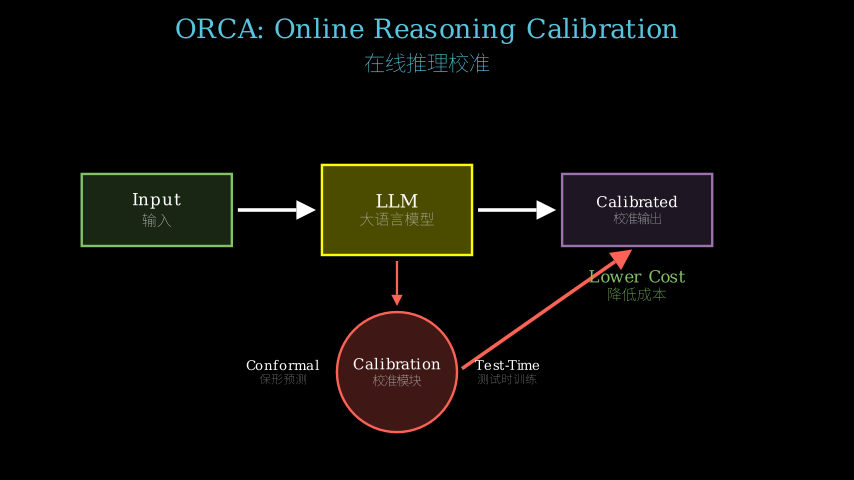
ORCA has three components: a base LLM that generates reasoning paths, a calibration module that decides when to stop sampling, and a meta-learning loop that updates the calibration module per input.
Here’s the flow: For a new question, the system samples a few reasoning paths. The calibration module (a small neural network) looks at these samples and predicts a “conformal score”—essentially, how many more samples you need to be confident. But instead of using a fixed calibration module, ORCA does a few gradient steps on this module using the current input’s samples. This is test-time training: the calibration adapts to the specific reasoning pattern of this question.
Input question
    |
    v
Sample k reasoning paths
    |
    v
Calibration module --> Conformal score
    ^                        |
    |                        v
    +--- Meta-update    Stop or sample more?
         (gradient steps)     |
                              v
                         Final answer
The structural metaphor: Think of ORCA as a chef tasting a dish while cooking. A static calibration approach is like following a recipe blindly—add salt once at the start, never adjust. ORCA is the chef who tastes after each step and adjusts seasoning based on what’s actually in the pot. The “tasting” is sampling a few reasoning paths. The “adjusting” is updating the calibration module. The “dish” is the final answer. Just as a chef adapts to ingredient variations (sweeter tomatoes today, saltier broth), ORCA adapts to reasoning variations (this question needs more samples, that one is already confident).
Key Concepts
-
Conformal prediction: Imagine you’re a weather forecaster who wants to give prediction intervals, not just point estimates. Conformal prediction is a framework that says: “I’ll give you a set of possible outcomes, and I guarantee that the true outcome is in this set 90% of the time (or whatever coverage you want).” The key trick: you calibrate on past data to figure out how big your prediction sets need to be. For LLMs, the “prediction set” is a collection of reasoning paths, and conformal prediction tells you when you’ve sampled enough paths to be confident. The guarantee holds even if your model is miscalibrated, as long as your calibration data is representative.
-
Test-time training: Most machine learning happens in two phases: train a model, then freeze it and deploy. Test-time training breaks this: when you see a new input at deployment, you do a few more gradient steps to adapt the model to that specific input. It’s like a musician who practices a piece (training), then does a quick warm-up right before the concert (test-time training) to adapt to the acoustics of the hall. For ORCA, the “warm-up” is updating the calibration module based on the first few samples from the current question.
-
Meta-learning for calibration: The calibration module needs to learn how to learn. During meta-training, ORCA sees many questions and practices updating its calibration module for each one. It learns a good initialization—a starting point that can quickly adapt to new questions with just a few gradient steps. Think of it as learning to learn a language: you don’t memorize every sentence, you learn grammar rules that let you construct new sentences quickly.
Framework Shift
Before (static calibration):        After (ORCA):

Train calibration once              Train meta-calibration
        |                                   |
        v                                   v
Deploy with fixed threshold         For each input:
        |                             - Sample a few paths
        v                             - Update calibration
Apply to all inputs                   - Decide: stop or continue
  (same threshold)                          |
        |                                   v
        v                             Adaptive threshold
   Oversample easy,                   per input difficulty
   undersample hard
From one-size-fits-all to bespoke tailoring, the core shift is treating calibration as a per-input optimization problem rather than a global hyperparameter.
Expert Assessment
Problem choice: This is a real gap. Test-time scaling is the current frontier for LLM capabilities, but compute costs are prohibitive. The observation that miscalibration causes waste is sharp—it’s not just about better models, it’s about better stopping rules. The problem sits at the intersection of statistical theory (conformal prediction) and practical deployment, which is a sweet spot.
Method maturity: The meta-learning approach is clever but not revolutionary—it’s a natural extension of test-time training to the calibration setting. The theoretical contribution (conformal guarantees under test-time training) is solid. However, the method adds complexity: you need to meta-train the calibration module, and test-time updates add latency. The paper doesn’t deeply explore failure modes—what happens when the first few samples are misleading?
Experimental integrity: Baselines are fair (static conformal prediction, self-consistency). The results are strong: 40-67% savings with maintained accuracy. But there’s a subtle issue: the “supervised labels” setting assumes you have ground truth during deployment, which is unrealistic. The self-consistency setting is more honest. Also, the paper tests on math and reasoning benchmarks—it’s unclear how this generalizes to other domains like creative writing or dialogue.
Writing quality: The paper is dense but well-structured. The theory section is rigorous but could use more intuition. The experimental section is thorough but buries the lead—the out-of-domain results (67% savings on MATH-500) are the most impressive and should be highlighted earlier. The related work section is perfunctory.
Verdict: weak accept — Solid contribution with practical impact, but the method’s complexity and limited domain exploration prevent it from being a strong accept.
Takeaways
Practitioners can steal the core idea: don’t treat calibration as a static hyperparameter. If you’re building systems that sample multiple outputs (not just LLMs—think Monte Carlo methods, ensemble models, or A/B tests), consider adaptive stopping rules that update based on early samples. The specific technique here is meta-learning, but even simpler heuristics (e.g., “if the first 5 samples agree, stop; otherwise, sample 20 more”) can capture some of the benefit.
For LLM deployment, the takeaway is that test-time compute is a tunable resource. Instead of always sampling 100 paths, you can dynamically allocate compute based on question difficulty. This requires upfront investment in calibration infrastructure, but the payoff is significant for high-volume applications.
The conformal prediction framing is also transferable: if you need uncertainty estimates with guarantees, conformal methods are more robust than raw model probabilities, especially under distribution shift.
论文: 2604.01170 作者: Cai Zhou, Zekai Wang, Menghua Wu, Qianyu Julie Zhu, Flora C. Shi, Chenyu Wang, Ashia Wilson, Tommi Jaakkola, Stephen Bates 分类: cs.LG, cs.AI, cs.CL, stat.AP, stat.ML
缺口
测试时扩展让大模型通过生成多条推理路径来解决难题,但代价高昂。
核心问题:训练后的模型校准不准——它们不知道什么时候该停止采样。
现有方法用静态校准(部署前设定固定阈值)或自洽性(多个样本投票)。
两者都浪费算力,因为无法适应每个输入的具体难度,也无法应对训练和部署之间的分布偏移。
先前工作(大模型的保形预测)提供理论保证,但假设校准数据与测试分布匹配。
当推理模式发生变化——比如从简单算术到复杂证明,或从域内到域外提示——静态校准就失效了。
你要么对简单问题过度采样,要么对困难问题采样不足。
问题:校准不准的大模型浪费算力
    |
    v
假设:校准可以针对每个输入自适应
    |
    v
方法:测试时元学习校准模块
    |
    v
证据:节省40-67%成本,低错误率
    |
    v
结论:自适应校准跨分布泛化
增量
一句话: ORCA之前,你校准一次然后祈祷它到处都管用;ORCA之后,校准针对每个输入更新,适应难度和分布偏移。
核心机制
ORCA有三个组件:生成推理路径的基础大模型、决定何时停止采样的校准模块、以及针对每个输入更新校准模块的元学习循环。
流程是这样的:对于新问题,系统先采样几条推理路径。
校准模块(一个小型神经网络)查看这些样本,预测一个”保形分数”——本质上就是你还需要多少样本才能有信心。
但ORCA不用固定的校准模块,而是用当前输入的样本对这个模块做几步梯度更新。
这就是测试时训练:校准适应这个问题的具体推理模式。
输入问题
    |
    v
采样k条推理路径
    |
    v
校准模块 --> 保形分数
    ^              |
    |              v
    +--- 元更新   停止还是继续采样?
       (梯度步)        |
                      v
                   最终答案
核喻:把ORCA想象成边做菜边尝味道的厨师。
静态校准就像盲目照着菜谱做——开始时加一次盐,之后再也不调整。
ORCA是每一步都尝味道、根据锅里实际情况调整调料的厨师。
“尝味道”就是采样几条推理路径。
“调整”就是更新校准模块。
“菜”就是最终答案。
就像厨师适应食材变化(今天的番茄更甜,高汤更咸),ORCA适应推理变化(这个问题需要更多样本,那个已经够自信了)。
关键概念
- 保形预测:想象你是个天气预报员,想给出预测区间,而不只是点估计。
保形预测是个框架,它说:“我给你一组可能的结果,我保证真实结果90%的时间(或你想要的任何覆盖率)在这个集合里。
“关键技巧:你在历史数据上校准,算出预测集需要多大。
对大模型来说,“预测集”是一组推理路径,保形预测告诉你什么时候采样够了、可以有信心了。
即使你的模型校准不准,只要校准数据有代表性,保证就成立。
- 测试时训练:大多数机器学习分两阶段:训练模型,然后冻结它部署。
测试时训练打破这个规则:部署时看到新输入,你再做几步梯度更新,让模型适应这个具体输入。
就像音乐家练完一首曲子(训练),然后音乐会前快速热身(测试时训练),适应音乐厅的声学效果。
对ORCA来说,“热身”就是根据当前问题的前几个样本更新校准模块。
- 校准的元学习:校准模块需要学会如何学习。
元训练期间,ORCA看到很多问题,练习为每个问题更新校准模块。
它学到一个好的初始化——一个起点,只需几步梯度就能快速适应新问题。
想象成学习学语言:你不是记住每个句子,而是学语法规则,让你能快速构造新句子。
框架转变
之前(静态校准):              之后(ORCA):

训练校准一次                    训练元校准
    |                               |
    v                               v
用固定阈值部署                  对每个输入:
    |                           - 采样几条路径
    v                           - 更新校准
应用到所有输入                   - 决定:停止或继续
 (同一阈值)                         |
    |                               v
    v                           自适应阈值
简单问题过采样,                 根据输入难度
困难问题欠采样
从一刀切到量体裁衣,核心转变是把校准当作针对每个输入的优化问题,而不是全局超参数。
专家评审
选题眼光: 这是真缺口。
测试时扩展是大模型能力的当前前沿,但算力成本令人望而却步。
观察到校准不准导致浪费很敏锐——不只是要更好的模型,还要更好的停止规则。
问题处于统计理论(保形预测)和实际部署的交叉点,这是个甜蜜点。
方法成熟度: 元学习方法巧妙但不革命——它是测试时训练在校准场景的自然延伸。
理论贡献(测试时训练下的保形保证)扎实。
但方法增加了复杂度:你需要元训练校准模块,测试时更新增加延迟。
论文没有深入探讨失败模式——如果前几个样本误导性强会怎样?
实验诚意: 基线公平(静态保形预测、自洽性)。
结果强劲:节省40-67%,保持准确率。
但有个微妙问题:“监督标签”设定假设部署时有真值,这不现实。
自洽性设定更诚实。
另外,论文在数学和推理基准上测试——不清楚这如何泛化到其他领域,比如创意写作或对话。
写作功力: 论文密集但结构良好。
理论部分严谨但可以多些直觉。
实验部分详尽但埋没了重点——域外结果(MATH-500上节省67%)最令人印象深刻,应该更早突出。
相关工作部分敷衍。
判决: 弱接收 — 扎实的贡献,有实际影响,但方法的复杂性和有限的领域探索使它达不到强接收。
要点总结
实践者可以偷走核心想法:别把校准当静态超参数。
如果你在构建采样多个输出的系统(不只是大模型——想想蒙特卡洛方法、集成模型或A/B测试),考虑根据早期样本更新的自适应停止规则。
这里的具体技术是元学习,但即使更简单的启发式(比如”如果前5个样本一致就停止;否则再采样20个”)也能捕获部分收益。
对大模型部署来说,要点是测试时算力是可调资源。
不用总是采样100条路径,你可以根据问题难度动态分配算力。
这需要前期投资校准基础设施,但对高流量应用来说回报显著。
保形预测框架也可迁移:如果你需要带保证的不确定性估计,保形方法比原始模型概率更鲁棒,尤其在分布偏移下。