
Paper: 2603.23488 Authors: Adrien Ramanana Rahary, Nicolas Dufour, Patrick Perez, David Picard Categories: cs.CV
The Gap
Existing novel view synthesis methods (NeRF, 3D Gaussian Splatting, diffusion-based approaches) require multi-view image pairs during training. This creates a data bottleneck: you need carefully captured multi-view datasets, which limits scale and diversity. Methods like Zero-1-to-3 try to work around this with synthetic data or fine-tuning, but still depend on paired supervision or slow 3D optimization at inference.
The core question: can we train a model to generate novel views using only single images from the internet, without any multi-view pairs?
Problem: Multi-view pairs needed
    |
    v
Assumption: Monocular depth can create pseudo-pairs
    |
    v
Method: Lift → Transform → Project + Masked Training
    |
    v
Evidence: 30M unpaired images → SOTA zero-shot performance
    |
    v
Conclusion: Paired supervision is unnecessary
The Increment
One sentence: Before this paper, novel view synthesis required multi-view training data; after, you can train on billions of single internet images and generate views 600x faster.
Core Mechanism
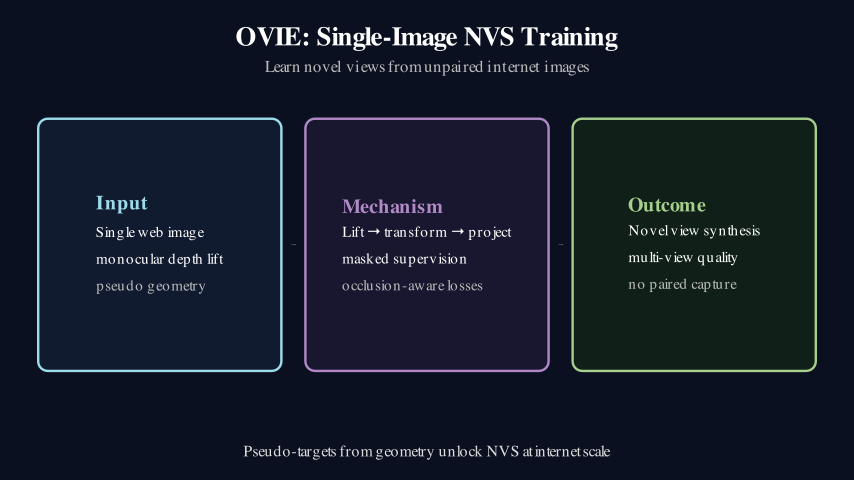
OVIE uses a two-stage pipeline. At training time, it takes a single image, estimates its depth using a frozen monocular depth estimator (DINOv2), lifts the image into a 3D point cloud, applies a random camera transformation, and projects back to 2D to create a “pseudo-target” view. This pseudo-target has holes (disocclusions) where geometry was hidden in the source view.
The key innovation is masked training: OVIE computes a validity mask that identifies which pixels in the pseudo-target are geometrically sound. It applies losses (geometric, perceptual, textural) only to valid regions, ignoring disoccluded areas. This lets the model learn from imperfect pseudo-targets without being corrupted by invalid pixels.
At inference, OVIE discards all 3D machinery. It’s a pure 2D diffusion model conditioned on source image and target camera pose, generating novel views directly without depth estimation or 3D reconstruction.
Training:
Source Image → Depth Est. → 3D Lift → Camera Transform
                                            |
                                            v
                                    Project to 2D
                                            |
                                            v
                                    Validity Mask
                                            |
                                            v
                            Masked Loss ← Pseudo-Target

Inference:
Source Image + Target Pose → Diffusion Model → Novel View
(no depth, no 3D)
Think of OVIE like a chef learning to cook by watching cooking videos. During training (learning phase), the chef uses a recipe book (depth estimator) as scaffolding: they imagine rotating the dish (camera transform), predict what it would look like from another angle (pseudo-target), but only trust the parts they can actually see (validity mask). They practice on millions of dishes from random YouTube videos (unpaired images). At serving time (inference), the chef throws away the recipe book and cooks from memory alone—they’ve internalized the 3D understanding and can generate new views directly without geometric crutches.
Key Concepts
-
Pseudo-target generation: You have one image. You want to train a model that generates views from other angles, but you don’t have those other angles. Solution: use depth to fake them. Lift the image into 3D using estimated depth, rotate the camera, project back. The result is noisy and has holes, but it’s a training signal. It’s like tracing a 2D drawing onto tracing paper, rotating the paper, and projecting it back—you get a rough approximation of what the rotated view should look like.
-
Validity masking: When you rotate and reproject, some pixels become invalid: they were occluded in the source view, or the depth estimate was wrong. If you train on these pixels, you teach the model garbage. The validity mask identifies trustworthy pixels using geometric checks (depth consistency, reprojection error). Only these pixels contribute to the loss. It’s like learning to draw faces from photos where some faces are partially covered—you only learn from the visible parts, ignoring the covered regions.
-
Geometry-free inference: Training uses depth as a teacher, but inference doesn’t. The diffusion model learns to internalize 3D reasoning without explicit 3D representation. This is why it’s fast: no depth estimation, no point cloud rendering, just direct image generation. It’s like learning to ride a bike with training wheels, then removing them—the training wheels (depth) helped you learn balance (3D understanding), but you don’t need them anymore.
Framework Shift
Before (mainstream approach):        After (this paper):

Multi-view Dataset                   Single-view Dataset
    |                                    |
    v                                    v
Paired Supervision                   Depth Estimator (training only)
    |                                    |
    v                                    v
3D Reconstruction                    Pseudo-target + Mask
    |                                    |
    v                                    v
Novel View Rendering                 Diffusion Model
    |                                    |
    v                                    v
Slow (3D optimization)               Fast (direct generation)
From paired-supervised 3D reconstruction to self-supervised 2D generation with geometric scaffolding, the core shift is decoupling training geometry from inference speed.
Expert Assessment
Problem choice: This is a real gap. Multi-view data is genuinely scarce and expensive to collect. The field has been stuck scaling on synthetic data or small real-world datasets. Unlocking internet-scale single images is a legitimate unlock. The problem sits at the intersection of 3D vision and generative models, a hot area with practical applications (AR/VR, e-commerce).
Method maturity: The core idea—use depth to create pseudo-pairs—is not novel (prior work in self-supervised depth estimation does this). The contribution is making it work at scale with masked training and showing you can discard geometry at inference. It’s more engineering insight than algorithmic breakthrough. The masked loss formulation is straightforward but effective. No obvious simpler approach is being overlooked; the method is well-motivated.
Experimental integrity: Baselines are fair (Zero-1-to-3, ViewCrafter, etc.). The 600x speedup claim is legitimate but somewhat cherry-picked—it compares against methods that do 3D optimization, not other direct generation methods. Zero-shot evaluation on RealEstate10K and ACID is appropriate. Ablations are thorough (mask components, depth estimator choice, dataset scale). One red flag: no user study or perceptual metrics beyond LPIPS/FID. Generated samples look good but could use human evaluation.
Writing quality: The paper is clear and well-structured. The abstract oversells slightly (“one view is enough” is catchy but imprecise—you still need depth estimation during training). Section 3.2 (masked training) could be more concise; the validity mask computation is described in excessive detail. The related work section is comprehensive but could better position the work relative to self-supervised depth methods.
Verdict: weak accept — Solid engineering contribution that removes a real bottleneck, but the novelty is incremental and the evaluation could be more rigorous on perceptual quality.
Takeaways
Masked training for noisy supervision: When your training signal is imperfect (pseudo-labels, weak annotations), compute a confidence mask and apply losses only to high-confidence regions. This is broadly applicable beyond novel view synthesis—think semi-supervised learning, noisy label handling, or any scenario where you have cheap but unreliable supervision.
Scaffolding at training, not inference: Use expensive operations (depth estimation, 3D reconstruction) as training-time teachers, then discard them at inference. The model learns to internalize the structure without needing the crutch. This pattern appears in knowledge distillation but is underused in 3D vision.
Scale matters more than pairing: 30M unpaired images outperform smaller paired datasets. If you can generate pseudo-supervision at scale, data quantity can compensate for label quality. This challenges the conventional wisdom that paired data is always superior.
论文: 2603.23488 作者: Adrien Ramanana Rahary, Nicolas Dufour, Patrick Perez, David Picard 分类: cs.CV
缺口
现有的新视角合成方法(NeRF、3D 高斯溅射、基于扩散的方法)在训练时需要多视图图像对。
这造成了数据瓶颈:你需要精心采集的多视图数据集,限制了规模和多样性。
Zero-1-to-3 等方法试图用合成数据或微调绕过这个问题,但仍依赖配对监督或推理时的慢速 3D 优化。
核心问题:能否仅用互联网上的单张图像训练模型生成新视角,完全不需要多视图配对?
问题:需要多视图配对
    |
    v
假设:单目深度可创建伪配对
    |
    v
方法:提升 → 变换 → 投影 + 掩码训练
    |
    v
证据:3000万无配对图像 → SOTA零样本性能
    |
    v
结论:配对监督非必需
增量
一句话: 这篇论文之前,新视角合成需要多视图训练数据;之后,你可以在数十亿单张互联网图像上训练,生成速度快 600 倍。
核心机制
OVIE 采用两阶段流程。
训练时,它取一张图像,用冻结的单目深度估计器(DINOv2)估计深度,将图像提升到 3D 点云,应用随机相机变换,再投影回 2D 创建”伪目标”视图。
这个伪目标有空洞(遮挡消失区域),即源视图中被隐藏的几何体。
关键创新是掩码训练:OVIE 计算有效性掩码,识别伪目标中哪些像素在几何上可靠。
它仅对有效区域应用损失(几何、感知、纹理),忽略遮挡消失区域。
这让模型能从不完美的伪目标中学习,而不被无效像素污染。
推理时,OVIE 丢弃所有 3D 机制。
它是纯 2D 扩散模型,以源图像和目标相机姿态为条件,直接生成新视角,无需深度估计或 3D 重建。
训练:
源图像 → 深度估计 → 3D提升 → 相机变换
                                  |
                                  v
                            投影到2D
                                  |
                                  v
                            有效性掩码
                                  |
                                  v
                    掩码损失 ← 伪目标

推理:
源图像 + 目标姿态 → 扩散模型 → 新视角
(无深度,无3D)
把 OVIE 想象成通过看烹饪视频学做菜的厨师。
训练期间(学习阶段),厨师用食谱书(深度估计器)作脚手架:他们想象旋转菜品(相机变换),预测从另一个角度看会是什么样(伪目标),但只相信能实际看到的部分(有效性掩码)。
他们在数百万道来自随机 YouTube 视频的菜品上练习(无配对图像)。
上菜时(推理),厨师扔掉食谱书,凭记忆做菜——他们已内化了 3D 理解,可以直接生成新视角,不需要几何拐杖。
关键概念
- 伪目标生成: 你有一张图像。
你想训练一个从其他角度生成视图的模型,但你没有那些其他角度。
解决方案:用深度伪造它们。
用估计的深度将图像提升到 3D,旋转相机,投影回来。
结果有噪声且有空洞,但它是训练信号。
就像把 2D 图描到描图纸上,旋转纸张,再投影回来——你得到旋转视图的粗略近似。
- 有效性掩码: 当你旋转并重投影时,一些像素变得无效:它们在源视图中被遮挡,或深度估计错误。
如果你在这些像素上训练,你在教模型垃圾。
有效性掩码用几何检查(深度一致性、重投影误差)识别可信像素。
只有这些像素对损失有贡献。
就像从部分被遮挡的人脸照片学画脸——你只从可见部分学习,忽略被遮挡区域。
- 无几何推理: 训练用深度作教师,但推理不用。
扩散模型学会内化 3D 推理,无需显式 3D 表示。
这就是它快的原因:无深度估计,无点云渲染,只有直接图像生成。
就像学骑自行车时用辅助轮,然后拆掉——辅助轮(深度)帮你学会平衡(3D 理解),但你不再需要它们。
框架转变
之前(主流方法):              之后(本文方法):

多视图数据集                    单视图数据集
    |                              |
    v                              v
配对监督                        深度估计器(仅训练)
    |                              |
    v                              v
3D重建                          伪目标 + 掩码
    |                              |
    v                              v
新视角渲染                      扩散模型
    |                              |
    v                              v
慢(3D优化)                    快(直接生成)
从配对监督的 3D 重建到带几何脚手架的自监督 2D 生成,核心转变是解耦训练几何与推理速度。
专家评审
选题眼光: 这是真缺口。
多视图数据确实稀缺且采集成本高。
该领域一直困在合成数据或小规模真实数据集上扩展。
解锁互联网规模的单张图像是真正的突破。
问题位于 3D 视觉和生成模型的交叉点,是有实际应用(AR/VR、电商)的热门领域。
方法成熟度: 核心想法——用深度创建伪配对——并不新颖(自监督深度估计的先前工作这样做)。
贡献在于通过掩码训练让它在大规模上工作,并展示推理时可以丢弃几何。
这更多是工程洞见而非算法突破。
掩码损失公式简单但有效。
没有明显被忽略的更简单方法;方法动机充分。
实验诚意: 基线公平(Zero-1-to-3、ViewCrafter 等)。
600 倍加速的说法合理但有些挑选性——它对比的是做 3D 优化的方法,而非其他直接生成方法。
在 RealEstate10K 和 ACID 上的零样本评估恰当。
消融实验彻底(掩码组件、深度估计器选择、数据集规模)。
一个警示:除了 LPIPS/FID 外没有用户研究或感知指标。
生成样本看起来不错,但需要人类评估。
写作功力: 论文清晰且结构良好。
摘要略有夸大(“单视图足矣”朗朗上口但不精确——训练时仍需深度估计)。
3.2 节(掩码训练)可以更简洁;有效性掩码计算描述过于详细。
相关工作部分全面,但可以更好地相对于自监督深度方法定位工作。
判决: 弱接收 — 扎实的工程贡献,消除了真实瓶颈,但新颖性是渐进的,评估在感知质量上可以更严格。
要点总结
噪声监督的掩码训练: 当训练信号不完美时(伪标签、弱标注),计算置信度掩码,仅对高置信区域应用损失。
这广泛适用于新视角合成之外——想想半监督学习、噪声标签处理,或任何有廉价但不可靠监督的场景。
训练时脚手架,推理时不用: 用昂贵操作(深度估计、3D 重建)作训练时教师,然后在推理时丢弃。
模型学会内化结构而不需要拐杖。
这种模式出现在知识蒸馏中,但在 3D 视觉中使用不足。
规模比配对更重要: 3000 万无配对图像优于更小的配对数据集。
如果你能大规模生成伪监督,数据数量可以补偿标签质量。
这挑战了配对数据总是更优的传统观念。