
Paper: 2604.13006 Authors: Erfan Baghaei Potraghloo, Seyedarmin Azizi, Souvik Kundu, Massoud Pedram Categories: cs.CL, cs.AI
The Gap
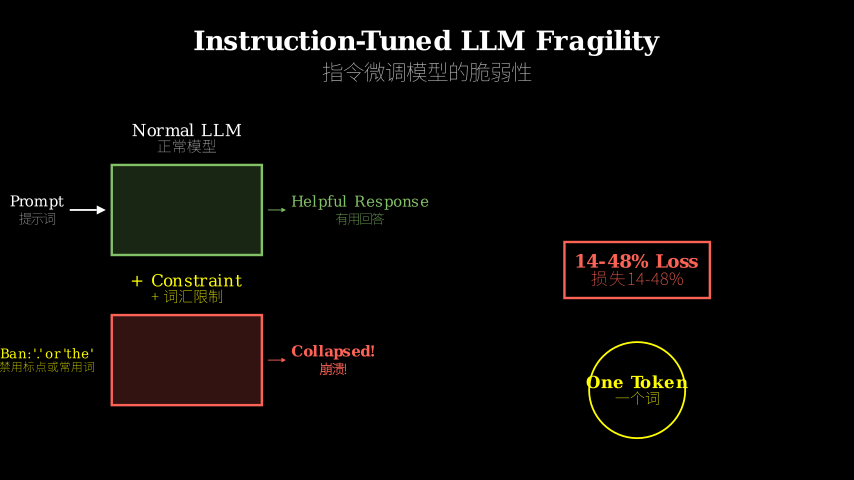
Instruction-tuned models are supposed to be robust helpers. Prior work showed they handle format constraints (JSON, XML) reasonably well. But nobody checked what happens with trivial lexical constraints—like “don’t use the word ‘the’” or “avoid commas.” Turns out this is where the facade cracks.
The gap: We assumed instruction tuning makes models more capable across the board. This paper shows it actually creates a new fragility—models become dependent on specific surface forms to trigger their helpfulness behavior.
Problem: Instruction-tuned models seem robust
   |
   v
Assumption: Format constraints are the hard case
   |
   v
Method: Test trivial lexical constraints (ban one word/punctuation)
   |
   v
Evidence: 14-48% comprehensiveness loss, 77-100% baseline preference
   |
   v
Conclusion: Instruction tuning couples competence to narrow templates
The Increment
One sentence: Before this paper, we thought instruction tuning made models more robust; after, we know it creates a hidden dependency on surface-form templates that collapses under trivial constraints.
Core Mechanism
The paper tests instruction-tuned models (Llama, Mistral, Qwen, GPT-4o-mini) and their base versions with simple constraints: ban a punctuation mark (comma, period, colon) or common word (the, and, to). They measure response length and quality through pairwise comparison.
The collapse happens before generation starts. Linear probes trained on prompt representations (the model’s internal state after reading the constraint) predict final response length with R² = 0.51-0.93. This means the decision to produce a short, unhelpful response is encoded in how the model represents the constrained prompt—it’s a planning failure, not a generation failure.
Constrained Prompt --> [Model Representation] --> Planning Decision
                              |                         |
                              |                         v
                       Linear Probe                Short/Long?
                       Predicts Length              (R² = 0.51-0.93)
                       (R² = 0.93)
                              |
                              v
                       Collapse happens HERE
                       (before any tokens generated)
Two-pass generation confirms this: generate freely first, then rewrite with constraints. This recovers 59-96% of response length, proving the model has the knowledge but fails to plan its use under constraints.
Think of it like a chef who’s been trained to follow recipes exactly. Give them a recipe that says “make pasta but don’t use water,” and instead of adapting (use broth, steam it, whatever), they just… stop. They’ve learned “pasta = boiling water” as a rigid template, not a flexible concept. The instruction-tuned model learned “helpful response = uses commas and ‘the’” as a template. Ban those, and the template doesn’t fire, so helpfulness collapses. The base model (untrained chef) doesn’t have this template dependency—it just tries stuff, sometimes good, sometimes bad, but never systematically collapses.
Key Concepts
-
Instruction Tuning Fragility: Instruction tuning teaches models to produce helpful, structured responses by showing them examples. But it does this by creating internal templates—patterns like “helpful answer = markdown formatting + common words + punctuation.” When you break the template (ban a word), the model doesn’t adapt; it fails to recognize the task as “be helpful” and produces minimal output. Base models don’t have these templates, so they don’t collapse—they’re inconsistent but not systematically fragile.
-
Planning vs Generation Failure: The model decides how long/comprehensive its response will be before generating any tokens. You can predict the final response length from the prompt representation alone (R² up to 0.93). This means the collapse isn’t “I tried to write a good response but couldn’t avoid the banned word”—it’s “I decided upfront to write a short response because the constraint broke my helpfulness template.” Two-pass generation (write freely, then rewrite) works because the first pass doesn’t have the constraint in the prompt representation, so planning succeeds.
-
Pairwise vs Independent Evaluation: Standard LLM-as-judge evaluation (rate this response 1-10) detects only 3.5% quality drop. Pairwise comparison (which is better: constrained or baseline?) reveals 23% drop and 77-100% baseline preference. Why? Independent scoring is anchored to “is this response acceptable?” (yes/no threshold), while pairwise forces relative judgment. The constrained responses are often acceptable in isolation but clearly worse when compared directly—a methodological blind spot in how we assess constrained generation.
Framework Shift
Before (assumed):                    After (this paper):

Instruction Tuning                   Instruction Tuning
       |                                    |
       v                                    v
  More Robust                          Template Dependency
  More Capable                              |
       |                                    +-- Helpful (template matches)
       v                                    |
  Handles Constraints                      +-- Collapse (template breaks)
  (format, lexical, etc.)
                                      Base Model: No Template
                                           |
                                           v
                                      Inconsistent but Not Fragile
From “instruction tuning = general robustness” to “instruction tuning = template-dependent competence that collapses when templates break.”
Expert Assessment
Problem choice: Real gap. Prior work focused on format constraints (JSON, XML) where models do okay. Nobody checked trivial lexical constraints because they seemed too easy. Turns out “too easy” is where the interesting failure mode lives. The problem sits at the intersection of alignment research and robustness—timely and underappreciated.
Method maturity: Elegant simplicity. The constraints are almost comically simple (ban “the”), which makes the 48% comprehensiveness loss hit harder. The mechanistic analysis (linear probes, two-pass generation) is solid and goes beyond “here’s a weird failure mode” to “here’s why it happens.” Could’ve tested more constraint types (semantic constraints? length limits?), but the lexical focus is sufficient to make the point.
Experimental integrity: Baselines are fair. Testing both base and instruction-tuned versions of the same models is the right control. The pairwise evaluation (1,920 comparisons) is thorough. One concern: GPT-4o-mini judges its own constrained outputs—potential bias, though the effect is so strong (99% baseline preference) that bias seems unlikely to explain it. The MT-Bench replication across eight task categories strengthens the claim of generality.
Writing quality: The abstract and intro are sharp. The mechanistic analysis section (linear probes, two-pass generation) could be clearer—it’s dense and assumes familiarity with probing methods. The discussion of why base models don’t collapse is buried in the results; pulling it forward would strengthen the narrative. The pairwise vs independent evaluation insight is gold but feels like an afterthought—deserves more prominence.
Verdict: Strong accept — Identifies a real, underappreciated fragility in instruction-tuned models with clean experiments and actionable mechanistic insights.
Takeaways
For practitioners: If you’re deploying instruction-tuned models with any kind of constraint (content filters, style requirements, domain-specific rules), test with trivial lexical constraints first. If the model collapses when you ban “the,” your production constraints might trigger the same planning failure. Two-pass generation (generate freely, then rewrite) is a practical workaround that recovers most quality.
For researchers: Pairwise evaluation catches quality drops that independent scoring misses—use it for constrained generation tasks. The linear probe result (predicting response length from prompt representations) is a transferable technique for diagnosing planning failures in other contexts.
For alignment work: Instruction tuning creates template dependencies that aren’t visible in standard benchmarks. If you’re training models to be helpful, test whether helpfulness survives when you break surface-form patterns. The base model comparison is a useful control—if base models don’t show the effect, instruction tuning created it.
论文: 2604.13006 作者: Erfan Baghaei Potraghloo, Seyedarmin Azizi, Souvik Kundu, Massoud Pedram 分类: cs.CL, cs.AI
缺口
指令微调模型应该是稳健的助手。
此前研究显示它们能较好地处理格式约束(JSON、XML)。
但没人检查过简单词汇约束会怎样——比如”不要用’the’这个词”或”避免逗号”。
结果这正是表象破裂的地方。
缺口在于:我们以为指令微调让模型全面变强。
这篇论文表明它实际上制造了新的脆弱性——模型变得依赖特定表层形式来触发有用性行为。
问题:指令微调模型看起来很稳健
   |
   v
假设:格式约束是困难案例
   |
   v
方法:测试简单词汇约束(禁用一个词/标点)
   |
   v
证据:完整性下降14-48%,基线偏好率77-100%
   |
   v
结论:指令微调将能力耦合到狭窄模板
增量
一句话: 这篇论文之前,我们以为指令微调让模型更稳健;之后,我们知道它制造了对表层形式模板的隐藏依赖,在简单约束下就会崩溃。
核心机制
论文测试了指令微调模型(Llama、Mistral、Qwen、GPT-4o-mini)及其基座版本,施加简单约束:禁用一个标点符号(逗号、句号、冒号)或常见词(the、and、to)。
通过成对比较测量响应长度和质量。
崩溃发生在生成开始之前。
在提示表示(模型读取约束后的内部状态)上训练的线性探针能以R² = 0.51-0.93预测最终响应长度。
这意味着产生简短、无用响应的决策编码在模型如何表示受约束提示中——这是规划失败,不是生成失败。
受约束提示 --> [模型表示] --> 规划决策
                    |              |
                    |              v
              线性探针        短/长?
              预测长度      (R² = 0.51-0.93)
              (R² = 0.93)
                    |
                    v
              崩溃发生在这里
              (任何token生成之前)
两遍生成证实了这点:先自由生成,再用约束重写。
这能恢复59-96%的响应长度,证明模型有知识但在约束下无法规划使用。
想象一个被训练成严格遵循食谱的厨师。
给他一个食谱说”做意大利面但不用水”,他不会变通(用高汤、蒸煮、随便什么),而是直接停下。
他学到的是”意大利面 = 煮沸水”这个刚性模板,不是灵活概念。
指令微调模型学到的是”有用响应 = 使用逗号和’the‘“作为模板。
禁用这些,模板不触发,有用性就崩溃。
基座模型(未训练的厨师)没有这种模板依赖——它只是尝试,有时好有时坏,但从不系统性崩溃。
关键概念
- 指令微调脆弱性: 指令微调通过展示示例教模型产生有用、结构化的响应。
但它通过创建内部模板来实现——像”有用答案 = markdown格式 + 常见词 + 标点”这样的模式。
当你打破模板(禁用一个词),模型不会适应;它无法识别任务是”要有用”,产生最少输出。
基座模型没有这些模板,所以不会崩溃——它们不一致但不系统性脆弱。
- 规划vs生成失败: 模型在生成任何token之前就决定响应会有多长/多全面。
你可以仅从提示表示预测最终响应长度(R²高达0.93)。
这意味着崩溃不是”我试图写好响应但无法避开禁用词”——而是”我预先决定写短响应,因为约束打破了我的有用性模板”。
两遍生成(自由写,然后重写)有效,因为第一遍的提示表示中没有约束,所以规划成功。
- 成对vs独立评估: 标准LLM评判(给这个响应打1-10分)只检测到3.5%质量下降。
成对比较(哪个更好:受约束的还是基线?)揭示23%下降和77-100%基线偏好。
为什么?独立评分锚定在”这个响应可接受吗?“(是/否阈值),而成对比较强制相对判断。
受约束响应单独看往往可接受,但直接比较时明显更差——这是我们评估受约束生成方式中的方法论盲点。
框架转变
之前(假设):                    之后(本文):

指令微调                         指令微调
    |                                |
    v                                v
更稳健                           模板依赖
更有能力                              |
    |                                +-- 有用(模板匹配)
    v                                |
处理约束                             +-- 崩溃(模板破裂)
(格式、词汇等)
                                基座模型:无模板
                                     |
                                     v
                                不一致但不脆弱
从”指令微调 = 普遍稳健性”到”指令微调 = 模板依赖的能力,模板破裂时崩溃”。
专家评审
选题眼光: 真实缺口。
此前工作聚焦格式约束(JSON、XML),模型表现尚可。
没人检查简单词汇约束,因为看起来太容易。
结果”太容易”正是有趣失败模式所在。
问题位于对齐研究和稳健性的交叉点——及时且被低估。
方法成熟度: 优雅的简洁性。
约束简单得几乎滑稽(禁用”the”),这让48%完整性损失更有冲击力。
机制分析(线性探针、两遍生成)扎实,超越了”这是个怪异失败模式”到”这是为什么发生”。
可以测试更多约束类型(语义约束?长度限制?),但词汇聚焦足以说明问题。
实验诚意: 基线公平。
测试同一模型的基座和指令微调版本是正确的对照。
成对评估(1920次比较)很彻底。
一个担忧:GPT-4o-mini评判自己的受约束输出——潜在偏差,虽然效果如此强烈(99%基线偏好)偏差似乎不太可能解释它。
MT-Bench在八个任务类别上的复现加强了普遍性主张。
写作功力: 摘要和引言犀利。
机制分析部分(线性探针、两遍生成)可以更清晰——密集且假设熟悉探针方法。
关于基座模型为何不崩溃的讨论埋在结果中;提前会加强叙事。
成对vs独立评估的洞见是金子,但感觉像事后想法——值得更突出。
判决: 强接收 — 用干净实验和可操作的机制洞见识别了指令微调模型中真实的、被低估的脆弱性。
要点总结
对实践者: 如果你部署带任何约束的指令微调模型(内容过滤、风格要求、领域特定规则),先用简单词汇约束测试。
如果模型在你禁用”the”时崩溃,你的生产约束可能触发同样的规划失败。
两遍生成(自由生成,然后重写)是实用的变通方法,能恢复大部分质量。
对研究者: 成对评估能捕捉独立评分遗漏的质量下降——用于受约束生成任务。
线性探针结果(从提示表示预测响应长度)是可迁移技术,用于诊断其他情境中的规划失败。
对对齐工作: 指令微调创建的模板依赖在标准基准中不可见。
如果你训练模型要有用,测试当你打破表层形式模式时有用性是否存活。
基座模型比较是有用的对照——如果基座模型不显示效果,是指令微调创建了它。