Paper: 2603.28762 Authors: Omer Dahary, Benaya Koren, Daniel Garibi, Daniel Cohen-Or Categories: cs.CV, cs.AI, cs.GR, cs.LG
The Gap
Modern text-to-image diffusion models like DALL-E and Stable Diffusion have mastered semantic alignment—they understand prompts well. But they suffer from “typicality bias”: given “a cat on a sofa,” they generate the same boring tabby on the same beige couch, over and over. Creative applications need variety, not just correctness.
Prior approaches hit a fundamental trade-off. Input-space methods (modifying prompts or noise) require expensive iterative optimization to incorporate feedback from the generation process. Latent-space methods (pushing apart intermediate images) act too late—the visual structure is already committed, so repulsion creates artifacts and breaks coherence.
Problem: Typicality bias in T2I models
   |
   v
Existing approaches:
   |
   +---> Input-space diversity -----> Costly optimization loop
   |                                   (slow, impractical)
   |
   +---> Latent-space repulsion ----> Acts on committed structure
                                       (artifacts, broken coherence)
   |
   v
Gap: Need intervention point that's
     - Structurally informed (not blind)
     - Compositionally flexible (not fixed)
     - Computationally cheap (not iterative)
   |
   v
This paper: Contextual Space repulsion
   - Intervene in attention channels
   - Between blocks where text meets emerging structure
   - On-the-fly, single forward pass
   |
   v
Evidence: Rich diversity + visual fidelity
          Works on Turbo/distilled models
   |
   v
Conclusion: Attention space is the sweet spot
            for diversity intervention
The Increment
One sentence: Before this paper, diversity required choosing between expensive optimization or visual artifacts; after, you can inject rich variation in a single forward pass by repelling in the attention space where text and image structure meet.
Core Mechanism
The method operates on Diffusion Transformers during generation. At each denoising step, the model processes noisy latents through transformer blocks. Each block contains multimodal attention layers where text tokens interact with image patch tokens. This is where text conditioning gets enriched with emerging visual structure.
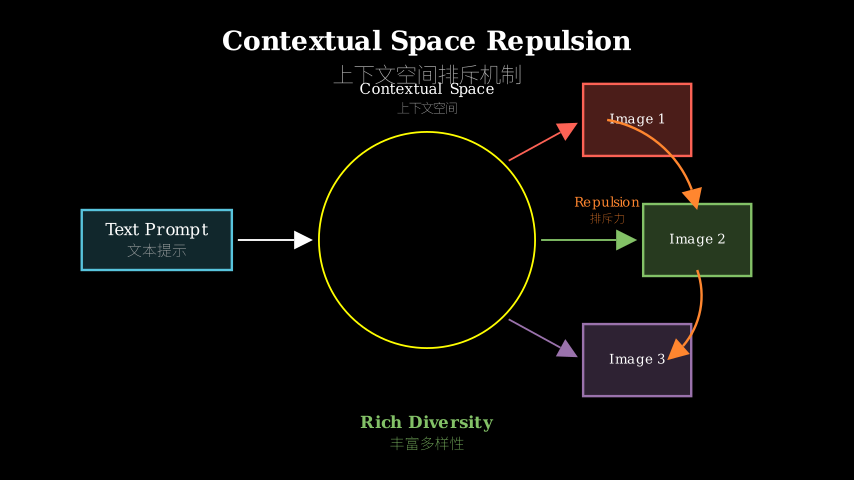
The intervention happens between transformer blocks. After a block computes attention but before the next block processes it, the method applies repulsion in the contextual space—the high-dimensional space where text and image representations are jointly embedded. Specifically, it identifies attention features that are becoming too similar across multiple generation samples and pushes them apart.
The repulsion is computed on-the-fly during the forward pass. For each batch of images being generated, the method compares their contextual representations (the attention outputs) and applies a repulsive force proportional to their similarity. This force redirects the attention trajectory without requiring backpropagation or iterative refinement.
Generation batch (N images from same prompt):
   |
   v
Transformer Block i:
   [Text tokens] + [Image patches] ---> Multimodal Attention
                                         |
                                         v
                                    Attention outputs
                                    (contextual features)
   |
   v
Repulsion injection point:

   Sample 1: [f1] ----\
   Sample 2: [f2] -----+---> Compute pairwise similarity
   Sample 3: [f3] ----/      |
                             v
                        Apply repulsive force:
                        f'_i = f_i + alpha * sum_j(repel(f_i, f_j))
                             |
                             v
                        Push apart similar features
   |
   v
Transformer Block i+1:
   Receives diversified contextual features
   Continues generation with redirected trajectory
Think of it like a group of hikers following the same trail description. Input-space methods are like giving each hiker a slightly different map before they start—but you need to simulate their entire journey to know if the maps lead to different destinations, then iterate. Latent-space methods are like physically pushing hikers apart when they’re already halfway up the mountain—they stumble and fall.
This paper’s approach is like having a guide who walks alongside the group. At key decision points (trail forks), the guide notices when hikers are clustering together and gently suggests different paths to each person. The guide acts at moments when the trail structure is visible (they can see the fork) but the choice isn’t yet committed (they haven’t taken the turn). The hikers naturally diverge without needing to backtrack or stumble.
The “contextual space” is that moment at the trail fork where both the map (text) and the terrain (emerging image structure) are visible. The “repulsion” is the guide’s gentle nudge. The “on-the-fly” means it happens during the hike itself, not through pre-planning or post-correction.
Key Concepts
-
Contextual Space: In a Diffusion Transformer, text and image don’t live in separate worlds. The multimodal attention layers create a shared representation space where text tokens and image patch tokens interact. This is the contextual space—it’s not the raw text embedding, not the pixel-level latent, but the intermediate representation where semantic meaning (from text) is being actively woven into spatial structure (from image patches). Imagine a conversation where two people are building a shared mental model—the contextual space is that shared model, not either person’s private thoughts. When you apply repulsion here, you’re diversifying the shared understanding before it crystallizes into concrete visual decisions.
-
Typicality Bias: Diffusion models are trained on internet-scale data where certain visual patterns dominate. “Cat on sofa” appears millions of times with similar compositions—tabby cats, beige sofas, centered framing. The model learns these statistical modes and gravitates toward them. It’s not a bug; it’s overfitting to the training distribution’s peaks. The model is like a chef who’s cooked the same popular dish so many times that even when asked to “make something with chicken,” they default to the bestseller. Typicality bias is the model’s muscle memory for common patterns.
-
On-the-fly Intervention: Traditional diversity methods require iterative optimization—generate samples, measure diversity, adjust inputs, regenerate. This paper’s method injects diversity during a single forward pass. “On-the-fly” means the repulsion force is computed and applied in real-time as the transformer processes each block, without stopping to backpropagate or re-plan. It’s like adjusting your steering while driving, not stopping to recalculate your route. This is crucial for efficiency and enables the method to work on fast “Turbo” models where there’s no time for iteration.
Framework Shift
Before (mainstream approach):        After (this paper):

Input Space Intervention:            Contextual Space Intervention:

[Prompt] --modify--> [Prompt']       [Prompt] -----> [Attention]
    |                    |                              |  ^
    v                    v                              |  |
[Generate] -----> [Evaluate]         [Text] + [Image] -+  |
    |                    |               structure         |
    v                    |                  |              |
[Diverse?] --no--> [Iterate]               v              |
    |                                   [Repel] -----> [Redirect]
    yes                                     |
    |                                       v
    v                                   [Continue]
[Done] (slow)                               |
                                            v
OR:                                     [Done] (fast)

Latent Space Intervention:           Key difference:
                                     - Acts at decision points
[Generate] -----> [Latent]           - Structurally informed
    |                |                - Single forward pass
    v                v
[Committed] --> [Push apart]
    |                |
    v                v
[Artifacts]      [Broken]
From iterative optimization or post-hoc correction to real-time trajectory redirection, the core shift is intervening where structure is informed but not yet committed.
Expert Assessment
Problem choice: This is a real gap. Typicality bias is a well-documented pain point in creative applications of diffusion models. The problem sits at the intersection of model behavior and user needs—technically interesting and practically relevant. It’s not manufactured; practitioners genuinely struggle with getting diverse outputs without quality degradation.
Method maturity: The insight is clever—attention space as the intervention point is non-obvious and well-motivated. However, the paper doesn’t deeply explore why this specific location works beyond intuition. The repulsion mechanism itself is relatively straightforward (pairwise similarity-based pushing), not a novel algorithmic contribution. A simpler approach might be stochastic attention dropout, but the authors don’t compare against such lightweight baselines.
Experimental integrity: The baselines are reasonable (input noise perturbation, latent-space repulsion), but the paper lacks comparison with recent diversity-focused methods like DivCon or semantic guidance variants. The metrics (diversity scores, FID, CLIP similarity) are standard but don’t capture subjective creative value—what looks “richly diverse” to a designer? The Turbo model results are impressive and suggest robustness, but the paper doesn’t show failure cases or discuss when the method breaks down.
Writing quality: The introduction and motivation are strong. The method section is clear but could benefit from ablation studies on where exactly to inject repulsion (which blocks? which layers?). The related work section glosses over recent attention-manipulation techniques in diffusion models. The conclusion oversells the generality—“rich diversity” is demonstrated on specific prompt types, not systematically across domains.
Verdict: weak accept — The method addresses a real problem with a practical solution that works on modern fast models, but the contribution is more engineering insight than fundamental advance, and the evaluation could be more rigorous.
Takeaways
Practitioners can steal the core idea: intervene in attention layers, not input or output spaces. This applies beyond diffusion models—any transformer-based generative model (language, audio, video) has attention layers where you can inject diversity without breaking coherence. The specific technique: compute pairwise similarity of attention outputs across a batch, apply repulsive forces proportional to similarity, do it between blocks where conditioning meets structure.
For implementation: the paper suggests a small computational overhead (they claim ~10% slowdown), which is practical. The key is identifying the right intervention point—not too early (before structure emerges) or too late (after commitment). In your domain, look for the layer where semantic input and structural output first interact.
A transferable framing: diversity interventions should be “trajectory redirections,” not “endpoint corrections.” Act at decision points, not after decisions are made.
论文: 2603.28762 作者: Omer Dahary, Benaya Koren, Daniel Garibi, Daniel Cohen-Or 分类: cs.CV, cs.AI, cs.GR, cs.LG
缺口
现代文生图扩散模型如DALL-E和Stable Diffusion已经掌握了语义对齐——它们能很好地理解提示词。
但它们患有”典型性偏差”:给定”沙发上的猫”,它们会反复生成同一只无聊的虎斑猫趴在同一张米色沙发上。
创意应用需要多样性,而不仅仅是正确性。
现有方法遇到了根本性的权衡。
输入空间方法(修改提示词或噪声)需要昂贵的迭代优化来整合生成过程的反馈。
潜空间方法(推开中间图像)行动太晚——视觉结构已经确定,排斥会产生伪影并破坏连贯性。
问题:文生图模型的典型性偏差
   |
   v
现有方法:
   |
   +---> 输入空间多样化 -----> 昂贵的优化循环
   |                           (慢,不实用)
   |
   +---> 潜空间排斥 --------> 作用于已确定的结构
                               (伪影,连贯性破坏)
   |
   v
缺口:需要一个干预点,它要:
     - 结构知情(非盲目)
     - 组合灵活(非固定)
     - 计算廉价(非迭代)
   |
   v
本文:上下文空间排斥
   - 在注意力通道中干预
   - 在文本与新兴结构相遇的块之间
   - 即时,单次前向传播
   |
   v
证据:丰富多样性 + 视觉保真度
      在Turbo/蒸馏模型上有效
   |
   v
结论:注意力空间是多样性干预的最佳位置
增量
一句话:这篇论文之前,多样性需要在昂贵优化和视觉伪影之间选择;之后,你可以在文本与图像结构相遇的注意力空间中通过单次前向传播注入丰富变化。
核心机制
该方法在生成过程中作用于扩散Transformer。
在每个去噪步骤,模型通过transformer块处理带噪潜变量。
每个块包含多模态注意力层,文本token与图像patch token在此交互。
这是文本条件与新兴视觉结构融合的地方。
干预发生在transformer块之间。
在一个块计算完注意力但下一个块处理之前,该方法在上下文空间中施加排斥——这是文本和图像表示共同嵌入的高维空间。
具体来说,它识别在多个生成样本中变得过于相似的注意力特征,并将它们推开。
排斥在前向传播过程中即时计算。
对于正在生成的每批图像,该方法比较它们的上下文表示(注意力输出)并施加与相似度成比例的排斥力。
这种力重定向注意力轨迹,无需反向传播或迭代精化。
生成批次(来自同一提示词的N张图像):
   |
   v
Transformer块 i:
   [文本token] + [图像patch] ---> 多模态注意力
                                    |
                                    v
                               注意力输出
                               (上下文特征)
   |
   v
排斥注入点:

   样本1:[f1] ----\
   样本2:[f2] -----+---> 计算成对相似度
   样本3:[f3] ----/      |
                          v
                     施加排斥力:
                     f'_i = f_i + alpha * sum_j(repel(f_i, f_j))
                          |
                          v
                     推开相似特征
   |
   v
Transformer块 i+1:
   接收多样化的上下文特征
   以重定向的轨迹继续生成
把它想象成一群徒步者遵循相同的路线描述。
输入空间方法就像在出发前给每个徒步者一张略有不同的地图——但你需要模拟他们的整个旅程才能知道地图是否通向不同的目的地,然后迭代。
潜空间方法就像在徒步者已经爬到半山腰时物理推开他们——他们会跌倒摔伤。
本文的方法就像有一个向导陪伴队伍行走。
在关键决策点(岔路口),向导注意到徒步者聚集在一起时,会温和地向每个人建议不同的路径。
向导在路径结构可见(他们能看到岔路口)但选择尚未确定(他们还没转弯)的时刻行动。
徒步者自然分散,无需回溯或跌倒。
“上下文空间”就是岔路口的那一刻,地图(文本)和地形(新兴图像结构)都可见。
“排斥”是向导的温和推动。
“即时”意味着它在徒步过程中发生,而非通过预先规划或事后纠正。
关键概念
- 上下文空间:在扩散Transformer中,文本和图像不是生活在独立的世界里。
多模态注意力层创建了一个共享表示空间,文本token和图像patch token在此交互。
这就是上下文空间——它不是原始文本嵌入,不是像素级潜变量,而是语义意义(来自文本)正在被主动编织进空间结构(来自图像patch)的中间表示。
想象一场对话,两个人正在构建一个共享的心智模型——上下文空间就是那个共享模型,而非任何一方的私人想法。
当你在这里施加排斥时,你是在共享理解结晶为具体视觉决策之前使其多样化。
- 典型性偏差:扩散模型在互联网规模的数据上训练,某些视觉模式占主导地位。
“沙发上的猫”以相似的构图出现数百万次——虎斑猫、米色沙发、居中取景。
模型学习这些统计模式并向它们靠拢。
这不是bug;这是对训练分布峰值的过拟合。
模型就像一个厨师,把同一道受欢迎的菜做了太多次,以至于即使被要求”用鸡肉做点什么”,他们也会默认做畅销菜。
典型性偏差是模型对常见模式的肌肉记忆。
- 即时干预:传统多样性方法需要迭代优化——生成样本、测量多样性、调整输入、重新生成。
本文方法在单次前向传播期间注入多样性。
“即时”意味着排斥力在transformer处理每个块时实时计算和施加,无需停下来反向传播或重新规划。
这就像开车时调整方向盘,而非停下来重新计算路线。
这对效率至关重要,使该方法能在快速”Turbo”模型上工作,那里没有时间迭代。
框架转变
之前(主流方法):               之后(本文方法):

输入空间干预:                   上下文空间干预:

[提示词] --修改--> [提示词']     [提示词] -----> [注意力]
    |                  |                          |  ^
    v                  v                          |  |
[生成] -----> [评估]             [文本] + [图像] -+  |
    |                  |             结构             |
    v                  |                |             |
[多样?] --否--> [迭代]                  v             |
    |                               [排斥] -----> [重定向]
    是                                  |
    |                                   v
    v                               [继续]
[完成](慢)                            |
                                        v
或:                                [完成](快)

潜空间干预:                     关键差异:
                                - 在决策点行动
[生成] -----> [潜变量]          - 结构知情
    |              |             - 单次前向传播
    v              v
[已确定] --> [推开]
    |              |
    v              v
[伪影]        [破坏]
从迭代优化或事后纠正到实时轨迹重定向,核心转变是在结构知情但尚未确定的地方干预。
专家评审
选题眼光:这是一个真实的缺口。
典型性偏差是扩散模型创意应用中有充分记录的痛点。
问题位于模型行为和用户需求的交叉点——技术上有趣且实际相关。
这不是人造的;实践者确实在努力获得多样化输出而不降低质量。
方法成熟度:洞察很巧妙——注意力空间作为干预点是非显而易见的且动机充分。
然而,论文没有深入探讨为什么这个特定位置有效,超出直觉。
排斥机制本身相对直接(基于成对相似度的推动),不是新颖的算法贡献。
一个更简单的方法可能是随机注意力dropout,但作者没有与这类轻量级基线比较。
实验诚意:基线是合理的(输入噪声扰动、潜空间排斥),但论文缺乏与最近的多样性聚焦方法如DivCon或语义引导变体的比较。
指标(多样性分数、FID、CLIP相似度)是标准的,但没有捕捉主观创意价值——什么对设计师来说看起来”丰富多样”?Turbo模型结果令人印象深刻并表明鲁棒性,但论文没有展示失败案例或讨论方法何时失效。
写作功力:引言和动机很强。
方法部分清晰,但可以从消融研究中受益,研究在哪里注入排斥(哪些块?哪些层?)。
相关工作部分掩盖了扩散模型中最近的注意力操纵技术。
结论过度推销了通用性——“丰富多样性”在特定提示词类型上得到证明,而非系统地跨领域。
判决:弱接收 — 该方法用实用解决方案解决了一个真实问题,在现代快速模型上有效,但贡献更多是工程洞察而非根本性进展,评估可以更严格。
要点总结
实践者可以偷走核心思想:在注意力层干预,而非输入或输出空间。
这适用于扩散模型之外——任何基于transformer的生成模型(语言、音频、视频)都有注意力层,你可以在其中注入多样性而不破坏连贯性。
具体技术:计算批次中注意力输出的成对相似度,施加与相似度成比例的排斥力,在条件与结构相遇的块之间进行。
对于实现:论文建议计算开销很小(他们声称约10%的减速),这是实用的。
关键是识别正确的干预点——不能太早(结构出现之前)或太晚(确定之后)。
在你的领域,寻找语义输入和结构输出首次交互的层。
一个可迁移的框架:多样性干预应该是”轨迹重定向”,而非”终点纠正”。
在决策点行动,而非决策做出之后。