Paper: 2605.28805 Authors: Xinchen Zhang, Bowei Liu, Jiale Liu, Chufan Shi, Yizhen Zhang, Junhong Liu, Youliang Zhang, Zhiheng Li, Yujiu Yang, Ling Yang Categories: cs.CL, cs.AI, cs.CV, cs.LG
The Gap
Multimodal LLMs generate visual outputs (images, layouts, spatial reasoning), but existing verifiers only say “right” or “wrong” without explaining where errors occur. Process supervision methods from text domains use natural language rationales, but these are vague for spatial tasks. You can’t fix “the object is slightly misplaced” without coordinates. Prior work either relies on expensive auxiliary judge models to score textual explanations, or trains verifiers end-to-end without interpretable intermediate reasoning.
Problem: Verifiers give binary signals, no spatial error localization
   |
   v
Assumption: Symbolic outputs (bounding boxes) > text for spatial tasks
   |
   v
Method: Train verifier to output boxes + decouple RL for judgment/localization
   |
   v
Evidence: Symbolic rationales enable rule-based rewards, outperform text
   |
   v
Conclusion: Verifier-driven agentic system achieves region-level self-correction
The Increment
One sentence: Before, multimodal verifiers were black-box classifiers; after, they output structured spatial rationales that enable automated error correction.
Core Mechanism
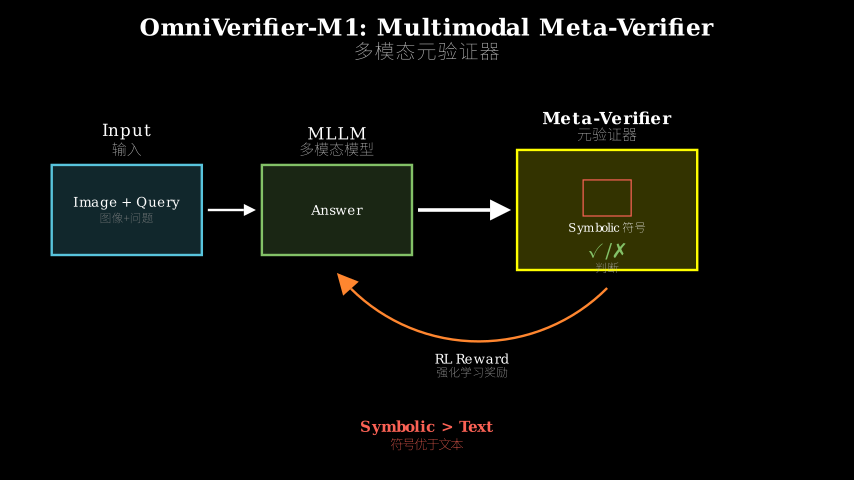
OmniVerifier-M1 is a vision-language model trained to perform two tasks simultaneously: (1) binary judgment (is this output correct?), and (2) meta-verification (where exactly is the error?). The key architectural choice is outputting bounding boxes instead of text explanations for spatial errors.
Training uses a two-stage process. First, supervised fine-tuning on labeled data where correct outputs get empty boxes and incorrect outputs get boxes around error regions. Second, reinforcement learning with decoupled objectives: one reward signal for judgment accuracy, a separate signal for box quality. Box quality is measured by rule-based metrics (IoU with ground truth error regions), avoiding the need for a separate judge model.
The verifier feeds into M1-TTS, an agentic generation system. When the verifier flags an error and provides a bounding box, the generator crops that region, regenerates it, and pastes it back. This loop continues until the verifier approves or a budget is exhausted.
Input Image + Generated Output
         |
         v
    [Verifier]
    /        \
   /          \
Judgment    Bounding Box
(binary)    (x,y,w,h)
   |            |
   v            v
Accept      Crop Region
            Regenerate
            Paste Back
               |
               v
          [Loop until OK]
Think of it like a photo editor with a built-in quality inspector. The inspector doesn’t just reject bad photos—it circles the problem areas with a red marker. The editor then knows exactly which regions to retouch. The inspector has two separate skill sets: recognizing overall quality (judgment) and precisely marking defects (localization). Training these skills separately is like teaching someone to grade essays and to annotate grammar errors as distinct competencies, rather than forcing them to learn both simultaneously.
Key Concepts
-
Meta-verification: Instead of just outputting “correct” or “incorrect,” the verifier explains its reasoning. In text domains, this might be a natural language explanation. In visual domains, this paper argues structured outputs (bounding boxes) are more useful because they’re unambiguous and actionable. A box at coordinates (100, 150, 50, 50) tells you exactly where the problem is; “the object is too far left” does not.
-
Decoupled reinforcement learning: Training a model to do two things at once (judgment + localization) with a single reward signal creates conflicts. Judgment rewards are sparse (right/wrong), while localization rewards are dense (IoU scores). Judgment needs to learn conservative decision boundaries, while localization needs to learn precise spatial regression. Decoupling means: optimize judgment with one loss function, optimize localization with another, even though they share the same model backbone. It’s like training a chess player on tactics puzzles and endgame studies separately, rather than only playing full games.
-
Rule-based rewards for symbolic outputs: When your verifier outputs bounding boxes, you can compute reward directly by comparing predicted boxes to ground truth boxes (IoU, precision, recall). No need for a separate “judge model” to score the quality of explanations. This is only possible because boxes are structured and comparable; you can’t do this with free-form text explanations without introducing another model to evaluate them.
Framework Shift
Before (mainstream approach):        After (this paper):

Generator --> [Verifier]             Generator --> [Verifier]
                  |                                /        \
                  v                               /          \
            Accept/Reject                    Judgment    Bounding Box
                                                 |            |
                                                 v            v
                                             Accept      Crop + Regen
                                                             |
                                                             v
                                                        [Loop]

Verifier = black box classifier      Verifier = structured reasoner
Feedback = binary signal             Feedback = spatial coordinates
From opaque judgment to transparent localization, the core shift is making verification interpretable and actionable through structured symbolic outputs.
Expert Assessment
Problem choice: Real gap. As multimodal models generate more complex visual outputs (layouts, diagrams, spatial arrangements), the inability to localize errors becomes a bottleneck for iterative refinement. This is not a manufactured problem—it’s the natural next step after achieving decent generation quality.
Method maturity: The insight about symbolic outputs is clever and well-motivated. Decoupled RL is a known technique but applied thoughtfully here. However, the paper doesn’t explore failure modes: what happens when errors are diffuse (overall composition is wrong) rather than localized? Bounding boxes assume errors are region-specific. The reliance on ground truth error regions during training is also a limitation—how do you scale annotation for this?
Experimental integrity: Baselines are reasonable (verifiers without meta-verification, verifiers with textual rationales). The ablation on decoupled vs joint RL is convincing. However, the paper lacks comparison with simpler alternatives: what if you just trained a separate localization model instead of multi-tasking? The M1-TTS results show improvement, but no analysis of when the agentic loop helps vs when it wastes compute by over-correcting.
Writing quality: The abstract and introduction are clear. The method section buries the key insight (symbolic > textual rationales) under implementation details. The experimental section would benefit from error analysis: show examples where the verifier succeeds and fails, not just aggregate metrics. The related work section is perfunctory.
Verdict: weak accept — Solid contribution with a useful insight (structured outputs for spatial verification), but the scope is narrower than the paper claims (only works for localized errors) and the experimental analysis could be deeper.
Takeaways
Practitioners can steal the core idea: when building verifiers for structured outputs (code, layouts, diagrams), prefer structured feedback over natural language explanations. Structured feedback enables rule-based reward computation, avoiding the need for auxiliary judge models. This applies beyond vision: a code verifier could output line numbers and error types instead of prose explanations.
The decoupled RL technique is transferable: if your model has multiple objectives with different learning dynamics (sparse vs dense rewards, classification vs regression), train them with separate loss functions even if they share a backbone. Don’t force a single reward signal to balance competing objectives.
The agentic loop pattern (generate → verify → localize → regenerate) is a general recipe for iterative refinement, but only works if your verifier provides actionable feedback. If your verifier just says “bad,” you’re stuck. If it says “bad at coordinates (x, y),” you can fix it.
论文: 2605.28805 作者: Xinchen Zhang, Bowei Liu, Jiale Liu, Chufan Shi, Yizhen Zhang, Junhong Liu, Youliang Zhang, Zhiheng Li, Yujiu Yang, Ling Yang 分类: cs.CL, cs.AI, cs.CV, cs.LG
缺口
多模态大语言模型生成视觉输出(图像、布局、空间推理),但现有验证器只会说”对”或”错”,不解释错误在哪里。
文本领域的过程监督方法使用自然语言解释,但这对空间任务太模糊。
你无法根据”物体位置稍有偏差”来修正,你需要坐标。
先前工作要么依赖昂贵的辅助评判模型来给文本解释打分,要么端到端训练验证器但没有可解释的中间推理。
问题:验证器只给二元信号,无空间错误定位
   |
   v
假设:符号输出(边界框)> 文本(对空间任务)
   |
   v
方法:训练验证器输出框 + 解耦强化学习(判断/定位)
   |
   v
证据:符号解释支持基于规则的奖励,优于文本
   |
   v
结论:验证器驱动的智能体系统实现区域级自我纠正
增量
一句话: 之前多模态验证器是黑盒分类器;
之后它们输出结构化空间解释,支持自动错误纠正。
核心机制
OmniVerifier-M1 是一个视觉-语言模型,同时执行两个任务:(1)二元判断(这个输出正确吗?
),(2)元验证(错误具体在哪里?
)。
关键架构选择是输出边界框而非文本解释来标注空间错误。
训练分两阶段。
第一阶段,在标注数据上监督微调,正确输出对应空白框,错误输出对应错误区域的框。
第二阶段,强化学习用解耦目标:一个奖励信号用于判断准确性,另一个信号用于框质量。
框质量用基于规则的指标衡量(与真实错误区域的 IoU),避免需要单独的评判模型。
验证器输入到 M1-TTS,一个智能体生成系统。
当验证器标记错误并提供边界框时,生成器裁剪该区域,重新生成,再粘贴回去。
这个循环持续到验证器通过或预算耗尽。
输入图像 + 生成输出
         |
         v
    [验证器]
    /        \
   /          \
判断        边界框
(二元)      (x,y,w,h)
   |            |
   v            v
接受        裁剪区域
            重新生成
            粘贴回去
               |
               v
          [循环直到OK]
把它想象成一个带内置质检员的照片编辑器。
质检员不只是拒绝坏照片——它用红笔圈出问题区域。
编辑器就知道该修哪些区域。
质检员有两套独立技能:识别整体质量(判断)和精确标记缺陷(定位)。
分开训练这些技能,就像教人评分作文和标注语法错误是两种能力,而不是强迫他们同时学会两者。
关键概念
- 元验证: 验证器不只输出”正确”或”错误”,还解释推理过程。
在文本领域,这可能是自然语言解释。
在视觉领域,本文认为结构化输出(边界框)更有用,因为它们明确且可操作。
坐标 (100, 150, 50, 50) 的框准确告诉你问题在哪;
“物体太靠左”则不行。
- 解耦强化学习: 训练模型同时做两件事(判断 + 定位)用单一奖励信号会产生冲突。
判断奖励是稀疏的(对/错),定位奖励是密集的(IoU 分数)。
判断需要学习保守的决策边界,定位需要学习精确的空间回归。
解耦意味着:用一个损失函数优化判断,用另一个优化定位,即使它们共享同一个模型主干。
这就像分别训练国际象棋选手做战术题和残局练习,而不是只下完整对局。
- 符号输出的基于规则奖励: 当验证器输出边界框时,你可以直接通过比较预测框和真实框(IoU、精确率、召回率)计算奖励。
不需要单独的”评判模型”来给解释质量打分。
这只有在框是结构化且可比较时才可能;
对自由形式的文本解释做不到这点,除非引入另一个模型来评估它们。
框架转变
之前(主流方法):                之后(本文方法):

生成器 --> [验证器]               生成器 --> [验证器]
              |                                /        \
              v                               /          \
        接受/拒绝                        判断        边界框
                                            |            |
                                            v            v
                                        接受        裁剪+重生成
                                                        |
                                                        v
                                                    [循环]

验证器 = 黑盒分类器                验证器 = 结构化推理器
反馈 = 二元信号                    反馈 = 空间坐标
从不透明判断到透明定位,核心转变是通过结构化符号输出让验证变得可解释且可操作。
专家评审
选题眼光: 真实缺口。
随着多模态模型生成更复杂的视觉输出(布局、图表、空间排列),无法定位错误成为迭代改进的瓶颈。
这不是人造问题——是达到不错生成质量后的自然下一步。
方法成熟度: 关于符号输出的洞见巧妙且动机充分。
解耦强化学习是已知技术但在此应用得当。
然而论文未探索失败模式:当错误是弥散的(整体构图错误)而非局部的时会怎样?
边界框假设错误是区域特定的。
训练时依赖真实错误区域标注也是局限——如何扩展这种标注?
实验诚意: 基线合理(无元验证的验证器、带文本解释的验证器)。
解耦 vs 联合强化学习的消融实验有说服力。
但论文缺少与更简单替代方案的比较:如果只训练一个单独的定位模型而非多任务会怎样?
M1-TTS 结果显示改进,但没有分析智能体循环何时有帮助 vs 何时通过过度纠正浪费算力。
写作功力: 摘要和引言清晰。
方法部分把关键洞见(符号 > 文本解释)埋在实现细节下。
实验部分需要错误分析:展示验证器成功和失败的例子,而非只有聚合指标。
相关工作部分敷衍。
判决: 弱接收 — 扎实贡献,有用洞见(空间验证的结构化输出),但范围比论文声称的窄(只适用于局部错误),实验分析可以更深入。
要点总结
实践者可以偷走核心想法:为结构化输出(代码、布局、图表)构建验证器时,优先选择结构化反馈而非自然语言解释。
结构化反馈支持基于规则的奖励计算,避免需要辅助评判模型。
这超越视觉领域:代码验证器可以输出行号和错误类型而非散文解释。
解耦强化学习技术可迁移:如果你的模型有多个学习动态不同的目标(稀疏 vs 密集奖励、分类 vs 回归),即使它们共享主干也用单独的损失函数训练。
不要强迫单一奖励信号平衡竞争目标。
智能体循环模式(生成 → 验证 → 定位 → 重生成)是迭代改进的通用配方,但只有在验证器提供可操作反馈时才有效。
如果验证器只说”坏”,你卡住了。
如果它说”坐标 (x, y) 处坏”,你能修。