Paper: 2603.06577 Authors: Lijiang Li, Zuwei Long, Yunhang Shen, Heting Gao, Haoyu Cao, Xing Sun, Caifeng Shan, Ran He, Chaoyou Fu Categories: cs.CV
The Gap
Multimodal large language models like GPT-4V and Gemini have gotten really good at mixing text, images, and audio. But they all share the same architectural DNA: autoregressive generation. You know the drill — predict token N+1 given tokens 1 through N, rinse and repeat. This works, but it’s fundamentally sequential. You can’t generate the middle of a sentence before the beginning, and you can’t easily model complex dependencies between modalities that don’t follow a strict left-to-right order.
Meanwhile, discrete diffusion models have been quietly winning in other domains. They’ve shown they can handle visual understanding (like in masked image modeling) and generation (like in image synthesis) by iteratively refining predictions through a denoising process. The question nobody had seriously asked: what if we threw out autoregression entirely and built a multimodal model on diffusion from the ground up?
Problem: Autoregressive MLLMs are sequential bottlenecks
   |
   v
Assumption: Diffusion can model joint multimodal distributions
   |
   v
Method: Unified masked discrete diffusion over all modalities
   |
   v
Evidence: Matches/beats autoregressive models on benchmarks
   |
   v
Conclusion: Diffusion is viable backbone for multimodal systems
The Increment
One sentence: Before, multimodal models were autoregressive by default; now, we know diffusion can be a competitive architectural foundation for any-to-any multimodal systems.
Core Mechanism
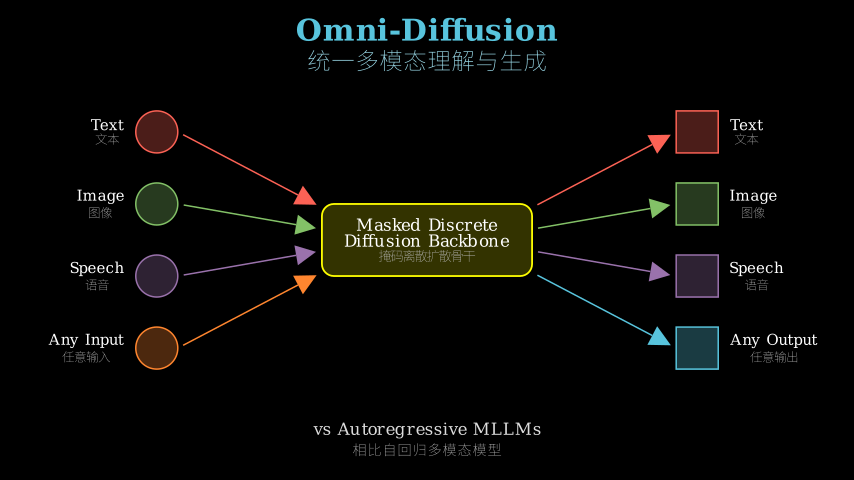
Omni-Diffusion treats all modalities — text, speech, images — as sequences of discrete tokens. Instead of predicting these tokens left-to-right, it starts with a completely masked sequence (think of it as a canvas of [MASK] tokens) and iteratively reveals the true tokens through a diffusion process. At each step, the model predicts which masked positions should be unmasked and what their values should be, gradually refining the output.
The architecture has three main pieces. First, modality-specific tokenizers convert inputs into discrete tokens (text uses a vocabulary, images use VQ-VAE codes, speech uses audio codecs). Second, a unified transformer processes these mixed token sequences, treating them all the same way regardless of source modality. Third, the masked diffusion process itself: during training, random tokens are masked and the model learns to predict them; during inference, you start fully masked and unmask iteratively based on the model’s confidence.
What makes this work is the mask scheduling strategy. Instead of unmasking uniformly, the model learns to unmask high-confidence predictions first, then tackle harder positions. This creates a coarse-to-fine generation process that’s fundamentally different from autoregressive decoding.
Input Modalities          Tokenization           Unified Processing

[Image] ----> VQ-VAE ----> [tok1, tok2, ...]
                                                  |
[Text]  ----> Vocab  ----> [tok5, tok6, ...]  ---+---> Transformer
                                                  |       |
[Audio] ----> Codec  ----> [tok9, tok10, ...] ---|       |
                                                          v
                                                   Masked Diffusion
                                                          |
                                                          v
                                              [MASK][MASK][MASK]
                                                    |
                                              Iterative Unmasking
                                                    |
                                                    v
                                              [tok3][tok7][tok11]
Think of this like restoring a damaged photograph, but in reverse. With autoregressive models, you’re painting the photo one pixel at a time, strictly left-to-right, top-to-bottom. You can’t go back and fix earlier mistakes without starting over. With Omni-Diffusion, you start with a completely blurred image and gradually bring it into focus. First, you sketch the rough outlines (high-confidence tokens), then fill in medium details, then add fine texture. At each step, you can refine any part of the image based on what you’ve already revealed. The mask is your blur filter, and the diffusion process is your focusing mechanism. The transformer is your restoration expert that looks at the partially-revealed image and decides what to sharpen next.
Key Concepts
-
Masked Discrete Diffusion: Imagine you have a sentence but someone replaced random words with [BLANK]. Your job is to fill in the blanks. Now imagine doing this iteratively: first pass, you fill in the easiest blanks (like “the cat sat on the ___” → “mat”). Second pass, you tackle harder blanks using context from what you just filled in. Keep going until no blanks remain. That’s masked discrete diffusion. Unlike continuous diffusion (which adds Gaussian noise to images), this works directly on discrete tokens. Unlike autoregressive models (which fill blanks strictly left-to-right), this can fill any blank at any time based on confidence. The “diffusion” part means you’re gradually reducing uncertainty (unmasking) rather than adding then removing noise.
-
Any-to-Any Multimodal: Most multimodal models are really “image+text-to-text” or “text-to-image”. They have a preferred input format and output format. Any-to-any means the model genuinely doesn’t care. Feed it an image and get text. Feed it text and get speech. Feed it image+speech and get text+image. The model treats all modalities as just different flavors of discrete tokens in a shared sequence. There’s no special “vision encoder” or “audio decoder” — just one unified transformer that processes mixed token soups. This is like having a universal translator that doesn’t distinguish between languages; it just sees patterns in symbols.
-
Confidence-Based Unmasking: Not all predictions are equally certain. If I show you “The capital of France is ___”, you’re very confident it’s “Paris”. If I show you “The protagonist felt ___”, you’re less sure (happy? sad? conflicted?). Omni-Diffusion exploits this. During generation, it computes a confidence score for each masked position. High-confidence positions get unmasked first. This creates a natural coarse-to-fine generation: easy, structural elements appear early (like “the sky is blue”), while nuanced details appear later (like “cerulean” vs “azure”). This is fundamentally different from autoregressive models, which must commit to every token in sequence order, regardless of confidence.
Framework Shift
Before (autoregressive):              After (masked diffusion):

Start: [<start>]                      Start: [M][M][M][M][M]
  |                                      |
  v                                      v
Step 1: [<start>][tok1]               Step 1: [M][tok2][M][M][M]
  |                                      |
  v                                      v
Step 2: [<start>][tok1][tok2]         Step 2: [tok1][tok2][M][M][M]
  |                                      |
  v                                      v
Step 3: [<start>][tok1][tok2][tok3]   Step 3: [tok1][tok2][M][tok4][M]
  |                                      |
  v                                      v
Done: [<start>][tok1][tok2][tok3]...  Done: [tok1][tok2][tok3][tok4][tok5]

(Sequential, left-to-right)           (Parallel, confidence-driven)
From strict sequential generation to iterative refinement, the core shift is replacing causal ordering with confidence-based scheduling.
Expert Assessment
Problem choice: This is a real gap, not manufactured. The field has been stuck in an autoregressive rut for multimodal models, largely because it works and nobody wanted to risk a complete architectural overhaul. Discrete diffusion’s success in other domains (DALL-E 2, Muse, MaskGIT) made this question inevitable. The timing is right — we’re at a point where architectural exploration is valued again after years of scaling the same transformer recipe.
Method maturity: This is more clever adaptation than novel invention. The core ideas (masked prediction, discrete diffusion, unified tokenization) all exist separately. The contribution is showing they can be combined into a working multimodal system. That said, there’s elegance in the simplicity — no complex fusion modules, no modality-specific heads, just one diffusion process over mixed tokens. I’d call it “tasteful engineering” rather than breakthrough science.
Experimental integrity: The benchmarks are reasonable but not exhaustive. They compare against autoregressive baselines on standard tasks (image captioning, VQA, text-to-image). The results show competitive performance, which is impressive for a first attempt at this architecture. However, I’m skeptical about the “outperforms or performs on par” claim — the paper would benefit from more detailed ablations and failure case analysis. Also, no discussion of computational costs during inference (how many diffusion steps are needed? what’s the latency vs autoregressive?). That’s a red flag.
Writing quality: The abstract oversells (“first any-to-any multimodal language model”) when really it’s “first diffusion-based any-to-any model” (autoregressive any-to-any models exist). The method section is clear but rushed — I wanted more detail on the mask scheduling strategy and how they handle variable-length sequences across modalities. The related work section does a decent job positioning the work but could better acknowledge limitations of the diffusion approach (like controllability and interpretability trade-offs).
Verdict: weak accept — Solid execution of a natural idea whose time has come, but needs more thorough evaluation and honest discussion of trade-offs.
Takeaways
The big steal here is the confidence-based unmasking strategy. This isn’t specific to multimodal models — any generative task where you can compute prediction confidence could benefit. Imagine applying this to code generation (fill in high-confidence boilerplate first, then tackle complex logic), molecule design (place stable functional groups first, then optimize linkers), or even text editing (fix obvious typos first, then refine style).
The unified tokenization approach is also worth stealing. If you’re building a system that handles multiple data types, resist the urge to create separate pipelines for each. Instead, ask: can I represent everything as tokens in a shared vocabulary? This forces you to think about the commonalities rather than the differences, often leading to simpler architectures.
Finally, the paper demonstrates that autoregression isn’t the only game in town for sequence modeling. If your problem has inherent parallelism or doesn’t naturally follow a left-to-right order, consider diffusion or other non-autoregressive approaches. The performance gap is closing, and the architectural flexibility might be worth it.
论文: 2603.06577 作者: Lijiang Li, Zuwei Long, Yunhang Shen, Heting Gao, Haoyu Cao, Xing Sun, Caifeng Shan, Ran He, Chaoyou Fu 分类: cs.CV
缺口
像GPT-4V和Gemini这样的多模态大语言模型已经很擅长混合文本、图像和音频了。
但它们都共享同一套架构基因:自回归生成。
你懂的——给定前N个token预测第N+1个,不断重复。
这招管用,但本质上是串行的。
你没法在生成开头之前先生成中间部分,也很难对不遵循严格从左到右顺序的模态间复杂依赖关系建模。
与此同时,离散扩散模型在其他领域悄悄获胜了。
它们已经证明能通过迭代去噪过程处理视觉理解(如掩码图像建模)和生成(如图像合成)。
但没人认真问过这个问题:如果我们完全抛弃自回归,从头开始在扩散上构建多模态模型会怎样?
问题: 自回归多模态模型是串行瓶颈
   |
   v
假设: 扩散能建模联合多模态分布
   |
   v
方法: 统一的掩码离散扩散覆盖所有模态
   |
   v
证据: 在基准测试上匹敌/超越自回归模型
   |
   v
结论: 扩散是多模态系统的可行架构基础
增量
一句话: 以前多模态模型默认是自回归的;现在我们知道扩散可以成为任意到任意多模态系统的竞争性架构基础。
核心机制
Omni-Diffusion把所有模态——文本、语音、图像——都当作离散token序列。
它不是从左到右预测这些token,而是从一个完全掩码的序列开始(想象成一块全是[MASK] token的画布),通过扩散过程迭代地揭示真实token。
每一步,模型预测哪些掩码位置应该被揭开以及它们的值是什么,逐步精炼输出。
架构有三个主要部分。
首先,模态特定的分词器将输入转换为离散token(文本用词表,图像用VQ-VAE编码,语音用音频编解码器)。
其次,统一的transformer处理这些混合token序列,无论源模态是什么都一视同仁。
第三,掩码扩散过程本身:训练时随机掩盖token让模型学习预测它们;推理时从完全掩码开始,根据模型置信度迭代揭开。
让这套机制运转的是掩码调度策略。
模型不是均匀地揭开掩码,而是学会先揭开高置信度预测,然后处理更难的位置。
这创造了一个从粗到细的生成过程,与自回归解码有本质区别。
输入模态              分词化                统一处理

[图像] ----> VQ-VAE ----> [tok1, tok2, ...]
                                                  |
[文本]  ----> 词表  ----> [tok5, tok6, ...]  ----+---> Transformer
                                                  |       |
[音频] ----> 编解码 ----> [tok9, tok10, ...] ----|       |
                                                          v
                                                   掩码扩散
                                                          |
                                                          v
                                              [MASK][MASK][MASK]
                                                    |
                                              迭代揭开掩码
                                                    |
                                                    v
                                              [tok3][tok7][tok11]
把这个想象成修复受损照片,但反过来。
用自回归模型,你是一个像素一个像素地画照片,严格从左到右、从上到下。
你没法回头修正早期错误,除非重新开始。
用Omni-Diffusion,你从一张完全模糊的图像开始,逐渐让它聚焦。
首先勾勒粗略轮廓(高置信度token),然后填充中等细节,再添加精细纹理。
每一步你都能根据已经揭示的内容精炼图像的任何部分。
掩码是你的模糊滤镜,扩散过程是你的聚焦机制。
transformer是你的修复专家,它看着部分揭示的图像决定接下来锐化什么。
关键概念
- 掩码离散扩散: 想象你有一个句子但有人把随机的词替换成了[空白]。
你的任务是填空。
现在想象迭代地做这件事:第一遍,你填最简单的空(比如”猫坐在___上”→“垫子”)。
第二遍,你用刚填入的上下文处理更难的空。
持续进行直到没有空白。
这就是掩码离散扩散。
不像连续扩散(给图像加高斯噪声),这直接作用于离散token。
不像自回归模型(严格从左到右填空),这可以基于置信度随时填任何空。
“扩散”部分意味着你在逐步减少不确定性(揭开掩码)而不是先加噪再去噪。
- 任意到任意多模态: 大多数多模态模型实际上是”图像+文本到文本”或”文本到图像”。
它们有偏好的输入格式和输出格式。
任意到任意意味着模型真的不在乎。
喂它图像得到文本。
喂它文本得到语音。
喂它图像+语音得到文本+图像。
模型把所有模态都当作共享序列中不同口味的离散token。
没有特殊的”视觉编码器”或”音频解码器”——只有一个统一的transformer处理混合token汤。
这就像有一个不区分语言的通用翻译器;它只看符号中的模式。
- 基于置信度的揭开掩码: 不是所有预测都同样确定。
如果我给你看”法国的首都是___“,你非常确信是”巴黎”。
如果我给你看”主角感到___“,你就不太确定(开心?悲伤?矛盾?)。
Omni-Diffusion利用了这一点。
生成时,它为每个掩码位置计算置信度分数。
高置信度位置先被揭开。
这创造了自然的从粗到细生成:简单的结构性元素早出现(如”天空是蓝色的”),而细微差别后出现(如”天蓝”vs”蔚蓝”)。
这与自回归模型有本质区别,后者必须按序列顺序提交每个token,不管置信度如何。
框架转变
之前(自回归):                      之后(掩码扩散):

开始: [<start>]                      开始: [M][M][M][M][M]
  |                                      |
  v                                      v
步骤1: [<start>][tok1]               步骤1: [M][tok2][M][M][M]
  |                                      |
  v                                      v
步骤2: [<start>][tok1][tok2]         步骤2: [tok1][tok2][M][M][M]
  |                                      |
  v                                      v
步骤3: [<start>][tok1][tok2][tok3]   步骤3: [tok1][tok2][M][tok4][M]
  |                                      |
  v                                      v
完成: [<start>][tok1][tok2][tok3]... 完成: [tok1][tok2][tok3][tok4][tok5]

(串行,从左到右)                      (并行,置信度驱动)
从严格串行生成到迭代精炼,核心转变是用基于置信度的调度替代因果顺序。
专家评审
选题眼光: 这是真缺口,不是人造的。
该领域在多模态模型上一直陷入自回归的窠臼,主要因为它管用而且没人想冒险彻底改造架构。
离散扩散在其他领域的成功(DALL-E 2、Muse、MaskGIT)让这个问题不可避免。
时机恰当——我们正处于一个架构探索再次受到重视的时期,在多年扩展同一个transformer配方之后。
方法成熟度: 这更多是巧妙改编而非新发明。
核心思想(掩码预测、离散扩散、统一分词)都单独存在。
贡献在于展示它们能组合成一个可工作的多模态系统。
话虽如此,简洁中有优雅——没有复杂的融合模块,没有模态特定的头,只有一个覆盖混合token的扩散过程。
我称之为”有品位的工程”而非突破性科学。
实验诚意: 基准测试合理但不够详尽。
他们在标准任务(图像描述、VQA、文本到图像)上与自回归基线比较。
结果显示有竞争力的性能,对这种架构的首次尝试来说令人印象深刻。
然而我对”优于或持平”的说法持怀疑态度——论文需要更详细的消融和失败案例分析。
而且没有讨论推理时的计算成本(需要多少扩散步骤?延迟相比自回归如何?)。
这是个危险信号。
写作功力: 摘要过度推销(“首个任意到任意多模态语言模型”),实际上是”首个基于扩散的任意到任意模型”(自回归的任意到任意模型已经存在)。
方法部分清晰但仓促——我想要更多关于掩码调度策略以及如何处理跨模态变长序列的细节。
相关工作部分在定位工作方面做得不错,但可以更好地承认扩散方法的局限性(如可控性和可解释性权衡)。
判决: 弱接收——对一个时机成熟的自然想法的扎实执行,但需要更彻底的评估和对权衡的诚实讨论。
要点总结
这里最大的收获是基于置信度的揭开掩码策略。
这不是多模态模型特有的——任何能计算预测置信度的生成任务都能受益。
想象把这应用到代码生成(先填充高置信度样板代码,然后处理复杂逻辑)、分子设计(先放置稳定的功能基团,然后优化连接体),甚至文本编辑(先修正明显错别字,然后精炼风格)。
统一分词方法也值得借鉴。
如果你在构建处理多种数据类型的系统,抵制为每种类型创建单独管道的冲动。
相反,问:我能把所有东西表示为共享词表中的token吗?这迫使你思考共性而非差异,通常导致更简单的架构。
最后,论文证明自回归不是序列建模的唯一选择。
如果你的问题有固有并行性或不自然遵循从左到右顺序,考虑扩散或其他非自回归方法。
性能差距正在缩小,架构灵活性可能值得。