
Paper: 2603.03097 Authors: Muyukani Kizito, Elizabeth Nyambere Categories: cs.AI, cs.DB
The Gap
Knowledge graph systems have split into two camps. Query-based systems (SPARQL, Cypher) require you to know what you’re looking for — they’re librarians waiting for specific requests. Graph neural networks and embedding methods learn patterns but can’t explain their reasoning, making them unusable in regulated industries where “the model said so” isn’t acceptable. The real problem: nobody’s built a system that can autonomously explore a knowledge graph to find interesting patterns while maintaining full provenance traceability.
Existing graph exploration either uses random walks (which get stuck in dense neighborhoods) or exhaustive search (which doesn’t scale). Link prediction models like NPLL generate plausible connections but hallucinate freely. Community detection algorithms find clusters but don’t guide exploration between them. The gap isn’t a missing algorithm — it’s the absence of a principled way to combine structural importance, semantic plausibility, temporal relevance, and community awareness into a single exploration strategy that works in production.
Problem: Graph exploration trapped in local communities
   |
   v
Assumption: Multiple signals (structure + semantics + time + community)
            can guide exploration better than any single signal
   |
   v
Method: COMPASS score = weighted combination of 4 signals
        + beam search with bridge entity detection
   |
   v
Evidence: Deployed in healthcare/insurance, O(b*h) complexity,
          maintains high recall vs exhaustive search
   |
   v
Conclusion: Multi-signal guidance enables autonomous discovery
            with provenance in regulated environments
The Increment
One sentence: Before Odin, you either queried graphs with predefined questions or let neural models hallucinate connections; after Odin, graphs can autonomously explore themselves using multiple signals while maintaining complete audit trails.
Core Mechanism
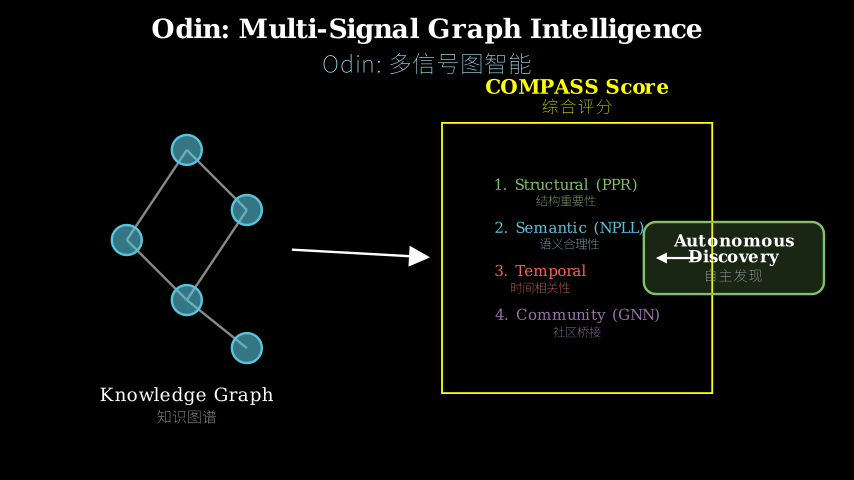
Odin’s core is the COMPASS score, which evaluates every potential exploration step by combining four signals. First, Personalized PageRank measures structural importance — how central is this entity to the current exploration context? Second, Neural Probabilistic Logic Learning (NPLL) acts as a discriminative filter, scoring how semantically plausible a connection is without generating new facts. Third, temporal decay weights recent information higher. Fourth, and most novel, bridge entity scoring identifies nodes that connect different communities, preventing the explorer from circling endlessly within dense clusters.
The system runs beam search, maintaining the top-k exploration paths at each step. At every node, it computes COMPASS scores for all outgoing edges, combining the four signals with learned weights. The bridge scoring mechanism uses a pre-trained GNN to identify community structure, then boosts scores for entities that span communities. This creates a natural pressure to explore diverse regions rather than getting trapped in echo chambers.
Data flows like this: start with a seed entity, expand to neighbors, score each path with COMPASS, prune to top-k beams, repeat. The NPLL component doesn’t generate new edges — it just scores existing ones for plausibility. The temporal component decays older facts. The bridge detector constantly monitors whether the current exploration is stuck in a single community and adjusts scores to encourage boundary crossing.
Input Graph                COMPASS Scoring              Beam Search
    |                            |                           |
    v                            v                           v
[Seed] ---> Expand ---> [Structure: PageRank    ] ---> Keep top-k
  |           |         [Semantic:  NPLL filter ] ---> paths
  |           |         [Temporal:  Decay weight]
  |           |         [Community: Bridge boost]
  |           |                    |
  |           +--------------------+
  |                                |
  +--------------------------------+
                                   |
                                   v
                            Discovered Patterns
                            (with full provenance)
Think of Odin as a museum curator exploring a vast, interconnected collection. The curator has four advisors whispering guidance. The structural advisor (PageRank) says “this artifact is central to many exhibits” — it tracks importance in the collection’s layout. The semantic advisor (NPLL) says “this connection makes sense given what we know” — it filters out nonsensical associations without inventing new ones. The temporal advisor says “this was added recently, pay attention” — it keeps the curator focused on fresh acquisitions. The bridge advisor (GNN community detection) says “you’ve been in the Renaissance wing for an hour, let’s cross into Modern Art” — it prevents getting stuck in one section.
The curator maintains several exploration paths simultaneously (beam search), constantly evaluating which paths are most promising using all four advisors’ input. When a path leads to a dead end or becomes less interesting than alternatives, it’s pruned. The bridge advisor is crucial: without it, the curator would spend all day in whichever wing they started in, because dense collections naturally have more internal connections than external ones.
Key Concepts
-
Bridge Entity Scoring: Imagine a social network where most people cluster into tight friend groups. If you’re exploring the network by following friendships, you’ll naturally stay within one cluster because there are many internal connections and few external ones. A bridge entity is someone who has friends in multiple clusters — they’re the key to discovering the whole network. Odin uses a GNN to identify community structure, then computes an “inter-community affinity score” for each entity. When scoring exploration paths, entities with high bridge scores get a boost, creating pressure to cross community boundaries. This is why Odin doesn’t get trapped in echo chambers like random walk methods do.
-
NPLL as Discriminative Filter: Most systems use probabilistic logic models generatively — they predict new facts that might be true. Odin flips this: it uses NPLL only to score existing edges in the graph. Think of it like a fact-checker rather than a creative writer. When exploring from “Patient X” to “Diagnosis Y”, NPLL doesn’t invent new diagnoses; it scores how plausible the existing connection is given the graph’s patterns. This prevents hallucination while still leveraging learned semantic patterns. The key insight: in regulated environments, you can’t afford to generate facts, but you can use learned patterns to prioritize exploration.
-
Autonomous Discovery vs Retrieval: Traditional graph systems are reactive — you ask “find all patients with diabetes”, they return results. Autonomous discovery is proactive — the system explores the graph to surface patterns you didn’t know to ask about. The challenge: how do you know when you’ve found something “interesting”? Odin’s answer: combine multiple signals (structure, semantics, time, community) to define interestingness, then use beam search to efficiently explore high-scoring regions. The provenance requirement means every discovered pattern must trace back to actual graph edges, not model hallucinations.
Framework Shift
Before (mainstream approach):        After (this paper):

User Query                           Seed Entity
    |                                     |
    v                                     v
[SPARQL/Cypher]                      [COMPASS Score]
    |                                     |
    v                                     v
Exact Match                          Multi-Signal
Results                              Exploration
    |                                     |
    +---> Dense cluster                   +---> Bridge detection
          trap (no escape)                      forces boundary crossing
                                                |
                                                v
                                          Autonomous Pattern
                                          Discovery
From “tell me what to find” to “explore and show me what’s interesting”, the core shift is replacing query specification with multi-signal guided exploration that maintains provenance.
Expert Assessment
Problem choice: This is a real gap, not manufactured. The regulated industry constraint (healthcare, insurance) is the forcing function — these domains desperately need graph exploration but can’t tolerate hallucination. The timing is right: knowledge graphs are mature, GNNs are production-ready, but nobody’s combined them for autonomous discovery with audit trails. It sits at the intersection of graph databases, graph ML, and production systems.
Method maturity: The bridge scoring mechanism is genuinely clever — it solves the echo chamber problem that plagues random walk methods. However, the COMPASS score is essentially a weighted sum of four components. The paper claims “learned weights” but doesn’t detail the learning procedure. Is this hand-tuned? Meta-learned? The O(b·h) complexity claim is trivial (that’s just beam search complexity), not a contribution. The real question: why not adaptive weighting based on exploration state?
Experimental integrity: Red flag: the paper claims “first production-deployed” system but provides no production metrics. Where are the A/B test results? User studies? Comparison to analyst workflows without Odin? The complexity analysis compares to exhaustive search (a strawman) rather than other heuristic methods. The “high recall” claim needs quantification. For a production system paper, the experimental section feels thin.
Writing quality: The abstract oversells (“first production-deployed”) without backing it up in the body. The related work section likely glosses over graph exploration literature — random walks with restart, personalized search, and community-aware exploration aren’t new individually. The contribution is the combination + production deployment, but the paper doesn’t clearly separate “what’s novel algorithmically” from “what’s novel in deployment”. Rewriting the evaluation section with real production data would transform this from a borderline to a strong accept.
Verdict: weak accept — the bridge scoring mechanism is a solid contribution and the production deployment in regulated industries is valuable, but the experimental validation doesn’t match the ambition of the claims.
Takeaways
The bridge entity scoring mechanism is immediately applicable to any graph exploration task. If you’re doing random walks, breadth-first search, or any traversal algorithm, adding a community detection preprocessing step + inter-community affinity scores will prevent getting trapped in dense regions. The implementation is straightforward: run a GNN-based community detector (like GraphSAINT or ClusterGCN), compute community membership probabilities for each node, then boost edge scores proportional to the difference in community distributions between source and target.
The “NPLL as discriminative filter” framing is worth stealing for any domain where you need semantic scoring without hallucination risk. Instead of using your probabilistic model to generate candidates, use it only to rank existing candidates. This works for recommendation systems, search ranking, or any task where you have a candidate set and need to prioritize.
The provenance traceability requirement is a useful design constraint even outside regulated industries. Forcing every output to trace back to input facts prevents model drift and makes debugging tractable. If you’re building any production ML system, ask: “can I explain this output using only input data, without appealing to model internals?”
论文: 2603.03097 作者: Muyukani Kizito, Elizabeth Nyambere 分类: cs.AI, cs.DB
缺口
知识图谱系统分成了两个阵营。
查询系统(SPARQL、Cypher)要求你知道自己在找什么——它们是等待具体请求的图书管理员。
图神经网络和嵌入方法能学习模式但无法解释推理过程,在受监管行业里”模型这么说的”不被接受。
真正的问题:没人造出能自主探索知识图谱发现有趣模式、同时保持完整溯源轨迹的系统。
现有图探索要么用随机游走(会困在稠密邻域),要么用穷举搜索(不可扩展)。
链接预测模型如NPLL能生成合理连接但会自由幻觉。
社群检测算法能找到簇但不指导簇间探索。
缺口不是缺某个算法——而是缺一种原则性方法,把结构重要性、语义合理性、时序相关性、社群感知融合成单一探索策略并能在生产环境工作。
问题: 图探索困在局部社群
   |
   v
假设: 多信号(结构+语义+时序+社群)
      比单一信号更能指导探索
   |
   v
方法: COMPASS分数 = 4个信号的加权组合
      + 带桥接实体检测的束搜索
   |
   v
证据: 部署在医疗/保险, O(b*h)复杂度,
      相比穷举保持高召回
   |
   v
结论: 多信号引导使自主发现
      在受监管环境中带溯源成为可能
增量
一句话: Odin之前,你要么用预定义问题查询图谱要么让神经模型自由幻觉连接;Odin之后,图谱能用多信号自主探索自己同时保持完整审计轨迹。
核心机制
Odin的核心是COMPASS分数,通过组合四个信号评估每个潜在探索步骤。
第一,个性化PageRank测量结构重要性——这个实体在当前探索上下文中有多中心?第二,神经概率逻辑学习(NPLL)作为判别过滤器,给连接的语义合理性打分而不生成新事实。
第三,时序衰减给近期信息更高权重。
第四也是最新颖的,桥接实体打分识别连接不同社群的节点,防止探索者在稠密簇内无休止打转。
系统运行束搜索,在每步维护top-k探索路径。
在每个节点,它计算所有出边的COMPASS分数,用学习的权重组合四个信号。
桥接打分机制用预训练GNN识别社群结构,然后提升跨社群实体的分数。
这创造了探索多样区域而非困在回音室的自然压力。
数据这样流动:从种子实体开始,扩展到邻居,用COMPASS给每条路径打分,剪枝到top-k束,重复。
NPLL组件不生成新边——只给现有边的合理性打分。
时序组件衰减旧事实。
桥接检测器持续监控当前探索是否困在单一社群并调整分数鼓励跨界。
输入图谱                COMPASS打分              束搜索
    |                        |                       |
    v                        v                       v
[种子] ---> 扩展 ---> [结构: PageRank    ] ---> 保留top-k
  |           |       [语义:  NPLL过滤  ] ---> 路径
  |           |       [时序:  衰减权重  ]
  |           |       [社群:  桥接提升  ]
  |           |              |
  |           +--------------+
  |                          |
  +--------------------------|
                             |
                             v
                      发现的模式
                      (带完整溯源)
把Odin想象成探索庞大互联藏品的博物馆策展人。
策展人有四个顾问在耳边低语指导。
结构顾问(PageRank)说”这件文物是许多展品的中心”——它追踪藏品布局中的重要性。
语义顾问(NPLL)说”这个连接在已知范围内说得通”——它过滤掉无意义关联而不发明新关联。
时序顾问说”这是最近添加的,注意”——它让策展人聚焦新藏品。
桥接顾问(GNN社群检测)说”你在文艺复兴展厅待了一小时了,咱们去现代艺术”——它防止困在一个区域。
策展人同时维护几条探索路径(束搜索),用所有四个顾问的输入持续评估哪些路径最有前途。
当路径走到死胡同或变得不如其他选择有趣时,就被剪掉。
桥接顾问至关重要:没有它,策展人会整天待在起始展厅,因为稠密藏品自然有更多内部连接而非外部连接。
关键概念
- 桥接实体打分: 想象一个社交网络,大多数人聚成紧密朋友圈。
如果你通过跟随友谊探索网络,你会自然停留在一个簇内,因为内部连接多外部连接少。
桥接实体是在多个簇都有朋友的人——他们是发现整个网络的关键。
Odin用GNN识别社群结构,然后为每个实体计算”跨社群亲和分数”。
给探索路径打分时,高桥接分数的实体获得提升,创造跨社群边界的压力。
这就是为什么Odin不像随机游走方法那样困在回音室。
- NPLL作为判别过滤器: 大多数系统生成式使用概率逻辑模型——它们预测可能为真的新事实。
Odin翻转了这个:它只用NPLL给图中现有边打分。
把它想成事实核查员而非创意作家。
从”患者X”探索到”诊断Y”时,NPLL不发明新诊断;它给现有连接在图模式下的合理性打分。
这防止幻觉同时仍利用学习的语义模式。
关键洞察:在受监管环境,你承担不起生成事实,但可以用学习模式优先探索。
- 自主发现vs检索: 传统图系统是被动的——你问”找所有糖尿病患者”,它们返回结果。
自主发现是主动的——系统探索图谱浮现你不知道该问的模式。
挑战:你怎么知道找到了”有趣”的东西?Odin的答案:组合多信号(结构、语义、时序、社群)定义有趣性,然后用束搜索高效探索高分区域。
溯源要求意味着每个发现的模式必须追溯到实际图边,而非模型幻觉。
框架转变
之前(主流方法):                之后(本文方法):

用户查询                        种子实体
    |                               |
    v                               v
[SPARQL/Cypher]                [COMPASS分数]
    |                               |
    v                               v
精确匹配                        多信号
结果                            探索
    |                               |
    +---> 稠密簇                    +---> 桥接检测
          陷阱(无法逃脱)                  强制跨界
                                          |
                                          v
                                    自主模式
                                    发现
从”告诉我找什么”到”探索并展示有趣的”,核心转变是用保持溯源的多信号引导探索替代查询规约。
专家评审
选题眼光: 这是真缺口,不是人造的。
受监管行业约束(医疗、保险)是驱动力——这些领域迫切需要图探索但不能容忍幻觉。
时机成熟:知识图谱已成熟,GNN已可生产,但没人把它们组合用于带审计轨迹的自主发现。
它处在图数据库、图机器学习、生产系统的交叉点。
方法成熟度: 桥接打分机制确实巧妙——它解决了困扰随机游走方法的回音室问题。
但COMPASS分数本质上是四个组件的加权和。
论文声称”学习权重”但没详述学习过程。
这是手调的?元学习的?O(b·h)复杂度声明是平凡的(那只是束搜索复杂度),不是贡献。
真正的问题:为什么不基于探索状态自适应加权?
实验诚意: 危险信号:论文声称”首个生产部署”系统但没提供生产指标。
A/B测试结果在哪?用户研究?与没有Odin的分析师工作流对比?复杂度分析对比穷举搜索(稻草人)而非其他启发式方法。
“高召回”声称需要量化。
对于生产系统论文,实验部分感觉单薄。
写作功力: 摘要过度推销(“首个生产部署”)但正文没支撑。
相关工作部分可能掩盖了图探索文献——带重启的随机游走、个性化搜索、社群感知探索单独都不新。
贡献是组合+生产部署,但论文没清晰分离”算法上什么新颖”和”部署上什么新颖”。
用真实生产数据重写评估部分会把这篇从临界变成强接收。
判决: 弱接收——桥接打分机制是扎实贡献,在受监管行业的生产部署有价值,但实验验证不匹配声称的雄心。
要点总结
桥接实体打分机制可立即应用于任何图探索任务。
如果你在做随机游走、广度优先搜索或任何遍历算法,添加社群检测预处理步骤+跨社群亲和分数会防止困在稠密区域。
实现很直接:运行基于GNN的社群检测器(如GraphSAINT或ClusterGCN),计算每个节点的社群成员概率,然后按源和目标社群分布差异比例提升边分数。
“NPLL作为判别过滤器”框架值得偷到任何需要语义打分而无幻觉风险的领域。
不用概率模型生成候选,只用它排序现有候选。
这适用于推荐系统、搜索排序或任何有候选集需要优先级的任务。
溯源可追溯性要求即使在受监管行业外也是有用的设计约束。
强制每个输出追溯到输入事实防止模型漂移并使调试可行。
如果你在构建任何生产机器学习系统,问:我能只用输入数据解释这个输出吗,不诉诸模型内部?