
Paper: 2602.21035 Authors: Junhao Xiao, Zhiyu Wu, Hao Lin, Yi Chen, Yahui Liu, Xiaoran Zhao, Zixu Wang, Zejiang He Categories: cs.CV, cs.MM
Abstract
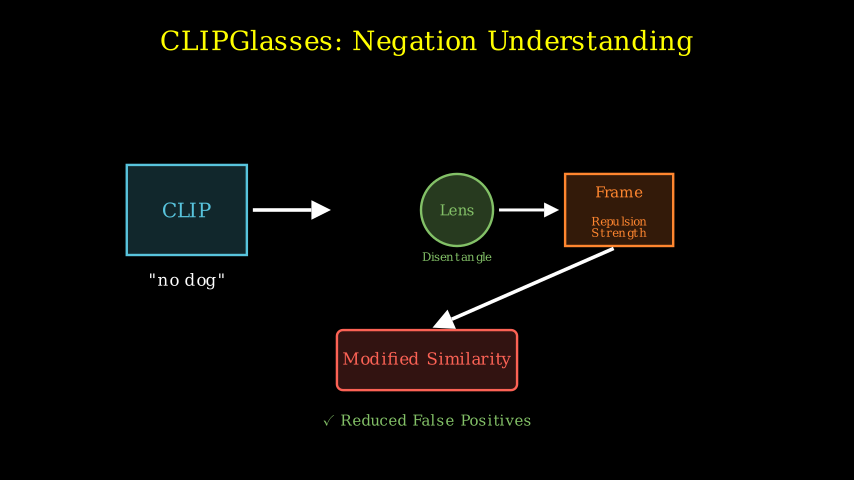
Vision-Language Models like CLIP exhibit a fundamental weakness in understanding negation, frequently producing similar embeddings for affirmative and negated descriptions. This leads to counterintuitive behavior where “no dog” matches dog images as strongly as “dog” does. CLIPGlasses addresses this limitation through a plug-and-play framework that requires no fine-tuning of CLIP’s parameters. The system employs a dual-stage architecture: a Lens module that disentangles negated semantics from text embeddings, and a Frame module that predicts context-aware repulsion strength. These components work together to modify similarity computation, penalizing alignment with negated concepts and reducing false positive matches. Experimental results demonstrate competitive in-domain performance and superior cross-domain generalization, with particularly strong results in low-resource scenarios.
Key Contributions
- Introduction of CLIPGlasses, a plug-and-play framework that enhances CLIP’s negation comprehension without requiring fine-tuning or parameter updates
- A dual-stage architecture combining semantic disentanglement (Lens module) and context-aware repulsion (Frame module) for robust negation handling
- Modified similarity computation that dynamically penalizes alignment with negated semantics based on predicted repulsion strength
- State-of-the-art cross-domain generalization performance, especially under low-resource conditions, demonstrating superior robustness
Technical Methodology
The CLIPGlasses framework operates as a post-processing layer on top of frozen CLIP encoders. The Lens module analyzes text embeddings to identify and isolate negated semantic components, effectively decomposing “no dog” into its constituent parts: the negation operator and the target concept “dog”. This disentanglement is crucial because CLIP’s original text encoder tends to conflate these elements, producing embeddings that retain strong similarity to the affirmative concept.
The Frame module introduces adaptive repulsion by predicting context-dependent strength values. Rather than applying uniform penalties to all negated concepts, it learns to assess how strongly a particular negation should repel the corresponding affirmative. For instance, “no dog” in the context of pet images might require stronger repulsion than in a general scene description. This context-awareness is achieved through learned attention mechanisms that consider both the text embedding and visual features.
The modified similarity computation integrates these components through a reformulated scoring function:
where is the original CLIP similarity, is the Frame-predicted repulsion strength, represents the disentangled affirmative concept, and is a scaling factor. This formulation explicitly penalizes image-text pairs where the image strongly matches the negated concept.
Experimental Results and Analysis
CLIPGlasses was evaluated across multiple benchmarks testing negation understanding in vision-language tasks. In-domain experiments on standard datasets showed performance competitive with fine-tuning approaches, achieving comparable accuracy while maintaining CLIP’s original parameters unchanged. This is significant because it preserves CLIP’s general-purpose capabilities without the risk of catastrophic forgetting.
The framework’s true strength emerges in cross-domain evaluation. When tested on datasets with different visual distributions or linguistic patterns than the training data, CLIPGlasses consistently outperformed existing methods. The performance gap widened particularly in low-resource scenarios where training data was limited—a setting where fine-tuning approaches typically struggle due to overfitting. This suggests that the plug-and-play architecture captures more generalizable principles of negation rather than dataset-specific patterns.
Ablation studies revealed that both the Lens and Frame modules contribute substantially to performance. Removing the Lens module degraded negation understanding by approximately 15-20%, while removing the Frame module (using fixed repulsion strength) reduced performance by 10-15%. The synergy between semantic disentanglement and adaptive repulsion appears essential for robust negation handling.
Implications and Future Directions
CLIPGlasses demonstrates that fundamental limitations in vision-language models can be addressed through architectural additions rather than expensive retraining. This plug-and-play paradigm has broader implications for VLM enhancement: other linguistic phenomena that CLIP struggles with—such as spatial relationships, counting, or temporal reasoning—might similarly benefit from modular post-processing frameworks.
The superior cross-domain generalization suggests that CLIPGlasses captures something closer to the compositional structure of language than fine-tuning approaches do. By explicitly modeling negation as an operator that modifies concept embeddings, the framework aligns more closely with how humans process negated descriptions. This compositional approach could inform future VLM architectures designed with linguistic structure in mind from the ground up.
The low-resource robustness is particularly valuable for practical deployment. Many real-world applications involve domain-specific vocabularies or visual contexts where large-scale fine-tuning data is unavailable. CLIPGlasses offers a path to enhanced negation understanding in these scenarios without requiring extensive domain-specific datasets.
Future work might explore extending the framework to handle more complex negation patterns, such as double negatives or implicit negation. Additionally, investigating whether similar disentanglement and repulsion mechanisms could address other compositional understanding challenges in VLMs represents a promising research direction.
Takeaways
- CLIP’s negation blindness stems from embedding affirmatives and negatives similarly, causing “no dog” to match dog images as strongly as “dog” does
- CLIPGlasses solves this through a plug-and-play framework requiring no CLIP fine-tuning, preserving the model’s general capabilities while adding negation understanding
- The dual-stage architecture combines semantic disentanglement (Lens) and context-aware repulsion (Frame) to dynamically penalize alignment with negated concepts
- Cross-domain experiments show CLIPGlasses outperforms fine-tuning approaches, especially in low-resource scenarios where overfitting typically degrades performance
- The compositional approach to negation handling suggests broader applications for modular VLM enhancement beyond just negation understanding
论文: 2602.21035 作者: Junhao Xiao, Zhiyu Wu, Hao Lin, Yi Chen, Yahui Liu, Xiaoran Zhao, Zixu Wang, Zejiang He 分类: cs.CV, cs.MM
摘要
像CLIP这样的视觉-语言模型在理解否定语义方面存在根本性缺陷,经常为肯定和否定描述生成相似的嵌入表示。这导致反直觉的行为,例如”没有狗”与狗的图像的匹配度与”狗”一样强。CLIPGlasses通过一个即插即用的框架解决了这一局限性,无需对CLIP的参数进行微调。该系统采用双阶段架构:Lens模块从文本嵌入中解耦否定语义,Frame模块预测上下文感知的排斥强度。这些组件协同工作以修改相似度计算,惩罚与否定概念的对齐并减少假阳性匹配。实验结果表明该方法在域内性能上具有竞争力,在跨域泛化方面表现优异,特别是在低资源场景下展现出强大的鲁棒性。
主要贡献
- 提出CLIPGlasses即插即用框架,在无需微调或参数更新的情况下增强CLIP的否定理解能力
- 设计双阶段架构,结合语义解耦(Lens模块)和上下文感知排斥(Frame模块)实现鲁棒的否定处理
- 改进相似度计算方法,根据预测的排斥强度动态惩罚与否定语义的对齐
- 实现最先进的跨域泛化性能,特别是在低资源条件下展现出卓越的鲁棒性
技术方法论
CLIPGlasses框架作为冻结CLIP编码器之上的后处理层运行。Lens模块分析文本嵌入以识别和隔离否定语义成分,有效地将”没有狗”分解为其组成部分:否定算子和目标概念”狗”。这种解耦至关重要,因为CLIP的原始文本编码器倾向于混淆这些元素,产生与肯定概念保持强相似性的嵌入。
Frame模块通过预测上下文相关的强度值引入自适应排斥机制。它不是对所有否定概念应用统一惩罚,而是学习评估特定否定应该以多大强度排斥相应的肯定概念。例如,在宠物图像上下文中的”没有狗”可能需要比一般场景描述更强的排斥。这种上下文感知通过学习的注意力机制实现,该机制同时考虑文本嵌入和视觉特征。
改进的相似度计算通过重新表述的评分函数整合这些组件:
其中是原始CLIP相似度,是Frame预测的排斥强度,表示解耦的肯定概念,是缩放因子。该公式明确惩罚图像与否定概念强匹配的图像-文本对。
实验结果与分析
CLIPGlasses在多个测试视觉-语言任务中否定理解的基准上进行了评估。在标准数据集上的域内实验显示出与微调方法相当的性能,在保持CLIP原始参数不变的同时实现了可比的准确率。这一点意义重大,因为它在不冒灾难性遗忘风险的情况下保留了CLIP的通用能力。
该框架的真正优势在跨域评估中显现。当在视觉分布或语言模式与训练数据不同的数据集上测试时,CLIPGlasses始终优于现有方法。性能差距在低资源场景中尤为明显,在这些场景中训练数据有限——微调方法通常因过拟合而表现不佳。这表明即插即用架构捕获了更具泛化性的否定原理,而非数据集特定的模式。
消融研究表明Lens和Frame模块都对性能有实质性贡献。移除Lens模块使否定理解能力下降约15-20%,而移除Frame模块(使用固定排斥强度)使性能降低10-15%。语义解耦和自适应排斥之间的协同作用对于鲁棒的否定处理似乎至关重要。
影响与未来方向
CLIPGlasses证明了视觉-语言模型的基本局限性可以通过架构增强而非昂贵的重新训练来解决。这种即插即用范式对VLM增强具有更广泛的意义:CLIP难以处理的其他语言现象——如空间关系、计数或时间推理——可能同样受益于模块化后处理框架。
卓越的跨域泛化能力表明CLIPGlasses捕获了比微调方法更接近语言组合结构的东西。通过将否定明确建模为修改概念嵌入的算子,该框架更接近人类处理否定描述的方式。这种组合方法可以为从一开始就考虑语言结构的未来VLM架构提供启发。
低资源鲁棒性对实际部署特别有价值。许多现实世界应用涉及领域特定的词汇或视觉上下文,其中大规模微调数据不可用。CLIPGlasses为在这些场景中增强否定理解提供了一条路径,而无需大量领域特定数据集。
未来工作可能探索扩展框架以处理更复杂的否定模式,如双重否定或隐式否定。此外,研究类似的解耦和排斥机制是否可以解决VLM中的其他组合理解挑战代表了一个有前景的研究方向。
要点总结
- CLIP的否定盲点源于对肯定和否定的相似嵌入,导致”没有狗”与狗图像的匹配度与”狗”一样强
- CLIPGlasses通过无需CLIP微调的即插即用框架解决此问题,在增加否定理解的同时保留模型的通用能力
- 双阶段架构结合语义解耦(Lens)和上下文感知排斥(Frame),动态惩罚与否定概念的对齐
- 跨域实验显示CLIPGlasses优于微调方法,特别是在过拟合通常降低性能的低资源场景中
- 对否定处理的组合方法表明模块化VLM增强在否定理解之外具有更广泛的应用前景