
Paper: 2605.20164 Authors: Utkarsh Tyagi, Xingang Guo, MohammadHossein Rezaei, Daniel George, Anas Mahmoud, Jackson Lee, Bing Liu, Yunzhong He Categories: cs.AI
The Gap
Reinforcement learning from verifiable rewards works well when correctness is binary (code compiles, math checks out). But real-world tasks demand satisfying multiple qualitative criteria simultaneously — think writing that’s clear, concise, and engaging, or code that’s correct, readable, and efficient. Rubric-based rewards handle this by scoring each criterion and combining scores into a single reward signal.
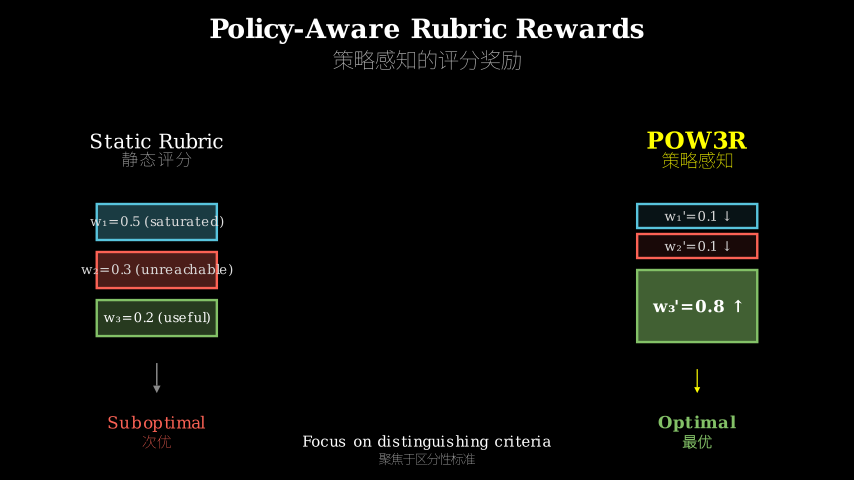
The problem: standard rubric RL treats all criteria equally during optimization, conflating human importance with training utility. A criterion weighted 30% by humans might already be saturated (the model nails it every time) or currently unreachable (requires capabilities the model doesn’t have yet). Meanwhile, criteria that actually distinguish good from bad rollouts right now might have lower human weights. Static aggregation wastes gradient signal on uninformative criteria while underweighting the criteria that could teach the policy something new.
Problem: Multi-criteria tasks
    |
    v
Prior approach: Rubric rewards with static weights
    |
    +---> Assumption: Human importance = Training utility
    |
    +---> Reality: Criteria saturate or become unreachable
    |
    v
POW3R: Policy-aware dynamic weighting
    |
    +---> Emphasize criteria that distinguish current rollouts
    |
    v
Evidence: 2.5-4x faster convergence, 24/30 metric wins
    |
    v
Conclusion: Separate "what should matter" from "what can teach"
The Increment
One sentence: Before POW3R, rubric RL used fixed criterion weights throughout training; after POW3R, weights adapt to emphasize criteria that currently separate the policy’s outputs, preserving human objectives while accelerating learning.
Core Mechanism
POW3R operates in two stages. First, it preserves the human-defined rubric objective by maintaining category-level balance and overall criterion importance. This ensures the final evaluation target stays aligned with human intent. Second, during training, it dynamically adjusts criterion-level reward weights based on rollout-level contrast — how much each criterion currently distinguishes between the policy’s outputs.
The contrast calculation works like this: for each training batch, POW3R measures how much variance each criterion contributes to separating good from bad rollouts. Criteria that are already saturated (everyone scores high) or uniformly failed (everyone scores low) contribute little contrast. Criteria where the policy’s outputs span the scoring range contribute high contrast. POW3R upweights high-contrast criteria in the GRPO reward signal while downweighting saturated or unreachable ones.
Critically, this adaptation happens only in the training reward, not the evaluation metric. The rubric objective remains fixed — POW3R doesn’t change what the model should learn, only which teaching signals are most informative right now. As training progresses and the policy improves, different criteria become contrastive, and the weights shift accordingly.
Training batch
    |
    v
+-------------------+
| Rollout scoring   |  <-- Static rubric evaluates each criterion
+-------------------+
    |
    v
+-------------------+
| Contrast analysis |  <-- Measure variance each criterion contributes
+-------------------+
    |
    v
+-------------------+
| Weight adaptation |  <-- Upweight high-contrast, downweight saturated
+-------------------+
    |
    v
+-------------------+
| GRPO update       |  <-- Policy learns from adapted reward
+-------------------+
    |
    v
Policy improves --> Different criteria become contrastive --> Weights shift
Think of POW3R as a personal trainer adjusting your workout routine. The human-defined rubric is your fitness goal: lose 20 pounds, run a 5K, build upper body strength. Those goals don’t change. But a good trainer doesn’t make you do the same exercises every session. Early on, when you can’t run a mile, they focus on walking intervals and basic cardio — exercises where you can actually make progress. Once you’ve built that base, they shift to speed work and hill training. The goal (run a 5K) stays fixed, but the training emphasis adapts to what will teach you the most right now. POW3R does the same: it keeps the rubric objective constant but shifts training focus to criteria where the policy can currently learn something, rather than wasting effort on criteria the policy has already mastered or can’t yet reach.
Key Concepts
-
Rollout-level contrast: In rubric RL, each criterion scores a model output on some scale (say 0-5). Contrast measures how much that criterion’s scores vary across the policy’s current rollouts. If every rollout scores 5 on “grammar correctness,” that criterion has zero contrast — it doesn’t distinguish good from bad outputs right now. If scores span 1-5, that criterion has high contrast and can teach the policy which behaviors lead to higher scores. POW3R uses contrast to identify which criteria are informative teaching signals at the current training stage, independent of their human-assigned importance.
-
Category balance preservation: Rubrics often group criteria into categories (e.g., “correctness,” “style,” “efficiency”). Humans assign weights both within and across categories to reflect priorities. POW3R’s adaptation could theoretically break this balance — if all high-contrast criteria come from one category, naive upweighting would make the model ignore other categories. POW3R prevents this by normalizing weights within each category before aggregating, ensuring that a category weighted 40% by humans contributes roughly 40% to the training reward even as individual criterion weights shift.
-
Saturation vs. unreachability: A criterion can be uninformative for two opposite reasons. Saturation means the policy already satisfies it consistently (everyone scores high). Unreachability means the policy can’t satisfy it yet (everyone scores low). Both produce low contrast, but they have different implications. Saturated criteria might become contrastive again if the policy regresses; unreachable criteria might become contrastive as the policy improves. POW3R doesn’t distinguish between these cases — it simply downweights both and lets the contrast signal naturally shift as training progresses.
Framework Shift
Before (static rubric RL):              After (POW3R):

Human weights                           Human weights
    |                                       |
    v                                       v
+-------------+                         +-------------+
| Criterion 1 | 30%                     | Criterion 1 | 30% (objective)
| Criterion 2 | 20%                     | Criterion 2 | 20% (objective)
| Criterion 3 | 50%                     | Criterion 3 | 50% (objective)
+-------------+                         +-------------+
    |                                       |
    |                                       +---> Contrast analysis
    |                                       |         |
    v                                       v         v
Training reward = weighted sum          Training reward adapts:
(fixed throughout)                      - High contrast: upweight
                                        - Saturated: downweight
                                        - Unreachable: downweight
                                        (weights shift during training)
From static aggregation to dynamic emphasis, the core shift is decoupling human importance (what should matter in the final answer) from training utility (what can teach the policy right now).
Expert Assessment
Problem choice: This is a real gap. Rubric-based rewards are increasingly common in post-training (think constitutional AI, multi-aspect evaluation), and the assumption that human weights equal training utility is genuinely naive. The paper identifies a concrete failure mode (wasted gradient on saturated criteria) and proposes a principled fix. The problem sits at the intersection of RL theory and practical post-training, which is timely given the field’s current focus on RLHF alternatives.
Method maturity: The core insight — use contrast to adapt weights — is elegant and well-motivated. The execution is solid: category balance preservation prevents pathological weight shifts, and the rollout-level contrast calculation is computationally cheap. However, the paper doesn’t explore failure modes deeply. What happens if contrast is noisy early in training? Can adversarial prompts game the contrast signal? The method feels like a strong v1 that would benefit from stress-testing in more diverse settings.
Experimental integrity: Baselines are fair (vanilla GRPO with static rubric rewards), and the evaluation spans multimodal and text-only tasks with three base policies. The 24/30 metric wins are convincing, and the 2.5-4× speedup is substantial. However, the datasets are relatively small-scale, and the paper doesn’t report variance across runs or sensitivity to hyperparameters. The “strict completion” metric (fraction of prompts satisfying every criterion) is a good addition, but I’d want to see per-criterion learning curves to understand which criteria benefit most from adaptation.
Writing quality: The abstract and introduction are clear, but the method section buries the contrast calculation in notation-heavy paragraphs. A worked example with concrete numbers would make the mechanism immediately graspable. The related work section is thorough but could be trimmed — the paper spends too much space on general RLHF background and not enough on prior work in curriculum learning or adaptive weighting, which are closer conceptual neighbors.
Verdict: weak accept — The problem is real, the method is principled, and the results are strong. The paper would be a clear accept with more rigorous experimental analysis (variance, ablations, failure modes) and clearer exposition of the core mechanism. As is, it’s a solid contribution that will likely influence how people think about rubric rewards, but it needs another round of polish to be a landmark paper.
Takeaways
Practitioners can steal the contrast-based weighting idea for any multi-objective optimization problem where objectives have different “readiness” at different training stages. The key transferable insight: don’t conflate importance with informativeness. If you’re training a model with multiple loss terms, measure how much each term’s gradient varies across your current batch — terms with low variance aren’t teaching the model anything right now, even if they’re important for the final objective. Downweight them temporarily and revisit as training progresses.
For rubric-based evaluation specifically, the category balance preservation trick is worth adopting. If you’re aggregating scores across categories, normalize within categories before combining to prevent one category from dominating just because its criteria happen to be more contrastive.
Finally, the paper’s framing — “what should matter vs. what can teach” — is a useful mental model for any curriculum learning or adaptive training scheme. It clarifies that adaptation should happen in the training signal, not the evaluation target, which keeps the optimization honest while making it more efficient.
论文: 2605.20164 作者: Utkarsh Tyagi, Xingang Guo, MohammadHossein Rezaei, Daniel George, Anas Mahmoud, Jackson Lee, Bing Liu, Yunzhong He 分类: cs.AI
缺口
当正确性可以二元验证时(代码能编译、数学能验算),基于可验证奖励的强化学习效果很好。
但现实任务要求同时满足多个定性标准——比如写作要清晰、简洁、引人入胜,代码要正确、可读、高效。
评分表奖励(rubric rewards)通过给每个标准打分并合成单一奖励信号来处理这种情况。
问题在于:标准的评分表强化学习在优化过程中平等对待所有标准,混淆了人类重要性与训练效用。
一个被人类赋予 30% 权重的标准可能已经饱和(模型每次都做对)或当前无法企及(需要模型尚不具备的能力)。
与此同时,当前真正能区分好坏输出的标准可能人类权重较低。
静态聚合在无信息量的标准上浪费梯度信号,同时低估了能教会策略新东西的标准。
问题:多标准任务
    |
    v
先前方法:静态权重的评分表奖励
    |
    +---> 假设:人类重要性 = 训练效用
    |
    +---> 现实:标准会饱和或变得无法企及
    |
    v
POW3R:策略感知的动态加权
    |
    +---> 强调能区分当前输出的标准
    |
    v
证据:2.5-4 倍收敛加速,24/30 指标胜出
    |
    v
结论:分离"应该重要的"与"能教学的"
增量
一句话:POW3R 之前,评分表强化学习全程使用固定标准权重;POW3R 之后,权重自适应地强调当前能区分策略输出的标准,在保持人类目标的同时加速学习。
核心机制
POW3R 分两个阶段运作。
首先,它通过维持类别级平衡和整体标准重要性来保留人类定义的评分表目标。
这确保最终评估目标与人类意图保持一致。
其次,在训练期间,它基于输出级对比度(rollout-level contrast)动态调整标准级奖励权重——即每个标准当前对区分策略输出的贡献度。
对比度计算的工作方式是:对每个训练批次,POW3R 测量每个标准对区分好坏输出贡献了多少方差。
已经饱和的标准(所有人都得高分)或一致失败的标准(所有人都得低分)贡献的对比度很低。
策略输出在评分范围内分布的标准贡献高对比度。
POW3R 在 GRPO 奖励信号中上调高对比度标准的权重,同时下调饱和或无法企及标准的权重。
关键是,这种适应只发生在训练奖励中,而非评估指标中。
评分表目标保持固定——POW3R 不改变模型应该学什么,只改变哪些教学信号当前最有信息量。
随着训练推进和策略改进,不同的标准变得有对比度,权重也相应转移。
训练批次
    |
    v
+-------------------+
| 输出评分          |  <-- 静态评分表评估每个标准
+-------------------+
    |
    v
+-------------------+
| 对比度分析        |  <-- 测量每个标准贡献的方差
+-------------------+
    |
    v
+-------------------+
| 权重适应          |  <-- 上调高对比度,下调饱和标准
+-------------------+
    |
    v
+-------------------+
| GRPO 更新         |  <-- 策略从适应后的奖励中学习
+-------------------+
    |
    v
策略改进 --> 不同标准变得有对比度 --> 权重转移
把 POW3R 想象成一个调整你训练计划的私人教练。
人类定义的评分表是你的健身目标:减 20 磅、跑 5 公里、增强上肢力量。
这些目标不变。
但好教练不会让你每次都做相同的练习。
早期,当你跑不了一英里时,他们专注于步行间歇和基础有氧——你能实际进步的练习。
一旦你建立了基础,他们转向速度训练和爬坡训练。
目标(跑 5 公里)保持固定,但训练重点适应当前最能教你的内容,而不是在你已经掌握或还无法企及的练习上浪费精力。
POW3R 做的是同样的事:它保持评分表目标不变,但将训练焦点转移到策略当前能学到东西的标准上,而不是在策略已经掌握或还无法企及的标准上浪费努力。
关键概念
- 输出级对比度:在评分表强化学习中,每个标准在某个量表上(比如 0-5)给模型输出打分。
对比度测量该标准的分数在策略当前输出中的变化程度。
如果每个输出在”语法正确性”上都得 5 分,该标准的对比度为零——它当前不区分好坏输出。
如果分数跨越 1-5,该标准有高对比度,能教策略哪些行为导致更高分数。
POW3R 使用对比度来识别哪些标准在当前训练阶段是有信息量的教学信号,独立于它们的人类赋予重要性。
- 类别平衡保持:评分表通常将标准分组为类别(如”正确性”、“风格”、“效率”)。
人类在类别内和类别间分配权重以反映优先级。
POW3R 的适应理论上可能打破这种平衡——如果所有高对比度标准都来自一个类别,朴素的上调会让模型忽略其他类别。
POW3R 通过在聚合前对每个类别内的权重归一化来防止这种情况,确保人类赋予 40% 权重的类别即使在单个标准权重转移时也大致贡献训练奖励的 40%。
- 饱和 vs. 无法企及:一个标准可能因两个相反的原因而无信息量。
饱和意味着策略已经一致地满足它(所有人都得高分)。
无法企及意味着策略还无法满足它(所有人都得低分)。
两者都产生低对比度,但含义不同。
饱和标准如果策略退步可能再次变得有对比度;无法企及的标准随着策略改进可能变得有对比度。
POW3R 不区分这些情况——它只是下调两者的权重,让对比度信号随着训练推进自然转移。
框架转变
之前(静态评分表强化学习):        之后(POW3R):

人类权重                            人类权重
    |                                   |
    v                                   v
+-------------+                     +-------------+
| 标准 1      | 30%                 | 标准 1      | 30%(目标)
| 标准 2      | 20%                 | 标准 2      | 20%(目标)
| 标准 3      | 50%                 | 标准 3      | 50%(目标)
+-------------+                     +-------------+
    |                                   |
    |                                   +---> 对比度分析
    |                                   |         |
    v                                   v         v
训练奖励 = 加权和                    训练奖励自适应:
(全程固定)                        - 高对比度:上调
                                    - 饱和:下调
                                    - 无法企及:下调
                                    (权重在训练中转移)
从静态聚合到动态强调,核心转变是解耦人类重要性(最终答案中应该重要的)与训练效用(当前能教策略的)。
专家评审
选题眼光:这是真缺口。
评分表奖励在后训练中越来越常见(想想宪法式 AI、多方面评估),而人类权重等于训练效用的假设确实天真。
论文识别了一个具体的失败模式(在饱和标准上浪费梯度)并提出了有原则的修复。
问题位于强化学习理论与实际后训练的交叉点,考虑到该领域当前对 RLHF 替代方案的关注,这很及时。
方法成熟度:核心洞见——使用对比度来适应权重——优雅且动机充分。
执行扎实:类别平衡保持防止病态权重转移,输出级对比度计算计算成本低。
然而,论文没有深入探索失败模式。
如果训练早期对比度有噪声会怎样?对抗性提示能否操纵对比度信号?方法感觉像一个强大的 v1,在更多样化的设置中进行压力测试会受益。
实验诚意:基线公平(带静态评分表奖励的原版 GRPO),评估跨越多模态和纯文本任务,使用三个基础策略。
24/30 指标胜出令人信服,2.5-4 倍加速很可观。
然而,数据集规模相对较小,论文没有报告跨运行的方差或对超参数的敏感性。
“严格完成”指标(满足每个标准的提示比例)是很好的补充,但我想看到每个标准的学习曲线,以了解哪些标准从适应中受益最多。
写作功力:摘要和引言清晰,但方法部分将对比度计算埋在符号密集的段落中。
一个带具体数字的实例会让机制立即可理解。
相关工作部分详尽但可以精简——论文在一般 RLHF 背景上花了太多篇幅,在课程学习或自适应加权等更接近的概念邻居上花的不够。
判决:弱接收——问题真实,方法有原则,结果强劲。
如果有更严格的实验分析(方差、消融、失败模式)和更清晰的核心机制阐述,论文会是明确接收。
目前,它是一个扎实的贡献,可能会影响人们对评分表奖励的思考方式,但需要再打磨一轮才能成为里程碑论文。
要点总结
实践者可以为任何多目标优化问题偷走基于对比度的加权思想,其中目标在不同训练阶段有不同的”就绪度”。
关键的可迁移洞见:不要混淆重要性与信息量。
如果你在用多个损失项训练模型,测量每个项的梯度在当前批次中的变化程度——方差低的项当前没有教模型任何东西,即使它们对最终目标很重要。
暂时下调它们的权重,随着训练推进再重新审视。
对于评分表评估,类别平衡保持技巧值得采用。
如果你在跨类别聚合分数,在组合前对类别内归一化,以防止一个类别仅因其标准恰好更有对比度而主导。
最后,论文的框架——“应该重要的 vs. 能教学的”——是任何课程学习或自适应训练方案的有用心智模型。
它澄清了适应应该发生在训练信号中,而非评估目标中,这让优化保持诚实的同时更高效。