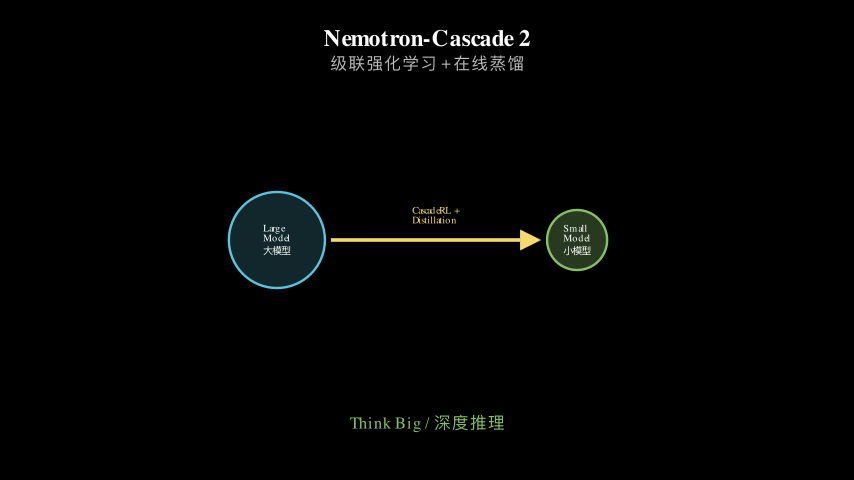
Paper: 2603.19220 Authors: Zhuolin Yang, Zihan Liu, Yang Chen, Wenliang Dai, Boxin Wang, Sheng-Chieh Lin, Chankyu Lee, Yangyi Chen, Dongfu Jiang, Jiafan He Categories: cs.CL, cs.AI, cs.LG
The Gap
Large reasoning models like DepSeek-R1 and Qwen-QwQ have shown thatRL post-training dramatically improves reasoning. But there’s a persistent tension: RL training is unstable across domains. When you push hard on math, coding regresses. When you fix coding, something else slips. The standard fix — just train longer or add more data — doesn’t resolve the underlying instability; it just papers over it. Meanwhile, distillation from a strong teacher is cheap and effective, but purely offline distillation mises the distribution of states the model actually visits duringRL. Nobody had cleanly combined staged RL with live, on-policy distillation from the best available teacher at each stage, especially at the MoE efficiency frontier.
Problem: RL post-training causes domain regression + instability
    |
    v
Assumption: Each domain has a "best teacher" at each RL stage;
            on-policy data matches the learner's current distribution
    |
    v
Method: Cascade RL (staged, domain-expanding) +
        Multi-domain on-policy distillation from intermediate checkpoints
    |
    v
Evidence: IMO Gold / IOI Gold / ICPC Gold at3B active params;
          benchmark regressions recovered without full retraining
    |
    v
Conclusion: Intelligence density >> parameter count
            when training curriculum + distillation are co-designed
The Increment
One sentence: Before this paper, you had to choose between RL’s exploration power and distillation’s stability — Nemotron-Cascade 2 shows you can run them simultaneously, domain by domain, and get both.
Core Mechanism
The training pipeline has three phases. First, SFT on a carefully curated multi-domain dataset establishes a solid base. Then Cascade RL kicks in — this is a staged curriculum where RL is applied to progressively broader domains: start with math, stabilize, add coding, stabilize, add agentic tasks, and so on. Each stage uses verifiable rewards (correct answer = positive signal) so the reward signal stays clean.
The key addition over Cascade 1 is multi-domain on-policy distillation. At each RL stage, the team identifies the strongest intermediate checkpoint for that domain — not the final model, but the best so far for, say, coding — and uses it as a teacher. The student (the model currently being trained) generates rollouts, and the teacher scores or re-labels those rollouts. Because the student generated the data, it’s on-policy: the distribution matches exactly what the student is currently exploring. This prevents the teacher’s knowledge from being wasted on states the student will never visit.
The MoE architecture (30B total, 3B active) is load-bearing here. Sparse activation means you get the capacity of a large model at the inference cost of a small one. The RL training budget stays tractable because you’re only backpropagating through 3B active parameters per forward pass.
SFT (curated multi-domain data)
    |
    v
Cascade RL Stage 1: Math
    |  \
    |   on-policy rollouts --> best math teacher checkpoint
    |                |
    |   <-- distillation loss -+
    |
    v
Cascade RL Stage 2: Math + Coding
    |  \
    |   on-policy rollouts --> best coding teacher checkpoint
    |                          |
    |   <-- distillation loss -+
    |
    v
Cascade RL Stage N: Math + Coding + Agentic + ...
    |
    v
Final Model: 30B MoE / 3B active
             IMO Gold / IOI Gold / ICPC Gold
Think of it like training a junior surgeon through a residency program. In residency, you don’t throw every specialty at them at once — you rotate: first internal medicine, then surgery, then ICU. At each rotation, the attending physician (the teacher) watches the resident’s actual cases (on-policy rollouts) and gives feedback on what the resident is actually doing, not on hypothetical cases from a textbook. The attending for the surgery rotation is the best surgeon available, not a generalist. That’s Cascade RL + multi-domain on-policy distillation: staged curriculum, domain-expert teachers, feedback on real work.
Key Concepts
-
Cascade RL: Instead of applying RL to all domains simultaneously (which causes interference and instability), you add domains one at a time in a cascade. Each new domain is introduced only after the model has stabilized on prior domains. The “cascade” is the ordered sequence of domain additions, each building on the last. Think of it as curriculum learning forRL — you don’t teach calculus before algebra.
-
On-policy distillation: Standard distillation uses a fixed dataset generated by the teacher. On-policy distillation means the student generates its own data during training, and the teacher provides labels or scores for that data. The critical property: the data distribution matches the student’s current policy, so the teacher’s guidance is always relevant to where the student actually is. Off-policy distillation is like a coach reviewing game tape from last season; on-policy is the coach watching today’s practice.
-
Intelligence density: The paper frames this as a design goal — how much reasoning capability per activated parameter. A 3B active parameter model hitting IMO Gold is a data point that MoE architecture + careful post-training can decouple capability from raw parameter count more agressively than previously demonstrated at this scale.
Framework Shift
Before (mainstream approach):        After (this paper):

  Large dense model                Sparse MoE (30B/3B active)
       |                                      |
  RL on all domains at once            Cascade RL (staged domains)
       |                                      |
  Regression -> patch with data        On-policy distillation per stage
       |                                      |
  Hope it generalizes                Domain-expert teacher per stage
       |                                      |
  Scale parameters to fix gaps         Intelligence density as target

  [one big push, hope for the best]    [staged, self-correcting loop]
From brute-force simultaneous RL to a staged, self-correcting curriculum, the core shift is treating post-training as an engineering problem with feedback loops rather than a single optimization pass.
Expert Assessment
Problem choice: This is a real gap. Domain regression during RL post-training is a known pain point that practitioners hit constantly. The paper doesn’t manufacture the problem — it’s been discussed in DepSeek-R1, Qwen, and related work. The positioning at the MoE efficiency frontier is smart: 3B active parameters is a deployment-relevant constraint, not an arbitrary one.
Method maturity: Honestly, this is more engineering craft than algorithmic novelty. Cascade RL and on-policy distillation are both known ideas. The contribution is the specific combination, the staging discipline, and the “best intermediate checkpoint as teacher” heuristic. That heuristic is actually the most interesting part — it’s not obvious that intermediate checkpoints outperform the final model as teachers, and the paper would benefit from more ablation here. The method is mature in the sense that it works reliably, not in the sense that it’s theoretically grounded.
Experimental integrity: The benchmark suite is comprehensive — IMO, IOI, ICPC are hard to game, which is a point in the paper’s favor. The comparison to DeepSeekV3.2-Special-671B-A37B is the headline claim, and it’s framed carefully (“second open-weight LM to achieve Gold Medal-level”). The 20x parameter efficiency claim is real but needs context: activated parameters vs. total parameters is an aples-to-oranges comparison with dense models, and the paper should be more explicit about this. No obvious red flags, but ablations on the distillation component feel thin based on the abstract.
Writing quality: The abstract front-loads the benchmark results and buries the mechanism. The “multi-domain on-policy distillation from strongest intermediate teacher models” is the actual contribution, but it reads like a footnote. The methods section (not visible here but implied) likely needs a cleaner separation between what’s inherited from Cascade 1 and what’s genuinely new. Rewriting the introduction to lead with the regression problem and the distillation solution — rather than the benchmark numbers — would make the paper’s logic much clearer.
Verdict: weak accept — solid engineering contribution with real benchmark impact, but the novelty is incremental and the ablations need to be stronger to fully justify the design choices.
Takeaways
-
The “best intermediate checkpoint as teacher” heuristic is directly stealable. When you’re doing multi-stage training, don’t assume the final checkpoint is the best teacher for each domain — track per-domain performance across checkpoints and use the domain-specific peak.
-
On-policy distillation as a regression recovery tool is underused. If yourRL run is degrading on a domain, generating rollouts and distilling from a domain-expert teacher on those exact rollouts is a targeted fix that doesn’t require restarting training.
-
The cascade curriculum design (stabilize before expanding) is a practical heuristic for anyone doing multi-domainRL post-training. The ordering matters — start with the domain that has the cleanest reward signal (math, with verifiable answers) before moving to fuzzier domains.
-
MoE + RL is a combination worth taking seriously for efficiency-constrained deployments. The 3B active parameter budget makesRL training tractable in ways that 70B dense models aren’t.
论文: 2603.19220 作者: Zhuolin Yang, Zihan Liu, Yang Chen, Wenliang Dai, Boxin Wang, Sheng-Chieh Lin, Chankyu Lee, Yangyi Chen, Dongfu Jiang, Jiafan He 分类: cs.CL, cs.AI, cs.LG
缺口
DepSeek-R1、Qwen-QwQ 等模型已经证明,强化学习后训练能大幅提升推理能力。 但有一个持续存在的矛盾:RL 训练在多领域之间极不稳定。 猛推数学,代码能力就退步;修好代码,别的地方又掉分。 常见的补救方案——加数据、训更久——治标不治本,只是把问题掩盖掉。
另一边,从强教师模型蒸馏既便宜又有效,但纯离线蒸馏有个致命缺陷: 教师生成的数据分布和学生当前探索的状态分布不匹配,大量指导信息被浪费。
没有人在 MoE 效率前沿上,把分阶段 RL 和每阶段最优教师的在线蒸馏干净地结合起来——直到这篇论文。
问题:RL 后训练导致领域退步 + 训练不稳定
    |
    v
假设:每个领域在每个 RL 阶段都有"最优教师";
      在线数据与学习者当前分布完全匹配
    |
    v
方法:级联 RL(分阶段扩展领域)+
      从中间检查点做多领域在线蒸馏
    |
    v
证据:3B 激活参数达到 IMO/IOI/ICPC 金牌级别;
      基准退步被恢复,无需完整重训
    |
    v
结论:训练课程 + 蒸馏协同设计时,
      智能密度远超参数规模所能预测的上限
增量
一句话:这篇论文之前,你必须在 RL 的探索能力和蒸馏的稳定性之间二选一;之后,你可以逐领域同时运行两者,两头都要。
核心机制
训练流程分三个阶段。 首先是 SFT,在精心筛选的多领域数据集上建立扎实的基础。 然后是级联 RL——这是一个分阶段的课程,RL 被逐步应用到越来越广的领域:先数学,稳定后加代码,再稳定后加智能体任务,依此类推。 每个阶段使用可验证奖励(答案正确 = 正向信号),保证奖励信号干净。
相比 Cascade 1,核心新增是多领域在线蒸馏。 在每个 RL 阶段,团队找出该领域当前最强的中间检查点——不是最终模型,而是到目前为止在该领域表现最好的模型——用它作为教师。 学生(当前正在训练的模型)生成 rollout,教师对这些 rollout 打分或重新标注。 因为数据是学生自己生成的,所以是在线的:分布与学生当前正在探索的状态完全吻合。 这确保了教师的知识不会浪费在学生永远不会访问的状态上。
MoE 架构(30B 总参数,3B 激活数)在这里是承重结构。 稀疏激活意味着你以小模型的推理成本获得大模型的容量。 RL 训练预算保持可控,因为每次前向传播只需对 3B 激活参数做反向传播。
SFT(精选多领域数据)
    |
    v
级联 RL 阶段 1:数学
    |  \
    |   在线 rollout --> 最优数学教师检查点
    |                |
    |   <-- 蒸馏损失 ----+
    |
    v
级联 RL 阶段 2:数学 + 代码
    |  \
    |   在线 rollout --> 最优代码教师检查点
    |                    |
    |   <-- 蒸馏损失 ----+
    |
    v
级联 RL 阶段 N:数学 + 代码 + 智能体 + ...
    |
    v
最终模型:30B MoE / 3B 激活参数
          IMO 金牌 / IOI 金牌 / ICPC 金牌
把它想象成住院医师培训制度。 住院医不会一开始就同时学所有科室——而是轮转:先内科,再外科,再 ICU。 每个轮转阶段,带教主任(教师)观察住院医的真实病例(在线 rollout),针对住院医实际在做的事情给出反馈,而不是拿教科书上的假设案例来讲。 外科轮转的带教是最好的外科医生,不是全医生。 这就是级联 RL + 多领域在线蒸馏:分阶段课程,领域专家教师,基于真实工作的反馈。
关键概念
-
级联 RL:不是同时对所有领域做 RL(那会导致干扰和不稳定),而是一次加入一个领域,形成级联。 每个新领域只在模型在前序领域上稳定之后才引入。 “级联”就是这个有序的领域添加序列,每一步都建立在上一步之上。 可以理解为 RL 的课程学习——你不会在学代数之前就教微积分。
-
在线蒸馏:标准蒸馏使用教师预先生成的固定数据集。 在线蒸馏则是学生在训练过程中自己生成数据,教师对这些数据打分或标注。 关键性质:数据分布与学生当前策略完全匹配,所以教师的指导始终与学生当前所处的位置相关。 离线蒸馏像是教练复盘上赛季的录像;在线蒸馏是教练在看今天的训练。
-
智能密度:论文把这个作为设计目标——每个激活参数能承载多少推理能力。 一个 3B 激活参数的模型达到 IMO 金牌,说明 MoE 架构 + 精心后训练可以把能力和原始参数量解耦,程度远超此前在这个规模上的示范。
框架转变
之前(主流方法):                之后(本文方法):

  大型稠密模型                          稀疏 MoE(30B/3B 激活)
       |                                      |
  同时对所有领域做 RL                   级联 RL(分阶段扩展领域)
       |                                      |
  退步 -> 用数据打补丁                  每阶段做在线蒸馏
       |                                      |
  希望它能泛化                          每领域用专家教师
       |                                |
  靠堆参数填补缺口                      以智能密度为设计目标

  [一次性猛推,听天由命]                [分阶段、自我修正的闭环]
从蛮力式同步 RL 到分阶段自我修正的课程,核心转变是:把后训练当作一个有反馈回路的工程问题,而不是一次性的优化过程。
专家评审
选题眼光:这是真缺口。 RL 后训练中的领域退步是从业者反复踩到的坑,DepSeek-R1、Qwen 等相关工作都提到过这个问题,论文没有制造问题。 把战场选在 MoE 效率前沿很聪明:3B 激活参数是一个与部署现实相关的约束,不是随意设定的。
方法成熟度:说实话,这更多是工程匠艺,而非算法创新。 级联 RL 和在线蒸馏都是已知思路,贡献在于具体的组合方式、分阶段的纪律性,以及”用最优中间检查点作为教师”这个启发式规则。 最后这个启发式其实是最有意思的部分——中间检查点比最终模型更适合做教师,这并不显而易见,论文在这里的消融实验应该更充分。 方法成熟的意义在于它稳定有效,而不是理论上有根基。
实验诚意:基准套件很全面——IMO、IOI、ICPC 很难刷分,这是论文的加分项。 与 DeepSeekV3.2-Special-671B-A37B 的对比是核心声明,措辞也比较谨慎(“第二个达到金牌级别的开源模型”)。 “20 倍参数效率”的说法是真实的,但需要语境:激活参数 vs. 总参数,和稠密模型比是在比不同的东西,论文应该更明确地说清楚这一点。 没有明显的红旗,但蒸馏组件的消融实验从摘要来看感觉偏薄。
写作功力:摘要把基准结果放在最前面,把机制埋在后面。 “从最强中间教师模型做多领域在线蒸馏”才是真正的贡献,但读起来像脚注。 引言如果能以退步问题和蒸馏解决方案为主线,而不是以基准数字开头,论文的逻辑会清晰得多。 这一段重写,整篇论文能升一个档次。
判决:弱接收——扎实的工程贡献,基准影响真实,但新颖性是渐进式的,设计选择的消融支撑还不够充分。
要点总结
“用最优中间检查点作为教师”这个启发式可以直接拿走用。 做多阶段训练时,不要假设最终检查点是每个领域的最佳教师——跨检查点追踪每个领域的性能,用领域专属的峰值检查点。
在线蒸馏作为退步修复工具被严重低估。 如果你的 RL 训练在某个领域退步,生成 rollout 然后在这些 rollout 上做领域专家教师的蒸馏,是一个不需要重启训练的定点修复方案。
级联课程设计(稳定后再扩展)是多领域 RL 后训练的实用启发式规则。 顺序很重要——从奖励信号最干净的领域开始(数学,有可验证答案),再移向更模糊的领域。
MoE + RL 的组合对于有效率约束的部署场景值得认真对待。 3B 激活参数的预算让 RL 训练变得可控,而 70B 稠密模型做不到这一点。