
Paper: 2603.05462 Authors: Abrar Eyasir, Tahsin Ahmed, Muhammad Ibrahim Categories: cs.CL
The Gap
Existing Bangla QA datasets assume every question has an answer in the given context. Models trained on these datasets never learn to abstain — they’ll confidently fabricate answers even when the context contains nothing relevant. SQuAD 2.0 solved this for English by adding unanswerable questions, but low-resource languages like Bangla lack equivalent resources. Prior Bangla datasets (BanglaQA, BanglaReading) contain only answerable questions, creating models that hallucinate rather than admit ignorance.
Problem: Bangla QA models hallucinate answers
   |
   v
Assumption: Models need negative examples (unanswerable questions)
   |
   v
Method: Build dataset with 43% unanswerable + adversarial distractors
   |
   v
Evidence: BERT F1 jumps 0.15 -> 0.62 after fine-tuning
   |
   v
Conclusion: Balanced answerable/unanswerable data enables abstention
The Increment
One sentence: Before NCTB-QA, Bangla QA systems would generate plausible-sounding nonsense when stumped; after, they can recognize when a question is unanswerable from context.
Core Mechanism
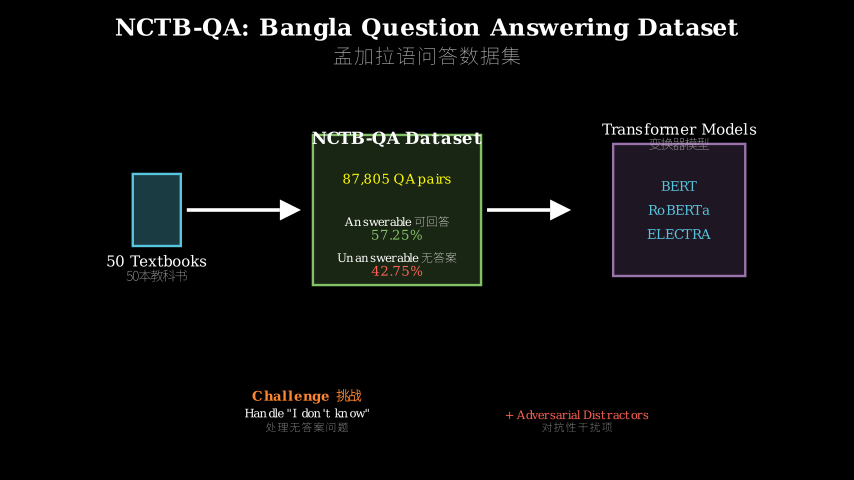
The dataset construction follows a three-stage pipeline. First, they extract passages from 50 official textbooks covering grades 1-12 across subjects (science, math, history, literature). Second, they generate question-answer pairs using both manual annotation and semi-automated extraction from textbook exercises. Third — and this is the critical part — they create unanswerable questions by pairing questions with passages that lack the answer but contain topically related content (adversarial distractors).
The adversarial design works like this: take a question about photosynthesis, then pair it with a passage about plant reproduction. Both discuss plants, both use botanical vocabulary, but one doesn’t answer the other. This forces models to do deep semantic matching rather than keyword spotting. They also include questions where the passage contains partial information but not enough to answer completely.
The benchmark tests three transformer architectures (BERT, RoBERTa, ELECTRA) in two settings: zero-shot (pretrained only) and fine-tuned on NCTB-QA. Performance is measured by exact match, F1 score, and BERTScore (semantic similarity between predicted and gold answers).
Textbook Corpus (50 books)
         |
         v
   [Passage Extraction]
         |
         +---> Answerable pairs (57%)
         |         |
         |         v
         |    Question + Answer + Supporting passage
         |
         +---> Unanswerable pairs (43%)
                   |
                   v
              Question + Distractor passage
                   |
                   v
            (topically related but lacks answer)

         All pairs
         |
         v
    [Train/Dev/Test Split]
         |
         v
    Benchmark: BERT/RoBERTa/ELECTRA
         |
         v
    Metrics: EM / F1 / BERTScore
Think of this like training a medical student with a trick exam. Most questions have answers in the textbook chapter (answerable), but some questions reference a different chapter entirely (unanswerable). The catch: the wrong chapter discusses related anatomy, uses similar terminology, and looks superficially relevant. A lazy student doing keyword matching will confidently write nonsense. A careful student learns to recognize “this passage doesn’t actually contain what I need” and writes “insufficient information.” The dataset is the exam; fine-tuning is the study process; the model’s ability to abstain is passing the trick questions.
Key Concepts
-
Unanswerable Questions: Not trick questions or riddles — these are perfectly valid questions whose answers simply don’t appear in the provided context passage. Example: “What causes diabetes?” paired with a passage about heart disease symptoms. The question is clear, but the passage is the wrong source. Models must learn to detect this mismatch rather than extract plausible-sounding fragments. This differs from “hard” answerable questions where the answer exists but requires complex reasoning.
-
Adversarial Distractors: Passages deliberately chosen to mislead keyword-matching approaches. If the question asks about “mitochondria function,” the distractor passage discusses “cell membrane structure” — same domain (cell biology), overlapping vocabulary (organelles, cellular processes), but fundamentally different content. This design punishes shallow pattern matching and rewards semantic understanding. Without adversarial design, models could cheat by checking if any sentence contains question keywords.
-
Domain-Specific Fine-Tuning: Pretrained models know general language patterns but lack specialized knowledge. A model pretrained on web text doesn’t know Bangla educational terminology or textbook discourse structure. Fine-tuning on NCTB-QA teaches both the domain vocabulary (scientific terms, historical names) and the task structure (when to abstain). The 313% F1 improvement shows pretrained knowledge alone is insufficient — you need in-domain adaptation for low-resource languages where pretraining data is scarce.
Framework Shift
Before (existing Bangla QA):        After (NCTB-QA):

Question --> [Model] --> Answer     Question + Passage
                                           |
Always produces output                    v
(even if nonsense)                   [Model Decision]
                                      /            \
                                     /              \
                              Answerable?      Unanswerable?
                                   |                 |
                                   v                 v
                               Extract           Return NULL
                               Answer            (abstain)

Assumption: answer exists       Assumption: answer may not exist
From “always answer” to “answer when possible, abstain when not,” the core shift is teaching models that silence is sometimes the right response.
Expert Assessment
Problem choice: Real gap. Low-resource NLP consistently lags English by 3-5 years, and unanswerable question handling is a known weakness even in high-resource settings. The educational domain choice is smart — textbooks provide clean, structured text and natural question-answer pairs. This isn’t manufactured; it’s addressing a practical need for Bangla educational technology.
Method maturity: Straightforward dataset construction, no novel algorithms. The adversarial distractor design is borrowed from SQuAD 2.0. The contribution is execution (building the resource) rather than methodological innovation. That’s fine — low-resource languages need datasets more than they need new architectures. However, the paper doesn’t explore automated methods for generating unanswerable pairs at scale, relying heavily on manual curation.
Experimental integrity: Baselines are fair (standard pretrained models), but the comparison is limited. No cross-lingual transfer experiments (e.g., does English SQuAD 2.0 fine-tuning help?). No analysis of what makes questions hard — which distractor types fool models most? The 313% improvement sounds dramatic but starts from a very low baseline (0.15 F1), suggesting the pretrained models are nearly useless without fine-tuning. More error analysis would strengthen claims.
Writing quality: The dataset description is clear, but the paper lacks depth in analysis. The “Results and Discussion” section mostly reports numbers without explaining why certain models perform better or what linguistic phenomena cause failures. A case study of model errors (false positives vs false negatives on unanswerable questions) would be valuable. The related work section adequately covers Bangla NLP but misses recent work on abstention mechanisms in QA.
Verdict: weak accept — Solid resource contribution for an underserved language, but limited analytical insight beyond “fine-tuning helps.”
Takeaways
If you’re building QA systems for any low-resource language, steal the adversarial distractor design: don’t just add random unanswerable questions, pair them with topically related passages that share vocabulary with the question. This creates a much harder benchmark than random negatives.
The 43/57 unanswerable/answerable split is worth noting — not 50/50, but enough negative examples to force models to learn abstention without overwhelming the dataset. If you’re creating similar datasets, this ratio seems like a reasonable starting point.
The dramatic improvement from fine-tuning (0.15 → 0.62 F1) suggests that for low-resource languages, pretrained models are nearly useless out-of-the-box for specialized tasks. Don’t assume transfer learning will save you — budget for domain-specific fine-tuning data.
论文: 2603.05462 作者: Abrar Eyasir, Tahsin Ahmed, Muhammad Ibrahim 分类: cs.CL
缺口
现有孟加拉语问答数据集默认每个问题都能从上下文中找到答案。
在这种数据上训练的模型从未学会拒绝回答——即使上下文完全不相关,它们也会自信地编造答案。
SQuAD 2.0通过加入无答案问题解决了英语的这个问题,但孟加拉语等低资源语言缺乏类似资源。
之前的孟加拉语数据集(BanglaQA、BanglaReading)只包含可回答问题,导致模型宁可幻觉也不承认无知。
问题: 孟加拉语问答模型会幻觉答案
   |
   v
假设: 模型需要负样本(无答案问题)
   |
   v
方法: 构建43%无答案+对抗性干扰项的数据集
   |
   v
证据: BERT的F1从0.15跃升至0.62
   |
   v
结论: 平衡的可答/不可答数据使模型学会拒答
增量
一句话: NCTB-QA之前,孟加拉语问答系统遇到难题会生成听起来合理的胡话;之后,它们能识别问题何时无法从上下文回答。
核心机制
数据集构建分三个阶段。
首先从50本官方教材中提取段落,覆盖1-12年级的科学、数学、历史、文学等科目。
其次通过人工标注和半自动提取教材习题生成问答对。
第三阶段是关键——他们通过将问题与缺少答案但包含主题相关内容的段落配对,创建无答案问题(对抗性干扰项)。
对抗性设计的工作原理:拿一个关于光合作用的问题,配上一段讨论植物繁殖的文本。
两者都谈植物,都用植物学词汇,但一个回答不了另一个。
这迫使模型做深度语义匹配而非关键词匹配。
他们还包括段落含有部分信息但不足以完整回答的问题。
基准测试在两种设置下测试三种transformer架构(BERT、RoBERTa、ELECTRA):零样本(仅预训练)和在NCTB-QA上微调。
性能通过精确匹配、F1分数和BERTScore(预测答案与标准答案的语义相似度)衡量。
教材语料库(50本书)
         |
         v
   [段落提取]
         |
         +---> 可答对(57%)
         |         |
         |         v
         |    问题+答案+支撑段落
         |
         +---> 不可答对(43%)
                   |
                   v
              问题+干扰段落
                   |
                   v
            (主题相关但缺答案)

         所有配对
         |
         v
    [训练/验证/测试划分]
         |
         v
    基准: BERT/RoBERTa/ELECTRA
         |
         v
    指标: EM / F1 / BERTScore
把这想象成给医学生出一份陷阱考卷。
大部分问题能在教材章节中找到答案(可答),但有些问题引用的是完全不同的章节(不可答)。
陷阱在于:错误章节讨论相关解剖学,使用相似术语,表面看起来相关。
偷懒的学生做关键词匹配会自信地写胡话。
仔细的学生学会识别「这段文字实际不包含我需要的内容」并写「信息不足」。
数据集是考卷;微调是学习过程;模型拒答的能力是通过陷阱题的标志。
关键概念
- 无答案问题: 不是脑筋急转弯或谜语——这些是完全有效的问题,只是答案不在提供的上下文段落中。
例子:「糖尿病的病因是什么?」配上一段关于心脏病症状的文字。
问题很清楚,但段落是错误的信息源。
模型必须学会检测这种不匹配,而非提取听起来合理的片段。
这不同于「困难」的可答问题,后者答案存在但需要复杂推理。
- 对抗性干扰项: 故意选择来误导关键词匹配方法的段落。
如果问题问「线粒体功能」,干扰段落讨论「细胞膜结构」——同一领域(细胞生物学),词汇重叠(细胞器、细胞过程),但内容根本不同。
这种设计惩罚浅层模式匹配,奖励语义理解。
没有对抗性设计,模型可以通过检查是否有句子包含问题关键词来作弊。
- 领域特定微调: 预训练模型知道通用语言模式但缺乏专业知识。
在网络文本上预训练的模型不知道孟加拉语教育术语或教材话语结构。
在NCTB-QA上微调既教领域词汇(科学术语、历史名称)也教任务结构(何时拒答)。
313%的F1提升表明仅靠预训练知识不够——低资源语言预训练数据稀缺时需要领域内适应。
框架转变
之前(现有孟加拉语问答):        之后(NCTB-QA):

问题 --> [模型] --> 答案        问题+段落
                                     |
总是产生输出                         v
(即使是胡话)                   [模型决策]
                                /            \
                               /              \
                          可答?              不可答?
                             |                 |
                             v                 v
                         提取答案           返回NULL
                                            (拒答)

假设:答案存在                  假设:答案可能不存在
从「总是回答」到「可能时回答,不可能时拒绝」,核心转变是教模型有时沉默才是正确回应。
专家评审
选题眼光: 真实缺口。
低资源NLP始终落后英语3-5年,无答案问题处理即使在高资源环境也是已知弱点。
教育领域的选择很聪明——教材提供干净、结构化的文本和自然的问答对。
这不是人造问题;它解决孟加拉语教育技术的实际需求。
方法成熟度: 直接的数据集构建,没有新算法。
对抗性干扰项设计借鉴自SQuAD 2.0。
贡献在于执行(构建资源)而非方法创新。
这没问题——低资源语言需要数据集多过需要新架构。
但论文没探索大规模自动生成无答案对的方法,严重依赖人工策展。
实验诚意: 基线公平(标准预训练模型),但比较有限。
没有跨语言迁移实验(例如英语SQuAD 2.0微调是否有帮助?)。
没有分析什么使问题困难——哪种干扰项类型最能迷惑模型?313%的提升听起来戏剧性但起点很低(0.15 F1),表明预训练模型不微调几乎无用。
更多错误分析会加强论证。
写作功力: 数据集描述清晰,但论文缺乏分析深度。
「结果与讨论」部分主要报告数字,没解释为何某些模型表现更好或什么语言现象导致失败。
无答案问题上模型错误的案例研究(假阳性vs假阴性)会很有价值。
相关工作部分充分覆盖孟加拉语NLP但遗漏了问答中拒答机制的近期工作。
判决: 弱接收——为服务不足的语言提供扎实的资源贡献,但除了「微调有帮助」之外分析洞见有限。
要点总结
如果你在为任何低资源语言构建问答系统,偷走对抗性干扰项设计:不要只是添加随机无答案问题,将它们与主题相关、与问题共享词汇的段落配对。
这创建了比随机负样本困难得多的基准。
43/57的不可答/可答分布值得注意——不是50/50,但有足够负样本迫使模型学会拒答而不压倒数据集。
如果你在创建类似数据集,这个比例似乎是合理起点。
微调带来的戏剧性提升(0.15→0.62 F1)表明对低资源语言,预训练模型开箱即用对专业任务几乎无用。
不要假设迁移学习会拯救你——为领域特定微调数据做预算。