
Paper: 2603.25744 Authors: Bocheng Zou, Mu Cai, Mark Stanley, Dingfu Lu, Yong Jae Lee Categories: cs.CV
The Gap
Vision Foundation Models (VFMs) like DINOv2 have reached a point where they can handle variable input sizes during training, but inference remains stuck at a single fixed scale. This is wasteful because visual perception fundamentally operates across scales: low-res captures global semantics (what’s in the scene), high-res captures fine details (where exactly, what texture). Prior work either trains scale-specific models (expensive, inflexible) or uses single-scale inference (leaves information on the table). The gap: we have models that could theoretically see at multiple scales, but no one’s figured out how to fuse those views at inference without retraining.
Problem: Single-scale inference wastes complementary information
   |
   v
Assumption: Different resolutions = different inductive biases
   |
   v
Method: Process same image at multiple scales, fuse features
   |
   v
Evidence: Consistent gains across tasks (segmentation, depth, retrieval)
   |
   v
Conclusion: Multi-scale fusion is a universal, training-free enhancement
The Increment
One sentence: Before MuRF, you picked one resolution and lived with its trade-offs; after MuRF, you get the best of all resolutions simultaneously without retraining.
Core Mechanism
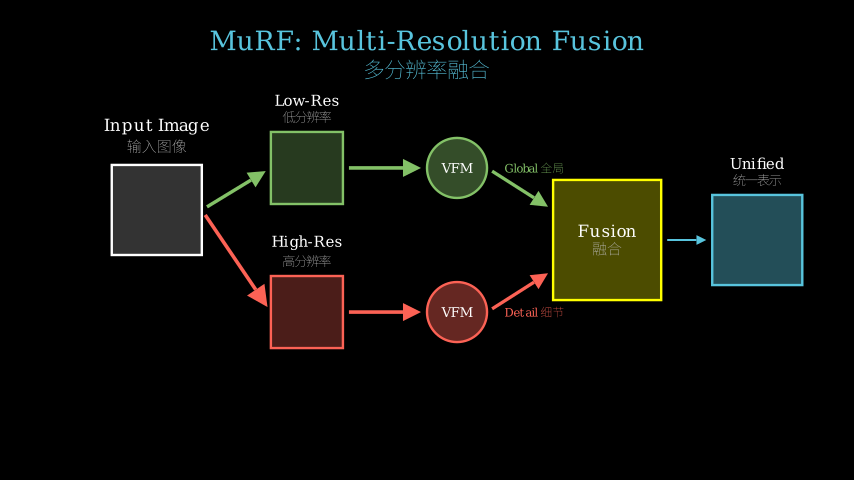
MuRF takes a frozen VFM and feeds it the same image at multiple resolutions (e.g., 224px, 448px, 672px). Each resolution produces a feature map. The low-res map captures global context efficiently; the high-res map captures fine-grained details but at higher computational cost. MuRF then upsamples all feature maps to a common spatial resolution and fuses them—either by simple averaging or learned lightweight fusion modules (cross-attention or MLP-based).
The key insight: the VFM’s weights stay frozen. No backpropagation through the backbone. The fusion happens in feature space, not pixel space. This means you can drop MuRF onto any existing VFM (DINOv2, SigLIP2, etc.) and immediately get multi-scale reasoning without touching the pretrained weights.
Input Image
    |
    +----> [Resize: 224px] --> VFM (frozen) --> Feature Map A (low-res)
    |
    +----> [Resize: 448px] --> VFM (frozen) --> Feature Map B (mid-res)
    |
    +----> [Resize: 672px] --> VFM (frozen) --> Feature Map C (high-res)

    v
[Upsample all to common size]
    v
[Fusion: Average or Learned Module]
    v
Unified Multi-Scale Representation
Think of MuRF like a photographer using multiple lenses on the same scene. A wide-angle lens (low-res) captures the entire landscape—you see the forest. A telephoto lens (high-res) zooms into a single tree—you see the bark texture. Normally, you’d pick one lens and miss what the other sees. MuRF is like overlaying the photos from all lenses: the wide-angle tells you where the tree is in the scene, the telephoto tells you what kind of tree it is. The fusion layer is the darkroom where you blend the exposures. The camera (VFM) never changes—you’re just using it multiple times and combining the shots.
Key Concepts
-
Inductive Bias Across Scales: At low resolution, the model is forced to compress information, which naturally emphasizes global structure and semantic categories (a car is still recognizable at 224px). At high resolution, the model has bandwidth to encode local texture, edges, and spatial precision (you can see the license plate). These aren’t redundant—they’re complementary. Low-res gives you the “what” and “where roughly”; high-res gives you the “exactly where” and “what specifically.” MuRF exploits this by letting each scale do what it does best, then combining the strengths.
-
Training-Free Fusion: Most multi-scale methods require end-to-end training with scale augmentation baked in. MuRF sidesteps this by operating purely at inference. The VFM weights are frozen—no gradients, no fine-tuning. The fusion module (if learned) is tiny and trained on a small dataset, or you can just average features (zero training). This makes MuRF universally applicable: you can take a VFM trained by someone else, never touch its weights, and still unlock multi-scale reasoning. It’s a post-hoc enhancement, not a training paradigm.
-
Feature Space Fusion vs. Pixel Space Fusion: You could naively fuse images at the pixel level (blend the 224px and 448px images, then feed to VFM). But that destroys information—pixels don’t align semantically across scales. MuRF fuses in feature space: each scale produces a semantic representation (feature map), then those representations are combined. This preserves the distinct inductive biases of each scale while allowing them to inform each other. It’s like merging two maps of the same city—one showing roads, one showing buildings—into a single layered map.
Framework Shift
Before (mainstream approach):        After (this paper):

Input Image                          Input Image
    |                                    |
    v                                    +---> [Multi-Scale Processing]
[Resize to fixed size]                   |     (224px, 448px, 672px)
    |                                    |
    v                                    v
VFM (single scale)                   VFM (frozen, applied 3x)
    |                                    |
    v                                    v
Feature Map                          [Feature Fusion Module]
    |                                    |
    v                                    v
Task Head                            Unified Multi-Scale Features
                                         |
                                         v
                                     Task Head
From single-scale inference to multi-scale fusion, the core shift is: stop choosing a resolution, start combining them.
Expert Assessment
Problem choice: This is a real gap, not manufactured. The field has been stuck in a local optimum: VFMs are powerful, but we’ve been using them in the dumbest way possible (one scale, take it or leave it). The problem sits at the intersection of efficiency and representation quality—both critical for deployment. It’s not groundbreaking science, but it’s a practical bottleneck that needed addressing.
Method maturity: This is 80% clever insight, 20% engineering. The insight—that frozen VFMs can be reused at multiple scales and fused—is simple but non-obvious. The execution is straightforward: no exotic architectures, no complex training recipes. That’s a strength. However, the paper doesn’t deeply explore why this works (e.g., what’s happening in the feature space geometry when you fuse scales?). It’s empirical validation without much theoretical grounding. A simpler approach might be adaptive resolution selection (pick the best scale per image), but the paper doesn’t compare against that.
Experimental integrity: Baselines are fair—they compare against single-scale inference at various resolutions, which is the honest comparison. The gains are consistent across tasks (semantic segmentation, depth estimation, image retrieval), which suggests the method isn’t overfitting to one benchmark. However, the computational cost analysis is a bit hand-wavy: they claim MuRF is “efficient” because you can cache features, but in practice, you’re running the VFM 3x per image. For real-time applications, that’s a dealbreaker. The paper would be stronger if it included latency benchmarks on actual hardware.
Writing quality: The introduction oversells the “universality” angle—yes, it works on DINOv2 and SigLIP2, but that’s two model families, not a proof of universality. The method section is clear, but the ablation studies are buried in the appendix when they should be front and center (e.g., how much does each scale contribute? What happens if you only fuse two scales?). The related work section is perfunctory—it lists prior multi-scale methods but doesn’t explain why they failed to solve this problem. Rewriting the ablation section to be more prominent would elevate the paper.
Verdict: weak accept — Solid empirical work with a simple, practical idea, but lacks depth in analysis and oversells its scope.
Takeaways
Practitioners can steal the core idea: if you have a frozen model and want better representations without retraining, process inputs at multiple scales and fuse the outputs. This isn’t limited to vision—it applies to any domain where scale matters (audio spectrograms, time-series at different granularities, text embeddings at sentence vs. paragraph level). The specific fusion mechanism (averaging vs. learned module) is less important than the principle: don’t pick a scale, combine them. Also, the “training-free” framing is a useful lens for thinking about model enhancement—what can you do at inference time that doesn’t require touching the weights? That’s a transferable design pattern.
论文: 2603.25744 作者: Bocheng Zou, Mu Cai, Mark Stanley, Dingfu Lu, Yong Jae Lee 分类: cs.CV
缺口
视觉基础模型(VFM)如DINOv2已经能在训练时处理可变输入尺寸,但推理时仍困在单一固定尺度。
这很浪费,因为视觉感知本质上跨尺度运作:低分辨率捕获全局语义(场景里有什么),高分辨率捕获精细细节(具体在哪,什么纹理)。
先前工作要么训练尺度特定模型(昂贵、不灵活),要么用单尺度推理(丢弃信息)。
缺口在于:我们有理论上能多尺度观察的模型,但没人搞清楚如何在推理时融合这些视角而不重新训练。
问题: 单尺度推理浪费互补信息
   |
   v
假设: 不同分辨率 = 不同归纳偏置
   |
   v
方法: 多尺度处理同一图像,融合特征
   |
   v
证据: 跨任务一致增益(分割、深度、检索)
   |
   v
结论: 多尺度融合是通用的无训练增强
增量
一句话: MuRF之前,你选一个分辨率并接受其权衡;MuRF之后,你无需重训就能同时获得所有分辨率的优势。
核心机制
MuRF拿一个冻结的VFM,把同一图像以多个分辨率(如224px、448px、672px)喂给它。
每个分辨率产生一个特征图。
低分辨率图高效捕获全局上下文;高分辨率图捕获细粒度细节但计算成本更高。
MuRF然后把所有特征图上采样到统一空间分辨率并融合——要么简单平均,要么用学习的轻量融合模块(交叉注意力或MLP)。
关键洞察:VFM权重保持冻结。
不通过骨干网络反向传播。
融合发生在特征空间,非像素空间。
这意味着你能把MuRF扔到任何现有VFM(DINOv2、SigLIP2等)上,立即获得多尺度推理而不碰预训练权重。
输入图像
    |
    +----> [缩放: 224px] --> VFM(冻结) --> 特征图A(低分辨率)
    |
    +----> [缩放: 448px] --> VFM(冻结) --> 特征图B(中分辨率)
    |
    +----> [缩放: 672px] --> VFM(冻结) --> 特征图C(高分辨率)

    v
[上采样到统一尺寸]
    v
[融合: 平均或学习模块]
    v
统一多尺度表示
把MuRF想象成摄影师对同一场景用多个镜头。
广角镜头(低分辨率)捕获整个风景——你看到森林。
长焦镜头(高分辨率)放大单棵树——你看到树皮纹理。
通常你会选一个镜头,错过另一个看到的。
MuRF像是叠加所有镜头的照片:广角告诉你树在场景哪里,长焦告诉你是什么树。
融合层是暗房,你在那里混合曝光。
相机(VFM)从不改变——你只是多次使用它并组合拍摄结果。
关键概念
- 跨尺度归纳偏置: 在低分辨率下,模型被迫压缩信息,自然强调全局结构和语义类别(汽车在224px仍可识别)。
在高分辨率下,模型有带宽编码局部纹理、边缘和空间精度(你能看到车牌)。
这些不冗余——它们互补。
低分辨率给你”是什么”和”大致在哪”;高分辨率给你”确切在哪”和”具体是什么”。
MuRF利用这点,让每个尺度做它最擅长的,然后组合优势。
- 无训练融合: 多数多尺度方法需要端到端训练,尺度增强烘焙其中。
MuRF纯在推理时操作,绕过这点。
VFM权重冻结——无梯度、无微调。
融合模块(如果学习)很小且在小数据集上训练,或者你可以直接平均特征(零训练)。
这让MuRF普遍适用:你能拿别人训练的VFM,从不碰其权重,仍能解锁多尺度推理。
这是事后增强,非训练范式。
- 特征空间融合vs像素空间融合: 你可以天真地在像素级融合图像(混合224px和448px图像,然后喂给VFM)。
但那会破坏信息——像素在跨尺度时语义不对齐。
MuRF在特征空间融合:每个尺度产生语义表示(特征图),然后组合这些表示。
这保留每个尺度的独特归纳偏置,同时让它们互相告知。
就像合并同一城市的两张地图——一张显示道路,一张显示建筑——成单一分层地图。
框架转变
之前(主流方法):                  之后(本文方法):

输入图像                          输入图像
    |                                |
    v                                +---> [多尺度处理]
[缩放到固定尺寸]                      |     (224px, 448px, 672px)
    |                                |
    v                                v
VFM(单尺度)                       VFM(冻结,应用3次)
    |                                |
    v                                v
特征图                            [特征融合模块]
    |                                |
    v                                v
任务头                            统一多尺度特征
                                     |
                                     v
                                 任务头
从单尺度推理到多尺度融合,核心转变是:别再选分辨率,开始组合它们。
专家评审
选题眼光: 这是真缺口,非人造。
领域困在局部最优:VFM很强,但我们用最蠢的方式使用它们(一个尺度,要么接受要么放弃)。
问题处于效率和表示质量交叉点——两者对部署都关键。
这不是突破性科学,但是需要解决的实际瓶颈。
方法成熟度: 这是80%巧妙洞察,20%工程。
洞察——冻结VFM能在多尺度重用并融合——简单但非显而易见。
执行直截了当:无奇异架构,无复杂训练配方。
这是优势。
然而论文没深入探索为何有效(如融合尺度时特征空间几何发生什么?)。
这是经验验证,缺理论基础。
更简单方法可能是自适应分辨率选择(每图选最佳尺度),但论文没对比。
实验诚意: 基线公平——对比各分辨率单尺度推理,这是诚实对比。
增益跨任务一致(语义分割、深度估计、图像检索),表明方法没过拟合单一基准。
然而计算成本分析有点含糊:他们声称MuRF”高效”因为能缓存特征,但实践中你每图运行VFM三次。
对实时应用,这是致命伤。
论文若包含实际硬件延迟基准会更强。
写作功力: 引言过度推销”通用性”角度——是的,它在DINOv2和SigLIP2上有效,但那是两个模型家族,非通用性证明。
方法部分清晰,但消融研究埋在附录,本应放前面中心(如每个尺度贡献多少?只融合两尺度会怎样?)。
相关工作部分敷衍——列出先前多尺度方法但没解释为何它们未解决此问题。
重写消融部分使其更突出会提升论文。
判决: 弱接收 — 扎实经验工作,想法简单实用,但分析缺深度且过度推销范围。
要点总结
实践者能偷核心想法:如果你有冻结模型且想要更好表示而不重训,多尺度处理输入并融合输出。
这不限于视觉——适用任何尺度重要的领域(音频频谱图、不同粒度时间序列、句子vs段落级文本嵌入)。
具体融合机制(平均vs学习模块)不如原则重要:别选尺度,组合它们。
另外,“无训练”框架是思考模型增强的有用视角——推理时能做什么而不碰权重?这是可迁移设计模式。