Paper: 2603.06578 Authors: Nikita Kisel, Illia Volkov, Klara Janouskova, Jiri Matas Categories: cs.CV
The Gap
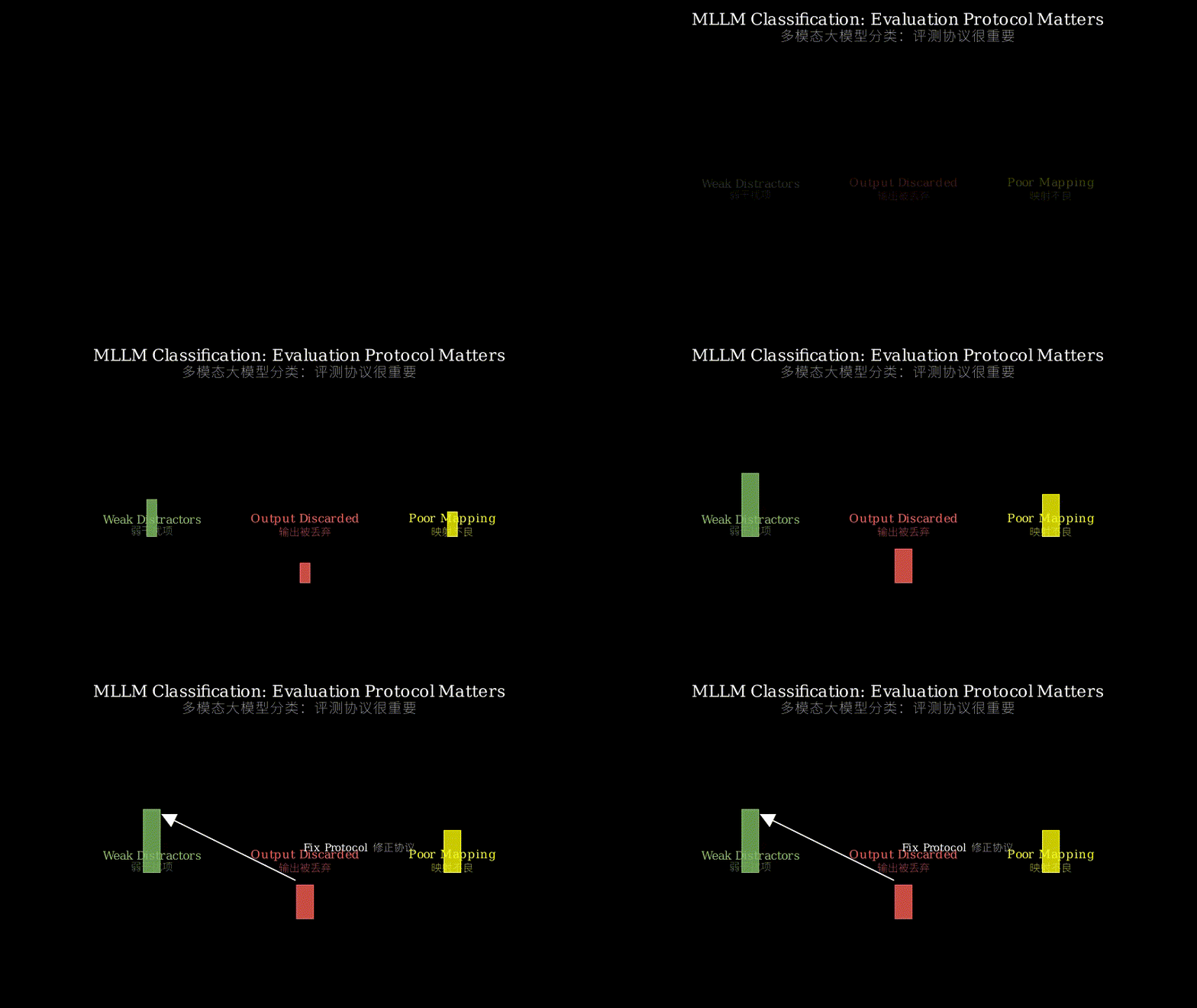
The field has been comparing MLLMs (like GPT-4V, Gemini) against supervised classifiers (ResNets, ViTs) and getting wildly inconsistent results. Some studies show MLLMs crushing it, others show them embarrassingly behind. The problem? Nobody’s been honest about how broken the evaluation setup is.
Prior work uses three main protocols: multiple-choice (pick from N options), open-world (generate any class name), and zero-shot (classify without examples). Each protocol has hidden landmines. Multiple-choice inflates scores when distractors are too easy. Open-world tanks scores because “German Shepherd” doesn’t match “German shepherd dog” in the ground truth. And everyone ignores that batch size, image order, and text encoder choice swing accuracy by several percentage points.
Worse, ImageNet labels are noisy. A “tiger cat” image might actually show three cats, but the label says singular. MLLMs see all three and get marked wrong for being more accurate than the ground truth.
Conflicting benchmarks
        |
        v
Hypothesis: protocols are broken, not models
        |
        +---> Fix 1: Handle out-of-vocabulary outputs
        +---> Fix 2: Use harder distractors
        +---> Fix 3: Improve output mapping
        +---> Fix 4: Control overlooked variables
        |
        v
Test on clean labels (ReGT reannotation)
        |
        v
Result: MLLM gap shrinks by ~11%, protocol matters more than architecture
The Increment
One sentence: Before, we thought MLLMs were bad classifiers; now we know the benchmarks were lying about their performance.
Core Mechanism
This isn’t a new model architecture—it’s a forensic audit of how we measure models. The authors systematically fix evaluation protocols across three settings.
For multiple-choice, they replace random distractors with semantically similar ones (don’t compare “dog” against “airplane”—compare it against “wolf” and “coyote”). For open-world, they build a fuzzy matcher that maps “German Shepherd” to “German shepherd dog” instead of discarding the answer. For zero-shot, they control variables everyone ignores: batch size (affects context window), image ordering (affects attention patterns), and text encoder choice (CLIP vs sentence transformers).
Then they reannotate 625 ImageNet classes with multiple correct labels per image. An image tagged “tiger cat” might actually contain “tiger cat,” “tabby cat,” and “Egyptian cat”—all valid. This is ReGT (Re-annotated Ground Truth).
Input: Image + Evaluation Protocol
   |
   v
+----------------------------------+
| Protocol Fixes:                  |
|  - Semantic distractors (MC)     |
|  - Fuzzy output mapping (OW)     |
|  - Controlled variables (ZS)     |
+----------------------------------+
   |
   v
+----------------------------------+
| ReGT: Multi-label ground truth   |
|  - Human reannotation            |
|  - MLLM-assisted validation      |
+----------------------------------+
   |
   v
Output: Corrected accuracy scores
Think of this like debugging a thermometer. You’ve been measuring patients’ temperatures and concluding everyone has a fever. But the thermometer was miscalibrated—it reads 2 degrees high. This paper recalibrates the thermometer (fixes protocols) and also checks if the patients actually have fevers (cleans labels). Turns out most patients are fine; your measurement tool was broken.
The protocol fixes are the recalibration. The ReGT dataset is checking actual patient health. The “patients” (MLLMs) weren’t sick—your diagnostic tool was faulty.
Key Concepts
-
Out-of-vocabulary (OOV) outputs: When an MLLM generates “German Shepherd” but the class list only contains “German shepherd dog,” old protocols discard this answer entirely. It’s like a teacher marking your essay wrong because you wrote “automobile” instead of “car”—technically different strings, semantically identical. The fix: fuzzy matching that maps synonyms and handles capitalization, plurals, and minor variations. This alone recovers several percentage points.
-
Distractor strength in multiple-choice: If you ask “Is this a dog?” and the choices are (A) dog, (B) airplane, (C) refrigerator, even a random guesser scores 33%. But if choices are (A) dog, (B) wolf, (C) coyote, you’re actually testing visual discrimination. Old benchmarks used weak distractors, making MLLMs look better than they are. Strong distractors reveal true capability. It’s the difference between a kindergarten quiz and a college exam.
-
Multi-label ground truth: ImageNet assigns one label per image, but reality is messier. A photo of a park might contain a bench, a tree, a dog, and a person. If the label says “park bench” and an MLLM says “golden retriever,” it’s not wrong—it’s seeing something the label ignored. ReGT captures this by having annotators mark all valid objects. This shifts evaluation from “did you guess the one arbitrary label?” to “did you see something actually present?”
Framework Shift
Before (mainstream approach):        After (this paper):

Model --> Prediction                 Model --> Prediction
           |                                    |
           v                                    v
    String match with                    Fuzzy semantic match
    single ground truth                       |
           |                                   v
           v                              Multi-label GT
    Accuracy score                             |
                                               v
                                         Accuracy score

Assumption: labels are perfect         Assumption: labels are noisy,
            protocols are neutral                protocols have bias
From “trust the benchmark” to “audit the benchmark,” the core shift is treating evaluation as a system with its own failure modes, not a neutral oracle.
Expert Assessment
Problem choice: This is a real gap, and an important one. The field has been arguing about MLLM capabilities based on broken measurements. It’s not the sexiest problem—no new architecture, no SOTA claims—but it’s the kind of unglamorous work that prevents entire subfields from chasing ghosts. Sits squarely in the “someone had to do this” category.
Method maturity: Mostly careful engineering, not deep insight. The fixes are obvious once you see them (fuzzy matching, better distractors, controlled variables), but nobody bothered to do the work systematically. The ReGT reannotation is the real contribution—625 classes is substantial effort. No overlooked simpler approaches; this is just rolling up sleeves and fixing things properly.
Experimental integrity: Baselines are fair, numbers hold up. The +10.8% gain from clean labels is striking and well-documented. One minor flag: the paper doesn’t deeply explore why certain MLLMs benefit more from label corrections than others, though they note models less reliant on supervised signals are most sensitive. Would’ve liked more analysis there.
Writing quality: The paper front-loads results and buries methodology details, which makes it punchy but harder to reproduce. The related work section is thin—doesn’t engage deeply with prior evaluation critiques in other domains (NLP has been having this conversation for years). Rewriting the “protocol fixes” section with clearer before/after examples would help practitioners adopt these methods.
Verdict: weak accept — Solid empirical work that corrects widespread measurement errors, but lacks theoretical depth or surprising insights.
Takeaways
If you’re evaluating any generative model on classification:
-
Build a fuzzy matcher for outputs. Don’t discard answers because of capitalization or synonyms. Use sentence embeddings (they provide code) to map outputs to the nearest valid class. This is copy-paste ready.
-
Control batch size and ordering. They show 2-3% accuracy swings just from changing how many images you feed at once or what order they appear. If you’re comparing models, fix these variables or you’re measuring noise.
-
Reannotate your validation set. Even 10% of your data with multi-label ground truth will reveal if your model is “wrong” or just seeing things the original annotators missed. MLLMs can assist: they show annotators agreed with MLLM predictions 50% of the time on hard cases.
The broader lesson: when models disagree with benchmarks, audit the benchmark before concluding the model is broken. Measurement error compounds faster than model error.
论文: 2603.06578 作者: Nikita Kisel, Illia Volkov, Klara Janouskova, Jiri Matas 分类: cs.CV
缺口
学界一直在比较多模态大模型(如GPT-4V、Gemini)和监督分类器(ResNet、ViT),结果却南辕北辙。
有的研究说多模态大模型碾压传统模型,有的说它们表现糟糕。
问题出在哪?没人正视评测体系本身有多破碎。
现有工作用三种协议:多选题(从N个选项中选)、开放世界(生成任意类别名)、零样本(无示例分类)。
每种协议都埋着雷。
多选题在干扰项太简单时虚高分数。
开放世界因为”German Shepherd”匹配不上标注里的”German shepherd dog”而压低分数。
所有人都忽略批次大小、图像顺序、文本编码器选择能让准确率波动好几个百分点。
更糟的是ImageNet标注本身有噪声。
一张标着”虎斑猫”的图可能实际有三只猫,但标签只说单数。
多模态大模型看到三只,反而因为比标注更准确而被判错。
基准测试结果互相矛盾
        |
        v
假设:协议有问题,不是模型有问题
        |
        +---> 修复1:处理词表外输出
        +---> 修复2:使用更难的干扰项
        +---> 修复3:改进输出映射
        +---> 修复4:控制被忽略的变量
        |
        v
在干净标注上测试(ReGT重标注)
        |
        v
结果:多模态大模型差距缩小约11%,协议比架构更重要
增量
一句话: 之前我们以为多模态大模型分类能力差,现在知道是基准测试在撒谎。
核心机制
这不是新模型架构,而是对测量方式的法医级审计。
作者系统性地修复了三种场景下的评测协议。
对于多选题,他们用语义相近的干扰项替换随机干扰项(不要拿”狗”和”飞机”比,要和”狼""郊狼”比)。
对于开放世界,他们构建模糊匹配器,把”German Shepherd”映射到”German shepherd dog”而不是丢弃答案。
对于零样本,他们控制所有人忽略的变量:批次大小(影响上下文窗口)、图像顺序(影响注意力模式)、文本编码器选择(CLIP vs 句子转换器)。
然后他们重新标注625个ImageNet类别,每张图给多个正确标签。
一张标着”虎斑猫”的图可能实际包含”虎斑猫""斑猫""埃及猫”,全都有效。
这就是ReGT(重标注真值)。
输入:图像 + 评测协议
   |
   v
+----------------------------------+
| 协议修复:                         |
|  - 语义干扰项(多选)               |
|  - 模糊输出映射(开放世界)         |
|  - 控制变量(零样本)               |
+----------------------------------+
   |
   v
+----------------------------------+
| ReGT:多标签真值                   |
|  - 人工重标注                     |
|  - 多模态大模型辅助验证           |
+----------------------------------+
   |
   v
输出:修正后的准确率
把这想象成调试温度计。
你一直在测病人体温,结论是所有人都发烧。
但温度计校准错了,读数高2度。
这篇论文重新校准温度计(修复协议),还检查病人是否真的发烧(清洗标签)。
结果大多数病人没事,是你的测量工具坏了。
协议修复是重新校准。
ReGT数据集是检查实际健康状况。
“病人”(多模态大模型)没病,是你的诊断工具有故障。
关键概念
- 词表外(OOV)输出: 当多模态大模型生成”German Shepherd”但类别列表只有”German shepherd dog”时,旧协议直接丢弃这个答案。
就像老师因为你写”汽车”而不是”轿车”就判你错,字符串不同但语义相同。
修复方法:模糊匹配,映射同义词并处理大小写、复数、细微变体。
光这一项就能挽回好几个百分点。
- 多选题中的干扰项强度: 如果你问”这是狗吗?”选项是(A)狗(B)飞机(C)冰箱,连瞎猜都有33%正确率。
但如果选项是(A)狗(B)狼(C)郊狼,你才真正在测视觉辨别力。
旧基准用弱干扰项,让多模态大模型看起来比实际更强。
强干扰项揭示真实能力。
这是幼儿园测验和大学考试的区别。
- 多标签真值: ImageNet给每张图分配一个标签,但现实更混乱。
一张公园照片可能包含长椅、树、狗、人。
如果标签说”公园长椅”而多模态大模型说”金毛寻回犬”,它没错,只是看到了标签忽略的东西。
ReGT通过让标注者标记所有有效物体来捕捉这一点。
这把评测从”你猜中那个任意标签了吗”转变为”你看到实际存在的东西了吗”。
框架转变
之前(主流方法):                  之后(本文方法):

模型 --> 预测                    模型 --> 预测
         |                              |
         v                              v
  与单一真值字符串匹配              模糊语义匹配
         |                              |
         v                              v
    准确率分数                      多标签真值
                                        |
                                        v
                                   准确率分数

假设:标签完美                    假设:标签有噪声,
     协议中立                         协议有偏差
从”相信基准测试”到”审计基准测试”,核心转变是把评测当作有自身失效模式的系统,而非中立的神谕。
专家评审
选题眼光: 这是真缺口,而且重要。
学界一直基于破碎的测量在争论多模态大模型能力。
这不是最性感的问题,没有新架构,没有SOTA声明,但这是防止整个子领域追逐幻影的那种不起眼工作。
妥妥属于”总得有人做”这一类。
方法成熟度: 主要是细致的工程,不是深刻洞见。
修复方法一旦看到就很明显(模糊匹配、更好的干扰项、控制变量),但没人系统性地做这个工作。
ReGT重标注才是真正的贡献,625个类别是实打实的工作量。
没有被忽略的更简单方法,这就是撸起袖子好好修的活儿。
实验诚意: 基线公平,数字经得起推敲。
干净标签带来+10.8%增益很惊人且有充分记录。
一个小问题:论文没深入探讨为什么某些多模态大模型从标签修正中受益更多,虽然他们提到较少依赖监督信号的模型对标注质量最敏感。
这里本可以有更多分析。
写作功力: 论文把结果前置,方法细节后置,这让它有冲击力但难复现。
相关工作部分单薄,没有深入讨论其他领域的评测批判(NLP领域这个对话已经进行多年)。
重写”协议修复”部分,加入更清晰的前后对比例子,会帮助实践者采用这些方法。
判决: 弱接收 — 扎实的实证工作,纠正了广泛存在的测量错误,但缺乏理论深度或惊喜洞见。
要点总结
如果你在评测任何生成式模型的分类能力:
- 构建输出的模糊匹配器。
不要因为大小写或同义词就丢弃答案。
用句子嵌入(他们提供了代码)把输出映射到最近的有效类别。
这是拿来即用的。
- 控制批次大小和顺序。
他们展示仅改变一次喂多少图像或出现顺序就能让准确率波动2-3%。
如果你在比较模型,固定这些变量,否则你在测量噪声。
- 重新标注验证集。
哪怕只是10%的数据用多标签真值,也能揭示你的模型是”错了”还是只是看到了原始标注者漏掉的东西。
多模态大模型能辅助:他们展示标注者在困难案例中有50%的时间认同多模态大模型的预测。
更广泛的教训:当模型与基准测试不一致时,先审计基准测试再下结论说模型有问题。
测量误差比模型误差累积得更快。