Paper: 2603.02188 Authors: Songtao Liu, Hongwu Peng, Zhiwei Zhang, Zhengyu Chen, Yue Guo Categories: cs.LG
The Gap
Long-context LLMs hit a wall during decoding: the KV cache bottleneck. Multi-Head Latent Attention (MLA) compressed the cache beautifully by projecting multiple attention heads into a single shared latent representation. Cache size dropped dramatically. Problem solved, right?
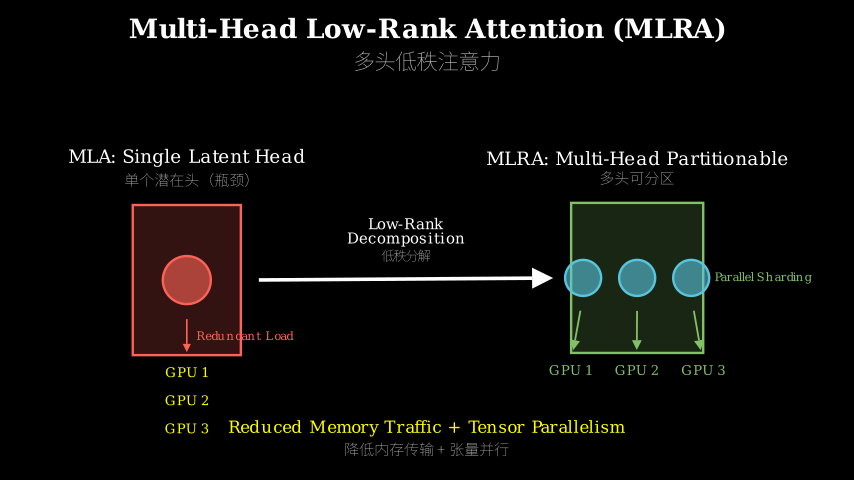
Not quite. MLA created a new problem: its single latent head can’t be split across GPUs. When you run distributed inference with Tensor Parallelism (TP), each device must load the entire KV cache redundantly. You saved memory but killed parallelism. It’s like compressing a file so well that you can’t unzip it in parallel anymore.
Long-context decoding bottleneck
         |
         v
MLA compresses KV cache (single latent head)
         |
         v
Single head blocks TP sharding
         |
         v
MLRA: Split latent into partitionable chunks
         |
         v
2.8x speedup + maintained quality
The Increment
One sentence: Before MLRA, you chose between small KV cache (MLA) or fast parallel decoding (standard MHA); after MLRA, you get both.
Core Mechanism
MLRA keeps MLA’s compression idea but redesigns the latent structure. Instead of one monolithic latent head, MLRA uses multiple independent low-rank latent heads. Each head handles a subset of the original attention heads and can be assigned to a different GPU.
The data flow works like this: input tokens get projected into multiple latent representations (one per latent head). Each latent head maintains its own compressed KV cache. During attention computation, each device loads only its assigned latent head’s cache, computes attention for its subset of heads, then the results get combined. The key insight: by keeping latent heads independent, you preserve both compression benefits and sharding capability.
Input tokens
     |
     v
+---+---+---+---+
| L1| L2| L3| L4|  <-- Multiple latent heads (partitionable)
+---+---+---+---+
  |   |   |   |
  v   v   v   v
[KV1][KV2][KV3][KV4]  <-- Separate compressed caches
  |   |   |   |
  +---+---+---+
        |
        v
   Attention output
Think of it like a library system. MLA is a single master catalog (one latent head) that indexes all books—compact, but only one librarian can use it at a time. MLRA splits the catalog into subject-specific sections (multiple latent heads). Each librarian (GPU) handles their section independently. You still save shelf space compared to storing full book details everywhere (compression), but now multiple librarians work in parallel (sharding). The sections don’t talk to each other during lookup, which is what makes parallelism possible.
Key Concepts
-
Latent Head: Imagine you have 32 attention heads, each storing keys and values for every token. That’s a lot of redundant information. A latent head is a compressed representation that captures the essential information from multiple attention heads in a smaller space. Instead of storing 32 separate KV caches, you project them into a shared lower-dimensional space. MLA uses one latent head for all 32 heads. MLRA uses, say, 4 latent heads—each handling 8 original heads. This middle ground preserves compression while enabling splits.
-
Tensor Parallelism Sharding: When a model is too big for one GPU, you split it across multiple devices. The naive way: each GPU handles different layers. Tensor Parallelism is smarter: you split individual operations within a layer. For attention, this means dividing the heads across GPUs. GPU 1 computes heads 1-8, GPU 2 handles 9-16, etc. But this only works if the data each GPU needs is actually separable. MLA’s single latent head isn’t separable—it’s shared by all heads, so every GPU needs the whole thing.
-
KV Cache Loading Bottleneck: During text generation, the model produces one token at a time. For each new token, it needs to attend to all previous tokens. The keys and values from those previous tokens (the KV cache) live in slow off-chip memory (HBM). Every generation step requires loading this cache into fast on-chip memory (SRAM). As context grows, this memory transfer becomes the slowest part of inference—not the actual computation. Compression helps by reducing what you transfer. Parallelism helps by splitting the transfer across devices. You need both.
Framework Shift
MLA (single latent):                MLRA (multiple latents):

All heads                           Head groups
    |                                   |
    v                                   v
+-------+                           +---+---+---+---+
|   L   |  <-- One latent           | L1| L2| L3| L4|
+-------+                           +---+---+---+---+
    |                                |   |   |   |
    v                                v   v   v   v
[  KV  ]  <-- Must load all        [KV1][KV2][KV3][KV4]
    |                                |   |   |   |
    |                               GPU1 GPU2 GPU3 GPU4
Cannot split across GPUs            Each GPU loads its chunk
From monolithic compression to modular compression, the core shift is trading a tiny bit of compression ratio for massive parallelization gains.
Expert Assessment
Problem choice: This is a real gap, not manufactured. MLA’s TP bottleneck is a genuine blocker for production deployments at scale. The paper sits at a sweet spot—addressing a limitation of a recent innovation (MLA from DeepSeek) before it becomes entrenched. Timely and practical.
Method maturity: The solution is almost embarrassingly simple: just use multiple latent heads instead of one. That’s the kind of simplicity that makes you wonder why nobody did it sooner, which is usually a good sign. No exotic techniques, no architectural gymnastics. The insight is in recognizing that MLA’s design choice (single latent) was optimizing for the wrong constraint.
Experimental integrity: The baselines are fair—they compare against MLA, standard MHA, and GQA across multiple model sizes. The 2.8× speedup claim is specific to 4-way TP, which they state clearly. Perplexity numbers look solid. One minor flag: the experiments are all on relatively small models (up to 1.3B parameters). Would be more convincing to see results on 7B+ models where TP is actually necessary.
Writing quality: The abstract and intro are crisp. The method section could use more ablation details—why 4 latent heads specifically? What’s the trade-off curve between number of latent heads and compression ratio? The paper reads like the authors knew exactly what problem they were solving and got straight to it, which is refreshing but leaves some exploration on the table.
Verdict: weak accept — Solves a real problem with an elegant solution, but experiments could be more comprehensive and the design space feels underexplored.
Takeaways
If you’re building distributed inference systems, the core lesson is: compression and parallelism are often at odds, and you need to design for both from the start. MLRA’s approach—modular compression units that align with your parallelism boundaries—is a pattern worth stealing.
Concretely: when designing any cache or state compression scheme for distributed systems, ask “can this be partitioned?” before asking “how small can I make it?” The 10% extra memory from using 4 latent heads instead of 1 is worth it if you get 2.8× faster inference.
For researchers: this paper is a reminder that recent “solved” problems often have second-order issues. MLA was celebrated for cache compression, but nobody stress-tested it under TP until now. There’s low-hanging fruit in auditing recent innovations for their distributed systems implications.
论文: 2603.02188 作者: Songtao Liu, Hongwu Peng, Zhiwei Zhang, Zhengyu Chen, Yue Guo 分类: cs.LG
缺口
长上下文大模型在解码时撞上了一堵墙:KV缓存瓶颈。 多头潜在注意力(MLA)通过将多个注意力头投影到单个共享潜在表示,漂亮地压缩了缓存。 缓存大小大幅下降。 问题解决了,对吧?
并没有。 MLA制造了一个新问题:它的单个潜在头无法跨GPU拆分。 当你用张量并行(TP)运行分布式推理时,每个设备必须冗余地加载整个KV缓存。 你省了内存却杀死了并行性。 就像把文件压缩得太好,反而没法并行解压了。
长上下文解码瓶颈
         |
         v
MLA压缩KV缓存(单个潜在头)
         |
         v
单头阻塞TP分片
         |
         v
MLRA:将潜在头拆分为可分区块
         |
         v
2.8倍加速+保持质量
增量
一句话: MLRA之前,你在小KV缓存(MLA)和快速并行解码(标准MHA)之间二选一;MLRA之后,两者兼得。
核心机制
MLRA保留了MLA的压缩思路,但重新设计了潜在结构。 不再是一个整体的潜在头,MLRA使用多个独立的低秩潜在头。 每个头处理原始注意力头的一个子集,可以分配给不同的GPU。
数据流是这样的:输入token被投影到多个潜在表示(每个潜在头一个)。 每个潜在头维护自己的压缩KV缓存。 在注意力计算时,每个设备只加载分配给它的潜在头的缓存,为其头子集计算注意力,然后结果被组合。 关键洞察:通过保持潜在头独立,你同时保留了压缩优势和分片能力。
输入tokens
     |
     v
+---+---+---+---+
| L1| L2| L3| L4|  <-- 多个潜在头(可分区)
+---+---+---+---+
  |   |   |   |
  v   v   v   v
[KV1][KV2][KV3][KV4]  <-- 独立的压缩缓存
  |   |   |   |
  +---+---+---+
        |
        v
   注意力输出
把它想象成图书馆系统。 MLA是单个主目录(一个潜在头),索引所有书籍——紧凑,但一次只有一个图书管理员能用。 MLRA把目录拆分成按主题分类的区域(多个潜在头)。 每个图书管理员(GPU)独立处理自己的区域。 相比到处存储完整书籍详情(压缩),你仍然节省了书架空间,但现在多个管理员并行工作(分片)。 查找时各区域之间不交流,这正是并行成为可能的原因。
关键概念
-
潜在头: 想象你有32个注意力头,每个都为每个token存储键和值。 那是大量冗余信息。 潜在头是一个压缩表示,用更小的空间捕获多个注意力头的核心信息。 不存储32个独立的KV缓存,而是将它们投影到一个共享的低维空间。 MLA为所有32个头使用一个潜在头。 MLRA使用比如4个潜在头——每个处理8个原始头。 这个中间方案在保留压缩的同时实现了拆分。
-
张量并行分片: 当模型对一个GPU太大时,你把它拆分到多个设备上。 朴素方法:每个GPU处理不同的层。 张量并行更聪明:你在层内拆分单个操作。 对于注意力,这意味着跨GPU划分头。 GPU 1计算头1-8,GPU 2处理9-16,等等。 但这只在每个GPU需要的数据确实可分离时才有效。 MLA的单个潜在头不可分离——它被所有头共享,所以每个GPU都需要整个东西。
-
KV缓存加载瓶颈: 在文本生成期间,模型一次产生一个token。 对于每个新token,它需要关注所有先前的token。 那些先前token的键和值(KV缓存)存在慢速片外内存(HBM)中。 每个生成步骤都需要将这个缓存加载到快速片上内存(SRAM)。 随着上下文增长,这个内存传输成为推理最慢的部分——不是实际计算。 压缩通过减少传输内容来帮助。 并行通过跨设备拆分传输来帮助。 你两者都需要。
框架转变
MLA(单潜在头):                    MLRA(多潜在头):

所有头                             头组
    |                                   |
    v                                   v
+-------+                           +---+---+---+---+
|   L   |  <-- 一个潜在头           | L1| L2| L3| L4|
+-------+                           +---+---+---+---+
    |                                |   |   |   |
    v                                v   v   v   v
[  KV  ]  <-- 必须全部加载         [KV1][KV2][KV3][KV4]
    |                                |   |   |   |
    |                               GPU1 GPU2 GPU3 GPU4
无法跨GPU拆分                       每个GPU加载自己的块
从整体压缩到模块化压缩,核心转变是用一点点压缩率换取巨大的并行化收益。
专家评审
选题眼光: 这是真缺口,不是人造的。 MLA的TP瓶颈是大规模生产部署的真正阻碍。 论文处于一个甜蜜点——在最近创新(DeepSeek的MLA)的局限变得根深蒂固之前就解决它。 及时且实用。
方法成熟度: 解决方案简单得几乎令人尴尬:就是用多个潜在头而不是一个。 这种简单性让你想知道为什么之前没人这么做,这通常是个好兆头。 没有奇特技术,没有架构体操。 洞察在于认识到MLA的设计选择(单潜在头)在为错误的约束优化。
实验诚意: 基线公平——他们在多个模型规模上与MLA、标准MHA和GQA比较。 2.8倍加速声明特定于4路TP,他们说得很清楚。 困惑度数字看起来扎实。 一个小警示:实验都在相对小的模型上(最多1.3B参数)。 在7B+模型上看到结果会更有说服力,那里TP才真正必要。
写作功力: 摘要和引言简洁。 方法部分可以有更多消融细节——为什么特别是4个潜在头?潜在头数量和压缩率之间的权衡曲线是什么?论文读起来像作者确切知道他们在解决什么问题并直奔主题,这令人耳目一新但留下了一些探索空间。
判决: 弱接收 — 用优雅方案解决真实问题,但实验可以更全面,设计空间感觉探索不足。
要点总结
如果你在构建分布式推理系统,核心教训是:压缩和并行性常常对立,你需要从一开始就为两者设计。 MLRA的方法——与并行边界对齐的模块化压缩单元——是值得偷师的模式。
具体来说:在为分布式系统设计任何缓存或状态压缩方案时,先问”这能分区吗?”再问”我能做多小?”使用4个潜在头而不是1个带来的10%额外内存是值得的,如果你获得2.8倍更快的推理。
对研究者:这篇论文提醒我们,最近”解决”的问题常有二阶问题。 MLA因缓存压缩受到赞誉,但直到现在才有人在TP下压力测试它。 审查最近创新的分布式系统影响有唾手可得的果实。