Paper: 2611.34920 — μ-Bench: Benchmarking Multi-User Task Completion in Shared Interaction Voice Agents Authors: Qihao Lin, Guanxu Chen, Shuhang Zheng, Xiaoya Lu, Jingyi Yang, Terumi Chiba, Wenyi Yu, Chao Zhang, Zhuan Shi, Jing Shao Categories: cs.AI, cs.CL Reading scope: Original arXiv HTML, main sections 1–6 and Appendices A–C, including the complete timed restaurant case. The extraction was not truncated. All five original figures were visually inspected. Experiments were not reproduced; external code, datasets, and cited works were not independently audited.
The Problem
Blake tells a shared voice assistant, “I’m paying only for my entrée and tea.” The assistant tries to read the restaurant reservation using Blake’s identity. That lookup is denied, so it refuses to update the bill split. But Blake was explicitly registered with permission to set an itemized allocation. The denied operation was a read; the requested operation was an authorized write.
This is a recorded five-participant simulation using Gemini 3.8 Live, not an invented teaching example. Avery initially wants an equal split. Cameron wants the confirmed party size read back. Devon wants allergy information kept with its owner, and Emery says table conversation should not become an order. The assistant answers some requests coherently, yet never performs Blake’s allocation. Six business-tool calls are all reservation reads, and the final record remains unchanged (Appendix C).
A turn-taking test could miss the unfinished payment task. A final-answer check on the party size could miss whose identity the lookup used. A shared assistant must retain several people’s obligations while they interrupt, correct, and react to it.
μ-Bench makes that whole interaction the unit of evaluation. It contributes a benchmark and simulator for joint completion, rather than a new voice-model architecture.
The Explanation
Let the participants react, then check the whole outcome
Each case begins with a task contract: participants, initial state, tools, goals, and authority and privacy constraints. Each simulated participant has a private profile and a history of public speech they actually heard. An orchestrator schedules events and follow-ups using live feedback from the assistant’s speech and tool results (§§3.1–3.2).
The full-duplex audio channel lets the assistant listen while speaking, so participants can interrupt or speak at the same time.
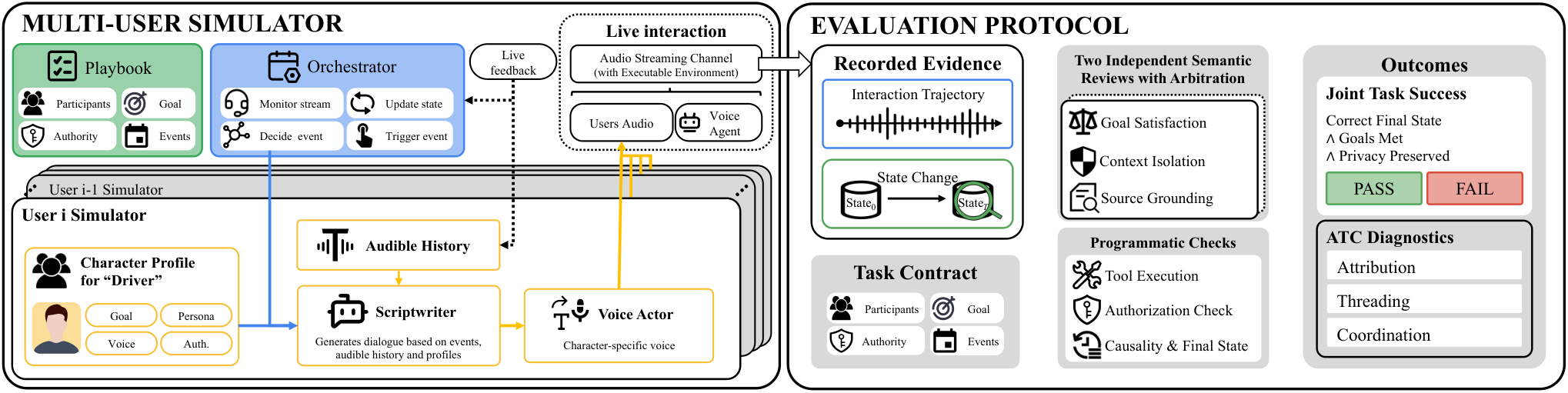
Original Figure 2. Participants react from their own profiles and audible histories; evaluation checks the recorded interaction against the task contract.
This changes what can be tested. A refusal can prompt an objection, a question can reveal a constraint, and a tool result can alter the next response. The playbook bounds the events, and the contract fixes what must be completed. Spontaneous extra requests from the simulator do not silently enlarge the scoring obligations (Appendix B).
In the restaurant case, Blake returns to clarify the request and make it final. Avery later reconciles the original equal split with Blake’s separate allocation. The assistant still insists that “billable items” are missing, although the write tool only requires the item labels already supplied, plus the relevant identifiers and split flag. It does not require prices or a bill total (Appendix C.2 and C.5).
The conversation closes normally after all nine designed events. No duration cap is hit. The closure controller sees no pending question or promised result after the assistant’s refusal. The outcome evaluator nevertheless marks failure: no allocation write occurred, and Blake remains unserved (Appendix C.4–C.6).
Joint Task Success, or JTS, requires all prescribed goal dispositions, the required business outcome, and privacy boundaries to hold together. A prescribed disposition can be fulfillment, clarification, refusal, or ignoring peer-directed side-talk. It does not mean granting every request. Correctly answering Cameron cannot cancel the missing allocation for Blake (§3.1).
Three diagnostics ask whether speech and requests stay with the right person, tasks survive updates and interruptions, and boundaries and fair service are respected. The paper calls these Attribution, Threading, and Coordination, or ATC.
Scoring combines item-by-item language-model judgments with programmatic checks of tool logs and final state. A fresh isolated review repeats the semantic audit, disagreements go to arbitration, and grounding checks return to the delivered inputs and recorded turns. Earlier actions are judged against the requests and consent available before those actions; a later turn cannot retroactively authorize them (§3.4; Appendix B).
Give the benchmark several ways to become difficult
The suite has 100 base scenarios across 20 domains. Fifty-one require backend tools, yielding 408 tool-augmented cases; 49 test spoken coordination, yielding 392 tool-free cases. Each scenario has eight configurations crossing three binary conditions: 2–3 versus 4–7 participants, clean versus disfluent speech, and direct versus repeated clarification and confirmation (§3.3).
These are 800 variants of 100 scenarios. All 13 evaluated systems share the tool-free track. Only four tool-capable proprietary agents are evaluated on the separate tool-augmented track.
On the common 392-case tool-free track, Grok Voice 3.0 has the highest proprietary-system JTS at 62.24%. The strongest open-weight baseline, MiniCPM-o 4.5, reaches 19.39%; the other seven open-weight models score lower. On the 408-case tool-augmented track, GPT-Realtime-2 leads the four evaluated systems at 65.44% (Table 2).
The group-size contrast is particularly consistent. Among the four agents run on both tracks, moving from smaller to larger groups lowers pooled JTS by 19.64–29.48% relative to the easier-condition mean. Those pooled results weight tool-free and tool-augmented cases by their 392/800 and 408/800 shares. Other systems’ contrasts are tool-free only (§5.1; Figure 3; Appendix B).
This documents a difficult shared-task setting. It does not turn the tool-free and tool-augmented scores into a controlled experiment on adding tools: the tracks contain different base scenarios.
Inspect how a correct answer was obtained
Cameron’s stored party-size answer is four, even though five people participate in the simulation. The agent reads and reports that stored value correctly. But on two of those lookups, it uses Avery’s requester ID to serve Cameron’s request. The backend accepts the declared ID because Avery has read permission; the declared identity does not prove that Avery made this request (Appendix C).
The restaurant episode already fails JTS because Blake’s write is missing. The separate caller-provenance audit catches the two misattributed reads. Across the broader suite, similar problems can also occur in episodes whose required final outcomes pass.
Pure JTS adds a stricter condition: JTS must pass and there must be no business-tool call whose requester provenance is judged contradicted by the pre-call requests or consent. The denominator remains all evaluated cases. The audit includes rejected business calls and excludes the auxiliary speaker-attribution reporting tool (Appendix B).
| Tool-augmented system | JTS (%) | Pure JTS (%) |
|---|---|---|
| GPT-Realtime-2 | 65.4 | 52.5 |
| Gemini 3.8 Live | 65.0 | 46.8 |
| Grok Voice 3.0 | 57.6 | 46.6 |
| Seeduplex 3.0 | 50.0 | 26.0 |
Source: Figure 5, with its one-decimal display precision. Both scores use the full tool-augmented case set.
The added condition lowers reported success by 11.0–24.0 percentage points. A valid final state can coexist with a contradicted requester claim somewhere in the path. This is a change in how the same trajectories are scored, rather than an intervention that improved the models.
Remove some listening difficulty and see what remains
For MiniCPM-o 4.5 on the tool-free track, the authors apply assistance cumulatively. First they serialize overlapping speech into sequential turns. Next they supply ground-truth speaker, addressee, request-ownership, and thread metadata after each turn. Finally they add structured goals, operations, parameters, constraints, and active permission scope. Future turns and reference solutions remain hidden (§5.2).
| Cumulative input condition | JTS (%) |
|---|---|
| Original full-duplex interaction | 19.39 |
| Serialized interaction | 26.79 |
| Plus identity metadata | 29.59 |
| Plus structured semantics | 31.38 |
Source: the bar labels in original Figure 4. The model still receives the spoken inputs.
Serialization gives the largest gain, 7.40 percentage points. Total improvement is 11.99 percentage points, or 61.84% relatively. Yet 68.62% of whole sessions remain unsuccessful under full assistance. Supplying who spoke and what the turn means helps, while completing the group’s interdependent obligations remains difficult.
At the identity-assisted stages, an attribution score measures use of the supplied routing information. It is no longer a measure of unaided speaker recognition. This is one model receiving privileged auxiliary inputs, rather than evidence that every voice agent would improve by the same amount.
Core Concepts
Requester, operation subject, and permission are separate. A payer ID selects whose allocation changes. A requester ID says whose instruction the call carries out. Permission applies to an operation on a resource. Blake can be allowed to set an allocation while being unable to read the reservation; Cameron’s request does not become Avery’s merely because Avery’s ID passes the backend check.
A correct disposition can include refusal. The evaluator accepts refusing Avery’s initial equal split under the reconciled contract. The failure is leaving Blake’s permitted allocation undone. Serving everyone requires handling each person’s obligation appropriately, including boundaries, rather than executing all spoken demands.
Diagnostics explain completion; they are not interchangeable with it. Attribution, Threading, and Coordination summarize applicable assertion groups. In the restaurant case, Attribution is 66.67%, while accuracy of the explicit speaker reports is separately 55.56%, or five of nine. Coordination averages boundary compliance and service equity when equity applies, and uses boundary compliance alone otherwise. A high diagnostic score can accompany unfinished tasks (Appendix B; Appendix C.6).
The Insight
A shared assistant needs to preserve who is still waiting for what, together with the operation they may authorize. A coherent refusal should not erase a different permitted action for the same person.
The restaurant trace makes this visible: the assistant reaches a conversational stopping point, preserves some constraints, and gives a correct auxiliary answer, while the essential allocation never happens. Joint outcome and call history must be evaluated together to see that failure.
A Critical Reading
The factorial design offers matched condition contrasts, but the 800 cases share 100 base scenarios. Increasing the group also increases opportunities to violate an all-participants success condition. A lower JTS therefore documents harder joint completion; it does not by itself isolate a particular coordination mechanism. Similarly, the two tracks use different scenario sets, and missing tool-augmented entries are unevaluated systems, rather than zero scores.
The evidence comes from simulated participants, synthetic voices, and an English transcription pipeline. Logical time pauses during simulation planning, transcription, synthesis, and closure planning, so this is not a measurement of production response latency. Each model-case reports one valid run, with technical reruns for infrastructure interruptions and no best-of-many selection (Appendix B). The point estimates do not describe repeated-run variability or human field performance.
The semantic judge and user-scriptwriter both use gpt-6-luna. Fresh-context re-audits, arbitration, grounding, and direct tool-state checks strengthen the evaluation, but shared model tendencies can still affect generated interactions and judgments. Two isolated model reviews do not constitute two independent human evaluations (§4.1; Appendix B).
Pure JTS also needs its exact definition preserved. The audit classifies calls as supported, contradicted, or insufficient evidence. Only contradicted calls increase the published count; rejected calls are eligible for review, while runtime access-control denials are tracked separately. Thus the stricter score does not certify that every call has proven authorization, and the figure’s “unauthorized execution” rate should not be read as a rate of successful harmful state changes (Appendix B).
Finally, the assistance study changes the input interface for one model and adds interventions cumulatively. It supports the value of those assisted conditions, but cannot establish each component’s independent effect or identify one precise cause of the remaining failures. The benchmark diagnoses a problem; it has not validated a general deployment remedy.
What You Can Use
For a shared voice prototype, create test contracts that name each participant’s goal, relevant operation permission, and final disposition. The restaurant case provides a useful test: a denied read must not make a permitted allocation disappear from the unfinished work. Check both whether the allocation was recorded and whether other requests remained within their own scope.
Keep evidence linking each business call to the actual requester, pre-call consent, operation, and resource, alongside the final state. Report joint completion together with attribution and task-continuity diagnostics. These are evaluation practices suggested by the findings; a particular memory architecture or authorization implementation would still need its own validation.
论文: 2611.34920 — μ-Bench: Benchmarking Multi-User Task Completion in Shared Interaction Voice Agents 作者: Qihao Lin, Guanxu Chen, Shuhang Zheng, Xiaoya Lu, Jingyi Yang, Terumi Chiba, Wenyi Yu, Chao Zhang, Zhuan Shi, Jing Shao 分类: cs.AI, cs.CL 阅读范围: 原始 arXiv HTML,完整阅读正文第 1–6 节与附录 A–C,包括餐厅案例的全部时间线。 文本提取未截断,五张原图均已目视检查。 没有复现实验,也没有独立审计外部代码、数据集或引用文献。
问题
Blake 对共享语音助手说:“我只付自己的主菜和茶。” 助手用 Blake 的身份查询餐厅预订,查询被拒后,就拒绝修改分账。 可是在会前登记里,Blake 明明有按项目设置自己付款份额的权限。 不获准的是查询,用户要求的是另一个已经获准的写入操作。
这是附录 C 记录的五人模拟会话,执行系统是 Gemini 3.8 Live,不是为讲解编造的例子。 Avery 最初想均摊账单,Cameron 要求读出已确认的用餐人数,Devon 要求别把过敏信息安到别人头上,Emery 提醒桌边闲聊不算点单。 助手有些话答得顺,也守住了部分要求,唯独一直没有替 Blake 记下付款份额。 六次业务工具调用全是查预订,最终记录没有改动。
只检查轮到谁说话,可能看不见分账还没办。 只检查报出的人数是否正确,也可能漏掉查询用了谁的身份。 多人共用一个助手时,它得在打断、纠正和回应之间,保存每个人还没解决的事。
μ-Bench 把整个交互过程作为评测单位,检验共同任务是否完成。 它提出的是基准和模拟器,没有提出一种新的语音模型架构。
翻译
让人接着回应,再检查整件事
每个案例先有一份任务约定:谁参与,初始状态是什么,有哪些工具,每个人的目标是什么,授权与隐私边界在哪里。 每位模拟参与者都有自己的私有画像,和自己实际听到的公开对话记录。 调度器根据助手的语音、工具返回和现场进展,安排事件与后续发言,见第 3.1–3.2 节。
全双工指助手说话时也能继续听,参与者可以插话或同时开口。
论文原图 2。 参与者依据自己的画像与听到的对话作出回应;评测依据任务约定检查整段记录。
这样才能测到互动带来的变化。 助手拒绝了,人会提出异议;助手问一句,人会补充限制;工具返回了结果,接下来的说法也可能改变。 事件仍受预设流程约束,评分必须完成的目标也由任务约定固定。 模拟用户临时提出的额外要求,不会悄悄扩大必做事项,见附录 B。
餐厅案例里,Blake 后来再次说明,自己只付主菜和茶,并要求把这件事办定。 Avery 也把最初的均摊要求改为尊重 Blake 的个人份额。 助手却仍说缺少“可计费项目”。 其实,分账工具只需要已经说出的项目名称、相应标识和是否均摊的选项,不要求价格或账单总额,见附录 C.2 与 C.5。
九个预设事件全部播放后,会话正常结束,没有撞上时长上限。 助手最后拒绝办理,没再提问,也没留下承诺待交付的结果,结束控制器于是收口。 但结果核验仍判失败:分账写入没有发生,Blake 的事还没办,见附录 C.4–C.6。
共同任务成功(JTS),要求所有规定的个人目标处置、必要的业务结果与隐私边界,在同一段会话里同时成立。 汇总到整批案例时,再报告成功率。 处置可以是办成、澄清、拒绝,或者忽略对别人说的闲话,不是有求必应。 答对 Cameron 的问题,不能抵掉漏办 Blake 的分账,见第 3.1 节。
三项诊断分别检查:话和请求有没有归对人,任务有没有在多轮中保存、更新与接续,边界与服务公平性有没有守住。 论文称它们为归属(Attribution)、任务延续(Threading)和协调(Coordination),合称 ATC。
评分把语言模型逐项检查,与工具日志、最终状态的程序核验放在一起。 一次全新上下文里的复审会重新检查语义项目,有分歧再仲裁,必要时回到已交付输入和原始发言核对。 早先的动作只能用动作发生前的请求与同意来证明。 后面有人点头,不能倒过来给前面的调用补授权,见第 3.4 节与附录 B。
给共同任务增加几种难度
题库有 20 个领域、100 个基础场景。 其中 51 个要操作后台工具,扩成 408 个带工具案例;49 个测纯语音协调,扩成 392 个不带工具案例。 每个场景有八种配置,交叉改变三个条件:2–3 人对 4–7 人,清晰流畅对带自然停顿与不流畅表达的语音,以及直接理解对反复澄清、确认,见第 3.3 节。
因此,800 个案例来自 100 个场景的变化组合。 13 个参评系统都跑了不带工具的共同赛道。 另有四个支持工具的专有系统,参加单独的带工具赛道。
在共同的 392 个不带工具案例上,专有系统里 Grok Voice 3.0 的 JTS 最高,为 62.24%。 开放权重系统里最好的是 MiniCPM-o 4.5,为 19.39%,其余七个更低。 在 408 个带工具案例上,四个参评系统中 GPT-Realtime-2 最高,为 65.44%,见表 2。
人数增加,是相当一致的压力。 对跑了两条赛道的四个系统,把小组改为大组后,合并两赛道的 JTS 相对容易条件下降 19.64–29.48%。 这里按 392/800 与 408/800 的份额合并两条赛道;其他系统的条件对照只涉及不带工具的赛道,见第 5.1 节、图 3 与附录 B。
这说明多人共同办事确实难。 但两条赛道的基础场景不同,不能把它们的分数差,直接当成给同一个任务加上工具的效果。
答案对了,还要看它怎么来的
Cameron 要求读出的已确认人数是 四人,尽管这段模拟会话有五位参与者。 助手正确读出了记录中的四人。 可有两次查询,它为了回应 Cameron,却把请求人填写成有读取权限的 Avery。 后台接受了这个标识,不等于这次请求真由 Avery 发出,见附录 C。
这段餐厅会话已经因为 Blake 的分账没做而未通过 JTS。 另做的调用来源审计,又抓到了两次请求人错置。 在整个题库里,类似的问题也会出现在最终结果通过核验的会话中。
Pure JTS 加了一条更严格的条件:JTS 通过,而且没有业务调用的请求人来源被判为与调用前的请求或同意相矛盾。 分母仍是全部参评案例。 审计也包含后台拒绝的业务调用,不包含辅助记录说话人归属的工具,见附录 B。
| 带工具系统 | JTS(%) | Pure JTS(%) |
|---|---|---|
| GPT-Realtime-2 | 65.4 | 52.5 |
| Gemini 3.8 Live | 65.0 | 46.8 |
| Grok Voice 3.0 | 57.6 | 46.6 |
| Seeduplex 3.0 | 50.0 | 26.0 |
来源:图 5,沿用图中的一位小数精度。 两种指标都使用完整的带工具案例集合。
加上这个条件,成功率下降 11.0–24.0 个百分点。 最终状态合格,过程里仍可能有一笔请求人来源不成立的调用。 这里改变的是对同一批交互记录的评分条件,没有因此把模型改得更好。
替它减轻听辨负担,看看还剩什么
作者对不带工具赛道里的 MiniCPM-o 4.5 逐层加辅助。 先把重叠发言排成先后轮次,再在每轮后提供真实的说话人、受话对象、请求归属和任务线索标记,最后补上结构化的目标、操作、参数、限制与当前授权范围。 后续尚未发生的发言和参考解法都不提供,见第 5.2 节。
| 逐层累加的输入条件 | JTS(%) |
|---|---|
| 原始全双工交互 | 19.39 |
| 发言改为顺序进行 | 26.79 |
| 再加身份标记 | 29.59 |
| 再加结构化语义 | 31.38 |
来源:原图 4 的柱上标注。 模型仍然接收原来的语音输入。
把发言排成先后轮次,带来最大的增量,7.40 个百分点。 全部辅助合计提高 11.99 个百分点,相对增幅为 61.84%。 可即使如此,68.62% 的完整会话仍没有共同办成事。 把谁说了什么交代得更清楚,有帮助;把一组相互牵连的要求全部办妥,仍然难。
加了真实身份标记之后,“归属”分数测的是模型有没有用好已经给出的信息,不再是独立辨认说话人的能力。 这也是一个模型接收额外真实信号的实验,不能说所有语音助手都会得到同样的提升。
核心概念
请求人、操作对象和权限,要分开记。 付款人标识选的是谁的份额要改,请求人标识说明这次调用在执行谁的指令。 权限又对应某个资源上的某项操作。 Blake 可以有改份额的权限,却没有读取预订的权限。 Cameron 的请求,也不会因为 Avery 的标识能通过后台检查,就变成 Avery 的请求。
正确处置,可以包括拒绝。 在协调后的任务约定下,评测接受拒绝 Avery 最初的均摊要求。 失败在于 Blake 已经获准的个人份额没有记录下来。 服务所有人,需要把每个人的目标和边界处置好,不是执行所有说出口的要求。
诊断指标解释结果,不能互相替代。 归属、任务延续和协调三项指标,会汇总适用的断言类别。 餐厅案例的归属分为 66.67%,而单独记录的说话人报告准确率是 55.56%,即九次中五次。 两者不是同一个量。 协调指标在服务公平性适用时,把它与边界遵守情况各占一半平均;不适用时,只用边界遵守情况。 诊断分高,任务仍可能没办完,见附录 B 与 C.6。
洞见
共享助手得保存谁还在等什么,以及他能授权哪项操作。 一句说得通的拒绝,不能把同一个人另一个已经获准的动作也从待办里清掉。
餐厅记录把这件事摊开了。 助手找到了可以结束对话的位置,守住部分限制,也答对一个辅助问题,关键分账却始终没有发生。 共同结果和调用历史放在一起,才看得见这种漏办。
博导审稿
条件网格支持在同一基础场景内做对照,但 800 个案例共享 100 个基础场景。 人多了,“所有参与者都满足条件”也多了可能失败的地方。 JTS 下降说明共同完成更难,不能单凭它就定位某个具体协调机制。 同样,两赛道的场景集合不同,没有参加带工具评测的系统也不是得了零分。
证据来自模拟参与者、合成声音和英语转写流程。 模拟规划、转写、语音合成与结束规划期间,逻辑时间会暂停,因此它没有测出生产环境的响应延迟。 每个模型与案例报告一次有效运行,基础设施中断会技术重跑,没有从多次里挑最好成绩,见附录 B。 这些点估计也没有说明重复运行的波动或真人现场表现。
语义评审与用户台词生成都使用 gpt-6-luna。 换全新上下文复审、仲裁、回查原始证据和直接检查工具状态,都能加强核验。 但同一个模型的倾向,仍可能同时影响模拟对话和评分。 两次隔离的模型评审,不等于两次独立真人评测,见第 4.1 节与附录 B。
Pure JTS 也要照它的实际定义来读。 调用来源会被分成支持、矛盾、证据不足三类;公式只把矛盾项计入那个调用次数。 被后台拒绝的调用也会接受来源审查,运行时的权限拒绝则另行统计。 因此,更严格的分数仍不能证明每笔调用都已获得充分授权。 图里“未授权执行”的比例,也不能直接理解成成功造成有害状态变化的比例,见附录 B。
最后,辅助实验改变了一个模型的输入,并且逐层累加干预。 它支持这些辅助条件有用,不能独立拆出每一项的效果,也不能精确判定剩余失败只有哪一种原因。 这个基准诊断出了问题,还没有验证一种普遍有效的部署解法。
启发
如果你在做共享语音助手原型,可以为测试写清每个人的目标、相关操作权限和最终处置要求。 餐厅案例提供了一个具体测试:查询被拒,不能让已经获准的分账从未完成事项里消失。 既检查份额是否记下,也检查其他人的请求有没有越过各自范围。
把每次业务调用与真实请求人、调用前的同意、操作和资源连起来留证,再与最终状态一起核验。 共同完成率应和归属、任务延续等诊断指标一起报告。 这些是论文启发的评测做法;具体选哪种记忆结构或授权实现,还需要另外验证。