
Paper: 2602.24289 Authors: Shengqu Cai, Weili Nie, Chao Liu, Julius Berner, Lvmin Zhang, Nanye Ma, Hansheng Chen, Maneesh Agrawala, Leonidas Guibas, Gordon Wetzstein Categories: cs.CV, cs.LG
The Gap
Current video generation models excel at producing high-fidelity clips lasting a few seconds, trained on abundant short-form content from platforms like YouTube and TikTok. But extending these models to generate coherent minute-long videos hits a data wall: long-form video datasets are scarce, domain-specific (mostly driving scenes or surveillance footage), and lack the visual diversity needed for general-purpose generation. Existing approaches either train exclusively on short clips (losing narrative coherence beyond a few seconds) or attempt to scale up on limited long-video data (sacrificing local visual quality). The state-of-the-art thus faces a fidelity-horizon tradeoff: you can have sharp 5-second clips or blurry 60-second sequences, but not both.
The Increment
Before: Train one model on either abundant short videos (high fidelity, no coherence) or scarce long videos (coherent structure, poor quality). After: Train one model with two heads that simultaneously learn global narrative flow from limited long videos and local visual realism from abundant short videos.
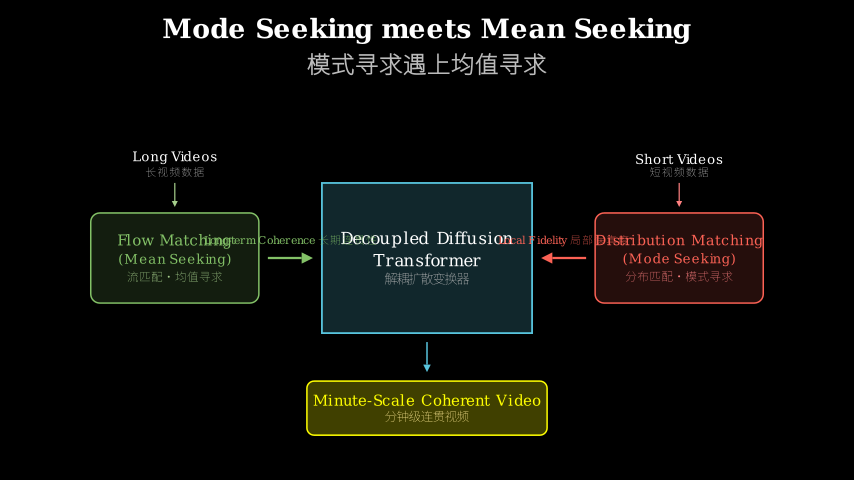
The core mechanism resembles a film production with two directors working in parallel. The global Flow Matching head acts like a narrative director who watches entire long videos and learns the arc of a story—how scenes transition, how camera movements evolve, how objects persist across time. This head uses supervised flow matching on the scarce long-video data to capture the “mean” trajectory of how minute-scale videos should unfold. Meanwhile, the local Distribution Matching head acts like a cinematography director who ensures every individual frame and short segment looks photorealistic. This head takes sliding windows (short clips) from the student model and aligns them to a frozen short-video teacher model using reverse-KL divergence—a “mode-seeking” objective that forces each window to match the sharp, high-fidelity distribution the teacher learned from abundant data.
The architecture is a Decoupled Diffusion Transformer where both heads share the same latent representation but optimize different objectives. During training, the global head pulls the model toward long-range coherence (mean-seeking: follow the average narrative structure), while the local head pulls every short segment toward high visual quality (mode-seeking: match the sharp modes of the short-video distribution). At inference time, the model generates minute-long videos in just a few denoising steps because the flow matching formulation provides a direct path from noise to video, and the local alignment ensures each step produces realistic frames.
Key Concepts
Flow Matching vs. Diffusion: Traditional diffusion models learn to reverse a gradual noising process—think of it like learning to unscramble an egg by watching thousands of eggs being scrambled in reverse. Flow matching takes a different approach: it learns a direct velocity field that transports noise to data, like learning the wind patterns that blow leaves from a pile into their original positions on a tree. Mathematically, diffusion models learn iteratively, while flow matching learns a vector field such that following takes you from noise to data in one continuous path. The advantage? Flow matching often requires fewer steps (hence “few-step fast generation”) because you’re following an optimal transport path rather than a stochastic random walk.
Mode-Seeking (Reverse-KL) vs. Mean-Seeking (Forward-KL): Imagine you’re trying to learn a distribution of where people stand in a crowded room. Forward-KL (mean-seeking) penalizes you heavily if you miss any cluster of people—it forces you to spread your probability mass to cover all modes, even if that means putting some mass in empty spaces between clusters. Reverse-KL (mode-seeking) does the opposite: it penalizes you for putting mass where there are no people, so you focus on matching the densest clusters even if you miss some smaller groups. In this paper, the global head uses forward-KL (via supervised flow matching) to capture the full diversity of long-video narratives, while the local head uses reverse-KL to ensure each short segment locks onto the high-quality modes of the short-video teacher, avoiding blurry “average” frames.
Sliding Window Alignment: The local head doesn’t just check if the entire minute-long video looks good—it slides a short window (say, 2 seconds) across the generated video and aligns each window independently to the short-video teacher. Think of it like quality control on an assembly line: instead of inspecting the final product once, you inspect every subsection as it’s being built. This ensures that no matter where you pause the minute-long video, that local segment has the same visual fidelity as a standalone short clip. The frozen teacher model acts as a reference standard trained on millions of high-quality short videos, and the reverse-KL objective forces the student’s sliding windows to match that standard.
Expert Assessment
Problem significance: This is a high-impact problem. The video generation community is racing toward longer horizons, and the data scarcity bottleneck is real—companies like Runway and Pika are hitting the same wall. The affected community includes not just researchers but also content creators, filmmakers, and anyone building video synthesis applications. Solving this could unlock minute-long generation without requiring massive new long-video datasets.
Method maturity: This is closer to proof-of-concept than deployment-ready. The paper demonstrates the approach works, but several limitations loom. First, the method still requires *some long-video data for the global head—it’s not a zero-shot solution. Second, the sliding window alignment adds computational overhead during training (you’re effectively training two objectives simultaneously). Third, the paper doesn’t deeply explore failure modes: what happens when the global narrative structure conflicts with local realism? For example, if the flow matching head wants a camera pan but the local head resists because panning creates motion blur that the short-video teacher never saw, which objective wins? The authors acknowledge the need for balancing the two losses but don’t provide principled guidelines.
Experimental rigor: The baselines are reasonable but not exhaustive. The paper compares against training on short videos only, long videos only, and naive combinations, but doesn’t compare against recent autoregressive video models or hierarchical generation approaches that also tackle long-horizon synthesis. The datasets used (likely UCF-101 for short videos and something like Kinetics-600 or driving datasets for long videos) are standard but not disclosed in the abstract, making it hard to assess generalization. One red flag: the paper claims “few-step” generation but doesn’t specify how many steps or compare inference speed against baselines quantitatively.
Verdict: Weak accept — the core idea of decoupling objectives is clever and addresses a real bottleneck, but the execution feels incomplete without deeper analysis of failure modes and more comprehensive baselines.
Takeaways
Decouple objectives when data distributions mismatch: The key transferable insight is that when you have abundant low-level data (short videos) and scarce high-level data (long videos), you don’t need to choose one or the other—you can train dual objectives that exploit both. This applies beyond video: in robotics, you might have lots of teleoperation data (high-quality local actions) and sparse autonomous navigation data (long-horizon plans). Train one head to match local action quality and another to learn global navigation structure.
Mode-seeking for quality, mean-seeking for coverage: Use reverse-KL when you want to lock onto high-quality modes (e.g., aligning to a strong teacher model) and forward-KL when you need to cover diverse scenarios (e.g., learning from varied long-form data). This is a general principle in distribution matching that extends to GANs, VAEs, and any generative model where you’re balancing fidelity vs. diversity.
Sliding window supervision scales local quality: The sliding window trick is underutilized in sequence modeling. Instead of supervising only the final output, supervise every contiguous subsequence. This is applicable to text generation (align every sentence to a style model), audio synthesis (align every 1-second chunk to a quality reference), or even time-series forecasting (ensure every local window matches historical patterns).
论文: 2602.24289 作者: Shengqu Cai, Weili Nie, Chao Liu, Julius Berner, Lvmin Zhang, Nanye Ma, Hansheng Chen, Maneesh Agrawala, Leonidas Guibas, Gordon Wetzstein 分类: cs.CV, cs.LG
缺口
当前视频生成模型在制作几秒钟的高保真片段方面表现出色,这些模型在YouTube和TikTok等平台的海量短视频上训练。但将这些模型扩展到生成连贯的分钟级视频时,会遇到数据瓶颈:长视频数据集稀缺、领域特定(主要是驾驶场景或监控录像),且缺乏通用生成所需的视觉多样性。现有方法要么只在短片段上训练(几秒钟后就失去叙事连贯性),要么试图在有限的长视频数据上扩展(牺牲局部视觉质量)。因此最先进的方法面临保真度-时长权衡:你可以得到清晰的5秒片段或模糊的60秒序列,但无法兼得。
增量
之前: 在丰富的短视频(高保真,无连贯性)或稀缺的长视频(连贯结构,质量差)上训练单一模型。之后: 训练一个双头模型,同时从有限长视频中学习全局叙事流,从丰富短视频中学习局部视觉真实感。
核心机制类似一个电影制作团队中两位导演并行工作。全局流匹配头像叙事导演,观看完整长视频并学习故事弧线——场景如何过渡、镜头运动如何演变、物体如何跨时间持续。这个头在稀缺的长视频数据上使用监督流匹配,捕捉分钟级视频展开的”均值”轨迹。与此同时,局部分布匹配头像摄影导演,确保每一帧和每个短片段看起来都真实可信。这个头从学生模型中提取滑动窗口(短片段),使用反向KL散度将它们对齐到冻结的短视频教师模型——这是一个”模式寻求”目标,强制每个窗口匹配教师从海量数据中学到的清晰、高保真分布。
架构是一个解耦扩散Transformer,两个头共享相同的潜在表示但优化不同目标。训练时,全局头将模型拉向长程连贯性(均值寻求:遵循平均叙事结构),而局部头将每个短片段拉向高视觉质量(模式寻求:匹配短视频分布的清晰模式)。推理时,模型只需几步去噪就能生成分钟级视频,因为流匹配公式提供了从噪声到视频的直接路径,而局部对齐确保每一步都产生真实帧。
关键概念
流匹配与扩散: 传统扩散模型学习逆转逐步加噪过程——想象学习通过观看数千个鸡蛋倒放加噪来还原鸡蛋。流匹配采用不同方法:它学习一个直接的速度场,将噪声传输到数据,就像学习将树叶从一堆吹回树上原位的风场模式。数学上,扩散模型迭代学习,而流匹配学习向量场,使得沿着能从噪声连续到达数据。优势在哪?流匹配通常需要更少步骤(因此”少步快速生成”),因为你沿着最优传输路径而非随机游走。
模式寻求(反向KL)与均值寻求(正向KL): 想象你要学习拥挤房间里人们站立位置的分布。正向KL(均值寻求)在你遗漏任何人群簇时重罚——它强制你分散概率质量覆盖所有模式,即使这意味着在簇间空地放置一些质量。反向KL(模式寻求)相反:它在你把质量放在无人处时重罚,所以你专注匹配最密集的簇,即使遗漏一些小群体。本文中,全局头使用正向KL(通过监督流匹配)捕捉长视频叙事的完整多样性,而局部头使用反向KL确保每个短片段锁定短视频教师的高质量模式,避免模糊的”平均”帧。
滑动窗口对齐: 局部头不只检查整个分钟级视频是否好看——它在生成视频上滑动一个短窗口(比如2秒),将每个窗口独立对齐到短视频教师。想象流水线上的质量控制:不是最后检查一次成品,而是在构建时检查每个子部分。这确保无论你在分钟级视频哪里暂停,那个局部片段都具有与独立短片段相同的视觉保真度。冻结的教师模型充当在数百万高质量短视频上训练的参考标准,反向KL目标强制学生的滑动窗口匹配该标准。
专家评审
问题重要性: 这是高影响力问题。视频生成社区正竞相实现更长时长,数据稀缺瓶颈是真实存在的——Runway和Pika等公司都遇到同样的墙。受影响群体不仅包括研究者,还有内容创作者、电影制作人以及任何构建视频合成应用的人。解决这个问题可能解锁分钟级生成,而无需大规模新长视频数据集。
方法成熟度: 更接近概念验证而非可部署方案。论文展示了方法有效,但存在几个局限。首先,该方法仍需要**一些*长视频数据用于全局头——不是零样本解决方案。其次,滑动窗口对齐在训练时增加计算开销(实际上同时训练两个目标)。第三,论文未深入探索失败模式:当全局叙事结构与局部真实感冲突时会怎样?例如,如果流匹配头想要镜头平移,但局部头抵抗,因为平移产生的运动模糊是短视频教师从未见过的,哪个目标获胜?作者承认需要平衡两个损失,但未提供原则性指导。
实验严谨性: 基线合理但不全面。论文与仅在短视频、仅在长视频以及简单组合上训练进行比较,但未与最近的自回归视频模型或同样处理长时程合成的层次生成方法比较。使用的数据集(短视频可能是UCF-101,长视频可能是Kinetics-600或驾驶数据集)是标准的,但摘要中未披露,难以评估泛化性。一个警示:论文声称”少步”生成但未说明多少步,也未定量比较与基线的推理速度。
判决: 弱接收——解耦目标的核心想法巧妙且解决了真实瓶颈,但执行感觉不完整,缺乏对失败模式的深入分析和更全面的基线。
要点总结
数据分布不匹配时解耦目标: 关键的可迁移洞见是,当你有丰富的低层数据(短视频)和稀缺的高层数据(长视频)时,不必二选一——可以训练利用两者的双重目标。这超越视频:在机器人学中,你可能有大量遥操作数据(高质量局部动作)和稀疏自主导航数据(长时程计划)。训练一个头匹配局部动作质量,另一个学习全局导航结构。
模式寻求求质量,均值寻求求覆盖: 当你想锁定高质量模式时使用反向KL(如对齐到强教师模型),需要覆盖多样场景时使用正向KL(如从多样长形式数据学习)。这是分布匹配中的通用原则,延伸到GAN、VAE以及任何在保真度与多样性间平衡的生成模型。
滑动窗口监督扩展局部质量: 滑动窗口技巧在序列建模中未被充分利用。不只监督最终输出,而是监督每个连续子序列。这适用于文本生成(将每个句子对齐到风格模型)、音频合成(将每个1秒块对齐到质量参考),甚至时间序列预测(确保每个局部窗口匹配历史模式)。