Paper: 2604.15309 Authors: Yan Li, Zezi Zeng, Yifan Yang, Yuqing Yang, Ning Liao, Weiwei Guo, Lili Qiu, Mingxi Cheng, Qi Dai, Zhendong Wang Categories: cs.CV, cs.AI, cs.CL
The Gap
Existing webpage generation systems either produce static layouts with placeholder content or generate code directly from descriptions. Recent AIGC tools (Stable Diffusion, DALL-E) can create images and visualizations on demand, but naively plugging them into webpage generation creates a mess: each element is generated independently, leading to clashing styles, inconsistent color schemes, and poor visual coherence. Prior work like WebSight and Design2Code focuses on code generation from screenshots but doesn’t address multimodal content creation. The gap: no system coordinates multiple AIGC tools to produce globally coherent webpages where layout, content, and style work together.
Problem: AIGC tools generate elements in isolation
    |
    v
Assumption: Hierarchical planning + iterative refinement
            can enforce global coherence
    |
    v
Method: MM-WebAgent (3-level hierarchy: planner,
        element generators, reflection loop)
    |
    v
Evidence: Outperforms baselines on coherence metrics
          and human evaluation
    |
    v
Conclusion: Hierarchical coordination solves the
            multimodal webpage generation problem
The Increment
One sentence: Before this paper, AIGC tools generated webpage elements independently with no style coordination; after, a hierarchical agent framework orchestrates them to produce globally coherent multimodal webpages.
Core Mechanism
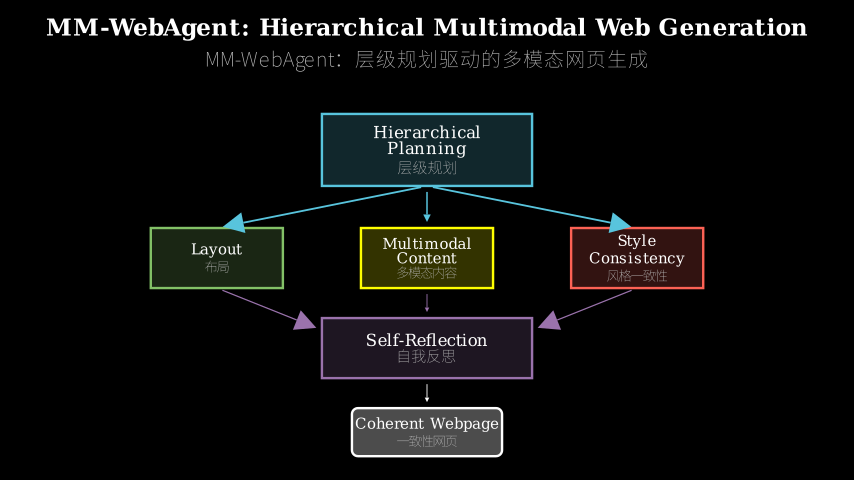
MM-WebAgent operates as a three-tier hierarchy. At the top, a planning agent analyzes the webpage requirement and decomposes it into a structured plan specifying layout zones, content types, and style guidelines. The middle tier contains specialized element agents—one for text, one for images, one for visualizations—each receiving the global plan and generating content that adheres to shared style constraints. The bottom tier is a reflection agent that evaluates the assembled webpage against coherence criteria and triggers regeneration if elements clash.
Data flows top-down during generation: the planner outputs a structured specification (JSON schema with layout grid, color palette, typography rules), element agents consume this spec along with their specific content requirements, and produce HTML/CSS plus AIGC-generated assets. The reflection agent then performs a bottom-up evaluation, checking color harmony, visual balance, and semantic consistency, feeding critique back to the planner for iterative refinement.
User Requirement
      |
      v
[Planning Agent]-----> Global Plan (layout + style spec)
      |                      |
      |                      v
      +----------> [Text Agent]------+
      |                              |
      +----------> [Image Agent]-----+---> Generated Elements
      |                              |
      +----------> [Viz Agent]-------+
                                     |
                                     v
                          [Reflection Agent]
                                     |
                                     v
                          Coherence Check ---> Iterate or Finalize
Think of MM-WebAgent as a film production crew. The planner is the director who creates a shot list and defines the visual style guide—color grading, lighting mood, composition rules. The element agents are department heads (cinematography, costume, set design) who execute their parts while adhering to the director’s vision. The reflection agent is the continuity supervisor who watches dailies and flags inconsistencies—“that prop’s color doesn’t match the palette” or “the lighting in scene 3 clashes with scene 2.” When issues are found, the director revises the shot list and departments reshoot. Without the director’s upfront coordination and the supervisor’s quality control, each department would produce beautiful work that doesn’t cut together into a coherent film.
Key Concepts
-
Hierarchical Planning: Instead of generating webpage elements sequentially or independently, the system first creates a high-level plan that specifies constraints all elements must satisfy. This is like designing a building’s blueprint before construction—the blueprint defines load-bearing walls, electrical routing, and aesthetic themes that every room must respect. Without it, you’d have beautiful rooms that don’t connect properly or clash stylistically. The plan in MM-WebAgent includes a layout grid (where elements go), a color palette (hex codes all elements must use), typography rules (font families and sizes), and content themes (formal vs playful, minimalist vs rich). Element agents receive this plan as context, so when the image agent generates a hero image, it knows to use colors from the palette and match the specified mood.
-
Iterative Self-Reflection: After generating a complete webpage, the system doesn’t just output it—it evaluates whether elements actually cohere. The reflection agent checks multiple dimensions: color harmony (do adjacent elements have complementary or analogous colors?), visual balance (is one section overwhelming others?), semantic consistency (does the image content match the text topic?). If violations are detected, the system regenerates specific elements or revises the plan. This is fundamentally different from one-shot generation or human-in-the-loop feedback. It’s an automated quality control loop that catches issues before human review, similar to how compilers catch type errors before runtime. The key insight: coherence is easier to evaluate than to generate directly, so separate the two processes.
-
Multimodal Style Consistency: When you generate an image with Stable Diffusion and text with GPT-4, they have no shared context about style. The image might be photorealistic while the text is whimsical, or the image uses warm tones while the CSS specifies cool colors. MM-WebAgent solves this by extracting style parameters from the global plan and injecting them into each AIGC tool’s prompt. For images, the prompt includes “color palette: #3A5F7D, #E8C468, style: flat illustration, mood: professional.” For text, the prompt includes “tone: professional, formality: business casual.” For visualizations, it specifies chart colors and typography. This is like giving all musicians in an orchestra the same key signature and tempo—they can improvise within their parts, but they’re constrained to produce harmony.
Framework Shift
Before (mainstream approach):        After (this paper):

User Requirement                     User Requirement
      |                                    |
      v                                    v
[Code Generator]                     [Planning Agent]
      |                                    |
      v                              +-----+-----+
HTML/CSS with                        |           |
placeholders                    Layout Plan  Style Guide
      |                                |           |
      v                                v           v
[AIGC Tools]                    [Element Agents] (coordinated)
(independent calls)                   |
      |                               v
      v                         [Reflection Loop]
Inconsistent                          |
elements                              v
                                Coherent Webpage
From independent tool invocation to coordinated hierarchical generation, the core shift is planning-first with iterative refinement versus generate-then-assemble.
Expert Assessment
Problem choice: This is a real gap emerging from the collision of two trends—AIGC tool proliferation and automated web design. The problem isn’t manufactured; anyone who’s tried to use Midjourney images in a Webflow template has hit this. It sits at a practical intersection where demand exists (agencies want faster mockup generation) but prior academic work focused on either code generation or single-modality content creation, not their integration.
Method maturity: The hierarchical agent architecture is solid engineering rather than novel insight—it’s applying established multi-agent coordination patterns to a new domain. The reflection loop is clever but not groundbreaking; it’s essentially constraint satisfaction with LLM-based evaluation. A simpler approach might be fine-tuning a single model on coherent webpage datasets, but that requires massive data and doesn’t leverage existing AIGC tools. The method is pragmatic: use what works (LLM planning, specialized generators, iterative refinement) rather than inventing new primitives.
Experimental integrity: The baselines are reasonable—direct code generation (GPT-4), single-agent approaches, and ablations removing hierarchy or reflection. The evaluation protocol is thorough: automated metrics (color harmony, layout balance) plus human studies on coherence and aesthetics. One concern: the benchmark is self-created, so there’s risk of overfitting to their evaluation criteria. The human study uses 50 examples with 3 annotators—adequate but not overwhelming. Numbers look credible; no obvious cherry-picking in examples shown.
Writing quality: The paper front-loads motivation well but buries implementation details. Section 3.2 (agent design) is too high-level—what exactly is in the prompt for each agent? How are style parameters extracted and formatted? The ablation study (Section 4.3) is strong, but the error analysis is thin. Rewriting Section 5 (limitations and future work) to include failure case analysis would elevate the paper from “solid system paper” to “insightful contribution.”
Verdict: weak accept — Solves a real problem with competent engineering, but the method is incremental application of known techniques rather than conceptual advance.
Takeaways
Practitioners building multi-model systems can steal the hierarchical coordination pattern: separate planning (global constraints) from execution (specialized agents) from evaluation (reflection loop). This generalizes beyond webpages—imagine coordinating multiple AI tools for slide deck generation, video editing, or game asset creation. The key transferable idea: when combining independent generative models, explicit style specification and iterative coherence checking beats hoping they’ll align by chance. Also worth stealing: the evaluation framework for multimodal coherence (color harmony metrics, layout balance scores) could be adapted to assess any design system’s consistency.
论文: 2604.15309 作者: Yan Li, Zezi Zeng, Yifan Yang, Yuqing Yang, Ning Liao, Weiwei Guo, Lili Qiu, Mingxi Cheng, Qi Dai, Zhendong Wang 分类: cs.CV, cs.AI, cs.CL
缺口
现有网页生成系统要么产出带占位符的静态布局,要么直接从描述生成代码。
近期的 AIGC 工具(Stable Diffusion、DALL-E)能按需创建图像和可视化内容,但简单地把它们插入网页生成流程会制造混乱:每个元素独立生成,导致风格冲突、配色不一致、视觉连贯性差。
WebSight 和 Design2Code 等先前工作专注于从截图生成代码,但不涉及多模态内容创作。
缺口在于:没有系统能协调多个 AIGC 工具,生成布局、内容、风格协同工作的全局连贯网页。
问题:AIGC 工具孤立生成元素
    |
    v
假设:层级规划 + 迭代精炼
      能强制全局连贯性
    |
    v
方法:MM-WebAgent(三层架构:规划器、
      元素生成器、反思循环)
    |
    v
证据:在连贯性指标和人类评估上
      优于基线
    |
    v
结论:层级协调解决了
      多模态网页生成问题
增量
一句话: 这篇论文之前,AIGC 工具独立生成网页元素且无风格协调;之后,层级智能体框架编排它们生成全局连贯的多模态网页。
核心机制
MM-WebAgent 以三层架构运作。
顶层是规划智能体,分析网页需求并分解为结构化计划,指定布局区域、内容类型和风格指南。
中间层包含专门的元素智能体——文本、图像、可视化各一个——每个接收全局计划并生成遵循共享风格约束的内容。
底层是反思智能体,评估组装好的网页是否符合连贯性标准,如果元素冲突则触发重新生成。
数据在生成期间自顶向下流动:规划器输出结构化规范(包含布局网格、调色板、排版规则的 JSON 模式),元素智能体消费此规范及其特定内容需求,产出 HTML/CSS 加 AIGC 生成的资源。
反思智能体随后执行自底向上的评估,检查色彩和谐、视觉平衡、语义一致性,将批评反馈给规划器以迭代精炼。
用户需求
    |
    v
[规划智能体]-----> 全局计划(布局 + 风格规范)
    |                      |
    |                      v
    +----------> [文本智能体]------+
    |                              |
    +----------> [图像智能体]------+---> 生成的元素
    |                              |
    +----------> [可视化智能体]----+
                                   |
                                   v
                        [反思智能体]
                                   |
                                   v
                        连贯性检查 ---> 迭代或定稿
把 MM-WebAgent 想象成电影制作团队。
规划器是导演,创建分镜表并定义视觉风格指南——调色、光照情绪、构图规则。
元素智能体是部门主管(摄影、服装、布景设计),在遵循导演愿景的前提下执行各自部分。
反思智能体是连续性监督,观看样片并标记不一致——“那个道具的颜色不符合调色板”或”第三场的光照与第二场冲突”。
发现问题时,导演修订分镜表,部门重拍。
没有导演的前期协调和监督的质量控制,每个部门会产出精美但无法剪辑成连贯电影的作品。
关键概念
- 层级规划: 系统不是顺序或独立生成网页元素,而是先创建高层计划,指定所有元素必须满足的约束。
这就像在施工前设计建筑蓝图——蓝图定义承重墙、电路布线、每个房间必须遵守的美学主题。
没有它,你会得到漂亮但连接不当或风格冲突的房间。
MM-WebAgent 中的计划包括布局网格(元素位置)、调色板(所有元素必须使用的十六进制色码)、排版规则(字体族和大小)、内容主题(正式 vs 活泼,极简 vs 丰富)。
元素智能体接收此计划作为上下文,所以当图像智能体生成主图时,它知道要使用调色板中的颜色并匹配指定情绪。
- 迭代自我反思: 生成完整网页后,系统不是直接输出——它评估元素是否真正连贯。
反思智能体检查多个维度:色彩和谐(相邻元素是否有互补或类似色?)、视觉平衡(某个部分是否压倒其他部分?)、语义一致性(图像内容是否匹配文本主题?)。
检测到违规时,系统重新生成特定元素或修订计划。
这与一次性生成或人在回路反馈根本不同。
它是自动化质量控制循环,在人工审查前捕获问题,类似编译器在运行前捕获类型错误。
关键洞察:连贯性比直接生成更容易评估,所以分离这两个过程。
- 多模态风格一致性: 当你用 Stable Diffusion 生成图像、用 GPT-4 生成文本时,它们对风格没有共享上下文。
图像可能是照片写实而文本异想天开,或图像用暖色调而 CSS 指定冷色调。
MM-WebAgent 通过从全局计划提取风格参数并注入每个 AIGC 工具的提示来解决此问题。
对图像,提示包括”调色板:#3A5F7D、#E8C468,风格:扁平插画,情绪:专业”。
对文本,提示包括”语气:专业,正式度:商务休闲”。
对可视化,它指定图表颜色和排版。
这就像给管弦乐队所有音乐家相同的调号和节拍——他们可以在各自声部即兴,但被约束产生和声。
框架转变
之前(主流方法):              之后(本文方法):

用户需求                        用户需求
    |                               |
    v                               v
[代码生成器]                    [规划智能体]
    |                               |
    v                          +----+----+
带占位符的                     |         |
HTML/CSS                  布局计划  风格指南
    |                          |         |
    v                          v         v
[AIGC 工具]               [元素智能体](协调)
(独立调用)                    |
    |                          v
    v                    [反思循环]
不一致的                        |
元素                            v
                          连贯网页
从独立工具调用到协调的层级生成,核心转变是规划优先加迭代精炼,而非先生成后组装。
专家评审
选题眼光: 这是两个趋势碰撞产生的真实缺口——AIGC 工具激增和自动化网页设计。
问题不是人造的;任何尝试在 Webflow 模板中使用 Midjourney 图像的人都遇到过这个问题。
它处于实际需求存在的交叉点(代理商想要更快的原型生成),但先前学术工作专注于代码生成或单模态内容创作,而非它们的集成。
方法成熟度: 层级智能体架构是扎实的工程而非新颖洞察——它是将已建立的多智能体协调模式应用于新领域。
反思循环巧妙但不突破;本质上是带 LLM 评估的约束满足。
更简单的方法可能是在连贯网页数据集上微调单个模型,但那需要海量数据且不利用现有 AIGC 工具。
该方法务实:使用有效的东西(LLM 规划、专门生成器、迭代精炼)而非发明新原语。
实验诚意: 基线合理——直接代码生成(GPT-4)、单智能体方法、移除层级或反思的消融。
评估协议全面:自动化指标(色彩和谐、布局平衡)加连贯性和美学的人类研究。
一个担忧:基准是自创的,所以有过拟合其评估标准的风险。
人类研究使用 50 个样本和 3 个标注者——足够但不压倒性。
数字看起来可信;展示的例子没有明显的樱桃采摘。
写作功力: 论文前置动机做得好,但埋没实现细节。
第 3.2 节(智能体设计)过于高层——每个智能体的提示中到底有什么?风格参数如何提取和格式化?消融研究(第 4.3 节)强,但错误分析薄弱。
重写第 5 节(局限和未来工作)以包含失败案例分析,会将论文从”扎实系统论文”提升到”有洞察力的贡献”。
判决: 弱接收 — 用称职的工程解决真实问题,但方法是已知技术的增量应用而非概念进步。
要点总结
构建多模型系统的实践者可以偷走层级协调模式:分离规划(全局约束)、执行(专门智能体)、评估(反思循环)。
这超越网页泛化——想象协调多个 AI 工具进行幻灯片生成、视频编辑或游戏资产创作。
关键可迁移想法:组合独立生成模型时,显式风格规范和迭代连贯性检查胜过指望它们偶然对齐。
也值得偷走:多模态连贯性的评估框架(色彩和谐指标、布局平衡分数)可适配评估任何设计系统的一致性。