
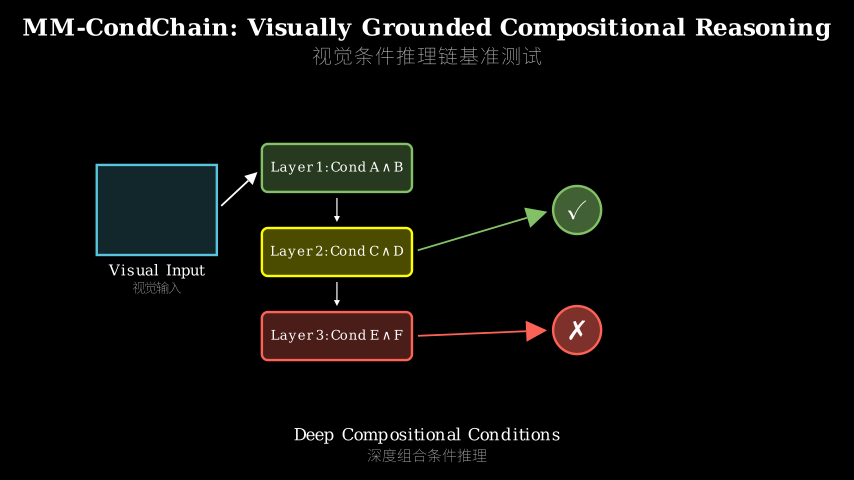
Paper: 2603.12266 Authors: Haozhan Shen, Shilin Yan, Hongwei Xue, Shuaiqi Lu, Xiaojun Tang, Guannan Zhang, Tiancheng Zhao, Jianwei Yin Categories: cs.CV
The Gap
Existing multimodal benchmarks — VQA, MMBench, MMStar, and their cousins — are fundamentally single-shot: you look at an image, you answer a question. Even the ones that claim “compositional reasoning” mostly mean “the question has two parts.” What they don’t test is whether a model can evaluate a chain of conditional statements where each step depends on visual evidence, and where getting step 2 wrong means the entire execution path diverges.
This matters because real-world visual workflows — GUI automation, document processing, robotic task planning — are structured as conditional programs: “if X is visible AND Y has property Z, then do A, else do B.” Prior benchmarks treat each condition as independent and shallow. They don’t test depth (chained dependencies), they don’t test hard negatives (conditions that look true but aren’t), and they don’t verify correctness programmatically — they rely on human annotation that doesn’t scale.
Problem: MLLMs deployed in workflows need conditional visual reasoning
    |
    v
Prior benchmarks: single-step QA or shallow independent conditions
    |
    v
Assumption: deep chained conditionals require a different evaluation paradigm
    |
    v
Method: MM-CondChain -- layered conditions + VPIR + agentic synthesis
    |
    v
Evidence: best model scores 53.33 Path F1, drops sharply with depth
    |
    v
Conclusion: deep compositional reasoning is a real, unsolved capability gap
The Increment
One sentence: Before this paper, we had no way to rigorously test whether a vision-language model can follow a branching conditional program grounded in visual evidence — now we do, and the answer is: not very well.
Core Mechanism
The benchmark is built around what the authors call a “multi-layer reasoning chain.” Each instance is a small conditional program: layer 1 checks some visual condition (e.g., “is there a dialog box AND is its border color red?”), and the result — true or false — determines which branch layer 2 evaluates, and so on. The final answer isn’t just a label; it’s the execution path the model took through the chain. This is evaluated with Path F1, which gives partial credit for getting some layers right even if the final outcome is wrong.
The construction pipeline has three stages. A Planner LLM generates compositional conditions layer by layer, making sure each condition involves multiple visual predicates (object presence, attribute value, spatial relation). Each condition is then compiled into a Verifiable Programmatic Intermediate Representation (VPIR) — essentially a structured logical expression that can be mechanically checked against ground truth. A Composer then assembles the verified layers into a natural-language instruction that reads like a real workflow step. This pipeline runs across three domains: natural images (COCO-style), data charts, and GUI screenshots.
The hard negative construction is worth noting separately. For each true condition, the pipeline generates a near-miss variant — same structure, slightly wrong attribute or object — so models can’t shortcut by pattern-matching the surface form of the question.
Image + Domain
    |
    v
[Planner LLM]
    |  generates layer-by-layer compositional conditions
    v
[VPIR Compiler]
    |  condition -> structured logical expression
    |  mechanical verification against ground truth
    v
[Composer LLM]
    |  assembles verified layers into natural-language instruction
    v
Benchmark Instance:
  Layer 1: condition_A (AND/OR predicates) -> True/False
      |
      +-- True  -> Layer 2a: condition_B -> True/False -> ...
      |
      +-- False -> Layer 2b: condition_C -> True/False -> ...
                                              |
                                              v
                                         Final outcome + execution path
Think of it like a building inspection checklist that branches. An inspector walks into a building and checks: “Is the fire exit clearly marked AND is the sprinkler system green-tagged?” If yes, move to the structural check. If no, flag it and go to the remediation branch. The inspector’s job isn’t just to answer yes/no at the end — it’s to follow the right path through the checklist based on what they actually see. The Planner is the person who writes the checklist. The VPIR is the legal standard that defines what “clearly marked” means precisely enough to be audited. The Composer turns the legal standard back into plain English for the inspector. And Path F1 scores not just whether the inspector reached the right final verdict, but whether they took the right path to get there.
Key Concepts
-
Verifiable Programmatic Intermediate Representation (VPIR): The core reliability trick. Instead of asking humans to judge whether a generated condition is correct, the pipeline compiles each condition into a formal logical expression (think:
AND(EXISTS(dialog_box), EQUALS(border_color, red))). This expression can be evaluated mechanically against annotated ground truth. It’s the difference between asking “does this sentence sound right?” and running a unit test. The VPIR is what makes the pipeline scalable — you can generate thousands of conditions and verify them without human review of each one. -
Path F1: Standard accuracy would just check the final answer. But in a branching chain, a model might get the final answer right by accident (wrong path, lucky outcome) or get it wrong despite correct intermediate reasoning. Path F1 treats the execution path as a sequence and computes F1 over the sequence of correct layer evaluations. This gives a much more honest picture of whether the model is actually reasoning or just guessing at the end.
-
Hard Negatives: For each condition in the benchmark, there’s a near-miss version — same visual scene, same question structure, but one predicate is subtly wrong (e.g., the dialog exists but the color is blue, not red). This forces models to actually evaluate each predicate rather than relying on heuristics like “dialogs usually appear with permission requests.” The sharp performance drop on hard negatives in the experiments is the most telling result in the paper.
Framework Shift
Before (mainstream approach):        After (this paper):

Image -> [Single Question]           Image -> [Layer 1 Condition]
             |                                      |
             v                              True /     \ False
         [Answer]                            /             \
                                    [Layer 2a]         [Layer 2b]
Image -> [Multi-part Question]              |               |
             |                          True/False      True/False
             v                              \               /
         [Answer A] + [Answer B]             \             /
         (independent, no branching)          v           v
                                         [Execution Path + Final Outcome]
                                         evaluated by Path F1
From flat question-answering to branching conditional execution, the core shift is: the model’s output is now a program trace, not a label.
Expert Assessment
Problem choice: This is a real gap, not a manufactured one. The motivation from GUI automation and visual workflows is genuine — anyone who has tried to use an MLLM to automate a multi-step UI task knows that conditional branching is exactly where these models fall apart. The paper sits at a natural intersection of program synthesis, visual grounding, and agent evaluation, which is where the field is clearly heading. Good timing.
Method maturity: The VPIR idea is the clever bit — using a formal intermediate representation to decouple generation from verification is a solid engineering insight that transfers well. The agentic synthesis pipeline is more “sensible engineering” than “novel insight,” but it works. The concern is that the VPIR expressiveness is never fully characterized — we don’t know what class of conditions it can and can’t represent, which matters if you want to extend this to more complex domains.
Experimental integrity: The baselines are reasonable — they test a range of open and closed models including GPT-4V class systems. The 53.33 Path F1 ceiling for the best model is a credible result, not suspiciously low or high. The ablations on depth and predicate complexity are the right experiments to run. One flag: the paper doesn’t report inter-annotator agreement for the human-verified portions of the pipeline, which makes it hard to assess how much noise is in the ground truth. Also, the three domains (natural images, charts, GUIs) are evaluated somewhat separately — a unified analysis of cross-domain transfer would strengthen the claims.
Writing quality: The pipeline description is the weakest section. The Planner/VPIR/Composer breakdown is clear in concept but the paper spends too much space on implementation details that belong in an appendix, and not enough on the formal properties of VPIR (what can it express? what are its limits?). Rewriting the VPIR section to include a formal grammar or at least a worked example with the actual logical expression would make the paper significantly more rigorous and reusable.
Verdict: weak accept — the benchmark fills a real gap and the VPIR construction trick is genuinely useful, but the paper undersells its own theoretical contribution and the experimental analysis stops just short of the depth needed to be fully convincing.
Takeaways
The VPIR pattern is the most transferable idea here. If you’re building any kind of synthetic benchmark where you need to verify that generated conditions are correct without human review of every instance, the “compile to a formal representation, verify mechanically, then render back to natural language” pipeline is a clean pattern worth stealing. It’s essentially test-driven data generation.
Path F1 as an evaluation metric for branching reasoning tasks is also worth adopting. If you’re evaluating any model on a task that has intermediate steps with dependencies, scoring only the final output throws away signal. Path F1 (or any sequence-level metric over the execution trace) gives you a much more diagnostic picture.
The hard negative construction strategy — generate near-miss variants by perturbing one predicate — is a simple but effective way to stress-test whether models are actually evaluating conditions or pattern-matching. Easy to adapt to other grounding tasks.
论文: 2603.12266 作者: Haozhan Shen, Shilin Yan, Hongwei Xue, Shuaiqi Lu, Xiaojun Tang, Guannan Zhang, Tiancheng Zhao, Jianwei Yin 分类: cs.CV
缺口
现有的多模态基准——VQA、MMBench、MMStar 这一家子——本质上都是单次问答:看一张图,回答一个问题。
就算那些声称测试「组合推理」的基准,大多数也只是把问题拆成两个部分而已。
它们没有测试的是:模型能不能评估一条条件语句链,其中每一步都依赖视觉证据,而且第二步答错了整条执行路径就会偏离。
这个问题在现实中很重要。GUI 自动化、文档处理、机器人任务规划,这些场景的结构本质上是条件程序:「如果 X 可见,且 Y 具有属性 Z,则执行 A,否则执行 B。」
现有基准把每个条件当作独立的、浅层的来处理。它们不测试深度(链式依赖),不测试难负例(看起来为真但实际为假的条件),也不用程序化方式验证正确性——它们依赖人工标注,根本无法规模化。
问题:部署在工作流中的 MLLM 需要条件视觉推理能力
    |
    v
现有基准:单步问答,或浅层独立条件
    |
    v
假设:深层链式条件需要一套不同的评估范式
    |
    v
方法:MM-CondChain -- 分层条件 + VPIR + 智能体合成流水线
    |
    v
证据:最强模型 Path F1 仅 53.33,随深度增加急剧下降
    |
    v
结论:深层组合推理是真实存在的、尚未解决的能力缺口
增量
一句话:这篇论文之前,我们没有办法严格测试视觉语言模型能不能跟着视觉证据走条件分支程序——现在有了,而且答案是:不太行。
核心机制
基准的核心是作者所说的「多层推理链」。
每个实例是一个小型条件程序:第一层检查某个视觉条件(比如「是否存在对话框,且其边框颜色是红色?」),结果为真或假,决定第二层走哪个分支,以此类推。
最终答案不只是一个标签,而是模型在整条链上走过的执行路径。评估指标是 Path F1——即使最终结果答错了,只要中间某些层答对了,也能得到部分分数。
构建流水线分三个阶段。
Planner LLM 逐层生成组合条件,确保每个条件涉及多个视觉谓词(物体存在性、属性值、空间关系)。
每个条件随后被编译成可验证程序化中间表示(VPIR)——本质上是一个结构化逻辑表达式,可以机械地对照真值进行核验。
Composer LLM 再把验证过的各层组装成自然语言指令,读起来像真实的工作流步骤。
这条流水线覆盖三个领域:自然图像(COCO 风格)、数据图表、GUI 截图。
图像 + 领域
    |
    v
[Planner LLM]
    |  逐层生成组合条件
    v
[VPIR 编译器]
    |  条件 -> 结构化逻辑表达式
    |  对照真值机械验证
    v
[Composer LLM]
    |  将验证层组装为自然语言指令
    v
基准实例:
  第1层:条件_A(AND/OR