Paper: 2604.11589 Authors: Shuitsu Koyama, Yuiga Wada, Daichi Yashima, Komei Sugiura Categories: cs.CV
The Gap
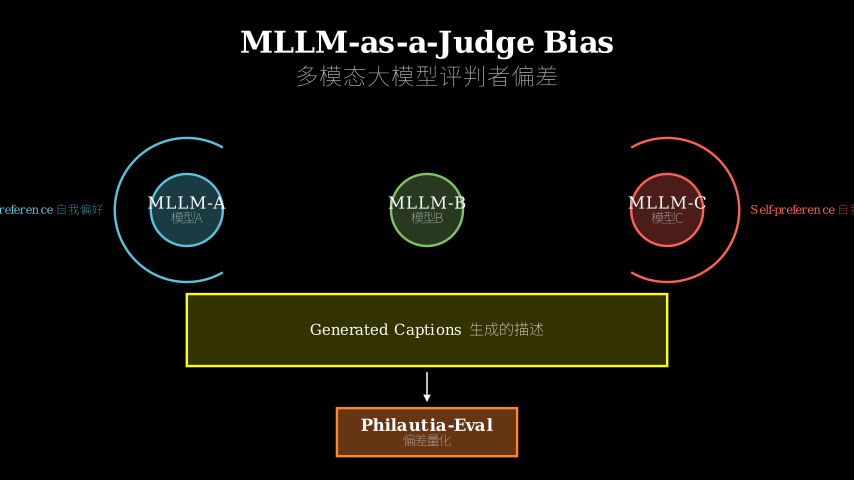
We’ve been using MLLMs to judge other MLLMs’ outputs — it’s faster and cheaper than human evaluation. But here’s the problem: nobody systematically checked whether these judge models play favorites. Prior work like LLM-as-a-Judge focused on text-only models, and multimodal evaluation studies assumed judges were neutral arbiters. This paper asks: what if the judge prefers outputs from models similar to itself?
The existing boundary is that we treat MLLM evaluation scores as ground truth for benchmarking, but we don’t account for systematic bias toward specific model architectures or training lineages.
Problem: MLLM judges may favor certain models
    |
    v
Assumption: Bias stems from architectural/training similarity
    |
    v
Method: Philautia-Eval (disentangle quality from preference)
    |
    v
Evidence: 1.29M caption-score pairs show self/family preference
    |
    v
Conclusion: Ensemble judges (Pomms) mitigate bias
The Increment
One sentence: Before this paper, we assumed MLLM judges were neutral; after, we know they exhibit measurable self-preference and family-preference biases that can be mitigated through ensembling.
Core Mechanism
Philautia-Eval works by collecting a massive dataset of caption-score pairs where different MLLMs judge captions generated by various MLLMs. The key insight is to separate two confounded factors: (1) actual quality differences between captions, and (2) systematic preference for certain generators.
The method uses a Bradley-Terry model to estimate both a “quality score” for each generator and a “preference bias” for each judge-generator pair. If a judge consistently rates one generator higher than quality alone would predict, that’s bias. They collect 1.29M evaluations across 12 MLLMs judging each other’s image captions.
Input: Image + Caption pairs from 12 MLLMs
    |
    v
[Judge MLLM A] --scores--> Caption from Generator X
[Judge MLLM B] --scores--> Caption from Generator X
[Judge MLLM C] --scores--> Caption from Generator X
    |
    v
Bradley-Terry Model:
  Score = Quality(Generator) + Bias(Judge, Generator)
    |
    v
Output: Disentangled quality vs. preference bias matrix
Think of it like a cooking competition where the judges are also contestants. You’d expect some judges to favor their own cooking style or the style of chefs they trained with. To detect this, you need many judges rating many dishes. If Judge A consistently rates Chef A’s dishes higher than other judges do (even after accounting for Chef A’s actual skill), that’s bias. Philautia-Eval is the statistical framework that separates “Chef A is genuinely good” from “Judge A just likes Chef A’s style.” The ensemble solution (Pomms) is like having a panel of judges with different biases — their individual preferences cancel out.
Key Concepts
-
Self-preference bias (Philautia): When an MLLM judge rates outputs from itself higher than outputs of equivalent quality from other models. Named after the Greek concept of self-love. Imagine you’re grading essays and unconsciously give higher marks to essays that use your favorite phrases or argument structures — that’s self-preference. In MLLMs, this happens because the judge recognizes patterns from its own training or generation style.
-
Family-preference bias: Models from the same “family” (sharing architectural components like vision-language connectors or trained on overlapping instruction-tuning datasets) prefer each other’s outputs. It’s like how people from the same school might unconsciously favor each other’s work because they share common frameworks and vocabulary. The paper found that LLaVA-family models prefer other LLaVA outputs, likely because they share the same connector architecture.
-
Bradley-Terry model: A statistical framework originally designed for pairwise comparisons (like chess rankings). Here, it models each evaluation score as the sum of a generator’s inherent quality and a judge-specific bias term. This lets you answer: “Is Generator X scoring high because it’s genuinely good, or because Judge Y happens to like it?” The math assumes that if you have enough cross-comparisons, you can solve for both quality and bias simultaneously.
Framework Shift
Before (mainstream approach):        After (this paper):

MLLM Judge                          Multiple MLLM Judges
    |                                   |    |    |
    v                                   v    v    v
[Score] --> Benchmark Ranking       [Scores with bias terms]
                                         |
Assumption: Judge is neutral            v
                                    Disentangle quality
                                    from preference bias
                                         |
                                         v
                                    Ensemble to cancel bias
                                         |
                                         v
                                    Debiased Ranking
From treating judges as neutral measurement instruments to treating them as biased observers whose systematic preferences must be modeled and corrected.
Expert Assessment
Problem choice: This is a real gap with immediate practical consequences. As MLLM-as-a-Judge becomes standard practice (it’s already used in major benchmarks), undetected bias could create feedback loops where models optimize for judge preferences rather than actual quality. The problem sits at a critical juncture — we’re scaling up automatic evaluation before validating its assumptions.
Method maturity: The approach is solid but not groundbreaking. Bradley-Terry models are well-established, and the application here is straightforward. The real contribution is empirical: systematically demonstrating the bias exists at scale. The ensemble solution (Pomms) is almost too simple — just average multiple judges — but that’s actually a strength. No need for complex debiasing algorithms when a simple fix works.
Experimental integrity: The 1.29M evaluation dataset is impressive in scale. Baselines are fair. One concern: the paper focuses on image captioning, which might not generalize to other multimodal tasks. Also, the Bradley-Terry model assumes transitivity (if A > B and B > C, then A > C), which might not hold for subjective quality judgments. The bias measurements are convincing, but I’d want to see ablations on different prompt templates — could the bias be prompt-dependent?
Writing quality: The paper is clear but front-loads too much motivation. The related work section could be tighter. The experimental section is well-structured, but the discussion of why family bias occurs (shared connectors, overlapping data) feels speculative — they should either test these hypotheses directly or frame them as open questions. The Pomms section feels rushed; more analysis of which ensemble combinations work best would strengthen it.
Verdict: weak accept — The empirical finding is important and the dataset is valuable, but the method is incremental and the solution is obvious once you identify the problem.
Takeaways
Concrete steal #1: If you’re building any kind of AI-judged evaluation pipeline, don’t rely on a single judge model. The ensemble approach (Pomms) is trivial to implement and demonstrably reduces bias. Even just averaging two diverse judges helps.
Concrete steal #2: The Bradley-Terry decomposition technique transfers to any domain where you have multiple evaluators rating multiple items. If you’re doing human evaluation studies, you can use the same math to separate item quality from annotator bias. This is useful for quality control in data labeling.
Concrete steal #3: The concept of “family bias” suggests that when fine-tuning or building on top of existing models, you should test evaluation on models from different lineages. If you only validate on models from the same family, you might be measuring in-group preference rather than actual improvement.
Warning: The paper doesn’t address a deeper issue — if all MLLMs are trained on similar internet data, they might share biases that no ensemble can fix. The bias they measure is relative (Model A prefers itself over Model B), but there could be absolute biases (all models prefer certain caption styles) that remain invisible.
论文: 2604.11589 作者: Shuitsu Koyama, Yuiga Wada, Daichi Yashima, Komei Sugiura 分类: cs.CV
缺口
我们一直在用多模态大模型来评判其他多模态大模型的输出——这比人工评估更快更便宜。
但问题来了:没人系统性地检查过这些评判模型是否会偏心。
之前关于 LLM-as-a-Judge 的工作只关注纯文本模型,多模态评估研究则假设评判者是中立的裁判。
这篇论文问:如果评判者偏好与自己相似的模型的输出怎么办?
现有的边界是,我们把多模态大模型的评估分数当作基准测试的真值,但没有考虑对特定模型架构或训练谱系的系统性偏差。
问题:多模态大模型评判者可能偏好某些模型
    |
    v
假设:偏差源于架构/训练的相似性
    |
    v
方法:Philautia-Eval(解耦质量与偏好)
    |
    v
证据:129万个标注-分数对显示自我/家族偏好
    |
    v
结论:集成评判者(Pomms)缓解偏差
增量
一句话:这篇论文之前,我们假设多模态大模型评判者是中立的;之后,我们知道它们表现出可测量的自我偏好和家族偏好偏差,可以通过集成来缓解。
核心机制
Philautia-Eval 的工作方式是收集大量标注-分数对数据集,让不同的多模态大模型评判各种多模态大模型生成的标注。
关键洞察是分离两个混淆因素:(1)标注之间的实际质量差异,(2)对某些生成器的系统性偏好。
该方法使用 Bradley-Terry 模型来估计每个生成器的”质量分数”和每个评判者-生成器对的”偏好偏差”。
如果一个评判者持续给某个生成器打出高于质量本身预测的分数,那就是偏差。
他们收集了 12 个多模态大模型互相评判图像标注的 129 万次评估。
输入:来自 12 个多模态大模型的图像+标注对
    |
    v
[评判者 A] --打分--> 生成器 X 的标注
[评判者 B] --打分--> 生成器 X 的标注
[评判者 C] --打分--> 生成器 X 的标注
    |
    v
Bradley-Terry 模型:
  分数 = 质量(生成器) + 偏差(评判者, 生成器)
    |
    v
输出:解耦的质量 vs. 偏好偏差矩阵
把它想象成一场烹饪比赛,评委同时也是参赛者。
你会预期某些评委偏好自己的烹饪风格或与他们一起训练过的厨师的风格。
要检测这一点,你需要很多评委给很多菜打分。
如果评委 A 持续给厨师 A 的菜打出比其他评委更高的分数(即使考虑了厨师 A 的实际技能),那就是偏差。
Philautia-Eval 是分离”厨师 A 确实很好”和”评委 A 只是喜欢厨师 A 的风格”的统计框架。
集成解决方案(Pomms)就像有一个由不同偏好的评委组成的评审团——他们的个人偏好相互抵消。
关键概念
- 自我偏好偏差(Philautia):当一个多模态大模型评判者给自己的输出打出高于其他模型同等质量输出的分数时。
以希腊语中的自爱概念命名。
想象你在批改论文,无意识地给使用你喜欢的短语或论证结构的论文打更高的分数——这就是自我偏好。
在多模态大模型中,这种情况发生是因为评判者识别出来自自己训练或生成风格的模式。
- 家族偏好偏差:来自同一”家族”的模型(共享架构组件如视觉-语言连接器或在重叠的指令调优数据集上训练)偏好彼此的输出。
这就像同一所学校的人可能无意识地偏好彼此的工作,因为他们共享共同的框架和词汇。
论文发现 LLaVA 家族模型偏好其他 LLaVA 输出,可能是因为它们共享相同的连接器架构。
- Bradley-Terry 模型:最初为成对比较(如国际象棋排名)设计的统计框架。
在这里,它将每个评估分数建模为生成器固有质量和评判者特定偏差项的总和。
这让你能回答:“生成器 X 得分高是因为它确实好,还是因为评判者 Y 恰好喜欢它?“数学假设如果你有足够的交叉比较,你可以同时求解质量和偏差。
框架转变
之前(主流方法):              之后(本文方法):

多模态大模型评判者              多个多模态大模型评判者
    |                               |    |    |
    v                               v    v    v
[分数] --> 基准排名              [带偏差项的分数]
                                     |
假设:评判者是中立的                v
                                解耦质量与偏好偏差
                                     |
                                     v
                                集成以抵消偏差
                                     |
                                     v
                                去偏差排名
从把评判者当作中立的测量工具,到把它们当作有偏差的观察者,其系统性偏好必须被建模和纠正。
专家评审
选题眼光:这是一个有直接实际后果的真实缺口。
随着多模态大模型评判者成为标准实践(它已经在主要基准测试中使用),未被检测到的偏差可能创造反馈循环,模型优化的是评判者偏好而非实际质量。
这个问题处于关键节点——我们在验证假设之前就扩大了自动评估的规模。
方法成熟度:方法扎实但不算突破性。
Bradley-Terry 模型已经很成熟,这里的应用很直接。
真正的贡献是实证性的:系统性地大规模展示偏差的存在。
集成解决方案(Pomms)几乎太简单了——只是平均多个评判者——但这实际上是优势。
当简单的修复有效时,不需要复杂的去偏算法。
实验诚意:129 万评估数据集的规模令人印象深刻。
基线公平。
一个担忧:论文专注于图像标注,可能无法推广到其他多模态任务。
另外,Bradley-Terry 模型假设传递性(如果 A > B 且 B > C,则 A > C),这对主观质量判断可能不成立。
偏差测量令人信服,但我想看到不同提示模板的消融实验——偏差可能依赖于提示吗?
写作功力:论文清晰但前置了太多动机。
相关工作部分可以更紧凑。
实验部分结构良好,但关于家族偏差为何发生(共享连接器、重叠数据)的讨论感觉是推测性的——他们应该直接测试这些假设或将其框定为开放问题。
Pomms 部分感觉仓促;更多关于哪些集成组合效果最好的分析会加强它。
判决:弱接收——实证发现很重要,数据集有价值,但方法是增量式的,解决方案在识别问题后是显而易见的。
要点总结
具体可偷 #1:如果你在构建任何类型的 AI 评判评估管道,不要依赖单一评判模型。
集成方法(Pomms)实现起来很简单,并且可证明地减少了偏差。
即使只是平均两个不同的评判者也有帮助。
具体可偷 #2:Bradley-Terry 分解技术可以迁移到任何有多个评估者给多个项目打分的领域。
如果你在做人工评估研究,可以用同样的数学方法分离项目质量和标注者偏差。
这对数据标注中的质量控制很有用。
具体可偷 #3:“家族偏差”的概念表明,在微调或基于现有模型构建时,应该在来自不同谱系的模型上测试评估。
如果只在同一家族的模型上验证,你可能测量的是群体内偏好而非实际改进。
警告:论文没有解决一个更深层的问题——如果所有多模态大模型都在相似的互联网数据上训练,它们可能共享任何集成都无法修复的偏差。
他们测量的偏差是相对的(模型 A 偏好自己胜过模型 B),但可能存在绝对偏差(所有模型偏好某些标注风格)仍然不可见。