Paper: 2606.06473 Authors: Shangheng Du, Xiangchao Yan, Jinxin Shi, Zongsheng Cao, Shiyang Feng, Zichen Liang, Boyuan Sun, Tianshuo Peng, Yifan Zhou, Xin Li Categories: cs.AI, cs.CL
The Gap
Existing LLM agents for machine learning engineering (like OpenHands, AIDE) treat each search branch independently—when one exploration path discovers something useful, that knowledge stays siloed. They also lack memory across tasks, starting from scratch every time. For long-horizon problems like discovering novel ML algorithms or optimizing pipelines over 12+ hours, this memoryless, isolated search becomes wasteful. Prior methods either explore too broadly without convergence (pure Monte Carlo) or exploit too narrowly without discovering fundamentally new approaches (greedy search).
Problem: Long-horizon ML algorithm discovery
         |
         v
Existing agents' limitations:
  - Tree search branches don't share info --> wasted exploration
  - No memory across tasks --> repeated failures
  - Flat search control --> can't shift explore/exploit balance
         |
         v
Assumption: Cross-branch knowledge + accumulated experience
            + progressive search schedule = better discovery
         |
         v
Method: MLEvolve
  [Graph-based tree search] + [Retrospective Memory] + [Hierarchical control]
         |
         v
Evidence: MLE-Bench (medal rate), AlphaEvolve comparison (math optimization)
         |
         v
Conclusion: SOTA on ML engineering benchmarks + cross-domain generalization
The Increment
One sentence: Before MLEvolve, LLM agents searched for ML solutions in isolated trees with no memory; after, they search in knowledge-sharing graphs with evolving experience, achieving competitive performance in half the standard time.
Core Mechanism
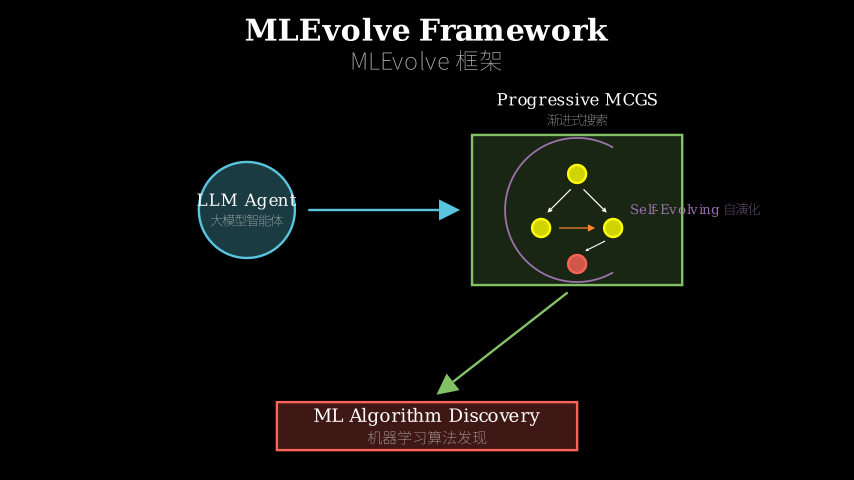
MLEvolve has three interlocking components. First, Progressive MCGS (Monte Carlo Graph Search) extends traditional tree search by adding reference edges between branches—when one branch discovers a useful technique, other branches can access it through these cross-links. The search starts with high-entropy exploration (try many diverse approaches) and gradually shifts to low-entropy exploitation (refine promising ones) following an annealing schedule.
Second, Retrospective Memory stores two kinds of knowledge: a cold-start knowledge base (general ML patterns) and a dynamic global memory (task-specific learnings from previous runs). When starting a new search branch, the agent retrieves relevant past experiences—both successes and failures—to guide decisions.
Third, Hierarchical Control decouples strategy from execution. A planner agent decides what to try next (which algorithm family, which hyperparameters) while separate coder agents implement those decisions using adaptive coding modes (direct generation vs. retrieval-augmented generation vs. chain-of-thought). This separation prevents low-level coding failures from derailing high-level strategy.
Input Task
    |
    v
[Planner Agent] <----- [Retrospective Memory]
    |                   /              \
    v                  /                \
Strategy Tree     Cold-start KB    Dynamic Memory
    |                                (past runs)
    +----+----+----+
    |    |    |    |
    v    v    v    v
 Branch1 Branch2 Branch3 ...
    |    |    |    |
    *====*====*====*  <-- Reference edges (graph structure)
    |
    v
[Coder Agents] (adaptive modes)
    |
    v
Generated Code --> Execution --> Feedback
                                    |
                                    +---> Update Global Memory
Think of MLEvolve like a research lab with multiple PhD students working on related problems. Each student (branch) pursues their own approach, but they regularly share findings in group meetings (reference edges). The lab keeps a library of textbooks (cold-start KB) and a wiki of past project notes (dynamic memory). A senior advisor (planner) assigns research directions but doesn’t micromanage implementation details. Early on, the advisor encourages diverse explorations—try neural nets, try ensemble methods, try different feature engineering. As deadlines approach, the advisor narrows focus to the most promising directions and pushes for refinement. When a student gets stuck on coding, they can choose their own method: write from scratch, adapt code from the wiki, or think through the logic step-by-step before coding.
Key Concepts
-
Progressive MCGS (Monte Carlo Graph Search): Imagine searching for a hiking trail in a mountain range. Traditional tree search is like sending explorers down different valleys, but they never talk to each other—if one finds a waterfall, others might waste time searching for water elsewhere. Graph search adds walkie-talkies and shared maps. The “progressive” part means you start by sending explorers in all directions (high entropy) to survey the terrain, then gradually focus resources on the most promising paths (low entropy) as you learn more. The entropy schedule controls this shift: early on, 80% of compute goes to exploration; by the end, 80% goes to refining the best route found so far.
-
Retrospective Memory: This is a two-tier filing system. The cold-start KB is like a cookbook—general recipes that work across many dishes. The dynamic global memory is like your personal cooking journal—notes on what worked last Tuesday when you made risotto, what burned, which substitutions succeeded. Before starting a new task, the agent queries both: “Show me standard approaches for tabular classification” (from KB) and “What did I learn when I worked on the credit-default dataset last week?” (from memory). This prevents rediscovering known failures and accelerates convergence by starting from informed priors rather than random guesses.
-
Adaptive Coding Modes: Not all code generation requires the same approach. When implementing a standard algorithm (logistic regression), direct generation from the LLM is fast and reliable. When tackling something unusual (custom loss function for imbalanced data), retrieval-augmented generation helps—fetch similar past implementations and adapt them. When debugging subtle failures (why does validation accuracy plateau?), chain-of-thought reasoning works better—explicitly reason through the logic before writing fixes. The coder agents switch between these modes based on task complexity and available examples, like a programmer choosing between copying from Stack Overflow, reading documentation, or whiteboarding the problem.
Framework Shift
Before (isolated tree search):          After (graph search + memory):

Task --> Agent                          Task --> [Retrospective Memory]
           |                                            |
           v                                            v
      Tree Search                              [Planner Agent]
      /    |    \                                      |
     /     |     \                                     v
  Branch Branch Branch                         Progressive MCGS
    |       |       |                          (graph structure)
    v       v       v                          /    |    \    \
  Code    Code    Code                        /     |     \    \
    |       |       |                     Branch--Branch--Branch--Branch
    v       v       v                       |       |       |       |
  Result  Result  Result                    *=======*=======*=======*
                                             |   (shared knowledge)  |
  (no cross-talk,                            v                       v
   no memory,                             Code (adaptive)         Code
   flat explore/exploit)                     |                       |
                                             v                       v
                                          Result --> Memory Update
One sentence: From isolated tree branches searching blindly, to knowledge-sharing graph nodes that learn from accumulated experience and progressively focus effort.
Expert Assessment
Problem choice: This addresses a real bottleneck. Long-horizon agent tasks genuinely suffer from the isolation and amnesia the authors identify. The problem sits squarely in the current trajectory of applying LLMs to complex, multi-step engineering tasks—relevant and timely.
Method maturity: The core ideas (graph search over trees, experience replay, hierarchical control) are well-established in classical AI and reinforcement learning. The contribution here is thoughtful integration rather than algorithmic novelty. That said, the progressive entropy schedule is a clever detail, and the separation of planning from coding is practical. Nothing groundbreaking, but solid engineering that solves the stated problems.
Experimental integrity: The MLE-Bench results are encouraging—achieving comparable performance in half the time is meaningful. However, the baselines are mostly prior LLM agent systems, not specialized AutoML tools like AutoGluon or FLAML. The AlphaEvolve comparison is good for demonstrating generalization, but it’s a single domain (mathematical optimization). More diverse baselines and ablation studies would strengthen confidence. The paper doesn’t deeply analyze failure modes or edge cases.
Writing quality: The abstract and introduction are clear. The method section becomes dense—too many moving parts introduced simultaneously without sufficient visual aids. The results section focuses on aggregate metrics (medal rate, submission rate) but doesn’t dig into qualitative analysis: which types of tasks benefited most from cross-branch sharing? Where did memory retrieval fail? A deeper case study would elevate the work from “here’s our system and numbers” to “here’s what we learned about agent design.”
Verdict: Weak accept — Solid engineering contribution with practical improvements on a relevant problem, but lacks conceptual depth and thorough experimental analysis that would make it a strong accept.
Takeaways
-
Progressive entropy scheduling: If you’re building any iterative search system (hyperparameter tuning, architecture search, prompt optimization), consider starting with high-variance exploration and gradually annealing to low-variance exploitation. The paper’s schedule (entropy decreases linearly from 0.8 to 0.2 over the search budget) is a concrete starting point you can adapt.
-
Hierarchical agent decomposition: Separate strategic decision-making from tactical execution. If your agent keeps getting derailed by implementation details, split it: one planner that decides “what to try next” and separate executors that handle “how to implement it.” This prevents low-level failures from corrupting high-level reasoning.
-
Cross-branch knowledge sharing: If you’re running multiple search branches (A/B testing, ensemble methods, parallel experiments), don’t treat them as independent. Add explicit mechanisms for branches to share intermediate findings—even a simple shared cache of “what worked” and “what failed” can reduce redundant exploration.
-
Dual memory system: Combine static domain knowledge (cold-start) with dynamic task-specific memory (accumulated experience). When starting a new task, query both to build informed priors. This pattern applies beyond ML agents—useful for any system that faces recurring but slightly varied tasks (customer support bots, code review assistants, diagnostic systems).
论文: 2606.06473 作者: Shangheng Du, Xiangchao Yan, Jinxin Shi, Zongsheng Cao, Shiyang Feng, Zichen Liang, Boyuan Sun, Tianshuo Peng, Yifan Zhou, Xin Li 分类: cs.AI, cs.CL
缺口
现有的机器学习工程大模型智能体(如 OpenHands、AIDE)把每个搜索分支当成独立个体——当某条探索路径发现有用的东西时,这个知识被困在那一支里。
它们在任务之间也没有记忆,每次都从零开始。
对于需要 12 小时以上的长时程问题(比如发现新的机器学习算法或优化流水线),这种无记忆、孤立的搜索变得低效。
之前的方法要么探索太宽泛而无法收敛(纯蒙特卡洛),要么开发太狭隘而无法发现根本性的新方法(贪心搜索)。
问题:长时程机器学习算法发现
         |
         v
现有智能体的局限:
  - 树搜索分支之间不共享信息 --> 探索浪费
  - 任务之间没有记忆 --> 重复失败
  - 扁平搜索控制 --> 无法调节探索/开发平衡
         |
         v
假设:跨分支知识 + 累积经验 + 渐进式搜索调度 = 更好的发现
         |
         v
方法:MLEvolve
  [基于图的树搜索] + [回溯记忆] + [层级控制]
         |
         v
证据:MLE-Bench(奖牌率)、AlphaEvolve 对比(数学优化)
         |
         v
结论:在机器学习工程基准上达到 SOTA + 跨领域泛化
增量
一句话: MLEvolve 之前,大模型智能体在孤立的树中搜索机器学习方案且没有记忆;
之后,它们在知识共享的图中搜索并积累演化经验,用一半标准时间达到竞争性能。
核心机制
MLEvolve 有三个互锁组件。
第一,渐进式 MCGS(蒙特卡洛图搜索)在传统树搜索基础上添加分支间的参考边——当一个分支发现有用技巧时,其他分支可以通过这些交叉链接访问它。
搜索从高熵探索开始(尝试许多不同的方法),遵循退火调度逐渐转向低熵开发(精炼有希望的方法)。
第二,回溯记忆存储两种知识:冷启动知识库(通用机器学习模式)和动态全局记忆(之前运行中特定于任务的学习)。
当开始新的搜索分支时,智能体检索相关的过往经验——成功和失败都包括——来指导决策。
第三,层级控制把策略和执行解耦。
规划器智能体决定接下来尝试什么(哪个算法族、哪些超参数),而单独的编码器智能体使用自适应编码模式(直接生成 vs 检索增强生成 vs 思维链)来实现这些决策。
这种分离防止底层编码失败破坏高层战略。
输入任务
    |
    v
[规划器智能体] <----- [回溯记忆]
    |                   /              \
    v                  /                \
策略树            冷启动知识库      动态记忆
    |                              (过往运行)
    +----+----+----+
    |    |    |    |
    v    v    v    v
 分支1 分支2 分支3 ...
    |    |    |    |
    *====*====*====*  <-- 参考边(图结构)
    |
    v
[编码器智能体](自适应模式)
    |
    v
生成代码 --> 执行 --> 反馈
                        |
                        +---> 更新全局记忆
把 MLEvolve 想象成一个有多名博士生研究相关问题的实验室。
每个学生(分支)追求自己的方法,但他们定期在组会上分享发现(参考边)。
实验室保存着教科书库(冷启动知识库)和过往项目笔记的 wiki(动态记忆)。
资深导师(规划器)分配研究方向但不微观管理实现细节。
早期,导师鼓励多样化探索——试试神经网络、试试集成方法、试试不同的特征工程。
随着截止日期临近,导师缩窄焦点到最有希望的方向并推动精炼。
当学生在编码上卡住时,他们可以选择自己的方法:从零写、从 wiki 改编代码,或者在编码前一步步推理逻辑。
关键概念
- 渐进式 MCGS(蒙特卡洛图搜索):想象在山脉中寻找徒步路线。
传统树搜索像是派探险者下到不同山谷,但他们之间不交流——如果一个人找到瀑布,其他人可能浪费时间到处找水。
图搜索加入对讲机和共享地图。
“渐进式”部分意味着你一开始向各个方向派探险者(高熵)来勘察地形,然后随着学到更多,逐渐把资源集中到最有希望的路径上(低熵)。
熵调度控制这个转变:早期,80% 的计算用于探索;
到最后,80% 用于精炼已找到的最佳路线。
- 回溯记忆:这是一个两层归档系统。
冷启动知识库像一本烹饪书——适用于许多菜肴的通用食谱。
动态全局记忆像你的个人烹饪日记——上周二做意式烩饭时什么管用、什么烧焦了、哪些替代成功了的笔记。
开始新任务前,智能体查询两者:“给我看表格分类的标准方法”(来自知识库)和”上周处理信用违约数据集时我学到了什么?
“(来自记忆)。
这防止重新发现已知失败,并通过从有信息的先验而非随机猜测开始来加速收敛。
- 自适应编码模式:不是所有代码生成都需要相同方法。
实现标准算法(逻辑回归)时,从大模型直接生成既快又可靠。
处理不寻常的事情(为不平衡数据定制损失函数)时,检索增强生成有帮助——获取类似的过往实现并改编它们。
调试微妙失败(为什么验证准确率停滞?
)时,思维链推理效果更好——在写修复代码前明确推理逻辑。
编码器智能体根据任务复杂度和可用示例在这些模式间切换,就像程序员在从 Stack Overflow 复制、阅读文档或在白板上画问题之间选择。
框架转变
之前(孤立树搜索):                 之后(图搜索 + 记忆):

任务 --> 智能体                      任务 --> [回溯记忆]
           |                                      |
           v                                      v
       树搜索                              [规划器智能体]
      /    |    \                                |
     /     |     \                               v
  分支   分支   分支                      渐进式 MCGS
    |       |       |                    (图结构)
    v       v       v                   /    |    \    \
  代码    代码    代码                /     |     \    \
    |       |       |            分支--分支--分支--分支
    v       v       v              |       |       |       |
  结果    结果    结果             *=======*=======*=======*
                                    |   (共享知识)      |
  (无跨分支交流,                 v                       v
   无记忆,                     代码(自适应)          代码
   扁平探索/开发)                 |                       |
                                   v                       v
                                结果 --> 记忆更新
一句话:从盲目搜索的孤立树分支,转向从累积经验中学习并渐进式集中努力的知识共享图节点。
专家评审
选题眼光:这解决了一个真实的瓶颈。
长时程智能体任务确实受困于作者所指出的孤立性和失忆症。
问题正处于将大模型应用于复杂多步骤工程任务的当前轨迹上——相关且及时。
方法成熟度:核心思想(树之上的图搜索、经验回放、层级控制)在经典人工智能和强化学习中已经成熟。
这里的贡献是深思熟虑的集成而非算法新颖性。
话虽如此,渐进式熵调度是一个巧妙的细节,规划和编码的分离是实用的。
没有突破性创新,但解决既定问题的扎实工程。
实验诚意:MLE-Bench 的结果令人鼓舞——用一半时间达到可比性能是有意义的。
然而,基线主要是之前的大模型智能体系统,而非专门的 AutoML 工具如 AutoGluon 或 FLAML。
AlphaEvolve 对比很好地展示了泛化能力,但它只是单一领域(数学优化)。
更多样化的基线和消融研究会增强信心。
论文没有深入分析失败模式或边缘情况。
写作功力:摘要和引言清晰。
方法部分变得密集——太多活动部件同时引入而没有足够的可视化辅助。
结果部分集中在聚合指标(奖牌率、提交率)上,但没有深入定性分析:哪类任务从跨分支共享中获益最多?
记忆检索在哪里失败了?
更深入的案例研究会把工作从”这是我们的系统和数字”提升到”这是我们关于智能体设计学到的东西”。
判决:弱接收 — 在相关问题上有实际改进的扎实工程贡献,但缺乏概念深度和透彻的实验分析,无法成为强接收。
要点总结
- 渐进式熵调度:如果你在构建任何迭代搜索系统(超参数调优、架构搜索、提示词优化),考虑从高方差探索开始并逐渐退火到低方差开发。
论文的调度(熵在搜索预算内从 0.8 线性降到 0.2)是一个可以改编的具体起点。
- 层级智能体分解:把战略决策和战术执行分开。
如果你的智能体不断被实现细节破坏,把它拆分:一个规划器决定”接下来尝试什么”,单独的执行器处理”如何实现它”。
这防止底层失败污染高层推理。
- 跨分支知识共享:如果你在运行多个搜索分支(A/B 测试、集成方法、并行实验),不要把它们当作独立的。
添加明确机制让分支共享中间发现——即使是简单的”什么管用”和”什么失败”的共享缓存也能减少冗余探索。
- 双重记忆系统:结合静态领域知识(冷启动)和动态任务特定记忆(累积经验)。
开始新任务时,查询两者来建立有信息的先验。
这个模式超越机器学习智能体——对面临重复但略有变化任务的任何系统都有用(客户支持机器人、代码审查助手、诊断系统)。