Paper: 2602.24281 Authors: Ali Behrouz, Zeman Li, Yuan Deng, Peilin Zhong, Meisam Razaviyayn, Vahab Mirrokni Categories: cs.LG, cs.AI
The Gap
Transformers dominate sequence modeling because they remember everything—their attention mechanism can look back at any previous token. This “growing memory” makes them excellent at recall-intensive tasks like retrieving facts from long documents. But it’s expensive: processing a sequence of length costs in both time and memory.
Recent recurrent alternatives (Mamba, RWKV, RetNet) promise subquadratic complexity by compressing history into a fixed-size hidden state. They’re fast— complexity—but they stumble on tasks requiring precise recall of distant information. The culprit? Their memory doesn’t grow. Once you compress 10,000 tokens into a 512-dimensional vector, you’ve lost details. State-of-the-art recurrent models consistently underperform Transformers on needle-in-haystack retrieval and long-context question answering, often by 10-20 percentage points.
The Increment
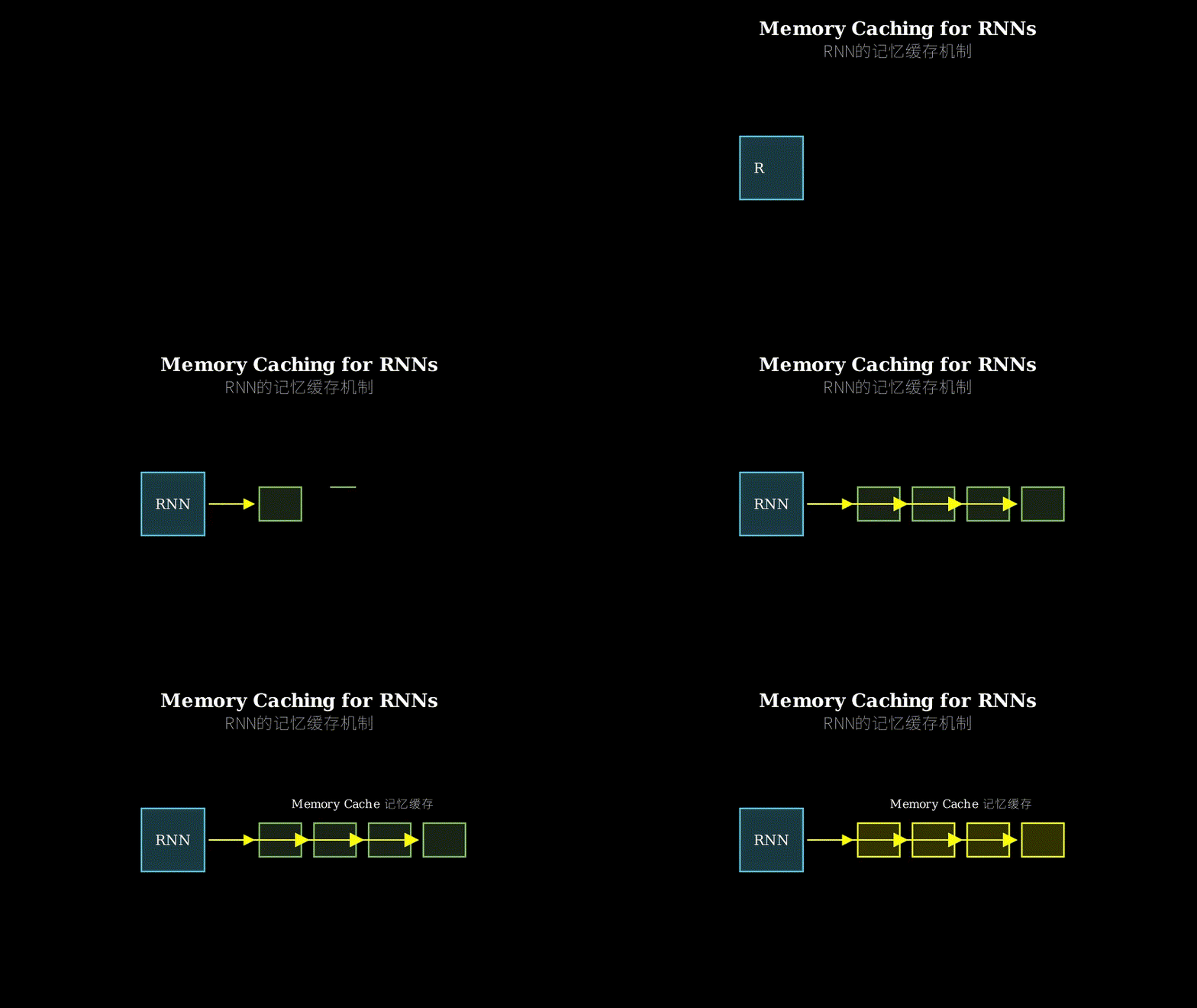
Before: RNNs choose between fixed memory (fast but forgetful) or full attention (accurate but quadratic). After: Memory Caching lets RNNs checkpoint their hidden states periodically, creating a sparse growing memory that interpolates smoothly between and complexity.
Think of Memory Caching like a library with reading rooms. A standard RNN is a single reader who takes notes (the hidden state) as they go through a book sequentially—they can only remember what fits in their notebook. A Transformer is a reading room where every page of every book stays open on tables—you can glance at any page instantly, but you need a massive room. Memory Caching is a reader who photocopies key pages at regular intervals and pins them to a wall. When they need to recall something, they first check their current notes (the hidden state), then scan the pinned pages (cached states), and finally re-read from the original if needed. The wall grows with the book’s length, but much slower than keeping every page open.
Mechanically, every tokens, the RNN saves a snapshot of its hidden state. When processing later tokens, the model can attend back to these cached states. Four variants control how: Uniform caches at fixed intervals; Gated learns to weight cached states; Sparse selectively attends to a subset; Hierarchical builds a tree of caches at multiple resolutions. The key insight is that you don’t need to remember every token—just enough checkpoints to reconstruct what matters. If you cache every 64 tokens in a 4096-token sequence, you store 64 states instead of 4096, but can still recover information by attending to the nearest cache and processing forward from there.
Key Concepts
Hidden State Compression: When an RNN processes a sequence, it maintains a hidden state vector (typically 512-2048 dimensions) that’s supposed to summarize everything seen so far. Imagine you’re listening to a story and can only remember 10 facts at a time—you constantly update which 10 facts matter most. Early tokens get “compressed out” as new information arrives. For the sentence “The cat that the dog that the mouse scared chased ran,” by the time you reach “ran,” a standard RNN has largely forgotten “cat” because it’s been overwritten by “dog,” “mouse,” “scared,” and “chased.” This is why RNNs struggle with long-range dependencies—not because they can’t theoretically represent them, but because the fixed-size bottleneck forces lossy compression.
Attention as Lookup: Transformers don’t compress—they keep every token’s representation and use attention to look up relevant ones. Attention is essentially a soft database query: given a query vector (current token), compute similarity scores with all key vectors (past tokens), then retrieve a weighted combination of value vectors. The cost is that comparing against past tokens takes operations per token, hence total. Memory Caching reduces this by only keeping every -th token’s representation, so you compare against cached states—still attention, but over a compressed index.
The Interpolation Trade-off: Memory Caching’s elegance is in its parameterization. Set cache interval , and you recover full Transformer attention (). Set , and you get a pure RNN (). Any in between gives you a point on the Pareto frontier between speed and recall capacity. If you cache every 32 tokens, you’re spending of a Transformer’s compute (since for a 1024-token context, but you still process the full sequence recurrently). This lets practitioners dial in their desired speed/accuracy trade-off based on deployment constraints—something neither pure RNNs nor pure Transformers offer.
Expert Assessment
Problem significance: This addresses a real bottleneck. The ML community is actively searching for Transformer alternatives that scale to million-token contexts (think: entire codebases, long videos, scientific papers). Current recurrent models are 2-5x faster but lag 5-15% in accuracy on long-context benchmarks. Closing that gap matters for production systems where both speed and quality are non-negotiable. The affected community is large—anyone doing document understanding, code analysis, or long-form generation.
Method maturity: This is a solid proof-of-concept with room to grow. The core idea is simple (almost obvious in hindsight), which is a strength—it’s easy to implement and integrate into existing recurrent architectures. However, the paper doesn’t deeply explore hyperparameter sensitivity (how does performance degrade as increases?) or provide theoretical analysis of what information is preserved vs. lost. The gated and sparse variants add learnable components, but it’s unclear if the gains justify the added complexity. The hierarchical variant is mentioned but not thoroughly evaluated. Deployment-wise, caching adds memory overhead (storing states) and complicates batching—these practical concerns aren’t addressed.
Experimental rigor: The experiments are reasonable but not exhaustive. Language modeling and long-context QA are appropriate testbeds. The in-context recall tasks (needle-in-haystack) are particularly telling—MC variants close the gap with Transformers from 20-30% to 5-10%, which is meaningful. However, baselines are limited to a few recent recurrent models (Mamba, RWKV); comparisons with hybrid architectures (e.g., Transformer-XL, Compressive Transformers) are missing. The datasets are standard but not adversarial—it would be interesting to see performance on tasks specifically designed to break recurrent models (e.g., counting, parity checks). One red flag: the paper doesn’t report wall-clock time or memory usage, only complexity analysis. Real-world speedups depend on implementation details and hardware.
Verdict: Weak accept — The idea is sound and the results are promising, but the paper feels like an early-stage exploration rather than a definitive solution; deeper analysis and broader comparisons would strengthen the contribution.
Takeaways
Checkpointing as a universal pattern: The core insight—periodically saving state snapshots to enable non-local lookups—applies beyond RNNs. Gradient checkpointing in backpropagation, key-value caches in autoregressive generation, and even version control systems (Git) use the same principle: trade storage for the ability to “rewind” without recomputing everything. If you’re designing any stateful system with sequential dependencies, ask: “What if I cached intermediate states?”
Pareto frontiers over binary choices: Instead of debating “RNN vs. Transformer,” Memory Caching offers a spectrum. This framing is valuable in other domains—rather than choosing between two extremes (batch vs. online learning, centralized vs. federated training), look for parameterized interpolations that let users navigate the trade-off space. The best solution is often not at the endpoints.
Sparse attention is underexplored: The sparse variant (selectively attending to a subset of caches) hints at a broader opportunity. Most attention mechanisms are dense—every query attends to every key. But in long contexts, most attention weights are near-zero. Learning which caches to attend to, or dynamically adjusting cache granularity based on content, could yield further gains. This connects to recent work on learned sparsity (e.g., Mixture of Experts, dynamic routing) and suggests that “smart indexing” is a fruitful research direction.
Implementation simplicity matters: Memory Caching’s appeal is partly that it’s a drop-in modification—you don’t need to redesign the architecture, just add a caching mechanism. When proposing new techniques, consider the “integration tax.” A 10% improvement that requires rewriting your entire training pipeline is less valuable than a 5% improvement that’s five lines of code. Practitioners will adopt the latter.
论文: 2602.24281 作者: Ali Behrouz, Zeman Li, Yuan Deng, Peilin Zhong, Meisam Razaviyayn, Vahab Mirrokni 分类: cs.LG, cs.AI
缺口
序列建模领域当前的格局是Transformer一家独大,因为它们能记住所有历史信息——注意力机制可以回看任意之前的token。这种”可增长记忆”让它们在需要精确回溯的任务上表现出色,比如从长文档中检索事实。代价是高昂的计算成本:处理长度为的序列需要的时间和内存。
近期的循环架构替代方案(Mamba、RWKV、RetNet等)承诺用次二次复杂度来解决问题,它们将历史压缩进固定大小的隐状态。速度确实快——复杂度——但在需要精确回忆远距离信息的任务上表现不佳。症结在哪?它们的记忆不会增长。当你把10000个token压缩进512维向量时,细节已经丢失。最先进的循环模型在大海捞针式检索和长上下文问答任务上持续落后Transformer 10-20个百分点。
增量
之前: RNN必须在固定记忆(快但健忘)和完整注意力(准确但二次复杂度)之间二选一。之后: 记忆缓存让RNN定期对隐状态做检查点,创建稀疏的可增长记忆,在和复杂度之间平滑插值。
把记忆缓存想象成带备忘墙的图书馆阅览室。标准RNN是单个读者顺序读书时做笔记(隐状态)——只能记住笔记本装得下的内容。Transformer是把每本书的每一页都摊开在桌上的阅览室——可以瞬间瞥见任何一页,但需要巨大的空间。记忆缓存是定期复印关键页面并钉在墙上的读者。需要回忆时,先查当前笔记(隐状态),再扫墙上的复印页(缓存状态),必要时才回头重读原文。墙面随书的长度增长,但比摊开所有页面慢得多。
机制上,每隔个token,RNN保存一次隐状态快照。处理后续token时,模型可以回看这些缓存状态。四个变体控制具体方式:均匀型按固定间隔缓存;门控型学习对缓存状态加权;稀疏型选择性地关注子集;层次型在多个分辨率上构建缓存树。核心洞察是你不需要记住每个token——只需足够的检查点来重建重要信息。如果在4096个token的序列中每64个token缓存一次,你存储64个状态而非4096个,但仍能通过关注最近的缓存并从那里向前处理来恢复信息。
关键概念
隐状态压缩的本质: RNN处理序列时维护一个隐状态向量(通常512-2048维),它应该总结迄今为止看到的一切。想象你在听故事但一次只能记住10个事实——你不断更新哪10个事实最重要。早期的token随着新信息到来被”压缩掉”。对于句子”被老鼠吓到的狗追赶的猫跑了”,当你读到”跑了”时,标准RNN已经基本忘记”猫”,因为它被”狗""老鼠""吓到""追赶”覆盖了。这就是RNN在长程依赖上挣扎的原因——不是理论上无法表示,而是固定大小的瓶颈强制有损压缩。
注意力即查表: Transformer不压缩——它们保留每个token的表示,用注意力查找相关的。注意力本质上是软数据库查询:给定查询向量(当前token),计算与所有键向量(过去token)的相似度分数,然后检索值向量的加权组合。代价是与个过去token比较每个token需要操作,因此总共。记忆缓存通过只保留每第个token的表示来降低这个成本,所以你与个缓存状态比较——仍是注意力,但在压缩索引上。
插值权衡的优雅: 记忆缓存的精妙在于其参数化。设置缓存间隔,你恢复完整Transformer注意力()。设置,你得到纯RNN()。中间任何值给你速度与回溯能力之间帕累托前沿上的一点。如果每32个token缓存一次,你花费约Transformer 3%的计算量(因为对于1024 token上下文,,但你仍循环处理完整序列)。这让实践者根据部署约束调节期望的速度/准确度权衡——纯RNN和纯Transformer都无法提供这种灵活性。
专家评审
问题重要性: 这确实解决了一个真实瓶颈。机器学习社区正积极寻找能扩展到百万token上下文的Transformer替代方案(想想:整个代码库、长视频、科学论文)。当前循环模型快2-5倍但在长上下文基准上准确度落后5-15%。缩小这个差距对于速度和质量都不可妥协的生产系统很重要。受影响的群体很大——任何做文档理解、代码分析或长文本生成的人。
方法成熟度: 这是扎实的概念验证,但有成长空间。核心想法简单(事后看几乎显而易见),这是优势——易于实现和集成到现有循环架构中。然而,论文没有深入探索超参数敏感性(随着增加性能如何退化?)或提供关于保留vs丢失什么信息的理论分析。门控和稀疏变体增加了可学习组件,但收益是否证明增加的复杂性尚不清楚。层次变体被提及但未充分评估。部署方面,缓存增加内存开销(存储个状态)并使批处理复杂化——这些实际问题未被讨论。
实验严谨性: 实验合理但不够全面。语言建模和长上下文问答是合适的测试平台。上下文内回忆任务(大海捞针)特别有说服力——MC变体将与Transformer的差距从20-30%缩小到5-10%,这很有意义。然而,基线仅限于几个近期循环模型(Mamba、RWKV);缺少与混合架构(如Transformer-XL、压缩Transformer)的比较。数据集是标准的但非对抗性的——看到在专门设计来破坏循环模型的任务(如计数、奇偶校验)上的表现会很有趣。一个警示信号:论文未报告实际运行时间或内存使用,只有复杂度分析。真实世界的加速取决于实现细节和硬件。
判决: 弱接收 — 想法可靠,结果有希望,但论文感觉像早期探索而非决定性解决方案;更深入的分析和更广泛的比较会加强贡献。
要点总结
检查点作为通用模式: 核心洞察——定期保存状态快照以实现非局部查找——适用于RNN之外。反向传播中的梯度检查点、自回归生成中的键值缓存,甚至版本控制系统(Git)都使用相同原理:用存储换取”倒带”能力而无需重新计算一切。如果你在设计任何有顺序依赖的状态系统,问问:“如果我缓存中间状态会怎样?”
帕累托前沿胜过二元选择: 记忆缓存不是争论”RNN vs Transformer”,而是提供一个谱系。这种框架在其他领域也有价值——与其在两个极端之间选择(批处理vs在线学习、集中式vs联邦训练),不如寻找参数化的插值让用户导航权衡空间。最佳解决方案往往不在端点。
稀疏注意力值得深挖: 稀疏变体(选择性地关注缓存子集)暗示更广阔的机会。大多数注意力机制是密集的——每个查询关注每个键。但在长上下文中,大多数注意力权重接近零。学习关注哪些缓存,或根据内容动态调整缓存粒度,可能产生进一步收益。这与近期关于学习稀疏性的工作(如专家混合、动态路由)相连,表明”智能索引”是富有成果的研究方向。
实现简洁性很重要: 记忆缓存的吸引力部分在于它是即插即用的修改——不需要重新设计架构,只需添加缓存机制。提出新技术时,考虑”集成税”。需要重写整个训练流程的10%改进不如五行代码的5%改进有价值。实践者会采用后者。