Paper: 2603.25739 Authors: Dingxi Zhang, Fangjinhua Wang, Marc Pollefeys, Haofei Xu Categories: cs.CV
The Gap
Optical flow methods have gotten good at small, local motions. RAFT and its descendants use iterative refinement within local search windows — works great when objects move a few pixels between frames. But when something moves 50+ pixels? The local search window misses it entirely. You either need massive search windows (computationally expensive) or domain-specific fine-tuning for each new scenario (kills generalization).
The core issue: local iterative methods are fundamentally mismatched to large displacements. They’re doing hill-climbing in a landscape where the peak is outside their visible horizon.
Problem: Large displacement breaks local search
    |
    v
Assumption: Pre-trained global features already "see" correspondences
    |
    v
Method: Global matching with ViT features + lightweight refinement
    |
    v
Evidence: SOTA zero-shot on Spring, Sintel, KITTI; competitive on point tracking
    |
    v
Conclusion: Global matching > iterative local search for generalization
The Increment
One sentence: Before — optical flow needed task-specific architectures and fine-tuning for each domain; after — a single model with frozen pre-trained features generalizes zero-shot across benchmarks.
Core Mechanism
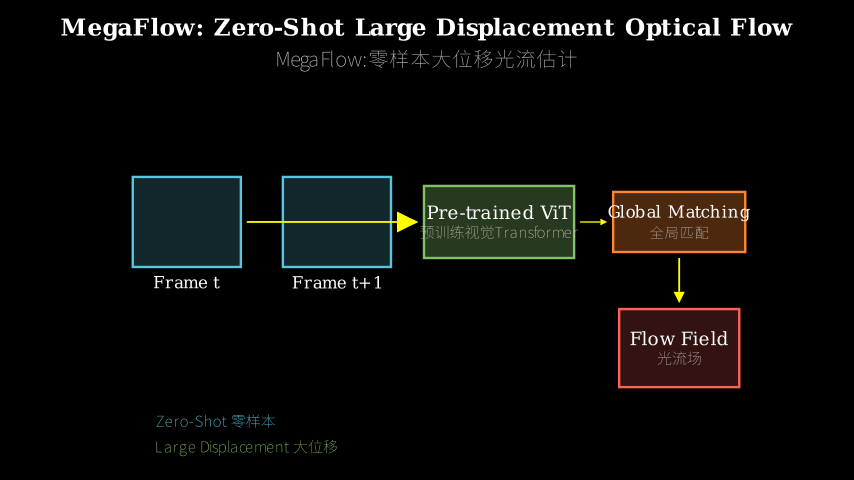
MegaFlow has three stages. First, extract dense features from both frames using a frozen pre-trained Vision Transformer (DINOv2). These features already encode semantic correspondences from pre-training on massive image datasets.
Second, perform global matching: for every pixel in frame 1, compute similarity with all pixels in frame 2 using these features. This produces a 4D correlation volume (height × width × height × width). Apply softmax to get a probability distribution over possible matches. The expected position gives you the initial flow estimate — this handles arbitrarily large displacements because you’re searching globally, not locally.
Third, run a few lightweight GRU-based refinement iterations (borrowed from RAFT’s architecture) to polish sub-pixel accuracy. But unlike RAFT, you’re starting from a globally-informed initialization, not random or coarse-to-fine pyramids.
Frame 1          Frame 2
   |                |
   v                v
[ViT features] [ViT features]  <-- Frozen, pre-trained
   |                |
   +-------+--------+
           |
           v
   [Global matching]  <-- 4D correlation, softmax
           |
           v
   [Initial flow estimate]
           |
           v
   [GRU refinement] <-- Few iterations, local polish
           |
           v
   [Final flow field]
Think of it like finding a friend in a crowded stadium. The old way (RAFT): you start at your seat and search row by row in expanding circles — works if they’re nearby, fails if they’re across the stadium. MegaFlow’s way: you both have phones with GPS (pre-trained features). You check the global map first to see roughly where they are (global matching), then walk over and fine-tune the exact meeting spot (refinement). The GPS doesn’t need to be trained on “finding friends in stadiums” — it already knows how to locate things globally. You’re just adapting that capability.
Key Concepts
-
Global matching vs local search: Local search means for each pixel, you only look at a small neighborhood (say 9×9 window) in the other frame. Fast, but if the true match is outside that window, you’ll never find it. Global matching means you compare against every pixel in the other frame — computationally heavy (O(N²) where N is image size), but you can’t miss large displacements. MegaFlow makes global matching tractable by using compact ViT features and efficient correlation computation.
-
Pre-trained vision priors: Models like DINOv2 are trained on millions of images to predict masked patches or match augmented views. They learn features that are semantically meaningful — a cat’s ear in one image has similar features to a cat’s ear in another, even under different lighting or poses. MegaFlow doesn’t train these features for optical flow; it just uses them as-is. The bet: if features already capture “what things are,” they implicitly capture “where the same thing moved to.”
-
Zero-shot generalization: Training on dataset A, testing on dataset B without any fine-tuning on B. Most optical flow methods overfit to training domain statistics (indoor vs outdoor, synthetic vs real, motion patterns). MegaFlow’s frozen features act as a universal prior — they don’t memorize training set quirks because they’re not updated during flow training. Only the lightweight refinement module is trained, and it learns generic “polish” operations that transfer across domains.
Framework Shift
Before (RAFT-style):                After (MegaFlow):

Frame pair                          Frame pair
    |                                   |
    v                                   v
[CNN pyramid]                       [Frozen ViT]
    |                                   |
    v                                   v
[Local correlation]                 [Global correlation]
 (small window)                      (full image)
    |                                   |
    v                                   v
[Many GRU iterations]               [Few GRU iterations]
 (search + refine)                   (refine only)
    |                                   |
    v                                   v
Final flow                          Final flow

Key: Iterative local search         Key: Global match then refine
From iterative local search to global-then-local: the core shift is trusting pre-trained features to handle the “search” part, leaving only “refinement” to be learned.
Expert Assessment
Problem choice: Real gap. Large displacement is a known pain point — autonomous driving, fast camera motion, sports analysis all hit this. The zero-shot angle is also genuine: current methods need retraining for new domains, which is expensive and limits deployment.
Method maturity: Clever reuse of existing components rather than novel architecture. The insight is architectural: global matching was too expensive before, but ViT features are compact enough to make it work. However, there’s a dependency risk — performance is tied to whatever DINOv2 learned. If the pre-training data lacks certain motion types, MegaFlow inherits that blindspot.
Experimental integrity: Benchmarks are standard (Sintel, KITTI, Spring). Zero-shot setup is clearly defined. The point tracking results are a nice bonus showing transferability. One concern: no ablation on different pre-trained models (what if you use CLIP instead of DINOv2?). Also, computational cost isn’t thoroughly analyzed — global matching is O(N²), which could be prohibitive for high-res video.
Writing quality: Abstract and intro are crisp. Method section could use more detail on how exactly the correlation volume is computed and reduced (they mention “softmax” but the full pipeline isn’t clear without reading code). The “unified paradigm” claim in the abstract is oversold — they show flow and tracking work, but that’s not quite a unified framework yet.
Verdict: Weak accept — solid empirical results and a clean idea, but the novelty is more in the combination than in new techniques. The reliance on frozen features is both a strength (generalization) and a limitation (can’t adapt to truly novel scenarios).
Takeaways
If you’re building any dense correspondence system (stereo, flow, tracking), consider starting with global matching using pre-trained features before diving into iterative refinement. The pattern here transfers: use a strong prior to get in the right ballpark, then use task-specific modules only for the last mile.
For practitioners: frozen pre-trained features are underused in low-level vision. Most people fine-tune everything. MegaFlow shows you can get SOTA by keeping the backbone frozen and training only a tiny head. This is huge for data-scarce domains.
The global-then-local pattern also applies beyond vision: in optimization, in search problems, in planning. Get a rough global solution cheap (even if it’s from a heuristic or pre-trained model), then refine locally. Don’t try to do both in one pass.
论文: 2603.25739 作者: Dingxi Zhang, Fangjinhua Wang, Marc Pollefeys, Haofei Xu 分类: cs.CV
缺口
光流方法在小范围局部运动上已经做得很好。 RAFT及其后续工作使用局部搜索窗口内的迭代优化——当物体在帧间移动几个像素时效果很棒。 但当某物移动50+像素呢? 局部搜索窗口完全错过它。 你要么需要巨大的搜索窗口(计算昂贵),要么需要针对每个新场景做领域微调(扼杀泛化能力)。
核心问题:局部迭代方法从根本上不匹配大位移。 它们在做爬山,但山峰在它们的视野之外。
问题:大位移打破局部搜索
    |
    v
假设:预训练全局特征已经"看到"对应关系
    |
    v
方法:用ViT特征做全局匹配 + 轻量优化
    |
    v
证据:Spring/Sintel/KITTI零样本SOTA;点追踪有竞争力
    |
    v
结论:全局匹配 > 迭代局部搜索(泛化性)
增量
一句话: 之前——光流需要针对每个领域设计特定架构和微调; 之后——单个模型用冻结的预训练特征就能零样本泛化到各个基准。
核心机制
MegaFlow有三个阶段。 首先,用冻结的预训练视觉Transformer(DINOv2)从两帧提取密集特征。 这些特征已经从海量图像数据集的预训练中编码了语义对应关系。
其次,执行全局匹配:对帧1的每个像素,用这些特征计算它与帧2所有像素的相似度。 这产生一个4D相关体积(高×宽×高×宽)。 应用softmax得到可能匹配的概率分布。 期望位置给出初始光流估计——这能处理任意大的位移,因为你在全局搜索,不是局部。
第三,运行几次轻量的基于GRU的优化迭代(借用RAFT的架构)来打磨亚像素精度。 但与RAFT不同,你从全局信息的初始化开始,而不是随机或粗到细的金字塔。
帧1            帧2
   |              |
   v              v
[ViT特征]    [ViT特征]  <-- 冻结,预训练
   |              |
   +------+-------+
          |
          v
   [全局匹配]  <-- 4D相关,softmax
          |
          v
   [初始光流估计]
          |
          v
   [GRU优化] <-- 少量迭代,局部打磨
          |
          v
   [最终光流场]
想象在拥挤的体育场找朋友。 旧方法(RAFT):你从座位开始,一圈圈向外搜索——朋友在附近就行,在对面看台就完蛋。 MegaFlow的方法:你俩都有带GPS的手机(预训练特征)。 你先查全局地图看他们大概在哪(全局匹配),然后走过去微调确切的见面地点(优化)。 GPS不需要在”体育场找朋友”上训练——它已经知道如何全局定位。 你只是在适配这个能力。
关键概念
-
全局匹配vs局部搜索: 局部搜索意味着对每个像素,你只看另一帧的小邻域(比如9×9窗口)。 快,但如果真实匹配在窗口外,你永远找不到。 全局匹配意味着你与另一帧的每个像素比较——计算重(O(N²),N是图像大小),但不会错过大位移。 MegaFlow通过使用紧凑的ViT特征和高效相关计算让全局匹配变得可行。
-
预训练视觉先验: 像DINOv2这样的模型在数百万图像上训练,预测被遮挡的patch或匹配增强视图。 它们学到语义上有意义的特征——一张图里猫耳朵的特征与另一张图里猫耳朵的特征相似,即使光照或姿态不同。 MegaFlow不为光流训练这些特征; 它直接用。 赌注是:如果特征已经捕获”东西是什么”,它们隐式捕获”同一个东西移到哪了”。
-
零样本泛化: 在数据集A上训练,在数据集B上测试,不在B上做任何微调。 大多数光流方法过拟合训练域的统计特性(室内vs室外,合成vs真实,运动模式)。 MegaFlow的冻结特征充当通用先验——它们不记忆训练集的怪癖,因为在光流训练期间不更新。 只有轻量优化模块被训练,它学到的是跨域迁移的通用”打磨”操作。
框架转变
之前(RAFT风格):                  之后(MegaFlow):

帧对                              帧对
    |                                 |
    v                                 v
[CNN金字塔]                       [冻结ViT]
    |                                 |
    v                                 v
[局部相关]                         [全局相关]
 (小窗口)                           (全图)
    |                                 |
    v                                 v
[多次GRU迭代]                     [少量GRU迭代]
 (搜索+优化)                        (仅优化)
    |                                 |
    v                                 v
最终光流                          最终光流

关键:迭代局部搜索                 关键:全局匹配后优化
从迭代局部搜索到先全局后局部:核心转变是信任预训练特征处理”搜索”部分,只留”优化”给学习。
专家评审
选题眼光: 真实缺口。 大位移是已知痛点——自动驾驶、快速相机运动、体育分析都会遇到。 零样本角度也是真实的:现有方法需要为新域重新训练,这既昂贵又限制部署。
方法成熟度: 巧妙复用现有组件而非新架构。 洞见是架构性的:全局匹配以前太贵,但ViT特征足够紧凑让它可行。 然而有依赖风险——性能绑定在DINOv2学到的东西上。 如果预训练数据缺少某些运动类型,MegaFlow继承这个盲点。
实验诚意: 基准是标准的(Sintel、KITTI、Spring)。 零样本设置定义清晰。 点追踪结果是展示可迁移性的好彩蛋。 一个担忧:没有对不同预训练模型的消融(如果用CLIP而不是DINOv2会怎样?)。 另外,计算成本没有彻底分析——全局匹配是O(N²),对高分辨率视频可能难以承受。
写作功力: 摘要和引言简洁。 方法部分可以更详细说明相关体积如何计算和降维(他们提到”softmax”但不读代码看不清完整流程)。 摘要里”统一范式”的说法有点过——他们展示了光流和追踪可行,但还不算统一框架。
判决: 弱接收——扎实的实证结果和清晰的想法,但新颖性更多在组合而非新技术。 对冻结特征的依赖既是优势(泛化)也是限制(无法适应真正新颖的场景)。
要点总结
如果你在构建任何密集对应系统(立体、光流、追踪),考虑在深入迭代优化前先用预训练特征做全局匹配。 这里的模式可迁移:用强先验进入正确的大致范围,然后只在最后一公里用任务特定模块。
对实践者:冻结的预训练特征在低层视觉中使用不足。 大多数人微调一切。 MegaFlow展示你可以通过保持骨干冻结、只训练一个小头来达到SOTA。 这对数据稀缺领域意义重大。
先全局后局部的模式也适用于视觉之外:优化、搜索问题、规划。 便宜地得到粗糙的全局解(即使来自启发式或预训练模型),然后局部优化。 不要试图一次完成两者。