Paper: 2602.23363 Authors: Sahal Shaji Mullappilly, Mohammed Irfan Kurpath, Omair Mohamed, Mohamed Zidan, Fahad Khan, Salman Khan, Rao Anwer, Hisham Cholakkal Categories: cs.CV
Abstract
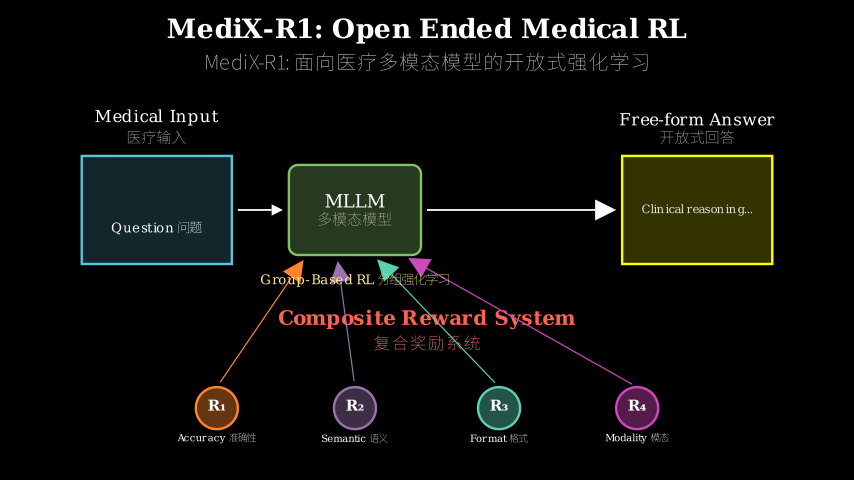
MediX-R1 introduces an open-ended reinforcement learning framework designed specifically for medical multimodal large language models (MLLMs). Unlike traditional approaches that rely on multiple-choice question formats, this framework enables models to generate clinically grounded, free-form responses. The system employs Group-Based RL with a sophisticated composite reward mechanism that includes LLM-based accuracy judgments, medical embedding-based semantic rewards for capturing terminology variants, and format/modality rewards for interpretable reasoning. The framework also proposes a unified evaluation methodology using LLM-as-judge instead of brittle string-matching metrics. Despite training on only approximately 51,000 instruction examples, MediX-R1 demonstrates excellent performance across both text-only and multimodal medical benchmarks, significantly outperforming existing open-source baselines particularly on open-ended clinical tasks.
Key Contributions
- Introduction of an open-ended RL framework for medical MLLMs that moves beyond restrictive multiple-choice formats to enable free-form clinical reasoning
- Design of a composite reward system combining LLM-based accuracy assessment, medical embedding-based semantic rewards, and format/modality rewards for stable training
- Proposal of a unified evaluation framework using Reference-based LLM-as-judge methodology that captures semantic correctness and contextual alignment
- Achievement of strong performance across medical benchmarks using only K training examples, demonstrating data efficiency
- Release of trained models, curated datasets, and source code for reproducibility and community advancement
Technical Methodology
The MediX-R1 framework builds upon a vision-language backbone and applies Group-Based Reinforcement Learning with a carefully designed multi-signal reward structure. The composite reward function addresses the unique challenges of medical reasoning:
The LLM-based accuracy reward employs a strict YES/NO decision mechanism to judge semantic correctness of generated responses. This component ensures that the model’s outputs align with medically accurate information, providing clear binary feedback that stabilizes training.
The medical embedding-based semantic reward captures the nuanced nature of medical terminology, recognizing paraphrases and terminology variants that are semantically equivalent but lexically different. This is crucial in medical contexts where multiple valid ways exist to express the same clinical concept.
The format and modality rewards are lightweight components that enforce interpretable reasoning chains and proper modality recognition. These ensure that the model not only generates correct content but also presents it in a clinically useful format and appropriately processes multimodal inputs (text and images).
This multi-signal design provides stable, informative feedback for open-ended outputs where traditional verifiable rewards or MCQ-only approaches fall short. The Group-Based RL approach allows for efficient exploration and exploitation of the reward landscape while maintaining training stability.
Evaluation Framework and Results
A significant contribution of this work is the unified evaluation framework that addresses limitations of traditional metrics. Instead of relying on brittle string-overlap measures like BLEU or exact match, MediX-R1 employs a Reference-based LLM-as-judge approach. This evaluation methodology assesses:
- Semantic correctness: Whether the generated answer conveys medically accurate information
- Reasoning quality: The logical coherence and clinical grounding of explanations
- Contextual alignment: How well the response addresses the specific clinical question
The framework demonstrates effectiveness across both text-only medical LLM benchmarks and vision-language medical VLM benchmarks. Despite the relatively small training dataset of approximately 51,000 instruction examples, MediX-R1 achieves excellent results, outperforming strong open-source baselines. The gains are particularly pronounced on open-ended clinical tasks, where the model’s ability to generate free-form, contextually appropriate responses provides substantial advantages over multiple-choice constrained approaches.
The results validate that open-ended RL with comprehensive reward signals and LLM-based evaluation represents a practical and effective path toward reliable medical reasoning in multimodal models.
Implications for Medical AI
MediX-R1 addresses a critical gap in medical AI systems: the ability to provide nuanced, free-form clinical reasoning rather than being constrained to predefined answer choices. This capability is essential for real-world clinical applications where physicians need detailed explanations, differential diagnoses, and contextual reasoning.
The data efficiency demonstrated by the framework—achieving strong performance with only K examples—is particularly significant for medical domains where large-scale annotated datasets are expensive and difficult to obtain. The composite reward design provides a template for training medical AI systems that can handle the complexity and variability of clinical language while maintaining accuracy.
The open release of models, datasets, and code at https://medix.cvmbzuai.com facilitates further research and development in medical multimodal AI, potentially accelerating progress toward clinically deployable systems that can assist healthcare professionals with complex reasoning tasks.
Takeaways
-
MediX-R1 demonstrates that open-ended RL with composite rewards can effectively train medical multimodal models for free-form clinical reasoning, moving beyond restrictive multiple-choice formats.
-
The multi-signal reward design—combining LLM-based accuracy, medical embedding semantics, and format/modality rewards—provides stable training feedback for complex medical reasoning tasks.
-
LLM-as-judge evaluation frameworks offer a more robust alternative to traditional string-matching metrics for assessing open-ended medical responses, capturing semantic correctness and contextual alignment.
-
Remarkable data efficiency is achievable in medical AI: strong performance across benchmarks with only approximately 51,000 training examples demonstrates the effectiveness of the RL approach.
-
The framework’s particularly strong performance on open-ended clinical tasks validates the importance of enabling free-form responses for practical medical AI applications.
论文: 2602.23363 作者: Sahal Shaji Mullappilly, Mohammed Irfan Kurpath, Omair Mohamed, Mohamed Zidan, Fahad Khan, Salman Khan, Rao Anwer, Hisham Cholakkal 分类: cs.CV
摘要
MediX-R1提出了一个专门为医疗多模态大语言模型(MLLMs)设计的开放式强化学习框架。与依赖多项选择题格式的传统方法不同,该框架使模型能够生成具有临床依据的自由形式回答。系统采用基于组的强化学习,配合精心设计的复合奖励机制,包括基于LLM的准确性判断、基于医疗嵌入的语义奖励(用于捕获术语变体)以及格式/模态奖励(用于可解释推理)。该框架还提出了一个统一的评估方法,使用LLM作为评判者而非脆弱的字符串匹配指标。尽管仅使用约5.1万条指令样本进行训练,MediX-R1在纯文本和多模态医疗基准测试中均表现出色,显著超越现有开源基线,特别是在开放式临床任务上取得了巨大进步。
主要贡献
- 提出面向医疗多模态大语言模型的开放式强化学习框架,突破限制性的多项选择格式,实现自由形式的临床推理
- 设计复合奖励系统,结合基于LLM的准确性评估、基于医疗嵌入的语义奖励以及格式/模态奖励,确保训练稳定性
- 提出统一评估框架,采用基于参考的LLM评判方法,捕获语义正确性和上下文对齐度
- 仅使用约K训练样本即在医疗基准测试中取得优异性能,展现数据高效性
- 开源训练模型、精选数据集和源代码,促进可重复性研究和社区发展
技术方法论
MediX-R1框架基于视觉-语言骨干网络构建,应用基于组的强化学习和精心设计的多信号奖励结构。复合奖励函数针对医疗推理的独特挑战:
基于LLM的准确性奖励采用严格的是/否决策机制来判断生成回答的语义正确性。该组件确保模型输出与医学准确信息对齐,提供清晰的二元反馈以稳定训练过程。
基于医疗嵌入的语义奖励捕获医疗术语的细微差别,识别语义等价但词汇不同的释义和术语变体。这在医疗场景中至关重要,因为同一临床概念存在多种有效的表达方式。
格式和模态奖励是轻量级组件,强制执行可解释的推理链和正确的模态识别。这些确保模型不仅生成正确内容,还以临床有用的格式呈现,并适当处理多模态输入(文本和图像)。
这种多信号设计为开放式输出提供稳定、信息丰富的反馈,弥补了传统可验证奖励或仅限多项选择方法的不足。基于组的强化学习方法允许高效探索和利用奖励空间,同时保持训练稳定性。
评估框架与实验结果
该工作的重要贡献是统一评估框架,解决了传统指标的局限性。MediX-R1不依赖BLEU或精确匹配等脆弱的字符串重叠度量,而是采用基于参考的LLM评判方法。该评估方法评估:
- 语义正确性: 生成答案是否传达医学准确信息
- 推理质量: 解释的逻辑连贯性和临床依据
- 上下文对齐: 回答对特定临床问题的针对性
该框架在纯文本医疗LLM基准和视觉-语言医疗VLM基准上均展现有效性。尽管训练数据集相对较小(约5.1万条指令样本),MediX-R1取得了优异结果,超越强大的开源基线。在开放式临床任务上的提升尤为显著,模型生成自由形式、上下文适当回答的能力相比多项选择约束方法提供了实质性优势。
实验结果验证了开放式强化学习配合综合奖励信号和基于LLM的评估,代表了实现多模态模型可靠医疗推理的实用有效路径。
对医疗人工智能的意义
MediX-R1解决了医疗AI系统的关键缺口:提供细致入微的自由形式临床推理能力,而非局限于预定义的答案选项。这种能力对于实际临床应用至关重要,医生需要详细解释、鉴别诊断和上下文推理。
该框架展现的数据效率——仅用K样本即达到优异性能——对于医疗领域尤为重要,因为大规模标注数据集成本高昂且难以获取。复合奖励设计为训练能够处理临床语言复杂性和变异性同时保持准确性的医疗AI系统提供了模板。
在https://medix.cvmbzuai.com开源模型、数据集和代码,促进了医疗多模态AI的进一步研究和开发,有望加速临床可部署系统的进展,协助医疗专业人员完成复杂推理任务。
要点总结
-
MediX-R1证明了开放式强化学习配合复合奖励能够有效训练医疗多模态模型进行自由形式临床推理,突破限制性的多项选择格式。
-
多信号奖励设计——结合基于LLM的准确性、医疗嵌入语义以及格式/模态奖励——为复杂医疗推理任务提供稳定的训练反馈。
-
LLM评判评估框架为评估开放式医疗回答提供了比传统字符串匹配指标更稳健的替代方案,捕获语义正确性和上下文对齐度。
-
医疗AI可实现显著的数据效率:仅用约5.1万训练样本即在基准测试中取得优异性能,验证了强化学习方法的有效性。
-
该框架在开放式临床任务上的突出表现验证了为实用医疗AI应用启用自由形式回答的重要性。