Paper: 2602.16703 Authors: Shen Zhou Hong, Alex Kleinman, Alyssa Mathiowetz, Adam Howes, Julian Cohen, Suveer Ganta, Alex Letizia, Dora Liao Categories: cs.CY, cs.AI
The Gap
Large language models score impressively on biological benchmarks—protein folding, sequence analysis, protocol design. This has raised biosecurity concerns: if LLMs can ace these tests, might they enable novice actors to acquire dangerous laboratory skills?
But there’s a critical question nobody had rigorously answered: Do benchmark scores translate to real-world laboratory performance? Benchmarks are in silico—computational tasks, text-based questions, simulated scenarios. Real biology happens in physical labs with pipettes, cell cultures, and equipment that doesn’t always behave as expected.
The gap between benchmark performance and practical utility is unknown. We don’t know if a model that scores 90% on a virology quiz actually helps a novice successfully culture cells or perform reverse genetics. Without this validation, biosecurity assessments based on benchmarks alone are speculative.
Known:
  LLMs perform well on biological benchmarks
  [In silico, text-based, controlled conditions]

Unknown:
  Do LLMs improve novice performance in physical labs?
  [Wet lab, hands-on, real-world constraints]

Gap: Benchmark scores → Real-world utility
     No empirical validation
     Biosecurity assessments lack grounding
The Increment
One sentence: Before this study, we had no rigorous evidence that LLM benchmark performance translates to improved novice laboratory skills; after this RCT with 153 participants, we know mid-2025 LLMs provide modest benefits (1.4× success rate) but don’t substantially increase workflow completion, revealing a benchmark-reality gap.
Core Mechanism
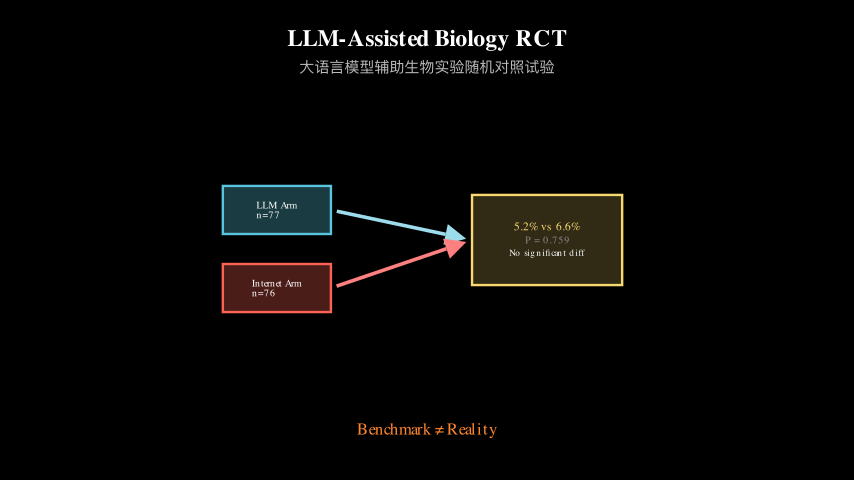
The researchers conducted a pre-registered, investigator-blinded, randomized controlled trial from June-August 2025 with 153 participants. Participants were novices (no prior molecular biology experience) randomly assigned to either LLM assistance or internet-only control.
The tasks modeled a viral reverse genetics workflow—the process of creating viruses from genetic sequences. This workflow has dual-use implications (legitimate research vs. potential misuse). Five tasks were tested:
- Protocol design: Plan experimental procedures
- Primer design: Design DNA primers for amplification
- Cell culture: Grow and maintain cells
- Transfection: Introduce genetic material into cells
- Virus rescue: Recover infectious virus from transfected cells
The primary endpoint was workflow completion—successfully completing all five tasks. Secondary endpoints included individual task success rates and progression through intermediate steps.
RCT Design:
  n = 153 novices (no prior molecular biology experience)

  Random assignment:
    LLM arm: Access to GPT-4 and Claude
    Control arm: Internet search only

  Tasks: Viral reverse genetics workflow
    1. Protocol design
    2. Primer design
    3. **Cell culture**
    4. Transfection
    5. Virus rescue

  Measurement:
    Primary: Complete workflow (all 5 tasks)
    Secondary: Individual task success
                Intermediate step progression
Think of it like comparing GPS navigation (LLM) versus paper maps (internet) for novice drivers attempting a complex route. The GPS might help with individual turns, but completing the entire journey depends on many factors beyond navigation—traffic, vehicle handling, decision-making under uncertainty.
Key Concepts
-
Randomized controlled trial (RCT): The gold standard for causal inference. Participants are randomly assigned to treatment (LLM) or control (internet), eliminating selection bias. Pre-registration prevents p-hacking. Investigator blinding reduces experimenter bias. This design lets us confidently attribute differences to LLM assistance rather than confounding factors.
-
Workflow completion vs. task success: Workflow completion requires succeeding at all five sequential tasks—a high bar that tests whether LLMs enable end-to-end capability. Task success measures individual components. The distinction matters: a novice might successfully culture cells (one task) but fail to complete the full workflow due to downstream failures.
-
Benchmark-reality gap: The difference between performance on standardized tests (benchmarks) and performance in real-world applications. Benchmarks control for confounds and measure specific capabilities in isolation. Reality is messy—tacit knowledge, equipment variability, time pressure, incomplete information. A model can score perfectly on a protocol design benchmark but provide advice that fails in practice due to unstated assumptions or context-dependent factors.
Framework Shift
Before (benchmark-based assessment):    After (RCT validation):

Evaluation: In silico benchmarks        Evaluation: Physical lab tasks
            Text-based questions                   Hands-on procedures
            Controlled conditions                  Real-world constraints

Assumption: Benchmark → Real utility    Finding: Modest benefit (1.4×)
            [Unvalidated]                         No workflow completion boost
                                                  [Empirically grounded]

Biosecurity: High benchmark scores      Biosecurity: Benchmark-reality gap
             = High risk?                          Risk assessment needs
             [Speculative]                         physical validation
                                                  [Evidence-based]
One sentence: From speculative biosecurity assessments based on in silico benchmarks to empirically grounded understanding that mid-2025 LLMs provide modest task-level benefits without substantially enabling end-to-end workflows.
Expert Assessment
Problem choice: This is exactly the right question. The field has been making biosecurity assessments based on benchmark performance without validating whether those benchmarks predict real-world capability. The RCT design is appropriate and the viral reverse genetics workflow is a reasonable proxy for dual-use skills. Well-motivated and timely.
Method maturity: The experimental design is rigorous—pre-registered, blinded, randomized, adequate sample size (n=153). The choice of tasks is thoughtful, covering the full workflow rather than isolated steps. The Bayesian modeling adds nuance beyond frequentist null hypothesis testing. The ordinal regression for intermediate steps is a smart way to capture partial progress.
Experimental integrity: The results are credible and honestly reported. No workflow completion difference (5.2% vs 6.6%, P=0.759) is the headline, but they don’t bury the secondary findings—cell culture showed a trend (68.8% vs 55.3%, P=0.059) and ordinal regression suggests LLMs help with intermediate steps. The 1.4× effect size (95% CrI 0.74-2.62) is modest and the confidence interval crosses 1, indicating uncertainty. This is honest science.
Writing quality: Clear exposition of motivation, methods, and results. The discussion appropriately emphasizes the benchmark-reality gap and the need for physical validation. Could benefit from more speculation about why the effect is modest—is it tacit knowledge? Equipment handling? Time pressure? The limitations section is appropriately cautious.
Verdict: strong accept — Rigorous empirical validation of a critical assumption in AI biosecurity, revealing that benchmark performance doesn’t straightforwardly translate to real-world capability, with important implications for risk assessment.
Takeaways
-
Validate in the real world: If you’re assessing AI capabilities for high-stakes applications (biosecurity, medical diagnosis, autonomous systems), don’t rely solely on benchmarks. Run physical-world validation studies. Benchmarks are useful for tracking progress but poor predictors of practical utility.
-
Modest effects matter: The 1.4× effect size seems small, but in biosecurity contexts, even modest capability increases could matter if they lower barriers for malicious actors. The finding that LLMs help with intermediate steps (81-96% posterior probability) suggests they provide scaffolding even when not enabling full workflows.
-
Task vs. workflow distinction: When evaluating AI assistance, distinguish between task-level success and end-to-end workflow completion. A system might help with individual steps without enabling the full process. This matters for both capability assessment and interface design.
-
Temporal dynamics: This is a snapshot of mid-2025 capabilities. The authors correctly note that “model capabilities and user proficiency evolve.” Continuous monitoring is needed—today’s modest effect could become substantial as models improve or as users learn to leverage them better.
-
Methodological template: The RCT design, pre-registration, blinding, and Bayesian analysis provide a template for evaluating AI assistance in other domains. This approach is transferable beyond biosecurity to any field where benchmark-reality gaps are suspected.
论文: 2602.16703 作者: Shen Zhou Hong, Alex Kleinman, Alyssa Mathiowetz, Adam Howes, Julian Cohen, Suveer Ganta, Alex Letizia, Dora Liao 分类: cs.CY, cs.AI
缺口
大语言模型在生物学基准测试上得分令人印象深刻——蛋白质折叠、序列分析、方案设计。这引发了生物安全担忧:如果LLM能在这些测试中取得好成绩,它们是否会帮助新手获得危险的实验室技能?
但有一个关键问题没有人严格回答过:基准测试分数是否转化为真实世界的实验室表现?基准测试是计算机模拟的——计算任务、基于文本的问题、模拟场景。真正的生物学发生在物理实验室中,有移液器、细胞培养和并不总是按预期运行的设备。
基准测试性能与实际效用之间的差距是未知的。我们不知道在病毒学测验中得分90%的模型是否真的能帮助新手成功培养细胞或进行反向遗传学。没有这种验证,仅基于基准测试的生物安全评估是推测性的。
已知:
  LLM在生物学基准测试上表现良好
  [计算机模拟,基于文本,受控条件]

未知:
  LLM是否提高新手在物理实验室的表现?
  [湿实验室,动手操作,真实世界约束]

差距:基准测试分数 → 真实世界效用
      没有经验验证
      生物安全评估缺乏依据
增量
一句话:在这项研究之前,我们没有严格的证据表明LLM基准测试性能转化为改善的新手实验室技能;在这项有153名参与者的RCT之后,我们知道2025年中期的LLM提供了适度的效益(1.4倍成功率),但不会大幅增加工作流程完成度,揭示了基准测试与现实之间的差距。
核心机制
研究人员在2025年6月至8月期间进行了一项预先注册、研究者盲法、随机对照试验,有153名参与者。参与者是新手(没有分子生物学经验),随机分配到LLM辅助组或仅互联网对照组。
任务模拟了病毒反向遗传学工作流程——从基因序列创建病毒的过程。这个工作流程具有双重用途含义(合法研究vs潜在滥用)。测试了五个任务:
- 方案设计:规划实验程序
- 引物设计:设计用于扩增的DNA引物
- 细胞培养:生长和维持细胞
- 转染:将遗传物质引入细胞
- 病毒拯救:从转染细胞中回收感染性病毒
主要终点是工作流程完成——成功完成所有五个任务。次要终点包括单个任务成功率和中间步骤的进展。
RCT设计:
  n = 153名新手(无分子生物学经验)

  随机分配:
    LLM组:访问GPT-4和Claude
    对照组:仅互联网搜索

  任务:病毒反向遗传学工作流程
    1. 方案设计
    2. 引物设计
    3. 细胞培养
    4. 转染
    5. 病毒拯救

  测量:
    主要:完整工作流程(所有5个任务)
    次要:单个任务成功
          中间步骤进展
可以把它想象成比较GPS导航(LLM)与纸质地图(互联网)对于尝试复杂路线的新手司机。GPS可能有助于单个转弯,但完成整个旅程取决于导航之外的许多因素——交通、车辆操控、不确定性下的决策。
关键概念
-
随机对照试验(RCT):因果推断的黄金标准。参与者被随机分配到治疗组(LLM)或对照组(互联网),消除选择偏差。预先注册防止p-hacking。研究者盲法减少实验者偏差。这种设计让我们可以自信地将差异归因于LLM辅助而不是混杂因素。
-
工作流程完成vs.任务成功:工作流程完成需要成功完成所有五个顺序任务——这是一个高标准,测试LLM是否能实现端到端能力。任务成功测量单个组件。这种区别很重要:新手可能成功培养细胞(一个任务),但由于下游失败而无法完成完整工作流程。
-
基准测试-现实差距:标准化测试(基准测试)上的表现与真实世界应用中的表现之间的差异。基准测试控制混杂因素并孤立地测量特定能力。现实是混乱的——隐性知识、设备变异性、时间压力、不完整信息。模型可以在方案设计基准测试上得满分,但由于未说明的假设或上下文相关因素,提供的建议在实践中失败。
框架转变
之前(基于基准测试的评估):      之后(RCT验证):

评估:计算机模拟基准测试            评估:物理实验室任务
      基于文本的问题                      动手操作程序
      受控条件                            真实世界约束

假设:基准测试 → 真实效用          发现:适度效益(1.4倍)
      [未验证]                              无工作流程完成提升
                                            [经验依据]

生物安全:高基准测试分数            生物安全:基准测试-现实差距
          = 高风险?                        风险评估需要
          [推测性]                          物理验证
                                            [基于证据]
一句话:从基于计算机模拟基准测试的推测性生物安全评估到经验依据的理解,即2025年中期的LLM提供适度的任务级效益,但不会大幅实现端到端工作流程。
专家评审
选题眼光:这正是正确的问题。该领域一直在基于基准测试性能进行生物安全评估,而没有验证这些基准测试是否预测真实世界能力。RCT设计是合适的,病毒反向遗传学工作流程是双重用途技能的合理代理。动机充分且及时。
方法成熟度:实验设计严格——预先注册、盲法、随机化、足够的样本量(n=153)。任务选择经过深思熟虑,涵盖完整工作流程而不是孤立步骤。贝叶斯建模在频率主义零假设检验之外增加了细微差别。中间步骤的序数回归是捕获部分进展的聪明方法。
实验诚意:结果可信且诚实报告。无工作流程完成差异(5.2% vs 6.6%,P=0.759)是标题,但他们没有掩盖次要发现——细胞培养显示趋势(68.8% vs 55.3%,P=0.059),序数回归表明LLM有助于中间步骤。1.4倍效应量(95% CrI 0.74-2.62)是适度的,置信区间跨越1,表明不确定性。这是诚实的科学。
写作功力:动机、方法和结果的清晰阐述。讨论适当地强调了基准测试-现实差距和物理验证的需要。可以从更多关于为什么效应适度的推测中受益——是隐性知识?设备处理?时间压力?局限性部分适当谨慎。
判决:强接收 — 对AI生物安全中关键假设的严格经验验证,揭示基准测试性能不能直接转化为真实世界能力,对风险评估具有重要意义。
要点总结
-
在真实世界中验证:如果你在评估高风险应用的AI能力(生物安全、医疗诊断、自主系统),不要仅依赖基准测试。进行物理世界验证研究。基准测试对跟踪进展有用,但对实际效用的预测很差。
-
适度效应很重要:1.4倍效应量看起来很小,但在生物安全背景下,即使是适度的能力提升也可能很重要,如果它们降低了恶意行为者的障碍。LLM有助于中间步骤(81-96%后验概率)的发现表明,即使不能实现完整工作流程,它们也提供了脚手架。
-
任务vs.工作流程区别:在评估AI辅助时,区分任务级成功和端到端工作流程完成。系统可能有助于单个步骤而不能实现完整过程。这对能力评估和界面设计都很重要。
-
时间动态:这是2025年中期能力的快照。作者正确地指出”模型能力和用户熟练度在演变”。需要持续监测——今天的适度效应可能随着模型改进或用户学会更好地利用它们而变得显著。
-
方法论模板:RCT设计、预先注册、盲法和贝叶斯分析为评估其他领域的AI辅助提供了模板。这种方法可迁移到生物安全之外的任何怀疑存在基准测试-现实差距的领域。