Paper: 2604.09514 Authors: Xinyu Wang, Sai Koneru, Wenbo Zhang, Wenliang Zheng, Saksham Ranjan, Sarah Rajtmajer Categories: cs.CL, cs.HC
The Gap
Existing fake news detection research treats the problem as binary: real vs fake. Benchmarks like FakeNewsNet and LIAR contain either fully fabricated stories or entirely truthful ones. Detectors trained on these datasets have reached 90%+ accuracy, suggesting the problem is nearly solved.
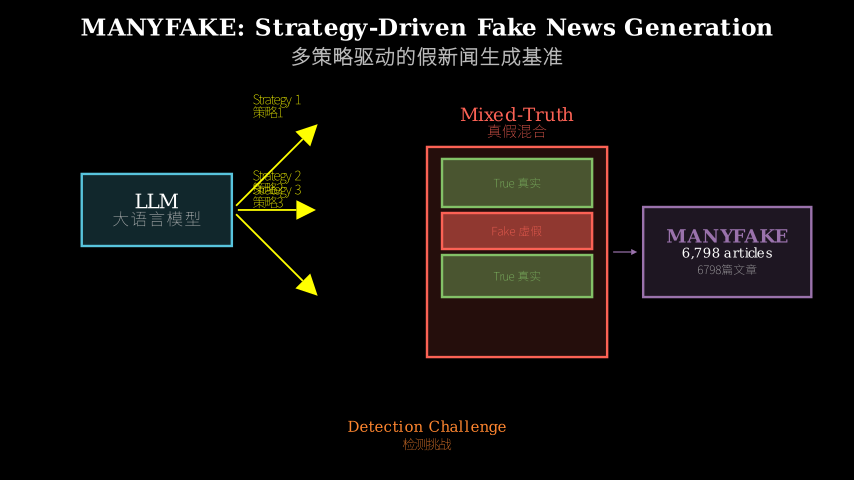
But modern fake news doesn’t work that way. With LLMs, adversaries don’t need to fabricate entire articles. They embed strategic inaccuracies within otherwise accurate reporting—a quote taken out of context here, a fabricated statistic there, all wrapped in credible journalistic style. These mixed-truth cases are what actually circulate and deceive people, yet they’re absent from existing benchmarks. Current detectors have never been tested on them.
Problem: Binary benchmarks miss mixed-truth threats
    |
    v
Assumption: Real fake news uses strategic partial fabrication
    |
    v
Method: Generate 6,798 articles via strategy-driven prompting
    |
    v
Evidence: Advanced detectors drop from 90%+ to ~60% accuracy
    |
    v
Conclusion: Detection is unsolved for realistic adversarial content
The Increment
One sentence: Before this paper, we thought fake news detection was nearly solved at 90%+ accuracy; after, we know detectors fail catastrophically when falsehoods are subtle and strategically embedded.
Core Mechanism
MANYFAKE generates fake news through a multi-stage prompting pipeline that mimics how adversaries actually operate. Stage 1: Generate base articles using different fabrication strategies (full fabrication, quote manipulation, statistic insertion, context distortion). Stage 2: Refine articles through adversarial optimization—make them more credible, harder to detect, stylistically polished. Stage 3: Create variations by mixing strategies and refinement levels.
The pipeline produces 6,798 articles spanning a spectrum from obvious fabrications to sophisticated mixed-truth pieces. Each article is labeled with its generation strategy, refinement level, and ground truth. The benchmark then evaluates detectors across this spectrum, revealing where they break.
Real News Corpus
    |
    v
[Strategy Selection] --> Full Fabrication
    |                --> Quote Manipulation
    |                --> Statistic Insertion
    |                --> Context Distortion
    v
[Base Generation] --> Raw fake articles
    |
    v
[Adversarial Refinement] --> Credibility boost
    |                      --> Style polishing
    |                      --> Detection evasion
    v
[Variation Mixing] --> 6,798 labeled articles
    |
    v
[Detector Evaluation] --> Performance breakdown by strategy
Think of MANYFAKE as a flight simulator for fake news detectors. Real-world training (existing benchmarks) only tests pilots in clear weather with full visibility—they pass with flying colors. But MANYFAKE introduces fog, crosswinds, and instrument failures. The base generation stage creates different weather conditions (fabrication strategies). The refinement stage adds turbulence (adversarial optimization). The evaluation reveals which conditions cause crashes. Just as a pilot who only trained in clear weather will panic in a storm, detectors trained on binary benchmarks fail when faced with mixed-truth adversarial content.
Key Concepts
-
Strategy-driven generation: Instead of randomly generating fake news, MANYFAKE uses explicit strategies that mirror real adversarial tactics. A “quote manipulation” strategy takes a real article, identifies a key quote, and subtly alters it to change meaning while preserving plausibility. A “statistic insertion” strategy embeds a fabricated number into an otherwise accurate report. This isn’t about creating random noise—it’s about simulating how a human adversary with an agenda would operate. The result: fake news that looks and reads like real journalism because it mostly is, with surgical falsehoods inserted at critical points.
-
Mixed-truth content: Traditional fake news is a fabricated story from start to finish. Mixed-truth content is 80% accurate reporting with 20% strategic falsehoods. Imagine a real article about unemployment rates where the headline statistic is fabricated but everything else—context, quotes, analysis—is accurate. Or a genuine interview where one key quote is altered to reverse the speaker’s position. These are harder to detect because most signals (writing style, source credibility, factual consistency) point to “real,” and only deep semantic understanding reveals the embedded falsehood.
-
Adversarial refinement: After generating a base fake article, MANYFAKE applies optimization passes to make it harder to detect. One pass improves stylistic credibility (fix awkward phrasing, add journalistic conventions). Another pass explicitly targets detection weaknesses (if detectors rely on sensational language, tone it down; if they check source consistency, add plausible attributions). This mimics how real adversaries iterate—they don’t publish the first draft, they refine until it passes scrutiny. The benchmark captures this arms race dynamic.
Framework Shift
Before (mainstream approach):        After (this paper):

[Real News] ---> Label: 1            [Real News] ---> Label: 1
                                          |
[Fake News] ---> Label: 0                v
                                     [Base Fake] ---> Refine
     |                                    |              |
     v                                    v              v
Binary Classifier                    [Mixed-Truth] ---> Label: 0
(90%+ accuracy)                           |
                                          v
                                     Spectrum Classifier
                                     (~60% on hard cases)
From binary classification on fully fabricated vs real to spectrum evaluation on strategically refined mixed-truth content, the core shift is treating fake news as an adversarial optimization problem rather than a static labeling task.
Expert Assessment
Problem choice: This is a real gap, not manufactured. The authors correctly identify that existing benchmarks don’t reflect how fake news actually circulates in 2024+. The LLM-enabled mixed-truth threat is consequential—it’s what’s actually fooling people on social media. The problem sits at a critical juncture: detection research has plateaued on old benchmarks, but the adversarial landscape has shifted underneath.
Method maturity: The strategy-driven generation is clever and well-motivated. However, the refinement stage feels somewhat ad-hoc—it’s unclear whether the specific optimization prompts used are representative of real adversarial behavior or just the authors’ intuitions. A stronger approach would involve red-teaming with actual adversaries or analyzing real-world fake news campaigns to extract refinement strategies. The benchmark is valuable, but the generation process could be more principled.
Experimental integrity: Baselines are fair—they test a range of detectors from classical ML to reasoning-enabled LLMs. The performance drop from 90%+ on binary benchmarks to ~60% on mixed-truth cases is striking and appears robust. One concern: the paper doesn’t deeply analyze failure modes. Which specific strategies break which detectors? Are there systematic patterns? The aggregate numbers are convincing, but the diagnostic analysis is shallow.
Writing quality: The introduction and motivation are strong. The method section is clear but could use more detail on prompt engineering choices. The results section is where the paper weakens—it presents numbers but doesn’t dig into why detectors fail or what this reveals about their internal representations. Rewriting the results section to include error analysis, case studies, and mechanistic hypotheses would elevate the paper significantly.
Verdict: weak accept — Addresses a real and timely gap with a useful benchmark, but the generation methodology could be more principled and the analysis could go deeper.
Takeaways
For practitioners building detectors: Stop optimizing for accuracy on binary benchmarks. Your 95% accuracy means nothing if it drops to 60% when adversaries refine their content. Start red-teaming your models with mixed-truth cases. The specific strategies in MANYFAKE (quote manipulation, statistic insertion) are concrete attack vectors you should test against.
For researchers: The strategy-driven generation framework is reusable. If you’re building benchmarks for any adversarial domain (phishing, spam, misinformation), don’t just generate random negative examples—explicitly model adversarial strategies and refinement processes. The gap between “random fake” and “optimized fake” is where real-world performance lives.
For anyone evaluating LLMs: Reasoning-enabled models (GPT-4, Claude) don’t solve this problem. They’re better than classical detectors but still brittle on subtle falsehoods. If you’re deploying LLMs for content moderation, don’t assume their reasoning capabilities transfer to adversarial settings. Test on refined, mixed-truth cases, not just obvious fabrications.
论文: 2604.09514 作者: Xinyu Wang, Sai Koneru, Wenbo Zhang, Wenliang Zheng, Saksham Ranjan, Sarah Rajtmajer 分类: cs.CL, cs.HC
缺口
现有假新闻检测研究把问题当作二元分类:真 vs 假。
FakeNewsNet 和 LIAR 等基准测试要么包含完全虚构的故事,要么包含完全真实的故事。
在这些数据集上训练的检测器准确率达到 90% 以上,似乎问题快解决了。
但现代假新闻不是这样运作的。
有了大语言模型,对手不需要编造整篇文章。
他们在原本准确的报道中嵌入策略性的不准确信息——这里断章取义一句引语,那里捏造一个统计数据,全都包裹在可信的新闻风格中。
这些真假混合的内容才是真正流传并欺骗人们的东西,但现有基准测试中却没有它们。
当前的检测器从未在这些内容上测试过。
问题:二元基准测试遗漏了真假混合威胁
    |
    v
假设:真实的假新闻使用策略性部分捏造
    |
    v
方法:通过策略驱动提示生成 6,798 篇文章
    |
    v
证据:先进检测器准确率从 90%+ 降至约 60%
    |
    v
结论:对于现实对抗性内容,检测问题尚未解决
增量
一句话:这篇论文之前,我们以为假新闻检测以 90% 以上准确率基本解决了;之后,我们知道当谎言微妙且被策略性嵌入时,检测器会灾难性失效。
核心机制
MANYFAKE 通过多阶段提示管道生成假新闻,模拟对手的实际操作方式。
第一阶段:使用不同的捏造策略生成基础文章(完全捏造、引语操纵、统计数据插入、语境扭曲)。
第二阶段:通过对抗性优化改进文章——使其更可信、更难检测、风格更精致。
第三阶段:通过混合策略和改进级别创建变体。
该管道生成 6,798 篇文章,涵盖从明显捏造到复杂真假混合的整个光谱。
每篇文章都标注了生成策略、改进级别和真实标签。
然后基准测试在这个光谱上评估检测器,揭示它们在哪里失效。
真实新闻语料库
    |
    v
[策略选择] --> 完全捏造
    |        --> 引语操纵
    |        --> 统计数据插入
    |        --> 语境扭曲
    v
[基础生成] --> 原始假文章
    |
    v
[对抗性改进] --> 可信度提升
    |          --> 风格打磨
    |          --> 检测规避
    v
[变体混合] --> 6,798 篇标注文章
    |
    v
[检测器评估] --> 按策略分解性能
把 MANYFAKE 想象成假新闻检测器的飞行模拟器。
现实世界训练(现有基准测试)只在晴朗天气、能见度良好的情况下测试飞行员——他们轻松通过。
但 MANYFAKE 引入了雾、侧风和仪表故障。
基础生成阶段创建不同的天气条件(捏造策略)。
改进阶段增加湍流(对抗性优化)。
评估揭示哪些条件会导致坠机。
就像只在晴天训练的飞行员在暴风雨中会惊慌失措一样,在二元基准测试上训练的检测器面对真假混合的对抗性内容时会失效。
关键概念
- 策略驱动生成:MANYFAKE 不是随机生成假新闻,而是使用明确的策略来镜像真实的对抗性战术。
“引语操纵”策略拿一篇真实文章,识别关键引语,然后微妙地改变它以改变含义,同时保持合理性。
“统计数据插入”策略在原本准确的报道中嵌入一个捏造的数字。
这不是创造随机噪声——而是模拟一个有议程的人类对手会如何操作。
结果:假新闻看起来和读起来像真正的新闻,因为它大部分确实是真的,只是在关键点插入了精准的谎言。
- 真假混合内容:传统假新闻是从头到尾捏造的故事。
真假混合内容是 80% 准确报道加 20% 策略性谎言。
想象一篇关于失业率的真实文章,其中标题统计数据是捏造的,但其他一切——背景、引语、分析——都是准确的。
或者一个真实采访,其中一句关键引语被改变以逆转说话者的立场。
这些更难检测,因为大多数信号(写作风格、来源可信度、事实一致性)都指向”真实”,只有深层语义理解才能揭示嵌入的谎言。
- 对抗性改进:生成基础假文章后,MANYFAKE 应用优化过程使其更难检测。
一次优化改进风格可信度(修正尴尬措辞,添加新闻惯例)。
另一次优化明确针对检测弱点(如果检测器依赖耸人听闻的语言,就降低语气;如果它们检查来源一致性,就添加合理的归因)。
这模拟了真实对手如何迭代——他们不发布初稿,而是改进直到通过审查。
基准测试捕捉了这种军备竞赛动态。
框架转变
之前(主流方法):                之后(本文方法):

[真实新闻] ---> 标签: 1          [真实新闻] ---> 标签: 1
                                      |
[假新闻] ---> 标签: 0                v
                                 [基础假新闻] ---> 改进
     |                                |              |
     v                                v              v
二元分类器                        [真假混合] ---> 标签: 0
(90%+ 准确率)                         |
                                      v
                                 光谱分类器
                                 (困难案例约 60%)
从对完全捏造 vs 真实的二元分类到对策略性改进的真假混合内容的光谱评估,核心转变是将假新闻视为对抗性优化问题而非静态标注任务。
专家评审
选题眼光:这是真实的缺口,不是人造的。
作者正确识别出现有基准测试不反映 2024 年以后假新闻的实际流传方式。
大语言模型赋能的真假混合威胁是有后果的——这正是社交媒体上真正欺骗人们的东西。
这个问题处于关键节点:检测研究在旧基准测试上已经停滞,但对抗性格局已经在底层发生了变化。
方法成熟度:策略驱动生成很巧妙且动机充分。
然而,改进阶段感觉有些临时——不清楚使用的特定优化提示是否代表真实的对抗性行为,还是只是作者的直觉。
更强的方法应该涉及与实际对手的红队演练,或分析真实世界的假新闻活动以提取改进策略。
基准测试很有价值,但生成过程可以更有原则。
实验诚意:基线公平——他们测试了从经典机器学习到推理赋能大语言模型的一系列检测器。
从二元基准测试的 90% 以上到真假混合案例的约 60% 的性能下降是显著的,看起来很稳健。
一个担忧:论文没有深入分析失败模式。
哪些特定策略破坏了哪些检测器?有系统性模式吗?总体数字令人信服,但诊断分析很浅。
写作功力:引言和动机很强。
方法部分清晰,但可以更详细地说明提示工程选择。
结果部分是论文变弱的地方——它呈现数字但没有深入探讨检测器为什么失效或这揭示了它们内部表示的什么。
重写结果部分以包括错误分析、案例研究和机制假设将显著提升论文。
判决:弱接收 — 用有用的基准测试解决了一个真实且及时的缺口,但生成方法可以更有原则,分析可以更深入。
要点总结
对于构建检测器的实践者:停止在二元基准测试上优化准确率。
当对手改进他们的内容时,你的 95% 准确率降到 60%,那就毫无意义。
开始用真假混合案例对你的模型进行红队演练。
MANYFAKE 中的特定策略(引语操纵、统计数据插入)是你应该测试的具体攻击向量。
对于研究人员:策略驱动生成框架是可重用的。
如果你正在为任何对抗性领域(网络钓鱼、垃圾邮件、错误信息)构建基准测试,不要只生成随机负面示例——明确建模对抗性策略和改进过程。
“随机假”和”优化假”之间的差距是真实世界性能所在。
对于评估大语言模型的任何人:推理赋能模型(GPT-4、Claude)不能解决这个问题。
它们比经典检测器更好,但在微妙的谎言上仍然脆弱。
如果你正在部署大语言模型进行内容审核,不要假设它们的推理能力会迁移到对抗性设置。
在改进的真假混合案例上测试,而不仅仅是明显的捏造。