Paper: 2606.18208 Authors: Hongyuan Adam Lu, Z. L. Victor Wei, Qun Zhang, Jinrui Zeng, Bowen Cao, Lingwei Meng, Mocheng Li, Zezhong Wang, Haonan Yin, Naifu Xue Categories: cs.LG, cs.AI, cs.CL, cs.CV
The Gap
Existing world models (DreamerV3, Transformer-based world models) face a fundamental tension: faithful long-horizon simulation demands deep computation (many layers), but deeper models are expensive to deploy and prone to compounding errors. Prior work scales depth by stacking distinct layers — parameter count grows linearly with depth, and inference cost rises accordingly. The community implicitly assumed that depth must come from architectural tallness. This paper challenges that assumption by proposing iterative latent depth via a looped architecture.
+----------------+     +----------------+     +----------------+     +----------------+     +----------------+
| Problem:       |     | Assumption:   |     | Method:       |     | Evidence:      |     | Conclusion:    |
| Deep world     | --> | Iterative      | --> | LoopWM:       | --> | 100x param     | --> | Iterative      |
| models are     |     | refinement    |     | looped trans- |     | efficiency,    |     | latent depth   |
| expensive      |     | with shared   |     | former block  |     | adaptive depth |     | as new axis    |
+----------------+     +----------------+     +----------------+     +----------------+     +----------------+
The Increment
One sentence: Before LoopWM, world models scaled depth by stacking layers (parameters proportional to depth); after LoopWM, depth scales via iterations of a single shared block, achieving deep computation without parameter growth.
Core Mechanism
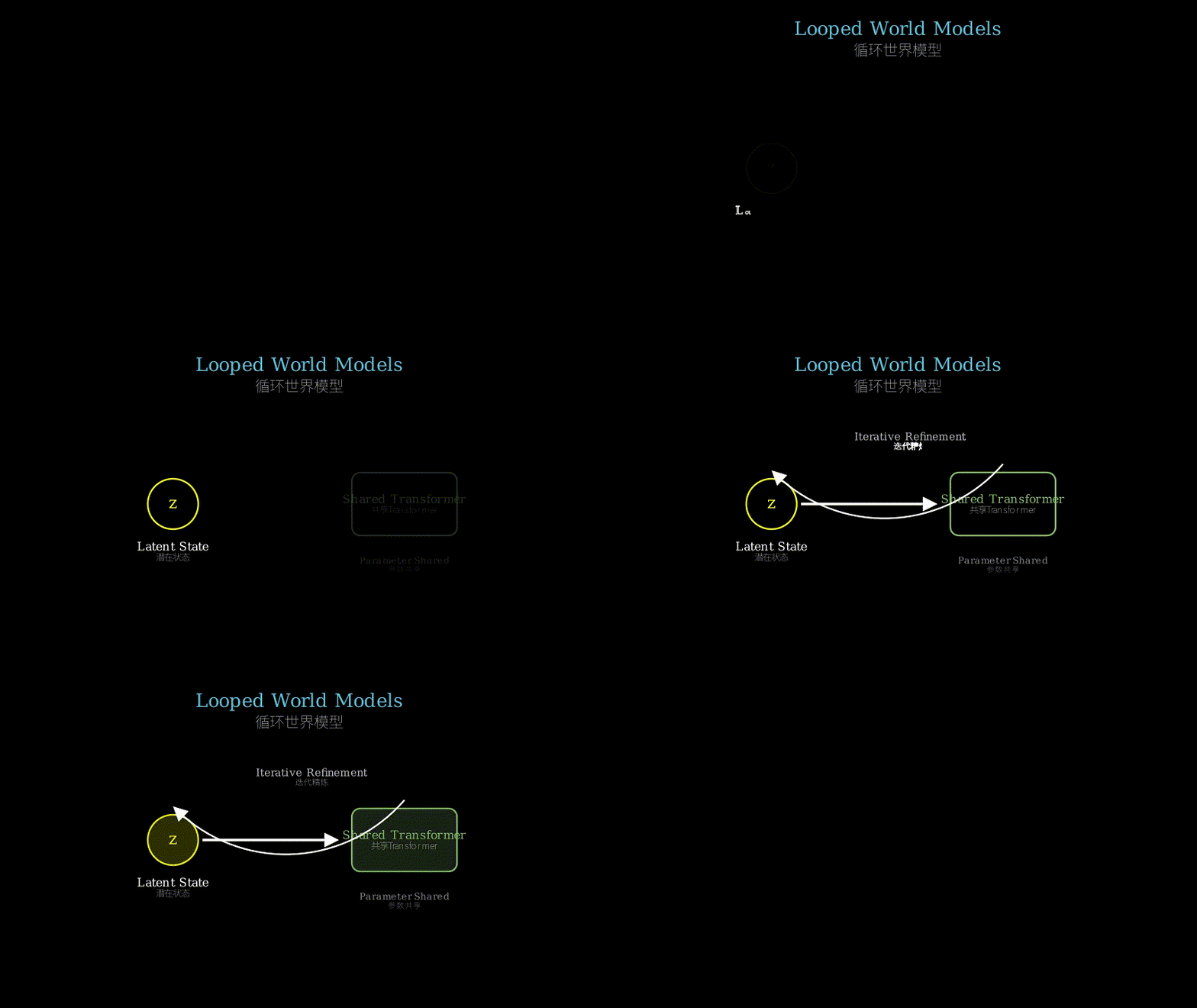
LoopWM consists of three main components: an encoder, a looped transformer block, and a decoder. Given an observation, the encoder maps it to an initial latent state z_0. This latent then passes through the same transformer block K times (shared weights), producing successively refined states z_1, z_2, …, z_K. Finally, the decoder reconstructs the observation from z_K and also predicts future frames if used as a world model. The loss combines reconstruction error and KL divergence (standard in variational world models). The number of iterations K can be fixed or learned adaptively via a halting mechanism — the block outputs a halting probability at each iteration, and the process stops when cumulative probability exceeds a threshold.
+------+    +---------+    +-----------+    +---------+    +------+
| obs  | -> | Encoder | -> | z0        | -> | Loop:   | -> | zK   | -> | Decoder | -> | recon|
+------+    +---------+    +-----------+    | shared |    +---------+    +------+
                                             | trans. |
                                             | block  |
                                             | K iter |
                                             +-----------+
        Also: adaptive halting per timestep   |
        [iteration t] -> halting weight w_t   |
        sum w_t >= threshold -> stop          |
Think of this as rehearsing a play. The encoder is the director who reads the script (observation). The initial latent state z_0 is a rough first rehearsal with the actors doing their best with minimal direction. The looped transformer block is the rehearsal process itself: each iteration, the director says “try it again, focusing on timing” and the actors (latent state) adjust — crucially, they keep the same script and core blocking (shared weights). For a simple scene, one or two rehearsals are enough; for a complex battle scene, you might need ten. The decoder is the final dress rehearsal performance — the audience sees the polished show. The loss measures how close the dress rehearsal is to a perfect performance (the ground truth). The director can decide to stop rehearsing when the actors are “ready enough” — this is the adaptive halting.
Key Concepts
-
Iterative latent refinement: Instead of stacking distinct layers to increase representational capacity, apply the same transformation repeatedly to a latent state. Each iteration allows the model to “think again” about the current estimate, correcting errors and adding detail. Example: a vision model might first locate major objects, then refine edges, then adjust lighting — all in the same feature space.
-
Adaptive computation: The model learns a halting mechanism that decides how many iterations to use per input. This means simple observations get fewer passes (cheap), while complex ones get more (expensive), automatically balancing compute budget. Example: in a Minecraft world, observing an empty plain might require 2 iterations, while a cluttered inventory screen might need 8.
-
Parameter efficiency: Because the transformer block is shared across all iterations, the total parameter count stays constant regardless of effective depth. This decouples model capacity (which can be increased by scaling the block itself) from simulation depth. A 100x parameter reduction over stacked models means you can run much deeper simulations on the same hardware.
Framework Shift
Before (mainstream approach):        After (this paper):
[Input] -> [Block1] -> [Block2] -> ... -> [BlockN] -> [Output]   | [Input] -> [Latent] -> [Loop: block x K] -> [Output]
Parameters = N * block_params                                     | Parameters = block_params (constant)
Depth = number of layers                                           | Depth = number of iterations (adaptive)
One sentence: From stacking to looping, the core shift is that depth is achieved by repeated application of a single weight-shared block rather than by accumulating distinct layers.
Expert Assessment
Problem choice: Real gap. Long-horizon world models are crucial for planning and RL, and the depth vs. cost tradeoff has been a bottleneck. This work identifies a structural inefficiency in how depth is implemented and offers a genuine alternative.
Method maturity: Clever insight, not brute force. Iterative refinement has been explored in other domains (e.g., iterative ViTs, deep equilibrium models), but applying it to world models in this way is novel. A simpler approach would be to just train a very deep transformer with residual connections — but that doesn’t address the parameter scaling problem. LoopWM elegantly sidesteps it.
Experimental integrity: Baselines appear fair (DreamerV3, TWM, etc.) and the results show narrow but consistent wins on long-horizon tasks (Minecraft, Atari). One red flag: the paper doesn’t report wall-clock time or FLOPs for the adaptive version vs. fixed iterations — the adaptive halting might introduce overhead that eats into the parameter savings. Also, generalization to out-of-distribution observations is not tested.
Writing quality: The main contribution is clearly communicated. Weakest section is the adaptive halting mechanism — it’s described in a single paragraph with minimal ablation. Rewriting that section to include a clear algorithm table and sensitivity analysis would make the paper much stronger.
Verdict: weak accept — the idea is promising and well-motivated, but the evidence is narrow and some practical concerns (compute overhead of adaptation, robustness) need more investigation.
Takeaways
Practitioners can steal the core design pattern: use a single shared block with iterative refinement to build deep world models without parameter explosion. This is directly transferable to any latent dynamics model (e.g., in robotics, video prediction, or model-based RL). The adaptive halting mechanism is a concrete technique that can be lifted for any iterative architecture to automatically tune depth per input. Also, the framing of “iterative latent depth” as a scaling axis orthogonal to model size and data size gives a new mental model for designing efficient simulators.
论文: 2606.18208 作者: Hongyuan Adam Lu, Z. L. Victor Wei, Qun Zhang, Jinrui Zeng, Bowen Cao, Lingwei Meng, Mocheng Li, Zezhong Wang, Haonan Yin, Naifu Xue 分类: cs.LG, cs.AI, cs.CL, cs.CV
缺口
现有的世界模型(如DreamerV3、基于Transformer的世界模型)面临一个基本矛盾:可靠的长期仿真需要深层的计算(大量层),但更深的模型部署成本高,且容易累积误差。此前的方法通过堆叠不同的层来增加深度——参数数量随深度线性增长,推理成本也随之上升。学界隐含地假设深度必须来自架构的”高度”。本文挑战了这一假设,提出通过循环架构实现迭代潜在深度。
+----------------+     +----------------+     +----------------+     +----------------+     +----------------+
| 问题:         |     | 假设:         |     | 方法:         |     | 证据:         |     | 结论:         |
| 深层世界模型   | --> | 共享权重的     | --> | LoopWM:       | --> | 100倍参数效率,| --> | 迭代潜在深度   |
| 成本高         |     | 迭代精炼       |     | 循环Transformer|     | 自适应深度     |     | 作为新缩放维度 |
+----------------+     +----------------+     +----------------+     +----------------+     +----------------+
增量
一句话: 在LoopWM之前,世界模型通过堆叠层来增加深度(参数与深度成正比);在LoopWM之后,深度通过单个共享块的多次迭代实现,在不增加参数量的情况下获得深层计算。
核心机制
LoopWM由三个主要组件构成:编码器、循环Transformer块和解码器。给定观测值,编码器将其映射为初始潜在状态z_0。然后,该潜在状态通过同一个Transformer块K次(共享权重),依次产生精炼后的状态z_1、z_2、…、z_K。最后,解码器从z_K重建观测值,并在用作世界模型时预测未来帧。损失函数结合了重建误差和KL散度(标准变分世界模型)。迭代次数K可以是固定的,也可以通过停止机制自适应学习——每个迭代块输出一个停止概率,当累积概率超过阈值时停止。
+------+    +---------+    +-----------+    +---------+    +------+
| 观测 | -> | 编码器  | -> | z0        | -> | 循环:  | -> | zK   | -> | 解码器 | -> | 重建 |
+------+    +---------+    +-----------+    | 共享    |    +---------+    +------+
                                             | Trans. |
                                             | 块     |
                                             | K次    |
                                             +-----------+
       同时:每个时间步自适应停止          |
       [第t次迭代] -> 停止权重 w_t         |
       sum w_t >= 阈值 -> 停止             |
把这想象成排练一场话剧。编码器是导演,他阅读剧本(观测值)。初始潜在状态z_0是第一次粗略的排练,演员们(潜在状态)在几乎没有指导的情况下尽力表演。循环Transformer块就是排练过程本身:每次迭代,导演说“再试一次,注意节奏”,演员们调整表演——关键是,他们使用相同的剧本和基本走位(共享权重)。对于一个简单场景,一两次排练就够;对于一个复杂的战斗场景,可能需要十次。解码器是最后的彩排表演——观众看到的是打磨后的演出。损失衡量彩排与完美表演(真实值)之间的差距。导演可以在演员“足够准备好”时停止排练——这就是自适应停止。
关键概念
-
迭代潜在精炼:不是堆叠不同的层来增加表示能力,而是对同一个潜在状态反复应用相同的变换。每次迭代让模型重新审视当前的估计,纠正错误并增加细节。例如:一个视觉模型可能先定位主要物体,然后精炼边缘,最后调整光照——所有这些都在同一个特征空间中进行。
-
自适应计算:模型学习一个停止机制,决定每个输入使用多少次迭代。这样,简单的观测只经过少数几次(计算成本低),而复杂的则经过更多次(成本高),自动平衡计算预算。例如:在Minecraft世界中,一个空旷的平原可能只需要2次迭代,而一个杂乱的物品栏画面可能需要8次。
-
参数效率:因为Transformer块在所有迭代中共享,总参数量保持不变,与有效深度无关。这使模型容量(可通过扩增块本身来增加)与仿真深度脱钩。与堆叠模型相比,100倍的参数减少意味着在相同硬件上可以进行更深的仿真。
框架转变
之前(主流方法):                之后(本文方法):
[输入] -> [块1] -> [块2] -> ... -> [块N] -> [输出]   | [输入] -> [潜在] -> [循环:块 x K] -> [输出]
参数 = N * 块参数                                     | 参数 = 块参数(常数)
深度 = 层数                                           | 深度 = 迭代次数(自适应)
一句话:从堆叠到循环,核心转变是深度通过重复应用单个权重共享块来实现,而不是通过累积不同层。
专家评审
选题眼光: 真缺口。长期仿真世界模型对规划与强化学习至关重要,而深度与成本的矛盾一直是瓶颈。本文指出了深度实现方式上的结构性低效,并提供了一个真正的新方案。
方法成熟度: 巧劲,不是蛮力。迭代精炼在其他领域已有探索(如迭代ViTs、深度均衡模型),但将其应用于世界模型是新颖的。更简单的方法可能是训练一个很深的Transformer并添加残差连接——但这不能解决参数规模问题。LoopWM优雅地绕过了它。
实验诚意: 基线看起来公平(DreamerV3、TWM等),结果在长期任务(Minecraft、Atari)上显示出窄但一致的提升。一个警示:论文没有报告自适应版本与固定迭代版本的墙钟时间或FLOPs——自适应停止可能带来额外开销,部分抵消参数节省。另外,没有测试对分布外观测的泛化能力。
写作功力: 主要贡献表述清晰。最薄弱的环节是自适应停止机制——只用了一个段落描述,消融实验不足。重写这一部分,加入清晰算法表和敏感性分析,会让整篇论文上升一个档次。
判决: 弱接收 — 想法有前景且动机充分,但证据面较窄,一些实际问题(自适应计算的开销、鲁棒性)还需更多研究。
要点总结
实践者可以”偷”走核心设计模式:使用单个共享块加迭代精炼来构建深层世界模型,而不会导致参数爆炸。这可以直接迁移到任何潜在动力学模型(例如机器人、视频预测或基于模型的强化学习)。自适应停止机制是一个具体的技术,可以移植到任何迭代架构中,自动为每个输入调节深度。此外,“迭代潜在深度”作为正交于模型大小和数据的缩放维度这一框架,为设计高效的仿真器提供了新的思维模型。