Paper: 2605.26106 Authors: Sanghyun Lee, Chunsan Hong, Seungryong Kim, Jonghyun Lee, Jongho Park, Dongmin Park Categories: cs.LG
The Gap
Masked diffusion models (MDMs) offer a non-autoregressive alternative to language modeling, but their transformer architectures remain underoptimized. Standard MDMs use fixed-depth transformers, forcing a tradeoff: deeper models improve performance but multiply training costs linearly with depth. Meanwhile, autoregressive models have explored layer looping (weight sharing across depth), but MDMs’ unique property—simultaneous processing of masked positions—hasn’t been exploited for architectural efficiency. The question: can we get depth-like benefits without proportional parameter or compute growth?
Problem: MDM depth scaling is expensive
   |
   v
Observation: MDMs process all masked tokens in parallel
   |                    (unlike autoregressive sequential processing)
   v
Hypothesis: Looping layers can simulate depth while reusing weights
   |
   v
Method: Selectively loop early-middle layers during training
   |
   v
Evidence: 3.3x fewer FLOPs for same performance, 8.5pt gain on GSM8K
   |
   v
Conclusion: Selective looping > naive depth scaling for MDMs
The Increment
One sentence: Before—MDMs scaled depth by adding layers proportionally to compute; after—selective layer looping decouples depth from parameters, enabling efficient training and flexible inference-time compute scaling.
Core Mechanism
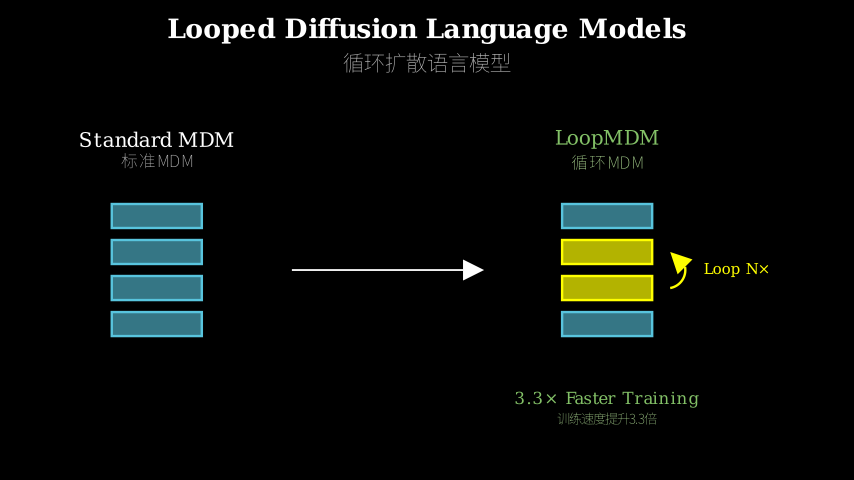
LoopMDM modifies the transformer architecture by repeating a subset of layers multiple times during a single forward pass. Specifically, it loops layers in the early-to-middle range (e.g., layers 3-8 in a 12-layer model) while keeping the first few and last few layers non-looped. During training, input passes through the looped section multiple times before proceeding to later layers. At inference, the number of loops can be adjusted independently—fewer loops for faster generation, more loops for better quality.
The looping mechanism works by feeding the output of the looped section back as input to the same layers. If layers 3-8 are looped twice, the forward pass becomes: layers 1-2 → layers 3-8 → layers 3-8 (again) → layers 9-12. This creates an effective depth of 16 layers (2+6+6+4) using only 12 layers’ worth of parameters. The key insight: MDMs process all masked positions simultaneously, so each loop iteration allows the model to refine predictions across the entire sequence, unlike autoregressive models where looping would redundantly process the same token.
Structural metaphor: Think of LoopMDM as a pottery wheel with multiple passes. A standard transformer is like shaping clay in one continuous motion from base to rim—each layer adds detail sequentially. LoopMDM is like returning to the middle section (the bowl’s curve) and reshaping it multiple times before finishing the rim. The first layers (base) establish structure, the looped middle layers (curve) get refined through repeated passes, and the final layers (rim) complete the form. The clay (hidden representations) gets more refined with each loop, but you’re not adding more clay (parameters)—you’re just working the same section more thoroughly. At inference, you can choose how many times to rework that middle section based on whether you need a quick rough bowl or a finely detailed one.
Key Concepts
-
Masked Diffusion Models (MDMs): Unlike autoregressive models that generate text left-to-right one token at a time, MDMs start with a fully masked sequence and iteratively unmask tokens over multiple diffusion steps. Imagine filling in a crossword puzzle where you can see all the blanks at once and gradually fill them in based on surrounding context, rather than writing a sentence word-by-word. Each diffusion step refines predictions for all positions simultaneously. This parallelism is why looping works differently here—each loop lets the model reconsider all masked positions together, creating richer interactions.
-
Selective Looping: Not all layers benefit equally from repetition. Early layers extract low-level features (token embeddings, local patterns), late layers produce final predictions, but middle layers perform iterative reasoning and cross-position interactions. Looping only the middle layers exploits this: the model gets multiple chances to refine its understanding of relationships between masked positions without redundantly re-extracting features or re-computing outputs. It’s like editing a draft—you don’t rewrite the title and conclusion every time, you focus on reworking the body paragraphs.
-
Depth-Scaling Effect: Traditional depth scaling adds more layers, increasing both parameters and compute proportionally. Looping achieves a similar effect—more processing steps, more representational capacity—but reuses the same parameters. A 12-layer model with 2× looping on 6 middle layers behaves like an 18-layer model (2+6+6+4) in terms of computation depth, but only stores 12 layers’ worth of weights. This decoupling is crucial: you get the benefits of depth (better reasoning, more refinement) without the memory cost or training instability of very deep networks.
Framework Shift
Before (standard MDM):              After (LoopMDM):

Input                               Input
  |                                   |
  v                                   v
[Layer 1 ]                          [Layer 1 ]
[Layer 2 ]                          [Layer 2 ]
[Layer 3 ]                          +--------+
[Layer 4 ]                          |Layer 3 |<--+
[Layer 5 ]                          |Layer 4 |   |
[Layer 6 ]      12 layers           |Layer 5 |   | Loop 2x
[Layer 7 ]      12 param sets       |Layer 6 |   |
[Layer 8 ]                          +--------+---+
[Layer 9 ]                          [Layer 7 ]
[Layer 10]                          [Layer 8 ]    12 layers
[Layer 11]                                        8 param sets
[Layer 12]                                        effective depth: 16
  |                                   |
  v                                   v
Output                              Output

Depth = Parameters                  Depth > Parameters
One sentence: From treating depth as a fixed architectural property to treating it as a dynamic computational budget that can be adjusted independently of model size.
Expert Assessment
Problem choice: Real gap. MDMs are gaining traction as autoregressive alternatives, but architectural design for them has been mostly borrowed from AR models without rethinking what MDMs’ parallel processing enables. The observation that middle layers benefit most from looping is well-motivated by attention analysis showing these layers drive cross-position interactions. This sits at the intersection of efficiency and architecture co-design—timely given the push for compute-efficient training.
Method maturity: Elegant simplicity. The core idea—loop middle layers—is almost trivial, yet the execution is thoughtful: they identify which layers to loop through ablations, show it works across model sizes and datasets, and provide mechanistic evidence (attention analysis) for why it works. No exotic techniques, just disciplined application of a simple principle. The inference-time compute scaling is a nice bonus that falls out naturally. One concern: the optimal loop count and layer range likely depend on model size and task, requiring per-setup tuning.
Experimental integrity: Solid baselines and fair comparisons. They compare against same-size MDMs, deeper MDMs with matched per-step compute, and report both training efficiency (FLOPs) and final performance. The GSM8K gains (8.5 points) are substantial, though it’s worth noting GSM8K is a reasoning benchmark where iterative refinement should help most—would be interesting to see performance on tasks requiring less multi-step reasoning. The adaptive looping experiments (varying loops during sampling) are a nice touch but feel slightly underexplored—more analysis on when to use more/fewer loops would strengthen the story.
Writing quality: Clear and well-structured, but the attention analysis section (Section 4.4) feels tacked on. The paper would benefit from integrating those insights earlier to motivate the method, rather than presenting them as post-hoc validation. The related work section is thorough but could be trimmed—some citations feel like box-checking rather than building narrative. The ablation studies are excellent and should be highlighted more prominently.
Verdict: strong accept — Addresses a real efficiency bottleneck in MDMs with a simple, well-validated method that offers both training and inference benefits, backed by solid experiments and mechanistic understanding.
Takeaways
For practitioners building MDMs: Don’t default to uniform depth. Profile which layers drive performance (likely middle layers handling cross-token interactions) and loop those. Start with 2× looping on the middle third of your model—it’s a low-risk architectural change that can cut training time significantly.
For efficiency researchers: The decoupling of depth from parameters via selective looping is a transferable pattern. Look for other architectures where certain operations benefit from repetition but don’t need unique parameters each time. The inference-time compute scaling idea—adjusting loops per sample or per diffusion step—could apply to other iterative generation methods.
For architecture designers: The paper’s attention analysis showing looped layers promote masked-position interactions is a useful diagnostic. When designing architectures for parallel generation tasks, measure cross-position information flow and allocate compute accordingly. Not all layers need to be equally deep or equally wide.
Steal this: The adaptive looping schedule (varying loops across diffusion steps) is underexplored in the paper but has potential. Early diffusion steps might need more loops (high uncertainty, need refinement), late steps fewer (predictions converging). This could be a simple heuristic for compute-quality tradeoffs in production systems.
论文: 2605.26106 作者: Sanghyun Lee, Chunsan Hong, Seungryong Kim, Jonghyun Lee, Jongho Park, Dongmin Park 分类: cs.LG
缺口
掩码扩散模型(MDM)为语言建模提供了非自回归的替代方案,但其 Transformer 架构仍未得到充分优化。
标准 MDM 使用固定深度的 Transformer,这迫使研究者面临权衡:更深的模型能提升性能,但训练成本随深度线性增长。
与此同时,自回归模型已经探索了层循环(跨深度的权重共享),但 MDM 的独特性质——同时处理所有掩码位置——尚未被用于提升架构效率。
问题是:我们能否在不成比例增加参数或计算量的情况下,获得类似加深模型的收益?
问题:MDM 深度扩展成本高昂
   |
   v
观察:MDM 并行处理所有掩码 token
   |                    (不同于自回归的顺序处理)
   v
假设:循环层可以模拟深度同时复用权重
   |
   v
方法:训练时选择性循环早期-中期层
   |
   v
证据:相同性能下 FLOPs 减少 3.3 倍,GSM8K 提升 8.5 分
   |
   v
结论:选择性循环 > 朴素深度扩展(针对 MDM)
增量
一句话:之前——MDM 通过按比例增加层数来扩展深度和计算量;之后——选择性层循环将深度与参数解耦,实现高效训练和灵活的推理时算力调节。
核心机制
LoopMDM 通过在单次前向传播中多次重复部分层来修改 Transformer 架构。
具体来说,它循环早期到中期范围的层(例如,12 层模型中的第 3-8 层),同时保持前几层和后几层不循环。
训练时,输入在进入后续层之前会多次通过循环部分。
推理时,循环次数可以独立调整——更少的循环用于更快的生成,更多的循环用于更好的质量。
循环机制的工作原理是将循环部分的输出反馈作为相同层的输入。
如果第 3-8 层循环两次,前向传播变为:第 1-2 层 → 第 3-8 层 → 第 3-8 层(再次)→ 第 9-12 层。
这创建了 16 层的有效深度(2+6+6+4),但只使用 12 层的参数量。
关键洞察:MDM 同时处理所有掩码位置,因此每次循环迭代都允许模型在整个序列上细化预测,这与自回归模型不同——在自回归模型中,循环会冗余地处理同一个 token。
核喻:把 LoopMDM 想象成一个多次打磨的陶轮。
标准 Transformer 就像从底座到边缘一次性连续塑形粘土——每一层按顺序添加细节。
LoopMDM 则像是回到中间部分(碗的曲线)并多次重塑它,然后再完成边缘。
第一批层(底座)建立结构,循环的中间层(曲线)通过重复打磨得到细化,最后的层(边缘)完成造型。
粘土(隐藏表示)随着每次循环变得更加精细,但你没有添加更多粘土(参数)——你只是更彻底地处理同一部分。
在推理时,你可以根据需要快速粗糙的碗还是精细的碗,选择重塑中间部分的次数。
关键概念
- 掩码扩散模型(MDM):与从左到右逐个 token 生成文本的自回归模型不同,MDM 从完全掩码的序列开始,在多个扩散步骤中迭代地揭示 token。
想象填字谜游戏,你可以一次看到所有空格,并根据周围上下文逐渐填充它们,而不是逐字写句子。
每个扩散步骤同时细化所有位置的预测。
这种并行性是循环在这里工作方式不同的原因——每次循环让模型一起重新考虑所有掩码位置,创造更丰富的交互。
- 选择性循环:并非所有层都能从重复中同等受益。
早期层提取低级特征(token 嵌入、局部模式),后期层产生最终预测,但中间层执行迭代推理和跨位置交互。
仅循环中间层利用了这一点:模型获得多次机会来细化对掩码位置之间关系的理解,而不会冗余地重新提取特征或重新计算输出。
这就像编辑草稿——你不会每次都重写标题和结论,你专注于重新处理正文段落。
- 深度扩展效应:传统的深度扩展增加更多层,参数和计算量成比例增加。
循环实现了类似的效果——更多的处理步骤、更大的表示能力——但复用相同的参数。
一个 12 层模型在 6 个中间层上进行 2 倍循环,在计算深度方面表现得像一个 18 层模型(2+6+6+4),但只存储 12 层的权重。
这种解耦至关重要:你获得了深度的好处(更好的推理、更多的细化),而没有非常深网络的内存成本或训练不稳定性。
框架转变
之前(标准 MDM):                之后(LoopMDM):

输入                               输入
  |                                   |
  v                                   v
[第 1 层]                          [第 1 层]
[第 2 层]                          [第 2 层]
[第 3 层]                          +--------+
[第 4 层]                          |第 3 层 |<--+
[第 5 层]                          |第 4 层 |   |
[第 6 层]      12 层               |第 5 层 |   | 循环 2 次
[第 7 层]      12 组参数           |第 6 层 |   |
[第 8 层]                          +--------+---+
[第 9 层]                          [第 7 层]
[第 10 层]                         [第 8 层]    12 层
[第 11 层]                                      8 组参数
[第 12 层]                                      有效深度:16
  |                                   |
  v                                   v
输出                               输出

深度 = 参数                        深度 > 参数
一句话:从将深度视为固定的架构属性,到将其视为可以独立于模型大小动态调整的计算预算。
专家评审
选题眼光:真实缺口。
MDM 作为自回归模型的替代方案正在获得关注,但针对它们的架构设计大多是从 AR 模型借鉴而来,没有重新思考 MDM 的并行处理能力。
观察到中间层最受益于循环这一点,通过注意力分析显示这些层驱动跨位置交互,动机充分。
这处于效率和架构协同设计的交叉点——考虑到对计算高效训练的推动,时机恰当。
方法成熟度:优雅的简洁性。
核心思想——循环中间层——几乎是微不足道的,但执行是深思熟虑的:他们通过消融实验确定循环哪些层,展示它在不同模型大小和数据集上有效,并提供机制证据(注意力分析)说明为什么有效。
没有奇特的技术,只是对简单原则的严谨应用。
推理时算力调节是一个自然产生的不错附加功能。
一个担忧:最优循环次数和层范围可能取决于模型大小和任务,需要针对每个设置进行调优。
实验诚意:基线扎实,比较公平。
他们与相同大小的 MDM、具有匹配每步计算量的更深 MDM 进行比较,并报告训练效率(FLOPs)和最终性能。
GSM8K 的提升(8.5 分)是显著的,尽管值得注意的是 GSM8K 是一个推理基准,迭代细化应该最有帮助——看看在需要较少多步推理的任务上的性能会很有趣。
自适应循环实验(在采样期间改变循环)是一个不错的补充,但感觉略微探索不足——更多关于何时使用更多/更少循环的分析会加强论述。
写作功力:清晰且结构良好,但注意力分析部分(第 4.4 节)感觉像是附加的。
如果将这些洞察更早地整合进来以激发方法,而不是将它们作为事后验证呈现,论文会受益。
相关工作部分很全面,但可以精简——一些引用感觉像是打勾而不是构建叙事。
消融研究非常出色,应该更突出地强调。
判决:强接收 — 用一个简单、经过充分验证的方法解决了 MDM 中的真实效率瓶颈,提供训练和推理双重收益,有扎实的实验和机制理解支撑。
要点总结
对于构建 MDM 的实践者:不要默认使用均匀深度。
分析哪些层驱动性能(可能是处理跨 token 交互的中间层)并循环这些层。
从模型中间三分之一的 2 倍循环开始——这是一个低风险的架构改变,可以显著减少训练时间。
对于效率研究者:通过选择性循环将深度与参数解耦是一个可迁移的模式。
寻找其他架构,其中某些操作受益于重复但每次不需要唯一参数。
推理时算力调节的想法——根据样本或扩散步骤调整循环——可以应用于其他迭代生成方法。
对于架构设计者:论文的注意力分析显示循环层促进掩码位置交互,这是一个有用的诊断工具。
在为并行生成任务设计架构时,测量跨位置信息流并相应分配计算。
并非所有层都需要同等深度或同等宽度。
偷走这个:自适应循环调度(在扩散步骤中改变循环)在论文中探索不足,但有潜力。
早期扩散步骤可能需要更多循环(高不确定性,需要细化),后期步骤更少(预测收敛)。
这可能是生产系统中计算-质量权衡的简单启发式方法。