
Paper: 2603.15618 Authors: Yulin Luo, Hao Chen, Zhuangzhe Wu, Bowen Sui, Jiaming Liu, Chenyang Gu, Zhuoyang Liu, Qiuxuan Feng, Jiale Yu, Shuo Gu Categories: cs.CV
The Gap
Vision-Language-Action (VLA) models like OpenVLA and RT-2 feed visual observations into a language model backbone to predict robot actions. The standard recipe: encode images with a vision foundation model (like CLIP or SigLIP), feed those tokens into an LLM alongside language instructions, and decode actions. Recent work has tried to enhance visual capabilities by using better vision encoders or adding more visual tokens.
But here’s the problem: everyone treats the LLM backbone as a black box. You dump visual tokens at the input and hope they survive the journey through 20+ transformer layers. The authors ran a systematic analysis across multiple VLA architectures and found something striking: visual token sensitivity progressively decays in deeper layers. By the time you’re generating actions in the final layers, the model has largely forgotten what it saw.
This explains why VLA models struggle with precise manipulation tasks that require fine-grained visual understanding—like inserting a peg into a hole or grasping small objects. The visual information gets diluted as it flows through the language model’s depth.
Problem: Visual tokens fade in deep layers
   |
   v
Observation: Attention to visual tokens drops 60%+ by layer 20
   |
   v
Hypothesis: Need to refresh visual context at multiple depths
   |
   v
Method: VL-MoT (inject vision features) + AGVP (prune noise)
   |
   v
Evidence: 9.0% gain (sim) / 7.5% gain (real-world)
   |
   v
Conclusion: Multi-level visual injection > single-shot encoding
The Increment
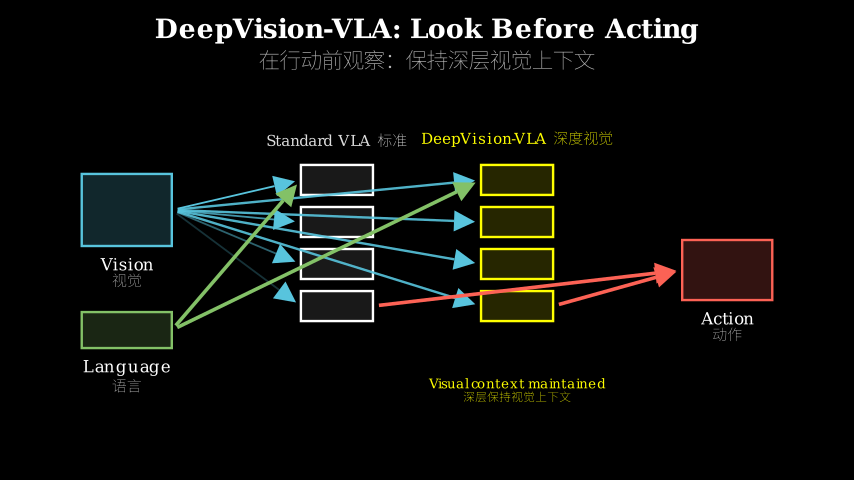
One sentence: Before, visual features entered once and faded through depth; now, they’re continuously refreshed at multiple layers while pruning irrelevant distractions.
Core Mechanism
DeepVision-VLA has two main components working together:
Vision-Language Mixture-of-Transformers (VL-MoT): Instead of just feeding vision tokens at the input, this framework maintains a separate vision expert (the foundation model) that runs in parallel with the VLA backbone. At selected deeper layers, the system injects fresh visual features from the vision expert into the VLA backbone through shared attention mechanisms. Think of it as having a vision specialist constantly whispering reminders about what’s actually in the scene, rather than relying on a single briefing at the start.
Action-Guided Visual Pruning (AGVP): Not all visual tokens matter equally for a given action. AGVP uses attention patterns from shallow layers (where visual sensitivity is still high) to identify which visual tokens are actually relevant to the task. It then prunes the irrelevant ones before they propagate through the network. This serves two purposes: reduces computational cost and amplifies the signal-to-noise ratio for task-relevant visual cues.
Input Layer:
  [Language Instruction] + [Vision Tokens (384)]
         |                        |
         v                        v
    LLM Layers              Vision Expert
    (Layer 1-8)             (Parallel)
         |                        |
         +--------<Inject>--------+  <- VL-MoT at Layer 8
         |                        |
    LLM Layers              Vision Expert
    (Layer 9-16)            (Parallel)
         |                        |
         +--------<Inject>--------+  <- VL-MoT at Layer 16
         |
    [AGVP: Prune irrelevant tokens]
         |
    LLM Layers
    (Layer 17-24)
         |
         v
    Action Tokens
Here’s the structural metaphor: Imagine you’re a chef (the VLA model) following a recipe (language instruction) while cooking a complex dish (robot action). You glance at the ingredients (visual input) at the start, but as you get deeper into the cooking process, you start forgetting exactly what that vegetable looked like or where you placed the knife.
VL-MoT is like having a sous chef (vision expert) standing next to you who keeps pointing at the ingredients and reminding you: “Hey, the carrot is on the left, it’s slightly curved, the knife is at 45 degrees.” They don’t just tell you once—they keep updating you at critical moments (layers 8, 16, etc.).
AGVP is like having that sous chef also clear away the clutter from your workspace. They notice you’re focused on dicing the carrot, so they move the unused spices and bowls out of your peripheral vision. You still have access to everything important, but the distractions are gone, letting you focus on what matters for the current step.
Key Concepts
-
Visual Token Sensitivity Decay: In transformer-based VLA models, attention mechanisms determine how much each layer “looks at” different input tokens. The authors measured attention weights on visual tokens across layers and found they drop dramatically in deeper layers—often by 60% or more. This isn’t just an academic curiosity; it directly correlates with failure modes in manipulation tasks. When the model needs to generate precise actions (like “move gripper 2cm left”), it’s doing so with degraded visual context. Think of it like trying to park a car while your windshield gradually fogs up—you started with a clear view, but by the time you’re making the final adjustment, you’re mostly guessing.
-
Mixture-of-Transformers (MoT) for Vision-Language: Traditional MoT architectures route tokens to different expert networks. VL-MoT adapts this by having the vision foundation model act as a persistent expert that runs in parallel with the main VLA backbone. The key innovation is shared attention: at injection points, the VLA backbone’s queries attend to both its own hidden states and fresh keys/values from the vision expert. This isn’t just concatenating features—it’s letting the action-generation process actively query the vision model for relevant details at multiple depths. The vision expert maintains its own processing pipeline, so injected features are multi-scale and semantically rich, not just raw pixel encodings.
-
Action-Guided Pruning: Most visual pruning methods use generic saliency or attention scores. AGVP is task-specific: it uses attention patterns from shallow layers (where visual-action correlation is strongest) to identify which visual tokens actually contribute to action prediction. Here’s the clever bit: shallow layers still have strong visual grounding, so their attention patterns reveal which parts of the image matter for the task. AGVP computes a relevance score for each visual token based on these patterns, then keeps only the top-k tokens. This is different from random pruning or uniform compression—it’s informed by the model’s own understanding of task relevance.
Framework Shift
Before (mainstream approach):        After (this paper):

Vision Encoder                       Vision Expert (parallel)
      |                                   |  |  |  |
      v                                   v  v  v  v
[Visual Tokens]                      Inject Inject Inject
      |                                   |  |  |  |
      v                                   v  v  v  v
+-------------+                      +-------------+
| LLM Layer 1 |                      | LLM Layer 1 |<--+
+-------------+                      +-------------+   |
      |                                   |            |
      v                                   v            |
| LLM Layer 8 |                      | LLM Layer 8 |<-+ Fresh
+-------------+                      +-------------+   | Vision
      |                                   |            | Context
      v                                   v            |
| LLM Layer 16|                      | LLM Layer 16|<-+
+-------------+                      +-------------+   |
      |                                   |            |
      v                              [AGVP Pruning]    |
| LLM Layer 24|                      +-------------+   |
+-------------+                      | LLM Layer 24|<--+
      |                                   |
      v                                   v
  [Actions]                           [Actions]

Visual info fades                    Visual info refreshed
From single-shot visual encoding to continuous multi-level visual grounding, the core shift is treating vision as an active consultant throughout action generation, not just an initial input.
Expert Assessment
Problem choice: This is a real gap. The observation about visual token sensitivity decay is empirically grounded and explains known failure modes in VLA models. It’s not manufactured—precise manipulation tasks genuinely struggle in current VLA systems, and the authors provide a mechanistic explanation. The problem sits at a sweet spot: important enough to matter for real applications, but tractable enough to address with architectural changes.
Method maturity: The VL-MoT framework is clever but not revolutionary—it’s a principled application of mixture-of-experts thinking to the vision-language interface. AGVP is more interesting; using shallow-layer attention for pruning is a neat insight that could transfer to other domains. However, I’m skeptical about one thing: the paper doesn’t deeply explore *why visual sensitivity decays. Is it fundamental to transformer architecture, or is it a training artifact? If it’s the latter, maybe better training objectives could solve this without architectural changes. The authors don’t engage with this question.
Experimental integrity: The baselines look fair—they compare against OpenVLA, RT-2, and other recent VLA models. The 9% improvement on simulation and 7.5% on real-world tasks is solid but not overwhelming. One red flag: the paper doesn’t report computational overhead clearly. VL-MoT requires running a vision expert in parallel and performing multiple injection operations. How much does this cost in terms of inference time and memory? For real-time robotics, this matters a lot. The AGVP pruning supposedly reduces overhead, but the net effect isn’t quantified transparently.
Writing quality: The abstract and introduction are strong—they clearly motivate the problem. The method section gets dense quickly, and the VL-MoT architecture description could use a clearer diagram showing data flow. The ablation studies are thorough, which is good. The weakest section is the related work—it’s a laundry list of VLA papers without clearly positioning this work’s unique contribution. If I were reviewing, I’d ask them to rewrite that section to emphasize the “black box” problem and why prior visual enhancement methods don’t address it.
Verdict: Weak accept — solid empirical contribution with a clear mechanistic insight, but the method feels incremental rather than paradigm-shifting, and computational cost concerns aren’t adequately addressed.
Takeaways
For VLA practitioners: The visual token sensitivity decay observation is immediately actionable. If you’re building VLA models, instrument your attention patterns across layers—you might be surprised how much visual context you’re losing. Even without adopting the full VL-MoT framework, you could experiment with simpler interventions like adding skip connections from early visual features to deeper layers.
For vision-language researchers: The idea of using shallow-layer attention for task-relevant pruning transfers beyond robotics. Any vision-language model that processes long visual sequences (video understanding, document analysis) could benefit from this. The key insight: early layers know what’s important before the model gets distracted by language processing.
For architecture designers: The parallel expert pattern (VL-MoT) is a template for any domain where one modality’s signal degrades through depth. Audio-language models, multimodal medical imaging, sensor fusion—anywhere you’re mixing modalities with different temporal or spatial characteristics, consider maintaining separate expert streams with periodic injection rather than early fusion.
Steal this technique: Action-guided pruning. It’s simple enough to implement in a weekend but principled enough to publish. The recipe: (1) identify where in your model task-relevant information is strongest, (2) use attention patterns from that region to score input tokens, (3) prune based on those scores. This beats generic saliency methods because it’s grounded in your specific task.
论文: 2603.15618 作者: Yulin Luo, Hao Chen, Zhuangzhe Wu, Bowen Sui, Jiaming Liu, Chenyang Gu, Zhuoyang Liu, Qiuxuan Feng, Jiale Yu, Shuo Gu 分类: cs.CV
缺口
视觉-语言-动作(VLA)模型如OpenVLA和RT-2将视觉观测输入语言模型主干来预测机器人动作。
标准做法是:用视觉基础模型(如CLIP或SigLIP)编码图像,将这些token与语言指令一起送入LLM,然后解码出动作。
近期工作试图通过使用更好的视觉编码器或添加更多视觉token来增强视觉能力。
但问题在于:所有人都把LLM主干当黑盒。
你在输入端倾倒视觉token,然后祈祷它们能在20多层transformer中存活下来。
作者对多个VLA架构进行了系统分析,发现了一个惊人现象:视觉token的敏感度在深层逐渐衰减。
等到最后几层生成动作时,模型基本已经忘记它看到了什么。
这解释了为什么VLA模型在需要精细视觉理解的精确操作任务上表现不佳——比如将销钉插入孔中或抓取小物体。
视觉信息在流经语言模型深度时被稀释了。
问题:视觉token在深层衰减
   |
   v
观察:到第20层时对视觉token的注意力下降60%+
   |
   v
假设:需要在多个深度刷新视觉上下文
   |
   v
方法:VL-MoT(注入视觉特征)+ AGVP(剪枝噪声)
   |
   v
证据:9.0%提升(仿真)/ 7.5%提升(真实世界)
   |
   v
结论:多层级视觉注入 > 单次编码
增量
一句话:之前视觉特征只输入一次然后在深度中衰减;现在它们在多个层级持续刷新,同时剪枝无关干扰。
核心机制
DeepVision-VLA有两个协同工作的主要组件:
视觉-语言混合Transformer(VL-MoT):这个框架不只是在输入端喂入视觉token,而是维护一个独立的视觉专家(基础模型),与VLA主干并行运行。
在选定的深层位置,系统通过共享注意力机制将视觉专家的新鲜视觉特征注入VLA主干。
可以把它想象成有一个视觉专家不断在耳边提醒场景中实际有什么,而不是只在开始时简报一次。
动作引导的视觉剪枝(AGVP):并非所有视觉token对给定动作都同等重要。
AGVP使用浅层的注意力模式(那里视觉敏感度仍然很高)来识别哪些视觉token实际上与任务相关。
然后在它们传播到网络之前剪枝掉无关的token。
这有两个目的:降低计算成本,提高任务相关视觉线索的信噪比。
输入层:
  [语言指令] + [视觉Token (384)]
       |                    |
       v                    v
   LLM层                视觉专家
  (第1-8层)            (并行)
       |                    |
       +------<注入>--------+  <- VL-MoT在第8层
       |                    |
   LLM层                视觉专家
  (第9-16层)           (并行)
       |                    |
       +------<注入>--------+  <- VL-MoT在第16层
       |
  [AGVP:剪枝无关token]
       |
   LLM层
  (第17-24层)
       |
       v
   动作Token
结构性比喻:想象你是一个厨师(VLA模型),按照食谱(语言指令)烹饪复杂菜肴(机器人动作)。
你在开始时瞥一眼食材(视觉输入),但随着烹饪过程深入,你开始忘记那个蔬菜到底长什么样,或者你把刀放在哪里了。
VL-MoT就像有一个副厨(视觉专家)站在你旁边,不断指着食材提醒你:“嘿,胡萝卜在左边,它略微弯曲,刀呈45度角。
“他们不只是告诉你一次——他们在关键时刻(第8层、第16层等)持续更新你。
AGVP就像让那个副厨也清理你工作台上的杂物。
他们注意到你正专注于切胡萝卜,所以把不用的香料和碗从你的余光中移开。
你仍然能接触到所有重要的东西,但干扰消失了,让你能专注于当前步骤的重要事项。
关键概念
- 视觉Token敏感度衰减:在基于transformer的VLA模型中,注意力机制决定每一层对不同输入token”关注”多少。
作者测量了跨层对视觉token的注意力权重,发现它们在深层急剧下降——通常下降60%或更多。
这不只是学术好奇心;它直接关联到操作任务中的失败模式。
当模型需要生成精确动作(如”将夹爪左移2厘米”)时,它是在视觉上下文退化的情况下进行的。
想象一下在挡风玻璃逐渐起雾时停车——你开始时视野清晰,但到做最后调整时,你基本在猜测。
- 视觉-语言的混合Transformer(MoT):传统MoT架构将token路由到不同的专家网络。
VL-MoT通过让视觉基础模型充当与主VLA主干并行运行的持久专家来适应这一点。
关键创新是共享注意力:在注入点,VLA主干的查询同时关注自己的隐藏状态和来自视觉专家的新鲜键/值。
这不只是拼接特征——它让动作生成过程在多个深度主动查询视觉模型以获取相关细节。
视觉专家维护自己的处理管道,因此注入的特征是多尺度和语义丰富的,而不只是原始像素编码。
- 动作引导剪枝:大多数视觉剪枝方法使用通用显著性或注意力分数。
AGVP是任务特定的:它使用浅层的注意力模式(那里视觉-动作相关性最强)来识别哪些视觉token实际上对动作预测有贡献。
巧妙之处在于:浅层仍然有强视觉基础,因此它们的注意力模式揭示了图像的哪些部分对任务重要。
AGVP基于这些模式为每个视觉token计算相关性分数,然后只保留top-k个token。
这不同于随机剪枝或均匀压缩——它由模型自己对任务相关性的理解所指导。
框架转变
之前(主流方法):              之后(本文方法):

视觉编码器                      视觉专家(并行)
    |                              |  |  |  |
    v                              v  v  v  v
[视觉Token]                     注入 注入 注入
    |                              |  |  |  |
    v                              v  v  v  v
+-------------+                 +-------------+
| LLM第1层   |                 | LLM第1层   |<--+
+-------------+                 +-------------+   |
    |                              |             |
    v                              v             |
| LLM第8层   |                 | LLM第8层   |<-+ 新鲜
+-------------+                 +-------------+   | 视觉
    |                              |             | 上下文
    v                              v             |
| LLM第16层  |                 | LLM第16层  |<-+
+-------------+                 +-------------+   |
    |                              |             |
    v                         [AGVP剪枝]         |
| LLM第24层  |                 +-------------+   |
+-------------+                 | LLM第24层  |<--+
    |                              |
    v                              v
 [动作]                          [动作]

视觉信息衰减                    视觉信息刷新
从单次视觉编码到连续多层级视觉基础,核心转变是将视觉视为整个动作生成过程中的主动顾问,而不只是初始输入。
专家评审
选题眼光:这是真实的缺口。
关于视觉token敏感度衰减的观察有经验基础,解释了VLA模型中已知的失败模式。
这不是人造的——精确操作任务在当前VLA系统中确实困难,作者提供了机制性解释。
问题处于一个甜蜜点:对实际应用足够重要,但通过架构改变又足够可处理。
方法成熟度:VL-MoT框架巧妙但不革命性——它是将混合专家思想原则性地应用到视觉-语言接口。
AGVP更有趣;使用浅层注意力进行剪枝是一个巧妙的洞察,可以迁移到其他领域。
但我对一点持怀疑态度:论文没有深入探讨为什么视觉敏感度会衰减。
这是transformer架构的根本问题,还是训练产物?如果是后者,也许更好的训练目标可以在不改变架构的情况下解决这个问题。
作者没有涉及这个问题。
实验诚意:基线看起来公平——他们与OpenVLA、RT-2和其他近期VLA模型比较。
在仿真上9%的提升和真实世界上7.5%的提升是扎实的,但不是压倒性的。
一个警示信号:论文没有清楚报告计算开销。
VL-MoT需要并行运行视觉专家并执行多次注入操作。
这在推理时间和内存方面的成本是多少?对于实时机器人,这很重要。
AGVP剪枝据说降低了开销,但净效果没有透明量化。
写作功力:摘要和引言很强——它们清楚地激发了问题。
方法部分很快变得密集,VL-MoT架构描述可以用更清晰的数据流图。
消融研究很彻底,这很好。
最弱的部分是相关工作——它是VLA论文的清单,没有清楚定位这项工作的独特贡献。
如果我在审稿,我会要求他们重写那一节,强调”黑盒”问题以及为什么先前的视觉增强方法没有解决它。
判决:弱接收 — 扎实的经验贡献和清晰的机制洞察,但方法感觉是渐进式而非范式转变,计算成本问题没有充分解决。
要点总结
对VLA实践者:视觉token敏感度衰减的观察可以立即行动。
如果你在构建VLA模型,检测跨层的注意力模式——你可能会惊讶于丢失了多少视觉上下文。
即使不采用完整的VL-MoT框架,你也可以尝试更简单的干预,比如从早期视觉特征到深层添加跳跃连接。
对视觉-语言研究者:使用浅层注意力进行任务相关剪枝的想法可以迁移到机器人之外。
任何处理长视觉序列的视觉-语言模型(视频理解、文档分析)都可以从中受益。
关键洞察:早期层在模型被语言处理分散注意力之前就知道什么重要。
对架构设计者:并行专家模式(VL-MoT)是任何一种模态信号在深度中退化的领域的模板。
音频-语言模型、多模态医学成像、传感器融合——任何你混合具有不同时间或空间特征的模态的地方,考虑维护带有周期性注入的独立专家流,而不是早期融合。
偷走这个技术:动作引导剪枝。
它简单到可以在一个周末实现,但又足够有原则可以发表。
配方:(1)识别模型中任务相关信息最强的位置,(2)使用该区域的注意力模式为输入token评分,(3)基于这些分数剪枝。
这优于通用显著性方法,因为它基于你的特定任务。