Paper: 2606.02553 Authors: Qixin Hu, Shuai Yang, Wei Huang, Song Han, Yukang Chen Categories: cs.CV
The Gap
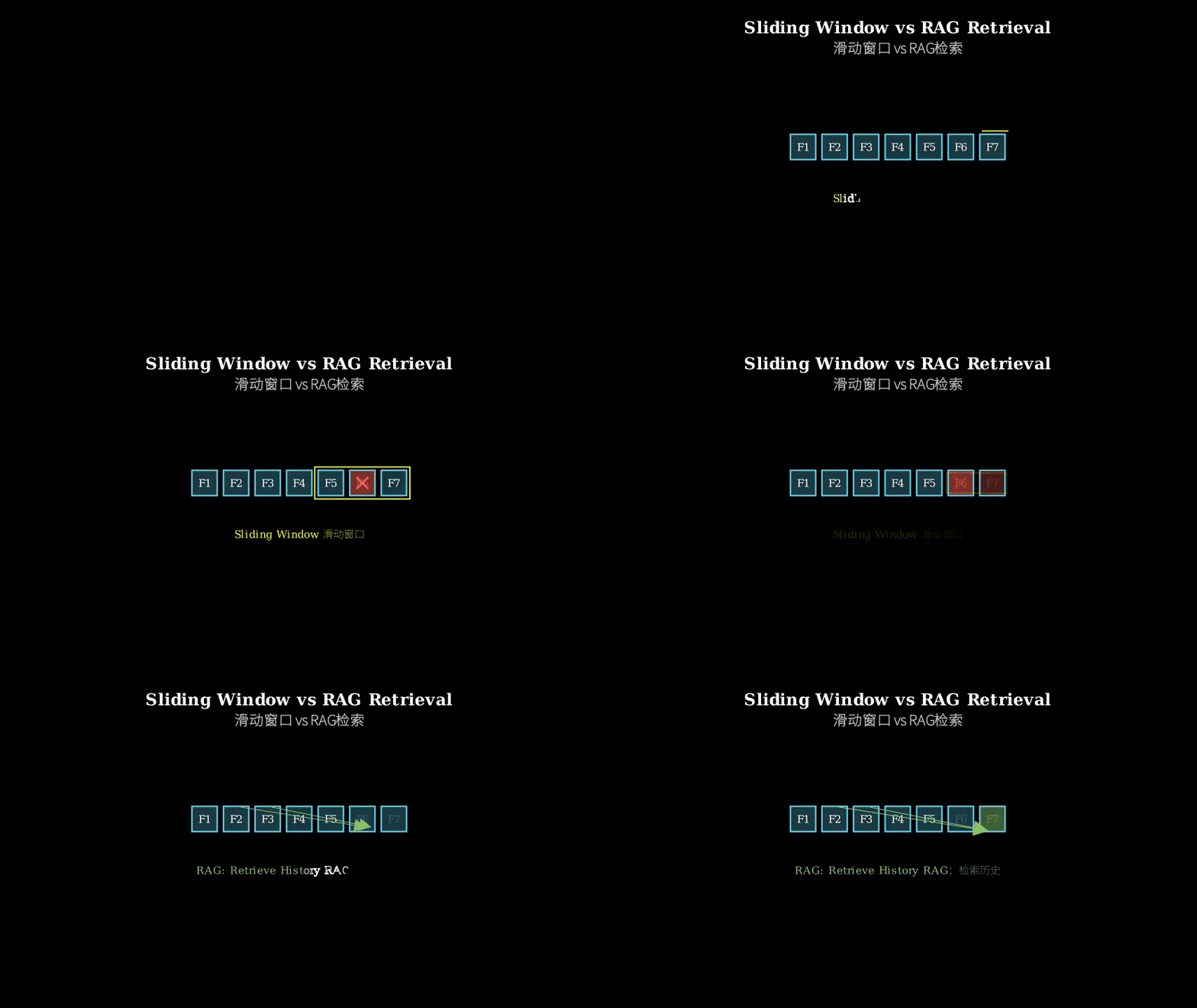
Autoregressive video diffusion models can generate variable-length videos, but they hit a wall when going long. Why? They use sliding-window attention for efficiency—each new frame looks only at the last N frames. This creates a one-way street: if frame 50 has appearance errors (wrong lighting, face drift), frame 51 can only see frames 40-50, including that mistake. Frame 52 compounds it. By frame 100, the model is conditioning on a 50-frame history of accumulated garbage.
Prior work (Streaming DiT, Lumina-Next, Wan et al. 2025) acknowledged this but stayed within the sliding-window paradigm. They adjusted window size, modified attention patterns, or added refinement steps—all still trapped in the “condition on recent frames only” constraint.
Problem: Sliding window attention
   |
   v
Observation: Errors accumulate because good early frames
             are discarded from attention scope
   |
   v
Hypothesis: If we could retrieve relevant *earlier* frames,
            we break the error cascade
   |
   v
Method: Treat generated latents as a retrieval database
   |
   v
Evidence: Reduced identity drift, better VBench-Long scores
   |
   v
Conclusion: Retrieval-augmented AR generation extends
            usable horizon without full recomputation
The Increment
One sentence: Before, AR video models were stuck in a degrading trajectory after frame N because they could only see the recent window; after, they can reach back to any earlier clean latent via retrieval, breaking the error cascade.
Core Mechanism
LongLive-RAG has three components: a memory bank storing all previously generated latent blocks, a retrieval module that searches this bank, and a generation module that fuses retrieved context with the sliding window.
Data flow: (1) Generate a new block of latents autoregressively. (2) Store this block in the memory bank along with a query embedding. (3) Before generating the next block, compute a query from the current window. (4) Retrieve K most similar historical blocks from the memory bank. (5) Concatenate retrieved blocks with the sliding window as input to the next generation step. (6) Repeat.
The retrieval uses cosine similarity between query embeddings. To make embeddings more discriminative, the authors introduce Window Temporal Delta Loss (WTDL): it pulls apart embeddings of adjacent windows (which are too similar due to temporal redundancy) while keeping embeddings of truly different content far apart. This prevents retrieval from just grabbing the immediately preceding window, which would be redundant with sliding-window attention.
Memory Bank: [Block_1, Block_2, ..., Block_t-1]
                |         |              |
           [embed_1] [embed_2] ... [embed_t-1]
                          |
                          v
                    Retrieval Query
                          |
                          v
                   Top-K similar blocks
                          |
                          v
      [Retrieved] + [Sliding Window] -> Generator -> Block_t
                          |
                          v
                   Store Block_t in Memory Bank
Think of it like writing a novel with a filing cabinet. The sliding-window approach is like writing while looking only at the last 5 pages—if you introduced a character flaw on page 50, by page 100 you’ve forgotten the character’s original personality. LongLive-RAG gives you index cards for every chapter you’ve written. When starting a new chapter, you pull out relevant earlier cards (“Oh, the protagonist was confident in chapter 3”) and use them alongside the recent pages. The WTDL loss is like writing better index cards: instead of “chapter 5 comes after chapter 4” (useless), you write “chapter 5: protagonist loses confidence” (useful signal). Now when you need confidence as a plot point in chapter 10, you can retrieve chapter 3’s card instead of being stuck with chapter 9’s degraded version.
Key Concepts
-
Retrieval-Augmented Generation (RAG) in latent space: In text LLMs, RAG means fetching external documents before answering. Here, the “documents” are the model’s own past outputs—latent blocks it generated 50 or 100 steps ago. Instead of throwing them away after they leave the sliding window, we store them in a searchable database. When generating frame 200, we retrieve latents from frame 50 if they’re relevant (e.g., same character pose). This breaks the Markov assumption of AR generation: you’re not just conditioning on the immediate past, but on any relevant past. The cost is one embedding computation and K similarity comparisons per new block—cheap compared to regenerating everything.
-
Window Temporal Delta Loss (WTDL): Standard contrastive learning would make all embeddings distinct, but adjacent video frames are naturally similar. If we naively contrast them, the model learns “frame N and frame N+1 are different” when they’re actually 95% identical—this wastes the embedding’s discriminative power. WTDL says: push apart embeddings of windows that are close in time (negative pairs within a local window), pull together embeddings that are far in time but semantically similar (positive pairs). Formally, it’s a modified InfoNCE loss with a temporal margin. The effect: embeddings encode “semantic change events” (character turns around, lighting shifts) rather than “this is frame N vs frame N+1.”
-
Irreversible generation trajectory: In AR models with sliding windows, once you generate a bad frame, all future frames condition on it. You can’t go back and fix frame 50 without regenerating frames 51-200. It’s like a chemical reaction—once you’ve added the wrong reagent, the product is ruined, and you can’t just fish it out. LongLive-RAG doesn’t fix the bad frame, but it lets future frames “remember” what the input looked like before the error, so they don’t drift as far.
Framework Shift
Before (Sliding-Window AR):              After (LongLive-RAG):

t=0   [Frame 0-9]                        t=0   [Frame 0-9] -> Store in Memory
         |                                         |
         v                                         v
t=1   [Frame 10-19]                      t=1   [Frame 10-19] -> Store
         | (error at frame 15)                     |
         v                                         v
t=2   [Frame 20-29]                      t=2   Retrieve relevant from Memory
         | (drifts further)                        + [Frame 10-19]
         v                                         |
t=3   [Frame 30-39]                                v
         | (severe drift)                   [Frame 20-29] -> Store
                                                   |
                                                   v
Outcome: Trapped in error cascade        t=3   Retrieve clean [Frame 0-9]
         No access to clean history              + [Frame 20-29]
                                                   |
                                                   v
                                          [Frame 30-39] -> Less drift

                                          Outcome: Break error cascade
                                                   by conditioning on clean past
From “condition on the last N frames in sequence” to “condition on the last N frames plus K most relevant frames from any earlier point,” the core shift is from local temporal coherence to global semantic coherence.
Expert Assessment
Problem choice: This is a real gap. Long-horizon AR video generation is economically important (film, simulation, synthetic data), and the sliding-window bottleneck is well-documented in recent work (Streaming DiT, Lumina-Next). The framing as a RAG problem is clever—it connects video generation to the retrieval-augmented paradigm that’s proven effective in LLMs. However, the paper doesn’t deeply explore *why retrieval helps beyond “access to earlier frames.” Is it diversity of context? Specific missing information? A more principled analysis of what retrieval provides would strengthen the contribution.
Method maturity: The core idea—treat latent history as a database—is elegant and computationally cheap (one retrieval per block). WTDL is a solid contribution that addresses a specific failure mode (redundant retrieval). But I’m skeptical of one design choice: retrieving full latent blocks rather than attention keys/values. Blocks are heavy (high-dimensional), and retrieval granularity is coarse. Could you retrieve at the token or patch level? The paper doesn’t ablate this. Also, the embedding dimension (512 in experiments) seems arbitrary—no ablation on embedding capacity vs retrieval quality tradeoff.
Experimental integrity: The baselines are fair (CogVideoX, Streaming DiT, Wan et al. 2025), and the paper tests across multiple backbones (DiT, Transformer). VBench-Long is a reasonable benchmark, though it’s somewhat holistic—hard to attribute improvements to specific failure modes. I appreciate the ablations on retrieval strategies and WTDL components. One red flag: the paper doesn’t show retrieval *mistakes—what happens when the model retrieves the wrong historical block? Does it inject irrelevant context and hurt quality? The paper claims retrieval is “lightweight,” but what’s the memory footprint for a 1000-frame generation? These practical concerns are underexplored.
Writing quality: Section 3.2 (method) is clear, but Section 4 (experiments) buries the lead. The VBench-Long comparison table is on page 7, after two pages of ablations. Swap them. The retrieval strategy comparison (random, sliding, fixed, adaptive) is insightful but presented in a dense paragraph—deserves a figure. The “Related Work” section name-drops RAG in NLP but doesn’t explain why latent-space retrieval is fundamentally different from text retrieval (embeddings are learned, not semantic). A tighter framing would help.
Verdict: Weak accept — The core idea is sound and the results are convincing, but the paper feels like it stopped one iteration short. Deeper analysis of what retrieval retrieves, finer-grained retrieval granularity, and failure case studies would elevate this from “good engineering solution” to “principled framework.”
Takeaways
For practitioners: If you’re building any autoregressive generative model with a sliding window (video, audio, long-form text), consider storing intermediate representations in a retrieval index. The overhead is minimal if you already compute embeddings. The WTDL insight applies beyond video—any domain where adjacent outputs are highly correlated (time series, sequential decision-making) benefits from embeddings that encode *change rather than state.
For researchers: The framing of self-generated history as retrieval memory is under-explored. Could this extend to diffusion models with recurrent sampling (e.g., latent consistency models)? Or to RL policies that need to recall diverse past behaviors? The key transferable idea: when your model’s context budget is tight, don’t discard history—compress it into a searchable index. This is cheaper than expanding the context window and more flexible than fixed attention patterns.
Specific trick worth stealing: Window Temporal Delta Loss. If you’re training embeddings for sequential data and your naive contrastive loss makes everything “equally different,” add a temporal margin that ignores local similarity and emphasizes semantic jumps. One line of code, often significant gains in downstream retrieval quality.
论文: 2606.02553 作者: Qixin Hu, Shuai Yang, Wei Huang, Song Han, Yukang Chen 分类: cs.CV
缺口
自回归视频扩散模型可以生成任意长度的视频,但在生成长视频时会遇到瓶颈。
为什么?
它们为了效率使用滑动窗口注意力——每个新帧只看最近的N帧。
这造成了单行道问题:如果第50帧有外观错误(光照不对、人脸漂移),第51帧只能看到第40-50帧,包括那个错误。
第52帧加剧了这个错误。
到第100帧时,模型是在基于50帧的累积垃圾历史进行生成。
先前工作(Streaming DiT、Lumina-Next、Wan等人2025)意识到了这个问题,但仍停留在滑动窗口范式内。
他们调整窗口大小、修改注意力模式或添加细化步骤——都还困在”只基于最近帧”的约束里。
问题:滑动窗口注意力
   |
   v
观察:误差累积是因为早期的好帧
      被丢出了注意力范围
   |
   v
假设:如果能检索到相关的*更早*帧,
      就能打破误差级联
   |
   v
方法:把已生成的潜变量当作检索数据库
   |
   v
证据:身份漂移减少,VBench-Long得分更好
   |
   v
结论:检索增强的AR生成扩展了
      可用视野,且无需完全重算
增量
一句话:之前,AR视频模型在N帧后陷入劣化轨迹,因为只能看到最近窗口;
之后,它们能通过检索回溯到任何早期干净潜变量,打破误差级联。
核心机制
LongLive-RAG有三个组件:记忆库存储所有已生成的潜变量块,检索模块搜索这个库,生成模块融合检索到的上下文和滑动窗口。
数据流程:(1) 自回归生成新的潜变量块。
(2) 将此块连同查询嵌入存入记忆库。
(3) 生成下一块前,从当前窗口计算查询。
(4) 从记忆库检索K个最相似的历史块。
(5) 将检索到的块与滑动窗口拼接,作为下一生成步骤的输入。
(6) 重复。
检索使用查询嵌入之间的余弦相似度。
为了让嵌入更有区分度,作者引入了窗口时序差分损失(WTDL):它拉开相邻窗口的嵌入(因时序冗余而过于相似),同时保持真正不同内容的嵌入距离。
这防止检索只抓取紧邻的前一窗口,那和滑动窗口注意力是冗余的。
记忆库:[块_1, 块_2, ..., 块_t-1]
          |      |           |
     [嵌入_1][嵌入_2] ... [嵌入_t-1]
                     |
                     v
                检索查询
                     |
                     v
              Top-K 相似块
                     |
                     v
   [检索块] + [滑动窗口] -> 生成器 -> 块_t
                     |
                     v
              将块_t存入记忆库
把它想象成带着档案柜写小说。
滑动窗口方法就像写作时只看最后5页——如果你在第50页给角色加了个性格缺陷,到第100页时你已经忘了角色原本的个性。
LongLive-RAG给你写过的每一章都准备了索引卡。
开始新章节时,你抽出相关的早期卡片(“哦,主角在第3章很自信”),和最近的几页一起用。
WTDL损失就像写更好的索引卡:不是写”第5章在第4章之后”(没用),而是写”第5章:主角失去信心”(有用信号)。
现在当你在第10章需要”信心”这个情节点时,能检索到第3章的卡片,而不是困在第9章的劣化版本里。
关键概念
- 潜空间中的检索增强生成(RAG):在文本LLM中,RAG意味着回答前先获取外部文档。
这里,“文档”是模型自己的过往输出——它在50步或100步前生成的潜变量块。
我们不是在它们离开滑动窗口后就丢弃,而是存入可搜索的数据库。
生成第200帧时,如果第50帧的潜变量相关(例如相同的角色姿势),就检索它们。
这打破了AR生成的马尔可夫假设:你不仅基于紧邻的过去,而是基于任何相关的过去。
代价是每个新块一次嵌入计算和K次相似度比较——比重新生成一切便宜多了。
- 窗口时序差分损失(WTDL):标准对比学习会让所有嵌入都不同,但相邻视频帧天然相似。
如果我们天真地对比它们,模型学到的是”第N帧和第N+1帧不同”,而它们实际上95%相同——这浪费了嵌入的区分能力。
WTDL说:推开时间上接近的窗口的嵌入(局部窗口内的负对),拉近时间上远但语义相似的嵌入(正对)。
形式上,这是带时序边距的改进InfoNCE损失。
效果:嵌入编码的是”语义变化事件”(角色转身、光照变化),而不是”这是第N帧vs第N+1帧”。
- 不可逆生成轨迹:在带滑动窗口的AR模型中,一旦生成了坏帧,所有未来帧都基于它。
你不能回去修复第50帧,除非重新生成第51-200帧。
这就像化学反应——一旦加了错误的试剂,产物就毁了,你无法把它捞出来。
LongLive-RAG不修复坏帧,但它让未来帧”记住”出错前输入的样子,所以不会漂得那么远。
框架转变
之前(滑动窗口AR):                 之后(LongLive-RAG):

t=0   [帧 0-9]                         t=0   [帧 0-9] -> 存入记忆库
         |                                      |
         v                                      v
t=1   [帧 10-19]                       t=1   [帧 10-19] -> 存储
         | (第15帧出错)                         |
         v                                      v
t=2   [帧 20-29]                       t=2   从记忆库检索相关内容
         | (进一步漂移)                         + [帧 10-19]
         v                                      |
t=3   [帧 30-39]                                v
         | (严重漂移)                     [帧 20-29] -> 存储
                                                |
                                                v
结果:困在误差级联中                   t=3   检索干净的[帧 0-9]
      无法访问干净历史                         + [帧 20-29]
                                                |
                                                v
                                         [帧 30-39] -> 漂移更少

                                         结果:通过基于干净过去
                                               打破误差级联
从”按顺序基于最近N帧”到”基于最近N帧加上来自任何早期时点的K个最相关帧”,核心转变是从局部时序连贯到全局语义连贯。
专家评审
选题眼光:这是真缺口。
长视野AR视频生成有经济重要性(电影、仿真、合成数据),滑动窗口瓶颈在最近工作中有充分记录(Streaming DiT、Lumina-Next)。
将其框定为RAG问题很巧妙——它把视频生成和在LLM中已证明有效的检索增强范式连接起来。
但论文没有深入探讨检索为什么有用,除了”访问早期帧”。
是上下文多样性?
特定缺失信息?
对检索提供什么的更原则性分析会加强贡献。
方法成熟度:核心想法——把潜变量历史当数据库——优雅且计算便宜(每块一次检索)。
WTDL是扎实贡献,针对特定失效模式(冗余检索)。
但我对一个设计选择持怀疑:检索完整潜变量块而非注意力键/值。
块很重(高维),检索粒度粗糙。
能在token或patch级别检索吗?
论文没有消融这个。
另外,嵌入维度(实验中512)似乎随意——没有嵌入容量vs检索质量权衡的消融。
实验诚意:基线公平(CogVideoX、Streaming DiT、Wan等人2025),论文在多个骨干上测试(DiT、Transformer)。
VBench-Long是合理基准,虽然有点整体性——难以将改进归因于特定失效模式。
我欣赏检索策略和WTDL组件的消融。
一个警示:论文没展示检索错误——模型检索到错误历史块时会怎样?
会注入无关上下文损害质量吗?
论文声称检索”轻量”,但1000帧生成的内存占用是多少?
这些实际问题探索不足。
写作功力:第3.2节(方法)清晰,但第4节(实验)埋了重点。
VBench-Long对比表在第7页,两页消融之后。
应该交换。
检索策略对比(随机、滑动、固定、自适应)有见地但塞在密集段落里——值得配图。
“相关工作”节提及NLP中的RAG但没解释为什么潜空间检索根本不同于文本检索(嵌入是学出来的,不是语义的)。
更紧凑的框定会有帮助。
判决:弱接收 — 核心想法扎实,结果令人信服,但论文感觉少迭代了一轮。
更深入分析检索到什么、更细粒度的检索粒度、失败案例研究,会把这篇从”好的工程方案”提升到”原则性框架”。
要点总结
给实践者:如果你在构建任何带滑动窗口的自回归生成模型(视频、音频、长文本),考虑将中间表示存入检索索引。
如果你已经计算嵌入,开销很小。
WTDL洞察超越视频——任何相邻输出高度相关的领域(时间序列、顺序决策)都能从编码变化而非状态的嵌入中受益。
给研究者:将自生成历史框定为检索记忆这个思路尚未充分探索。
能扩展到带循环采样的扩散模型(例如潜在一致性模型)吗?
或需要回忆多样过往行为的RL策略?
关键可迁移想法:当模型的上下文预算紧张时,别丢弃历史——将其压缩进可搜索索引。
这比扩大上下文窗口便宜,比固定注意力模式灵活。
值得偷学的具体技巧:窗口时序差分损失。
如果你在为序列数据训练嵌入,天真的对比损失让一切”同等不同”,加个时序边距来忽略局部相似性、强调语义跳变。
一行代码,下游检索质量往往显著提升。