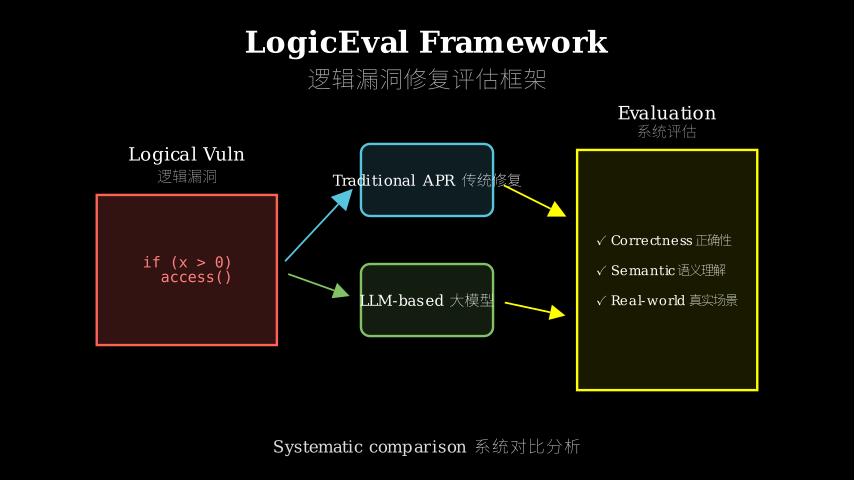
Paper: 2604.12994 Authors: Syed Md Mukit Rashid, Abdullah Al Ishtiaq, Kai Tu, Yilu Dong, Tianwei Wu, Ali Ranjbar, Tianchang Yang, Najrin Sultana, Shagufta Mehnaz, Syed Rafiul Hussain Categories: cs.CR, cs.AI
The Gap
Automated program repair (APR) has made progress on memory corruption bugs — buffer overflows, use-after-free, the usual suspects. Tools like GenProg and Prophet can patch these because the fix patterns are mechanical: add bounds checks, insert null checks, swap allocation orders. But logical vulnerabilities are different beasts. They’re flaws in the program’s reasoning: authentication bypasses, incorrect state transitions, missing permission checks. No amount of pattern matching fixes “the code does the wrong thing by design.”
Traditional APR fails here because it lacks semantic understanding. LLMs promise better — they’ve seen millions of code examples, they can reason about intent. But nobody’s actually tested whether they can fix real logical vulnerabilities at scale. Existing benchmarks use synthetic bugs or focus on memory issues. We’re flying blind on whether GPT-4 can patch an authentication bypass in production code.
Problem: Logical vulns in real software (auth bypass, state errors)
   |
   v
Gap: No APR tools understand program semantics deeply enough
   |
   +---> Traditional APR: Pattern matching fails on logic
   |
   +---> LLMs: Promising but untested on real logical CVEs
   |
   v
Method: LogicDS (86 CVE bugs) + LogicEval (systematic testing)
   |
   v
Evidence: LLMs fail 60%+ due to prompt sensitivity, context loss
   |
   v
Conclusion: Current approaches inadequate; need better context handling
The Increment
One sentence: Before this paper, we had no way to systematically test whether AI can fix logical security bugs in real code; after it, we have a benchmark of 86 CVE vulnerabilities and evidence that current LLMs fail most of the time due to context limitations.
Core Mechanism
LogicEval operates in three stages. First, it takes a real-world logical vulnerability from LogicDS — say, CVE-2023-12345, an authentication bypass in OpenSSL. The dataset includes the vulnerable code, the human-written patch, test cases, and metadata about the bug type.
Second, it feeds this to repair tools (both traditional APR and LLMs like GPT-4, Claude) with carefully designed prompts. For LLMs, it experiments with different prompt strategies: minimal context (just the buggy function), expanded context (surrounding functions), and full file context. It also varies how much information about the vulnerability it provides — sometimes just “there’s a security bug,” sometimes the full CVE description.
Third, it evaluates the generated patches through a multi-level filter: Does it compile? Do existing tests pass? Does it actually fix the vulnerability (verified against the CVE test case)? Does it introduce new bugs? The framework tracks failure modes at each stage — syntax errors, test failures, incomplete fixes, regressions.
Input: CVE bug from LogicDS
   |
   v
[Prompt Engineering Layer]
   |
   +---> Context: minimal / expanded / full
   +---> Info: vague / detailed / CVE description
   |
   v
[Repair Tool]
   |
   +---> Traditional APR (GenProg, Prophet)
   +---> LLM (GPT-4, Claude, CodeLlama)
   |
   v
[Evaluation Pipeline]
   |
   +---> Stage 1: Compilation check
   +---> Stage 2: Test suite pass
   +---> Stage 3: CVE fix verification
   +---> Stage 4: Regression detection
   |
   v
Output: Success/Failure + Failure mode classification
Think of LogicEval as a driving test for repair tools. LogicDS is the test course — 86 real-world scenarios where the driver (repair tool) must navigate actual security hazards, not cones in a parking lot. The framework is the examiner with a clipboard, checking: Can you start the car (compile)? Can you follow traffic rules (pass tests)? Can you avoid the specific hazard (fix the CVE)? Can you do it without causing an accident (no regressions)?
The key insight: just like a driving test reveals whether someone can handle real roads versus just memorizing the manual, LogicEval reveals whether repair tools can handle real logical bugs versus just pattern-matching on synthetic examples. The multi-stage evaluation catches where tools fail — some can’t even “start the car” (syntax errors), others “run red lights” (break existing functionality), and most can’t “avoid the hazard” (actually fix the logic bug).
Key Concepts
-
Logical vulnerability vs memory corruption: Memory bugs are like broken locks — the door mechanism is physically damaged (buffer overflow, null pointer). Logical bugs are like having the wrong key — the lock works fine, but the authentication logic gives access to the wrong person. Traditional tools can replace broken locks (add bounds checks), but can’t reason about “who should have which key” (semantic correctness). That’s why an authentication bypass where
if (user.role == "admin")is accidentallyif (user.role != "admin")is invisible to pattern-matching tools — syntactically valid, semantically wrong. -
Prompt sensitivity: LLMs are like consultants who give wildly different advice depending on how you phrase the question. Ask “fix this security bug” and you get one patch. Ask “there’s an authentication issue in this function” and you get a different patch. Change the order of code context and the answer changes again. This isn’t randomness — it’s because LLMs don’t have stable internal models of the code. They’re pattern-completing based on surface features of your prompt. LogicEval found that rephrasing the same bug description could swing success rates by 30%+.
-
Context window limitations: Imagine trying to fix a car engine while looking through a toilet paper tube — you can see one component at a time, but not how they connect. That’s what LLMs face with large codebases. A logical vulnerability might require understanding how function A calls function B which modifies state C, but the LLM’s context window only fits function A and half of B. It generates a patch that looks locally correct but breaks the global invariant. LogicEval shows this is a primary failure mode — patches that compile and pass local tests but miss the cross-function logic.
Framework Shift
Before (traditional APR):              After (LogicEval):

[Pattern Library]                      [Real CVE Dataset]
     |                                      |
     v                                      v
Synthetic bugs  -----> Match pattern  Real logic bugs -----> Semantic reasoning
     |                      |               |                      |
     v                      v               v                      v
Fix = template fill    Works on          Fix = understand      Fails 60%+
                       memory bugs        program intent        of the time
One sentence: From “match this bug to a known pattern” to “understand what the program should do and why it’s wrong,” the core shift is from syntactic repair to semantic reasoning — and current tools aren’t ready.
Expert Assessment
Problem choice: This is a real gap, not manufactured. The field has been celebrating APR progress on memory bugs while ignoring that logical vulnerabilities account for a huge fraction of CVEs. The timing is perfect — LLMs are being hyped for code generation, and someone needed to actually test them on hard, real-world security bugs. The 86-CVE dataset is valuable independent of the evaluation results.
Method maturity: Solid empirical work, not trying to be clever. The multi-stage evaluation pipeline is well-designed — catching failures at compilation, testing, and verification separately gives diagnostic value. The prompt sensitivity analysis is particularly useful. However, the paper doesn’t explore hybrid approaches (LLM + static analysis, LLM + symbolic execution) which might address the context limitations. That’s a missed opportunity.
Experimental integrity: Baselines are fair — they test both traditional APR and multiple LLMs with various prompting strategies. The 60%+ failure rate is believable and aligns with what practitioners see. One concern: the paper doesn’t deeply analyze *why specific bugs are unfixable. Are there bug classes that are fundamentally harder? Is it code complexity, or something about the logic itself? More failure taxonomy would strengthen the claims.
Writing quality: The related work section is too long and generic. The paper would be stronger if it cut half of that and expanded the failure mode analysis. The results section presents numbers but doesn’t tell stories — showing 2-3 detailed case studies of “here’s a bug, here’s what GPT-4 tried, here’s why it failed” would make the findings stick. The conclusion oversells the “framework” when the real contribution is the dataset and the negative results.
Verdict: weak accept — The LogicDS dataset is a valuable contribution and the negative results on LLMs are important for the field to know, but the analysis could go deeper and the writing could be tighter.
Takeaways
If you’re building code repair tools, steal the multi-stage evaluation pipeline — don’t just check “does it compile,” check “does it break existing behavior” and “does it actually fix the root cause” separately. The failure modes matter more than the success rate.
If you’re using LLMs for code generation, the prompt sensitivity findings are a warning: don’t trust a single generation. Run multiple prompts, compare outputs, and use static analysis to catch when the LLM is hallucinating fixes that look good but break invariants.
The context window problem suggests a specific architecture: don’t feed the LLM the whole codebase. Use static analysis to build a dependency graph, extract the minimal context needed for the bug, and only feed that. The paper hints at this but doesn’t implement it — that’s the next paper someone should write.
For security researchers: logical vulnerabilities need different tooling than memory bugs. Stop trying to adapt memory-focused APR tools. The semantic gap is real, and current LLMs don’t bridge it. We need tools that can reason about program invariants, not just pattern-match on syntax.
论文: 2604.12994 作者: Syed Md Mukit Rashid, Abdullah Al Ishtiaq, Kai Tu, Yilu Dong, Tianwei Wu, Ali Ranjbar, Tianchang Yang, Najrin Sultana, Shagufta Mehnaz, Syed Rafiul Hussain 分类: cs.CR, cs.AI
缺口
自动程序修复(APR)在内存损坏漏洞上取得了进展——缓冲区溢出、释放后使用,这些常见问题。
GenProg 和 Prophet 这类工具能修补它们,因为修复模式是机械的:添加边界检查、插入空指针检查、交换分配顺序。
但逻辑漏洞是另一种野兽。
它们是程序推理中的缺陷:身份验证绕过、错误的状态转换、缺失的权限检查。
再多的模式匹配也修不了”代码在设计上就做错了事”。
传统 APR 在这里失效,因为它缺乏语义理解。
LLM 承诺更好——它们见过数百万代码示例,能推理意图。
但没人真正测试过它们能否大规模修复真实的逻辑漏洞。
现有基准使用合成漏洞或专注于内存问题。
我们对 GPT-4 能否修补生产代码中的身份验证绕过一无所知。
问题:真实软件中的逻辑漏洞(身份验证绕过、状态错误)
   |
   v
缺口:没有 APR 工具能深入理解程序语义
   |
   +---> 传统 APR:模式匹配在逻辑上失效
   |
   +---> LLM:有前景但未在真实逻辑 CVE 上测试
   |
   v
方法:LogicDS(86 个 CVE 漏洞)+ LogicEval(系统测试)
   |
   v
证据:LLM 因提示敏感性、上下文丢失失败 60%+
   |
   v
结论:当前方法不足;需要更好的上下文处理
增量
一句话: 这篇论文之前,我们没法系统测试 AI 能否修复真实代码中的逻辑安全漏洞;之后,我们有了 86 个 CVE 漏洞的基准,以及当前 LLM 因上下文限制大多数时候失败的证据。
核心机制
LogicEval 分三个阶段运作。
首先,它从 LogicDS 中取一个真实世界的逻辑漏洞——比如 CVE-2023-12345,OpenSSL 中的身份验证绕过。
数据集包含易受攻击的代码、人工编写的补丁、测试用例,以及关于漏洞类型的元数据。
其次,它将这些喂给修复工具(传统 APR 和 GPT-4、Claude 等 LLM),使用精心设计的提示。
对于 LLM,它实验不同的提示策略:最小上下文(仅有漏洞函数)、扩展上下文(周围函数)、完整文件上下文。
它还改变提供多少漏洞信息——有时只是”有个安全漏洞”,有时是完整的 CVE 描述。
第三,它通过多级过滤器评估生成的补丁:能编译吗?现有测试通过吗?真的修复了漏洞吗(根据 CVE 测试用例验证)?引入新漏洞了吗?框架在每个阶段跟踪失败模式——语法错误、测试失败、不完整修复、回归。
输入:来自 LogicDS 的 CVE 漏洞
   |
   v
[提示工程层]
   |
   +---> 上下文:最小 / 扩展 / 完整
   +---> 信息:模糊 / 详细 / CVE 描述
   |
   v
[修复工具]
   |
   +---> 传统 APR(GenProg、Prophet)
   +---> LLM(GPT-4、Claude、CodeLlama)
   |
   v
[评估管道]
   |
   +---> 阶段 1:编译检查
   +---> 阶段 2:测试套件通过
   +---> 阶段 3:CVE 修复验证
   +---> 阶段 4:回归检测
   |
   v
输出:成功/失败 + 失败模式分类
把 LogicEval 想象成修复工具的驾照考试。
LogicDS 是考试路线——86 个真实世界场景,驾驶员(修复工具)必须应对真实的安全隐患,而不是停车场里的锥筒。
框架是拿着记录板的考官,检查:你能发动车吗(编译)?能遵守交通规则吗(通过测试)?能避开特定隐患吗(修复 CVE)?能做到不引发事故吗(无回归)?
关键洞察:就像驾照考试揭示某人能否应对真实道路而不只是背诵手册,LogicEval 揭示修复工具能否处理真实逻辑漏洞而不只是在合成示例上模式匹配。
多阶段评估捕捉工具失败的位置——有些甚至不能”发动车”(语法错误),其他”闯红灯”(破坏现有功能),大多数不能”避开隐患”(真正修复逻辑漏洞)。
关键概念
- 逻辑漏洞 vs 内存损坏: 内存漏洞像坏掉的锁——门的机制物理损坏了(缓冲区溢出、空指针)。
逻辑漏洞像拿错了钥匙——锁运作正常,但身份验证逻辑把访问权给了错误的人。
传统工具能更换坏锁(添加边界检查),但不能推理”谁应该有哪把钥匙”(语义正确性)。
这就是为什么身份验证绕过中 if (user.role == "admin") 意外写成 if (user.role != "admin") 对模式匹配工具不可见——语法有效,语义错误。
- 提示敏感性: LLM 像顾问,根据你如何措辞问题给出截然不同的建议。
问”修复这个安全漏洞”你得到一个补丁。
问”这个函数有身份验证问题”你得到不同的补丁。
改变代码上下文的顺序,答案又变了。
这不是随机性——而是因为 LLM 没有代码的稳定内部模型。
它们基于提示的表面特征进行模式补全。
LogicEval 发现重新措辞同一漏洞描述能让成功率摆动 30% 以上。
- 上下文窗口限制: 想象试图通过卫生纸筒修理汽车引擎——你一次能看到一个组件,但看不到它们如何连接。
这就是 LLM 面对大型代码库的处境。
逻辑漏洞可能需要理解函数 A 如何调用函数 B,函数 B 修改状态 C,但 LLM 的上下文窗口只能容纳函数 A 和半个函数 B。
它生成的补丁局部看起来正确,但破坏了全局不变量。
LogicEval 显示这是主要失败模式——补丁能编译并通过局部测试,但错过了跨函数逻辑。
框架转变
之前(传统 APR):                  之后(LogicEval):

[模式库]                            [真实 CVE 数据集]
     |                                   |
     v                                   v
合成漏洞 -----> 匹配模式           真实逻辑漏洞 -----> 语义推理
     |              |                    |                |
     v              v                    v                v
修复 = 模板填充  在内存漏洞        修复 = 理解程序      60%+ 时间
                 上有效             意图                 失败
一句话: 从”将这个漏洞匹配到已知模式”到”理解程序应该做什么以及为什么错了”,核心转变是从句法修复到语义推理——而当前工具还没准备好。
专家评审
选题眼光: 这是真缺口,不是人造的。
该领域一直在庆祝 APR 在内存漏洞上的进展,同时忽略逻辑漏洞占 CVE 的巨大比例。
时机完美——LLM 在代码生成上被炒作,有人需要真正在困难的真实世界安全漏洞上测试它们。
86 个 CVE 数据集独立于评估结果就很有价值。
方法成熟度: 扎实的实证工作,不试图耍聪明。
多阶段评估管道设计良好——分别捕捉编译、测试和验证的失败提供了诊断价值。
提示敏感性分析特别有用。
然而,论文没有探索混合方法(LLM + 静态分析、LLM + 符号执行),这可能解决上下文限制。
这是错失的机会。
实验诚意: 基线公平——它们测试传统 APR 和多个 LLM,使用各种提示策略。
60% 以上的失败率可信,与实践者看到的一致。
一个担忧:论文没有深入分析为什么特定漏洞无法修复。
有些漏洞类别本质上更难吗?是代码复杂性,还是逻辑本身的某些特性?更多失败分类法会加强论证。
写作功力: 相关工作部分太长且泛泛。
论文如果砍掉一半并扩展失败模式分析会更强。
结果部分呈现数字但不讲故事——展示 2-3 个详细案例研究”这是个漏洞,这是 GPT-4 尝试的,这是为什么失败”会让发现更有冲击力。
结论过度推销”框架”,而真正的贡献是数据集和负面结果。
判决: 弱接收——LogicDS 数据集是有价值的贡献,LLM 的负面结果对该领域很重要,但分析可以更深入,写作可以更紧凑。
要点总结
如果你在构建代码修复工具,偷走多阶段评估管道——不要只检查”能编译吗”,分别检查”破坏现有行为了吗”和”真正修复根本原因了吗”。
失败模式比成功率更重要。
如果你在使用 LLM 进行代码生成,提示敏感性发现是个警告:不要相信单次生成。
运行多个提示,比较输出,使用静态分析捕捉 LLM 何时幻想出看起来好但破坏不变量的修复。
上下文窗口问题暗示特定架构:不要喂给 LLM 整个代码库。
使用静态分析构建依赖图,提取漏洞所需的最小上下文,只喂那个。
论文暗示了这点但没实现——这是下一篇论文该写的。
对于安全研究者:逻辑漏洞需要不同于内存漏洞的工具。
停止试图改造专注内存的 APR 工具。
语义鸿沟是真实的,当前 LLM 不能弥合它。
我们需要能推理程序不变量的工具,而不只是在语法上模式匹配。