Paper: 2603.14937 Authors: Ying Zhang, Hang Yu, Haipeng Zhang, Peng Di Categories: cs.LG, cs.CL
The Gap
Graph Neural Networks (GNNs) compress text into static embeddings before message passing. LLM-hybrid approaches use LLMs as feature extractors, then feed embeddings into GNN layers. Both create an information bottleneck: once text becomes a vector, you can’t go back to reason over the original words. Updates happen in embedding space, detached from the raw content that actually carries meaning.
The problem is architectural: we treat text as a node attribute to be encoded, not as the medium through which graph structure manifests. In citation networks, the text IS the relationship—one paper cites another because of specific claims in specific paragraphs. Compressing that into 768 dimensions throws away the very information message passing should propagate.
Problem: Text-rich graphs lose information in compression
   |
   v
Assumption: Text is the primary medium, not just an attribute
   |
   v
Method: LLM as aggregation operator, anchor on raw text
   |
   v
Evidence: Competitive performance without embedding bottleneck
   |
   v
Conclusion: LLMs can serve as graph kernels for structural reasoning
The Increment
One sentence: Before, LLMs extracted features then GNNs propagated; now, the LLM itself performs message passing directly on raw text.
Core Mechanism
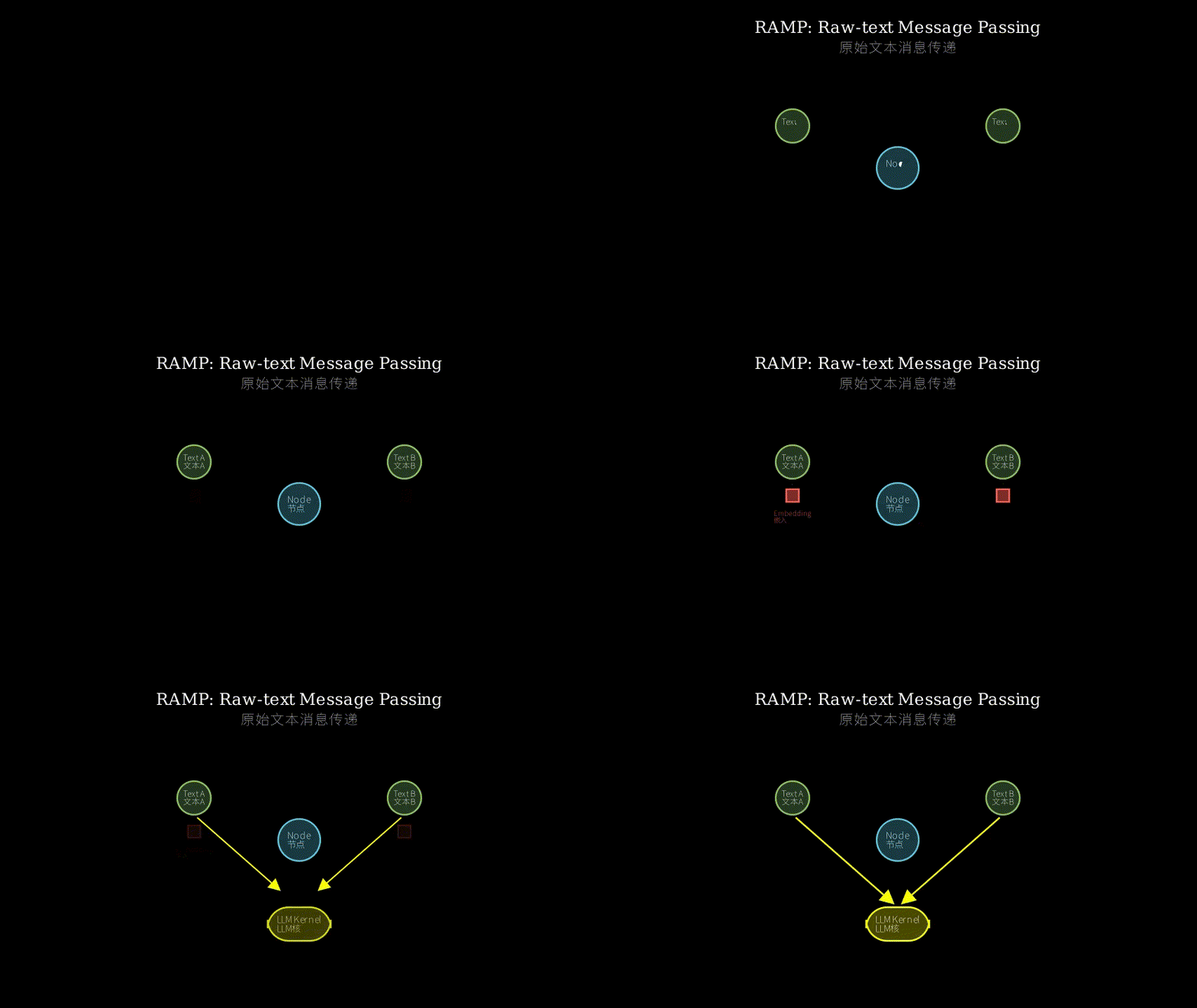
RAMP maintains two representations per node: the original raw text (static anchor) and a dynamically updated message (compressed summary from neighbors). During each iteration, the LLM receives both: the node’s own text and aggregated messages from its neighbors. It generates a new message that gets sent to the next layer.
The key is that inference always happens on raw text. The LLM doesn’t reason over embeddings—it reads actual words. Messages are the only thing that flows through the graph structure, and they’re optimized to be compact (via learned compression) while preserving task-relevant information. The final prediction comes from the LLM processing the node’s raw text plus its final aggregated message.
For generative tasks, RAMP unifies everything under a generation framework. Instead of separate classification heads, it prompts the LLM to generate the answer directly. This means the same architecture handles both discriminative tasks (node classification) and generative tasks (question answering) without structural changes.
Iteration t:

  Node i raw text ----+
                      |
                      v
                  [ LLM ]  <--- Messages from neighbors
                      |
                      v
                  New message -----> Propagate to neighbors
                      |
                      v
                  (repeat for t+1)

Final prediction:
  Node i raw text + Final aggregated message --> [LLM] --> Output
Think of it like a book club discussion. Each person (node) brings their own book (raw text) that never changes. During each round of discussion, people share short summaries (messages) of what they learned from their neighbors’ books. You always read your own book, but the summaries help you understand context. After several rounds, you write your final interpretation based on your book plus all the accumulated insights from the group. The summaries flow and evolve, but everyone’s original book stays intact—you can always go back to the source material.
Key Concepts
-
Raw Text Anchoring: Instead of converting text to embeddings once and working in vector space, RAMP keeps the original text accessible throughout. Every time the LLM makes a decision, it reads the actual words. This is like keeping the original document open while taking notes, versus only working from your notes. If your notes miss something important, you can’t recover it from the vector—but with anchoring, the LLM can always reference the source. The cost is computational (LLM processes text repeatedly), but the benefit is no information loss from premature compression.
-
LLM as Aggregation Operator: Traditional GNNs use mathematical operations (sum, mean, attention) to combine neighbor features. RAMP replaces this with an LLM call. The LLM receives messages from neighbors and generates a new message. This is fundamentally different from using LLMs as encoders. An encoder runs once per node; an aggregator runs once per node per iteration, and its output depends on graph structure. The LLM becomes the message passing mechanism itself, not a preprocessing step.
-
Dual Representation Scheme: Each node has two things: immutable raw text (the anchor) and mutable messages (the propagated information). The raw text provides grounding—it’s the source of truth. Messages provide context—they’re compressed summaries of what neighbors know. During inference, both feed into the LLM. This separation lets you preserve full text fidelity while still enabling efficient propagation. Without it, you’d either lose text detail (pure GNN) or have no way to propagate information (pure LLM on isolated nodes).
Framework Shift
Before (GNN + LLM hybrid):        After (RAMP):

Text --> [LLM] --> Embedding      Text (static anchor)
            |                         |
            v                         v
      [GNN layers]              [LLM as aggregator]
       /    |    \                /    |    \
      v     v     v              v     v     v
   Propagate in              Messages propagate
   embedding space           (text stays raw)
            |                         |
            v                         v
      Prediction                Text + Messages --> [LLM] --> Output
[One sentence: From encoding text once then propagating vectors, to anchoring on raw text while propagating LLM-generated messages.]
Expert Assessment
Problem choice: Real gap. Text-rich graphs are everywhere (citation networks, knowledge graphs, social networks with posts), and the embedding bottleneck is a genuine limitation. The paper correctly identifies that existing LLM+GNN hybrids still compress too early. This sits at the intersection of two mature fields (GNNs and LLMs) and proposes a non-obvious integration.
Method maturity: Clever insight with practical constraints. The core idea—LLM as aggregation operator—is elegant. But the execution requires careful engineering: message compression to avoid context length explosion, prompt design for aggregation, handling computational cost. The paper doesn’t fully solve the efficiency problem (running LLMs iteratively is expensive), but it demonstrates the concept works. A simpler approach might be caching LLM representations with retrieval-augmented generation, but that reintroduces the bottleneck.
Experimental integrity: Baselines seem fair—they compare against both pure GNNs and recent LLM+GNN hybrids. The datasets (citation networks, product graphs) are appropriate for text-rich scenarios. One concern: the paper doesn’t deeply analyze when RAMP wins versus when embeddings suffice. If the text is simple or the task is purely structural, the overhead might not be worth it. The ablations show message passing helps, but more analysis of the cost-benefit tradeoff would strengthen the claims.
Writing quality: The abstract and introduction are strong—they clearly articulate the bottleneck problem. The method section gets dense with implementation details (prompt templates, message compression strategies) that could be streamlined. The related work section tries to cover too much ground. If they focused the related work on just the embedding bottleneck problem and moved other comparisons to appendix, the narrative would be tighter.
Verdict: weak accept — Solid idea with demonstrated feasibility, but needs more analysis of when the computational cost is justified and clearer guidelines for practitioners.
Takeaways
Dual representation pattern: Keep raw data accessible while propagating compressed summaries. This applies beyond graphs—any scenario where you need both full context and efficient propagation. For example, in multi-document QA, maintain original documents while passing around query-relevant snippets.
LLMs as operators, not just encoders: Stop thinking of LLMs as one-time feature extractors. They can be iterative components in larger systems. The key is designing what flows between iterations (here, messages) and what stays fixed (here, raw text).
Unified generative formulation: Instead of building separate heads for classification versus generation, frame everything as text generation with appropriate prompts. This simplifies architecture and potentially enables transfer between task types.
When to avoid this: If your text is short and simple, or if your task is primarily structural (like link prediction based on topology), the embedding bottleneck might not matter. RAMP’s overhead is only justified when text complexity and graph structure both matter significantly.
论文: 2603.14937 作者: Ying Zhang, Hang Yu, Haipeng Zhang, Peng Di 分类: cs.LG, cs.CL
缺口
图神经网络(GNN)在消息传递之前将文本压缩成静态嵌入。
大语言模型混合方法将 LLM 用作特征提取器,然后把嵌入送入 GNN 层。
两者都造成了信息瓶颈:文本一旦变成向量,就无法回溯到原始词句进行推理。
更新发生在嵌入空间,与真正承载意义的原始内容脱节。
问题出在架构上:我们把文本当作需要编码的节点属性,而非图结构显现的媒介。
在引用网络中,文本本身就是关系——一篇论文引用另一篇是因为特定段落中的特定论断。
把这些压缩成 768 维向量,恰恰丢掉了消息传递应该传播的信息。
问题:文本丰富的图在压缩中丢失信息
   |
   v
假设:文本是主要媒介,不只是属性
   |
   v
方法:LLM 作为聚合算子,锚定原始文本
   |
   v
证据:无嵌入瓶颈下的竞争性能
   |
   v
结论:LLM 可作为结构推理的图核
增量
一句话: 之前是 LLM 提取特征然后 GNN 传播;现在 LLM 本身直接在原始文本上执行消息传递。
核心机制
RAMP 为每个节点维护两种表示:原始文本(静态锚点)和动态更新的消息(来自邻居的压缩摘要)。
每次迭代中,LLM 同时接收节点自身的文本和来自邻居的聚合消息。
它生成新消息,传递到下一层。
关键在于推理始终发生在原始文本上。
LLM 不对嵌入进行推理——它读取真实的词句。
消息是唯一流经图结构的东西,它们通过学习压缩保持紧凑,同时保留任务相关信息。
最终预测来自 LLM 处理节点的原始文本加上最终聚合的消息。
对于生成任务,RAMP 在生成框架下统一一切。
不用单独的分类头,而是提示 LLM 直接生成答案。
这意味着同一架构无需结构改变就能处理判别任务(节点分类)和生成任务(问答)。
迭代 t:

  节点 i 原始文本 ----+
                      |
                      v
                  [ LLM ]  <--- 来自邻居的消息
                      |
                      v
                  新消息 -----> 传播给邻居
                      |
                      v
                  (重复 t+1)

最终预测:
  节点 i 原始文本 + 最终聚合消息 --> [LLM] --> 输出
把它想象成读书会讨论。
每个人(节点)带着自己的书(原始文本),书永远不变。
每轮讨论中,人们分享简短摘要(消息),说明从邻居的书中学到了什么。
你始终读自己的书,但摘要帮你理解上下文。
几轮之后,你基于自己的书加上小组积累的所有见解写出最终解读。
摘要流动和演化,但每个人的原书保持完整——你总能回到源材料。
关键概念
- 原始文本锚定: 不是将文本转换为嵌入一次然后在向量空间工作,RAMP 始终保持原始文本可访问。
每次 LLM 做决策时,它读取实际的词句。
这就像在做笔记时保持原始文档打开,而不是只从笔记工作。
如果笔记遗漏了重要内容,你无法从向量中恢复——但有了锚定,LLM 总能参考源头。
代价是计算量(LLM 重复处理文本),但好处是不会因过早压缩而丢失信息。
- LLM 作为聚合算子: 传统 GNN 使用数学运算(求和、平均、注意力)来组合邻居特征。
RAMP 用 LLM 调用替代这一过程。
LLM 接收来自邻居的消息并生成新消息。
这与使用 LLM 作为编码器有本质区别。
编码器每个节点运行一次;聚合器每个节点每次迭代运行一次,其输出依赖于图结构。
LLM 本身成为消息传递机制,而非预处理步骤。
- 双重表示方案: 每个节点有两样东西:不可变的原始文本(锚点)和可变的消息(传播的信息)。
原始文本提供基础——它是真相的来源。
消息提供上下文——它们是邻居所知的压缩摘要。
推理时,两者都输入 LLM。
这种分离让你在保持完整文本保真度的同时实现高效传播。
没有它,你要么失去文本细节(纯 GNN),要么无法传播信息(孤立节点上的纯 LLM)。
框架转变
之前(GNN + LLM 混合):        之后(RAMP):

文本 --> [LLM] --> 嵌入         文本(静态锚点)
            |                         |
            v                         v
      [GNN 层]                  [LLM 作为聚合器]
       /    |    \                /    |    \
      v     v     v              v     v     v
   在嵌入空间                  消息传播
   中传播                     (文本保持原始)
            |                         |
            v                         v
      预测                      文本 + 消息 --> [LLM] --> 输出
[一句话:从编码文本一次然后传播向量,到锚定原始文本同时传播 LLM 生成的消息。
]
专家评审
选题眼光: 真实缺口。
文本丰富的图无处不在(引用网络、知识图谱、带帖子的社交网络),嵌入瓶颈是真实的局限。
论文正确识别出现有 LLM+GNN 混合方法仍然压缩得太早。
这处于两个成熟领域(GNN 和 LLM)的交叉点,提出了非显而易见的整合。
方法成熟度: 巧妙洞察加实际约束。
核心想法——LLM 作为聚合算子——很优雅。
但执行需要仔细工程:消息压缩以避免上下文长度爆炸,聚合的提示设计,处理计算成本。
论文没有完全解决效率问题(迭代运行 LLM 很昂贵),但证明了概念可行。
更简单的方法可能是用检索增强生成缓存 LLM 表示,但那会重新引入瓶颈。
实验诚意: 基线看起来公平——他们与纯 GNN 和最近的 LLM+GNN 混合方法比较。
数据集(引用网络、产品图)适合文本丰富的场景。
一个担忧:论文没有深入分析 RAMP 何时胜出与何时嵌入就够用。
如果文本简单或任务纯粹是结构性的,开销可能不值得。
消融实验显示消息传递有帮助,但更多成本收益权衡分析会加强论断。
写作功力: 摘要和引言很强——清楚阐明了瓶颈问题。
方法部分在实现细节(提示模板、消息压缩策略)上变得密集,可以精简。
相关工作部分试图覆盖太多内容。
如果他们把相关工作聚焦在嵌入瓶颈问题上,把其他比较移到附录,叙事会更紧凑。
判决: 弱接收 — 扎实的想法加上可行性证明,但需要更多分析说明何时计算成本是合理的,以及给实践者更清晰的指导。
要点总结
双重表示模式: 保持原始数据可访问,同时传播压缩摘要。
这超越图——任何需要完整上下文和高效传播的场景都适用。
例如在多文档问答中,维护原始文档同时传递查询相关片段。
LLM 作为算子而非仅编码器: 停止把 LLM 想成一次性特征提取器。
它们可以是更大系统中的迭代组件。
关键是设计迭代间流动的内容(这里是消息)和保持固定的内容(这里是原始文本)。
统一生成表述: 不为分类与生成构建单独的头,而是用适当提示将一切框定为文本生成。
这简化了架构,可能实现任务类型间的迁移。
何时避免: 如果文本短且简单,或任务主要是结构性的(如基于拓扑的链接预测),嵌入瓶颈可能无关紧要。
只有当文本复杂性和图结构都显著重要时,RAMP 的开销才合理。