Paper: 2611.33005 — Leto: Utility-Centric Agent Memory
Authors: Shuguang Chen, Salman Paracha
Category: cs.CL
Reading scope: Original arXiv v1 HTML. All six main sections, Limitations and Appendices A–C were read, including Tables 1–8 from original cells and complete extracts. Figures 1–5 were visually inspected; original SVGs 1–4 were rendered locally. Bibliographic entries, external cited papers and implementation were not independently audited. The experiments were not reproduced.
The Problem
“Book me a hotel near the workshop venue.” The memory store already knows where the workshop is, that the flight lands at 9 pm, and that the user uses a wheelchair. In the paper’s fictional illustration, serving only the request-matching memories leads to a hotel three minutes away with stairs only. Adding the wheelchair information leads to an accessible hotel six minutes away. Both have a 24-hour desk (§1; Figure 1).
The missing fact was remembered. It simply did not reach the decision. The illustration is not an experimental booking, but it exposes a question that a faithful summary or a relevant-looking retrieval result cannot settle: did the memory help produce an answer the user could use?
Leto treats memory as a prediction problem. At the end of a conversation, the system does not know which details a future request will need. When the request arrives, it may leave standing constraints unstated. The paper combines a source-preserving index, context prepared before the next request, and a feedback-based priority for selecting memory. It evaluates the resulting system across personalization, task chains and questions about long histories (§§3–5).
The Explanation
Keep a route back to what was said
Leto retains every conversation. It extracts atomic facts, self-contained statements about one thing, and uses each as a retrieval key. The value attached to that key is the source span of adjacent messages. A matched fact can therefore bring the original wording and qualifications to the agent, including details omitted from the fact itself (§4.1).
The index also marks a revised fact as superseding an earlier one, without deleting the earlier record. A current profile can use what holds now while the store retains earlier history. Each session also has a short summary.
In the hotel illustration, a brief fact about wheelchair use can point back to its conversational context. Keeping the source reduces the cost of a premature summary choice. It does not guarantee retrieval: a source message with no fact pointing to it may remain unreachable unless another fact’s source span includes it (Limitations).
Prepare context the request may not name
Between conversations, memory replay rewrites a concise user profile from current user facts and session summaries. It merges related facts and leaves superseded preferences out of the current profile. This standing context is composed before the next request arrives (§4.2).
When a task is declared, replay also renders its state: current facts grouped by entity, followed by ordered summaries of prior sessions. A later task step can start with what previous steps established, instead of relying on its request to restate everything.
The hotel request does not say “wheelchair,” so similarity to that sentence alone can miss the constraint. Standing context gives such information another route into the response. It may also contain facts the particular request does not need, and the generated profile can still misstate them.
Update a serving priority after the response
Each memory starts with a forecast score between zero and one. Leto then observes conversation signals detected by lexical rules: confirmations or use of a memory count positively, corrections negatively. A graded task outcome can also supply an observation (§4.3).
The score is a weighted average. The initial forecast counts as a fixed number of prior observations; subsequent feedback gradually changes its influence. Retrieved memories must meet a threshold to be served, and higher scores take priority when the context budget is tight. A low score does not delete the fact or its source.
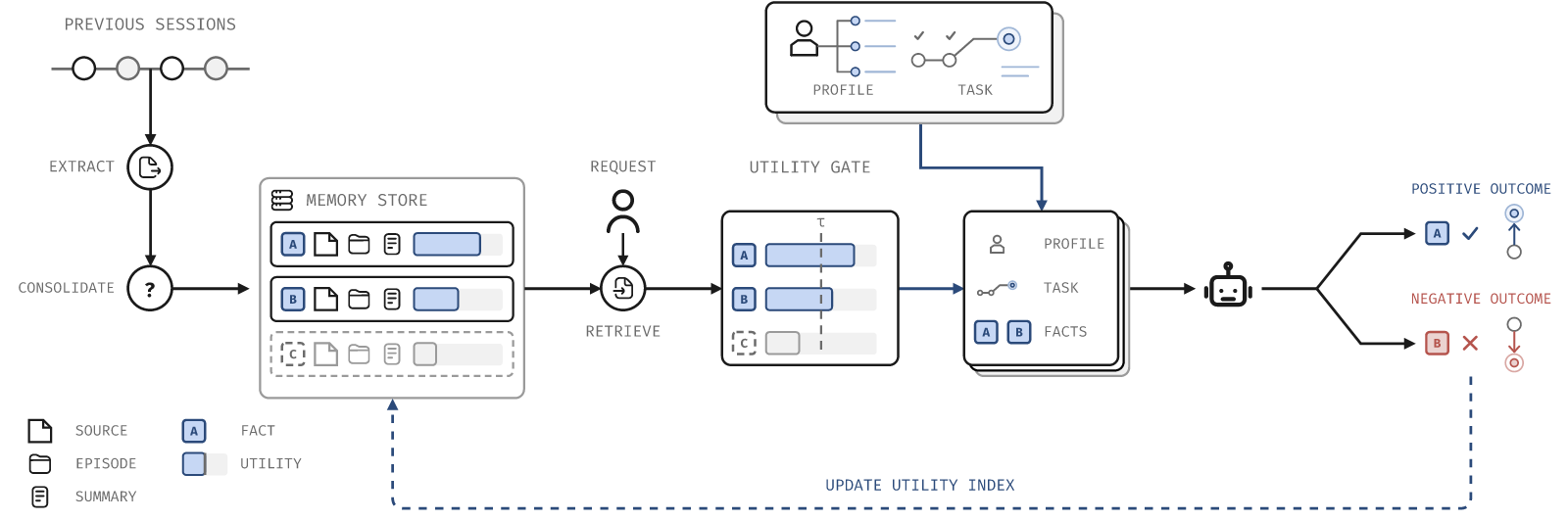
Original Figure 2, rendered from its SVG. The utility index guides selection; it is not a measurement of an individual memory’s causal contribution.
This distinction is central. The paper’s target utility compares the task outcome with memory against the outcome without it: a failed answer becoming correct is beneficial, a correct answer becoming wrong is detrimental, and equal outcomes are unchanged. The practical score uses proxy feedback to guide selection. A confirmation is not the same as proving that a particular memory caused the successful answer (§§3–4.3).
Judge what the response does
The evaluation covers five benchmarks and six compared memory systems, plus raw-history retrieval, no memory and full-history baselines. Systems use benchmark configurations when provided and their documented setup otherwise (§5.1).
On 1,000 PrefEval items after ten filler turns, Leto follows the earlier preference correctly in 60.5% of responses, versus 44.2% for Hindsight, the strongest compared memory system: 16.3 percentage points. A lexical proxy detects the preference in about 84% of Leto’s served contexts, yet the agent follows it in only about 64% of those detected cases. Detection requires at least 40% of the preference’s content words to appear in context; it does not establish semantic use (§5.2.1; Table 1; Figure 3).
PERMA asks whether personal preferences help complete a task. In its clean multi-domain condition, Leto completes 72.61%, versus 64.97% for Memobase. Its single-domain completion is 80.38%, below raw-history retrieval’s 83.69%. Averaging the two conditions equally gives about 76.5%, roughly 3.1 points above Memobase; this is not a pooled average of their 423 and 157 samples (§5.2.2; Tables 1 and 4).
The fidelity score tells a different story. In multi-domain PERMA, Letta has the highest memory score, 2.28 out of 4, but completes only 54.78%. Leto’s memory score is 2.15, with the higher completion rate above. Coverage of the gold preferences and usefulness to the task are different measurements.
Count both improvements and regressions
On those same multi-domain completion units, the paper reports that Leto passes while No Memory fails in 18.47% of cases. The reverse happens in 6.37%. Their balance is a 12.10-point gain, taking the reported completion level from No Memory’s 60.51% to Leto’s 72.61% (Appendix B; Tables 5–6).
The average improves while some cases get worse. These are paired observed outcomes for the system as a whole. They do not tell us which individual fact helped, which was unnecessary, or which caused a regression.
MemoryArena extends the question to dependent task steps in five environments. With equal weight for each environment, Leto has the highest reported mean progress score, 32.01%, and success score, 18.33%; No Memory has 23.41% and 10.63%. Success measures full-chain completion except in search, where it measures success on the final question (§5.3; Table 2).
Those averages do not mean every environment improves most. Leto’s full shopping-chain completion remains zero, and physics success is 50%, below Letta’s 55%. Its task state is a plausible way to supply earlier decisions, but step progress and completing the entire chain remain separate outcomes.
When the question names the history it needs
Raw-history retrieval is already useful for explicit questions about prior conversations. The long-context comparison reports:
| Benchmark | Leto accuracy | Leto memory tokens/question | RAG accuracy | RAG memory tokens/question |
|---|---|---|---|---|
| LoCoMo | 71.82% | 1,192 | 74.61% | 1,999 |
| LongMemEval S | 73.20% | 1,185 | 66.40% | 9,813 |
Leto wins on LongMemEval S and loses to raw retrieval on LoCoMo, while reporting fewer retrieved-memory tokens on both. These counts describe memory supplied per question, not total processing cost or the storage, indexing and replay work (§5.4; Table 3).
The LoCoMo gap points back to the first design choice. In about 40% of single-hop questions that RAG answers correctly but Leto misses, no extracted fact points to an evidence message. Keeping the original conversation cannot help if the relevant source never reaches the agent (§5.4).
Core Concepts
Retaining a fact and serving it are separate decisions. The wheelchair constraint can exist in storage yet be absent from the hotel decision. Leto keeps low-priority sources while changing what is selected for the response, so a serving choice need not become permanent deletion.
Retrieval and standing context solve different gaps. Retrieval follows the current request toward matching facts. Replay carries a profile and task state before the request. The latter matters when users expect an earlier constraint to apply without repeating its wording.
A useful outcome and a priority score are different evidence. Paired task outcomes measure whether the system’s answer improves. The utility index summarizes forecast and feedback signals for later selection. It is a heuristic, not a calibrated estimate of the benefit of adding one particular memory.
The Insight
The hotel’s distance was remembered correctly, but the response needed more than distance. A memory system earns its value when the user can use the answer it enables. Fidelity and retrieval coverage can support that goal without guaranteeing it.
The practical judgment is to keep access to source detail, distinguish retention from serving, and evaluate both improvements and regressions in the response. The paper supports that direction for the tested systems; it does not make feedback an infallible judge of memory value.
A Critical Reading
The feedback problem remains coarse. A task outcome can be shared by every memory served for that answer, rewarding an unnecessary fact or penalizing a correct one. A memory never served receives no observation. The paper explicitly identifies these limits, along with agent-specific utility: the same memory can help one agent and fail to help another (Limitations).
Profiles and task states are generated summaries, so they can misstate the history. Source retention costs storage and write-time computation, and fact extraction still bounds source access. The presented comparisons evaluate complete memory systems; they do not isolate how much indexing, replay or the utility gate contributes. This reading did not audit implementations or configuration equivalence (§§4–5; Limitations).
Depth trends need their scope. Figure 4 reports shopping gains of 1.3 points at the first purchase and 7.3 at the sixth, with intermediate gains that are not monotonic. Search reaches about 14 points at the eighth question, while the number of chains reaching that position falls from 221 to 97. These are tested position-wise comparisons, not a general law that deeper tasks always benefit more.
Benchmark averages also hide category differences. On LongMemEval’s 30 abstention questions, Leto scores 63.33%, versus RAG’s 80%. Store scopes vary across benchmarks, from one user or task chain to one item or question. Evidence recall is a content-word overlap proxy, not proof that an agent applies the right fact. The results should be read within those scopes (Appendices A and C; Table 8).
What You Can Use
For an agent that remembers earlier interactions, preserve source references and distinguish current facts from superseded ones. Keep standing constraints separate from request-matched retrieval, and inspect the context actually supplied before blaming the final response.
Compare answers with and without memory on representative tasks. Count cases rescued and cases made worse, alongside accuracy, abstention and context size. Record which memories were served and which feedback changed their priority; treat that feedback as evidence to examine rather than exact credit assignment.
The hotel example gives the final check: an accurate memory of the workshop is useful only when the resulting plan also respects the user’s wheelchair constraint. Judge memory by that completed response, while keeping enough source detail to understand and correct the selection.
论文: 2611.33005 — Leto: Utility-Centric Agent Memory
作者: Shuguang Chen、Salman Paracha
分类: cs.CL
阅读范围: arXiv v1 原始 HTML。
读过六个正文节、局限性和附录 A–C,表1–8按原始单元格及完整提取文本读取。
图1–5已目视检查,原始 SVG 图1–4在本地渲染后查看。
未逐项独立核查参考文献、外部论文及实现代码,没有复现实验。
问题
“帮我订一家会场附近的酒店。” 记忆库已经知道会场在哪里、航班晚上九点到,还知道用户使用轮椅。 论文的虚构示意里,只把与请求文字相配的记忆送过去,智能体选了步行三分钟、却只有楼梯的酒店;补上轮椅信息,选的是六分钟外、能够无障碍使用的酒店。 两家都有全天前台(§1;图1)。
缺的事实其实记住了,只是没进入决定。 这不是一次实验订房,却把问题问出来:摘要忠实、检索看着相关,记忆究竟有没有帮用户得到能用的答案?
Leto 把记忆看成预测问题。 对话结束时,还不知道下一次请求会用到哪段细节;请求到来,也可能不重述长期约束。 论文组合了保留原文的索引、请求前准备的常驻背景,以及根据反馈更新的选择优先级,再用个性化、连续任务和长历史问答检验整套系统(§§3–5)。
翻译
留一条回到原话的路
Leto 保留每次对话,提取原子事实,也就是能够独立读懂、只说一项事情的陈述。 事实作为检索键,对应的值却是它来自的相邻消息片段。 匹配到事实,可以把原来的措辞、限定条件,以及事实本身没写进去的细节一并带给智能体(§4.1)。
新事实修订旧事实时,会标出取代关系,不删除旧记录;当前画像可以用现状,历史仍保留。 每次会话还保存一份简短摘要。
在酒店示意里,“用户使用轮椅”这句简短事实,可以指回原来的对话背景。 这减少了过早压缩细节的代价,但不保证都找得到:没有事实指向的消息,只有被另一条事实的来源片段顺带覆盖,才可能进入上下文(局限性)。
提前准备请求没写出的背景
对话之间,记忆重放根据当前用户事实和会话摘要,重写一份简洁画像。 它合并相关事实,把已被取代的偏好排除在当前画像之外。 下一次请求尚未到来,这份常驻背景就已经准备好(§4.2)。
若声明了任务,还会生成任务状态:先按实体整理当前事实,再列此前会话的顺序摘要。 后面的步骤因此可以接上前面已经确定的内容,不必等用户每次重述。
订酒店的请求没有“轮椅”二字,单凭与这句话的相似度,容易漏掉约束。 常驻背景给它另一条进入回答的路。 代价是有些背景本次用不到,生成的画像也可能写错事实。
回答之后,再更新选择优先级
每条记忆先得到一个零到一的预测分。 Leto 再用词面规则观察对话信号:确认、使用某条记忆算正向,改正算负向;有任务评分时,也可以把结果记作观察(§4.3)。
更新方式是加权平均。 最初的预测相当于固定份数的先前观察,后续反馈逐渐改变它的影响。 检索出来的记忆,要达到门槛才送出;上下文预算紧时,分高的优先。 低分不会删除事实或原文。
原论文图2,由原始 SVG 渲染。优先分指导选择,没有测出某条记忆单独造成的效果。
这项区别很关键。 论文想衡量的效用,是有记忆与没有记忆时的任务结果差:原本失败、现在正确算有帮助;原本正确、现在失败算拖累;结果一样算未改变。 实际优先分则用反馈代理信号指导下一次选择。 用户确认了回答,不等于已经证明某条记忆造成了成功(§§3–4.3)。
看回答做到了什么
评测用五个基准、六套被比较的记忆系统,还加入原始历史检索、无记忆和完整历史基线。 能用基准配置时按基准配置,其余按各系统的文档设置(§5.1)。
PrefEval 在 1,000个样本、十轮填充对话之后检查早先偏好是否被正确遵守。 Leto 的准确率为 60.5%,最强的对比记忆系统 Hindsight 为 44.2%,相差 16.3个百分点。 按词面代理检测,约 84% 的 Leto 上下文里能发现偏好,但这些已检测到的案例,约 64% 的回答遵守了它。 检测要求偏好至少40%的内容词出现在上下文,不能据此认定语义已经被正确使用(§5.2.1;表1;图3)。
PERMA 检查偏好能否帮助完成任务。 干净的跨领域条件下,Leto 完成 72.61%,Memobase 为 64.97%;单领域完成率 80.38%,却低于原文检索的 83.69%。 两种条件等权平均约 76.5%,比 Memobase 高约3.1个百分点;这不是把423个与157个样本直接合并的比例(§5.2.2;表1、4)。
忠实度分数又是另一幅图景。 跨领域 PERMA 中,Letta 的记忆分最高,四分制里有 2.28分,完成率却仅 54.78%。 Leto 记忆分是 2.15分,完成率则是上面的72.61%。 覆盖标准偏好,与帮助完成任务,测的是不同事情。
有多少次帮上忙,也有多少次拖后腿
同一批跨领域任务里,Leto 通过、无记忆失败的案例占 18.47%;反过来占 6.37%。 相抵净增 12.10个百分点,对应完成率从无记忆的 60.51% 到 Leto 的 72.61%(附录 B;表5–6)。
平均结果更好,同时有一部分案例变差。 这些是整套系统在配对样本上的观察,没指出哪条事实帮了忙、哪条多余、哪条造成了退步。
MemoryArena 把问题放进五种环境的连续任务。 每种环境等权平均,Leto 的进度分 32.01%、成功分 18.33%,是报告中的最高值;无记忆分别为 23.41%和10.63%。 成功分通常看整条任务链完成,搜索环境则看最后一问是否成功(§5.3;表2)。
平均领先,不代表每种环境都最强。 Leto 的整条购物链完成率仍为 零,物理任务成功率 50%,低于 Letta 的 55%。 任务状态是补上先前决定的一种合理办法,步骤有进展与整条链完成,仍要分别看。
问题明确指出要找哪段历史时
对旧对话的明确提问,原文检索本来就有效。 长历史问答报告如下:
| 基准 | Leto准确率 | Leto每题记忆词元 | RAG准确率 | RAG每题记忆词元 |
|---|---|---|---|---|
| LoCoMo | 71.82% | 1,192 | 74.61% | 1,999 |
| LongMemEval S | 73.20% | 1,185 | 66.40% | 9,813 |
Leto 在 LongMemEval S 领先,在 LoCoMo 则输给原文检索;两组报告的检索记忆词元都更少。 这些数是每题送来的记忆量,没有算整个流程的存储、写入、索引和重放成本(§5.4;表3)。
LoCoMo 的差距又回到最初的索引选择。 RAG答对、Leto答错的单跳题里,约40%有一条证据消息没有任何提取事实指向它。 原对话保存着,相关原文却没有到达智能体,仍帮不上忙(§5.4)。
核心概念
保留与送出,是两项决定。 轮椅约束可以在库里,却不在订房时的上下文里。 Leto 保留低优先级的原文,改变的是这次选什么;一次没送出,不必变成永久删除。
检索与常驻背景,补不同的缺口。 检索跟着当前请求找匹配事实,重放提前带来画像和任务状态。 用户希望旧约束继续生效、却没重述字面内容时,后者尤其有用。
有用的结果与优先分,是不同证据。 配对任务结果衡量整套系统的回答有没有改善,优先分把预测和反馈汇总为后续选择线索。 它不是对“加上某一条记忆会带来多少收益”的校准估计。
洞见
酒店距离记得很准,回答需要的却不止距离。 用户能够使用记忆帮它生成的答案,记忆才体现价值。 忠实度与检索覆盖能支持这件事,不能保证这件事。
可用的判断,是留住通向原文的路,分开保留和送出的决定,再检验回答中帮了多少、拖累多少。 论文在这些受测系统上支持这条方向,没有把反馈变成永远正确的记忆裁判。
博导审稿
反馈仍很粗。 一次任务结果可以分给该回答用到的所有记忆,于是多余事实可能获奖,正确事实可能受罚;从来没送出的记忆,拿不到观察。 论文明确写出这些限制,也指出效用依赖智能体:同一条记忆对一个智能体有帮助,对另一个未必如此(局限性)。
画像和任务状态是生成的摘要,可能误述历史。 保留原文增加存储及写入计算,事实提取的覆盖范围仍限制能找回哪些来源。 报告的比较针对完整记忆系统,没有拆出索引、重放或效用门槛各自贡献多少。 这次阅读也没有审计实现和配置是否等价(§§4–5;局限性)。
链条深度的趋势要带着范围读。 图4购物任务从第一步高1.3个百分点,到第六步高7.3,中间并非单调上升。 搜索第八问高约14个百分点,到达该位置的链条数量却从第一问的221降到97。 这是受测位置上的对照,不是任务越深、记忆收益就必然越大的规律。
基准平均也藏着类别差异。 LongMemEval 的 30道应弃答问题里,Leto 为 63.33%,RAG 为 80%。 各基准的记忆库范围不同,可以是一位用户、一条任务链,也可以只是一项样本或一个问题。 证据召回按内容词重叠作代理,没有证明智能体应用了正确事实,结果要连同这些范围一起读(附录 A、C;表8)。
启发
给智能体做跨会话记忆,先保留来源引用,区分当前事实与被取代的旧事实。 常驻约束与请求匹配检索分开安排;检查实际送出的上下文,再判断最后的回答为什么没做好。
在有代表性的任务上,比较有记忆与无记忆的答案。 准确率之外,统计救回的案例、变差的案例、弃答表现和上下文大小。 记录送过哪些记忆、哪些反馈改变了优先分,把反馈当作待检查的证据,不当作精确归功。
酒店例子给最后一项检查:会场信息记得准确,订出的方案还得照顾用户的轮椅约束。 用这份完成的回答判断记忆,同时留够原文,让选择过程能够被理解和纠正。