
Paper: 2603.24558 Authors: Keliang Li, Yansong Li, Hongze Shen, Mengdi Liu, Hong Chang, Shiguang Shan Categories: cs.CV, cs.AI
The Gap
Current video understanding systems use Vision-Language Models (VLMs) to process videos, but they suffer from a fundamental disconnect: reasoning happens separately from perception. Existing methods pre-process the entire video into a fixed representation—uniform frame sampling, dense captioning, or compressed embeddings—then feed this static snapshot to a language model for reasoning. The reasoner can’t go back and look more carefully at a suspicious moment, can’t zoom out to check context, can’t decide “I need to see frames 45-52 at higher density.” It’s like being handed a stack of photos and asked to solve a mystery without being allowed to revisit the crime scene.
This matters because videos are temporally dense and semantically sparse. Important events might cluster in 5 seconds of a 10-minute clip. Uniform sampling wastes tokens on irrelevant frames; aggressive compression loses critical details. The reasoner is stuck with whatever the perception module decided to show it upfront.
Problem: Static perception → reasoning bottleneck
   |
   v
Assumption: Reasoning needs dynamic control over what it sees
   |
   v
Method: LensWalk - agent controls temporal scope + sampling density
   |
   v
Evidence: +5% on LVBench/Video-MME, no fine-tuning needed
   |
   v
Conclusion: Active visual control unlocks better video reasoning
The Increment
One sentence: Before LensWalk, video reasoners were blind passengers fed pre-chewed visual summaries; after LensWalk, they’re drivers who steer their own perception by specifying when and how densely to sample frames.
Core Mechanism
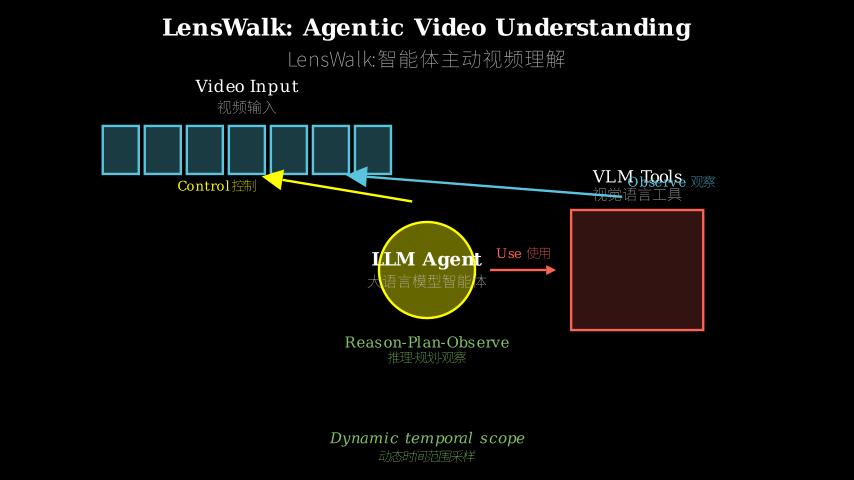
LensWalk establishes a reason-plan-observe loop. At each reasoning step, the LLM agent doesn’t just think—it issues observation commands. These commands have two parameters: temporal scope (which time range to look at) and sampling density (how many frames to extract from that range). A suite of VLM-based tools executes these commands: broad scanning tools for initial cues, focused extraction tools for detailed fact-checking, and stitching tools that gather evidence across multiple non-contiguous moments.
The agent starts with a question, performs a coarse scan to locate candidate regions, then drills down. If it needs to verify “did the person put the cup down before or after opening the door?”, it can request dense frames around both events and compare. If initial evidence is ambiguous, it can widen the temporal window or increase sampling density. The observation results feed back into the reasoning chain, which decides the next observation command. This continues until the agent has enough evidence to answer confidently.
The architecture is tool-agnostic—any VLM can power the observation tools. The LLM reasoner (GPT-4, Claude, etc.) orchestrates everything through natural language commands like “observe frames 120-180 with density 0.5” which the tool layer translates into actual frame extraction and VLM queries.
Question → LLM Reasoner
             |
             v
    [Reason-Plan-Observe Loop]
             |
    +--------+--------+
    |                 |
    v                 v
Reasoning         Observation
 Chain             Command
    |              (scope + density)
    |                 |
    |                 v
    |            VLM Tools
    |          (scan/focus/stitch)
    |                 |
    +<----------------+
         Evidence
Think of LensWalk like a detective with a DVR. Old methods are like being handed a case file with 100 pre-selected screenshots—you can read them, but you can’t rewind the tape. LensWalk gives the detective the remote control. They can fast-forward through boring parts (broad scan, low density), pause and zoom on suspicious moments (focused extraction, high density), and jump between scenes to cross-reference alibis (stitching across temporal gaps). The detective’s reasoning evolves as they gather evidence, and they control the gathering process. The DVR (VLM tools) is dumb—it just fetches what’s requested. The intelligence is in knowing what to request next.
Key Concepts
-
Temporal Scope and Sampling Density: These are the two knobs the agent turns. Temporal scope is the time range (e.g., seconds 30-45 of the video). Sampling density is how many frames to pull from that range—0.1 means one frame per 10 seconds, 1.0 means every frame. Low scope + high density = zooming in on a moment. High scope + low density = scanning for landmarks. The agent adjusts these dynamically based on what it’s learned so far. If you’re looking for “when did the cat jump?”, you scan broadly (wide scope, low density) until you see motion blur, then zoom in (narrow scope, high density) on that segment to pinpoint the exact frame.
-
Reason-Plan-Observe Loop: This is the heartbeat of LensWalk. Traditional pipelines are one-way: video → features → answer. LensWalk is circular: question → reasoning → observation plan → execute observation → new evidence → updated reasoning → new observation plan. The loop terminates when the agent decides it has sufficient evidence. This mirrors how humans watch videos to answer questions—we don’t process every frame uniformly; we skim, pause, rewind, and zoom based on what we’re trying to figure out.
-
Tool-Mediated Perception: The agent doesn’t “see” the video directly. It issues commands to a tool layer that wraps VLMs. Tools include BroadScan (low-density overview), FocusExtract (high-density detail), and EvidenceStitch (multi-segment comparison). Each tool takes scope and density parameters, fetches frames accordingly, runs them through a VLM, and returns structured observations (captions, object lists, action descriptions). The agent reasons over these observations, not raw pixels. This abstraction lets the agent work with any VLM backend without retraining.
Framework Shift
Before (mainstream approach):          After (LensWalk):

Video                                  Video
  |                                      |
  v                                      v
[Pre-process]                       [Tool Layer]
(uniform sampling /                  (on-demand)
 dense captioning)                       ^
  |                                      |
  v                                  [Commands]
Fixed Features                       (scope+density)
  |                                      |
  v                                      v
LLM Reasoner -----> Answer          LLM Reasoner
(one-shot)                           (iterative)
                                         |
                                         v
                                   Observation
                                         |
                                         v
                                     Answer
From passive consumption of pre-processed features to active steering of perception through iterative observation commands.
Expert Assessment
Problem choice: This is a real gap. The disconnect between reasoning and perception in video understanding is well-documented—models fail on questions requiring temporal reasoning precisely because they can’t revisit or refine their observations. The problem sits at the intersection of agentic AI and multimodal understanding, both hot areas. Not manufactured.
Method maturity: The core insight—let the reasoner control its own perception—is elegant and underexplored. The execution is pragmatic: no new model architectures, just orchestration logic. However, the paper doesn’t deeply explore failure modes. What happens when the agent gets stuck in a local observation loop? How does it decide when to stop observing? The tool design feels ad-hoc (BroadScan, FocusExtract, EvidenceStitch)—are these the right primitives, or just what worked in experiments? A more principled decomposition of observation strategies would strengthen this.
Experimental integrity: Baselines are fair—they compare against strong VLM pipelines (GPT-4V, Gemini) on established benchmarks (LVBench, Video-MME). The +5% gain is consistent across models, which suggests the method is robust. However, the paper doesn’t report computational cost. If LensWalk makes 10x more VLM calls than baselines, the gain might not justify the expense. Also, the benchmarks are long-video QA—does this work on short, dense videos where uniform sampling is already effective? The scope of applicability is unclear.
Writing quality: The abstract and introduction are crisp. The method section is readable but lacks depth on tool design decisions. The analysis section (ablations, case studies) is where the paper shines—showing which observation strategies matter most. The related work section is thin; it doesn’t engage deeply with prior work on active perception or tool-use agents. Rewriting the method section to justify tool choices and adding a failure analysis would elevate this significantly.
Verdict: weak accept — Solid idea with clear empirical wins, but the method feels like a strong prototype rather than a mature framework. The lack of cost analysis and failure mode exploration are notable gaps.
Takeaways
The transferable idea here is reasoning-driven perception control. This isn’t specific to videos—any domain where you have a large, structured input space (long documents, codebases, sensor logs) and a reasoning task could benefit. Instead of feeding everything to the reasoner upfront, let it request specific slices at varying granularities. The key is designing the right observation primitives (scope, density, aggregation) and a termination condition. For practitioners: if your model is drowning in context or missing details, consider flipping the pipeline—make the reasoner an active agent that controls what it sees, rather than a passive consumer of pre-processed features.
论文: 2603.24558 作者: Keliang Li, Yansong Li, Hongze Shen, Mengdi Liu, Hong Chang, Shiguang Shan 分类: cs.CV, cs.AI
缺口
当前的视频理解系统使用视觉-语言模型(VLM)处理视频,但存在根本性的割裂:推理与感知分离。
现有方法将整个视频预处理成固定表示——均匀帧采样、密集字幕或压缩嵌入——然后把这个静态快照喂给语言模型推理。
推理器无法回头仔细查看可疑时刻,无法放大检查上下文,无法决定”我需要以更高密度查看第45-52帧”。
这就像拿到一叠照片被要求破案,却不允许重返犯罪现场。
这很重要,因为视频在时间上密集但语义上稀疏。
重要事件可能集中在10分钟片段中的5秒内。
均匀采样在无关帧上浪费token;激进压缩丢失关键细节。
推理器只能接受感知模块预先决定展示的内容。
问题:静态感知 → 推理瓶颈
   |
   v
假设:推理需要动态控制所见内容
   |
   v
方法:LensWalk - 智能体控制时间范围+采样密度
   |
   v
证据:LVBench/Video-MME上+5%,无需微调
   |
   v
结论:主动视觉控制解锁更好的视频推理
增量
一句话: LensWalk之前,视频推理器是被喂预嚼视觉摘要的盲目乘客;之后,它们是通过指定何时以何种密度采样帧来驾驭自己感知的司机。
核心机制
LensWalk建立了推理-规划-观察循环。
在每个推理步骤,LLM智能体不只是思考——它发出观察指令。
这些指令有两个参数:时间范围(看哪个时间段)和采样密度(从该范围提取多少帧)。
一套基于VLM的工具执行这些指令:用于初始线索的广泛扫描工具、用于详细事实核查的聚焦提取工具、以及跨多个非连续时刻收集证据的拼接工具。
智能体从问题开始,执行粗略扫描定位候选区域,然后深入钻取。
如果需要验证”这个人是在开门之前还是之后放下杯子?“,它可以请求两个事件周围的密集帧并比较。
如果初始证据模糊,它可以扩大时间窗口或增加采样密度。
观察结果反馈到推理链,决定下一个观察指令。
这持续进行直到智能体有足够证据自信回答。
架构与工具无关——任何VLM都能驱动观察工具。
LLM推理器(GPT-4、Claude等)通过自然语言指令编排一切,如”以0.5密度观察第120-180帧”,工具层将其转换为实际的帧提取和VLM查询。
问题 → LLM推理器
         |
         v
  [推理-规划-观察循环]
         |
    +----+----+
    |         |
    v         v
推理链    观察指令
    |    (范围+密度)
    |         |
    |         v
    |    VLM工具
    |  (扫描/聚焦/拼接)
    |         |
    +<--------+
       证据
把LensWalk想象成一个拿着DVR遥控器的侦探。
旧方法像是拿到一份案卷,里面有100张预选截图——你能读它们,但不能倒带。
LensWalk把遥控器交给侦探。
他们可以快进无聊部分(广泛扫描,低密度),在可疑时刻暂停放大(聚焦提取,高密度),在场景间跳转交叉核对不在场证明(跨时间间隙拼接)。
侦探的推理随着收集证据而演进,他们控制收集过程。
DVR(VLM工具)是哑的——它只获取请求的内容。
智能在于知道接下来请求什么。
关键概念
- 时间范围和采样密度: 这是智能体转动的两个旋钮。
时间范围是时间区间(如视频的第30-45秒)。
采样密度是从该范围抽取多少帧——0.1意味着每10秒一帧,1.0意味着每一帧。
低范围+高密度=放大某个时刻。
高范围+低密度=扫描地标。
智能体根据目前所学动态调整这些参数。
如果你在找”猫什么时候跳的?“,你广泛扫描(宽范围,低密度)直到看到运动模糊,然后放大(窄范围,高密度)该片段以精确定位帧。
- 推理-规划-观察循环: 这是LensWalk的心跳。
传统流水线是单向的:视频→特征→答案。
LensWalk是循环的:问题→推理→观察计划→执行观察→新证据→更新推理→新观察计划。
当智能体决定有足够证据时循环终止。
这反映了人类如何观看视频回答问题——我们不均匀处理每一帧;我们根据试图弄清的内容浏览、暂停、倒带和放大。
- 工具中介的感知: 智能体不直接”看”视频。
它向包装VLM的工具层发出指令。
工具包括BroadScan(低密度概览)、FocusExtract(高密度细节)和EvidenceStitch(多片段比较)。
每个工具接受范围和密度参数,相应获取帧,通过VLM运行,返回结构化观察(字幕、对象列表、动作描述)。
智能体对这些观察推理,而非原始像素。
这种抽象让智能体可以使用任何VLM后端而无需重新训练。
框架转变
之前(主流方法):                之后(LensWalk):

视频                            视频
  |                               |
  v                               v
[预处理]                       [工具层]
(均匀采样/                      (按需)
 密集字幕)                         ^
  |                               |
  v                           [指令]
固定特征                      (范围+密度)
  |                               |
  v                               v
LLM推理器 -----> 答案          LLM推理器
(一次性)                        (迭代)
                                  |
                                  v
                              观察结果
                                  |
                                  v
                                答案
从被动消费预处理特征到通过迭代观察指令主动驾驭感知。
专家评审
选题眼光: 这是真实缺口。
视频理解中推理与感知的割裂有充分记录——模型在需要时间推理的问题上失败,正是因为它们无法重访或细化观察。
问题位于智能体AI和多模态理解的交叉点,两者都是热门领域。
非人造。
方法成熟度: 核心洞见——让推理器控制自己的感知——优雅且探索不足。
执行务实:没有新模型架构,只是编排逻辑。
然而论文没有深入探索失败模式。
当智能体陷入局部观察循环时会怎样?它如何决定何时停止观察?工具设计感觉临时拼凑(BroadScan、FocusExtract、EvidenceStitch)——这些是正确的原语,还是只是实验中有效的?更有原则的观察策略分解会加强这点。
实验诚意: 基线公平——它们在既定基准(LVBench、Video-MME)上与强VLM流水线(GPT-4V、Gemini)比较。
+5%增益在模型间一致,表明方法稳健。
然而论文没有报告计算成本。
如果LensWalk的VLM调用是基线的10倍,增益可能不值得开销。
此外,基准是长视频问答——这在短而密集的视频上有效吗,那里均匀采样已经有效?适用范围不清楚。
写作功力: 摘要和引言简洁。
方法部分可读但缺乏工具设计决策的深度。
分析部分(消融、案例研究)是论文亮点——展示哪些观察策略最重要。
相关工作部分单薄;它没有深入讨论主动感知或工具使用智能体的先前工作。
重写方法部分以证明工具选择并添加失败分析会显著提升论文。
判决: 弱接收 — 扎实想法有清晰的实证胜利,但方法感觉像强原型而非成熟框架。
缺乏成本分析和失败模式探索是显著缺口。
要点总结
这里可迁移的想法是推理驱动的感知控制。
这不限于视频——任何有大型结构化输入空间(长文档、代码库、传感器日志)和推理任务的领域都能受益。
不要预先把所有东西喂给推理器,让它以不同粒度请求特定切片。
关键是设计正确的观察原语(范围、密度、聚合)和终止条件。
对实践者:如果你的模型淹没在上下文中或遗漏细节,考虑翻转流水线——让推理器成为控制所见内容的主动智能体,而非预处理特征的被动消费者。