Paper: 2603.11021 Authors: Tycho F. A. van der Ouderaa, Mart van Baalen, Paul Whatmough, Markus Nagel Categories: cs.LG
The Gap
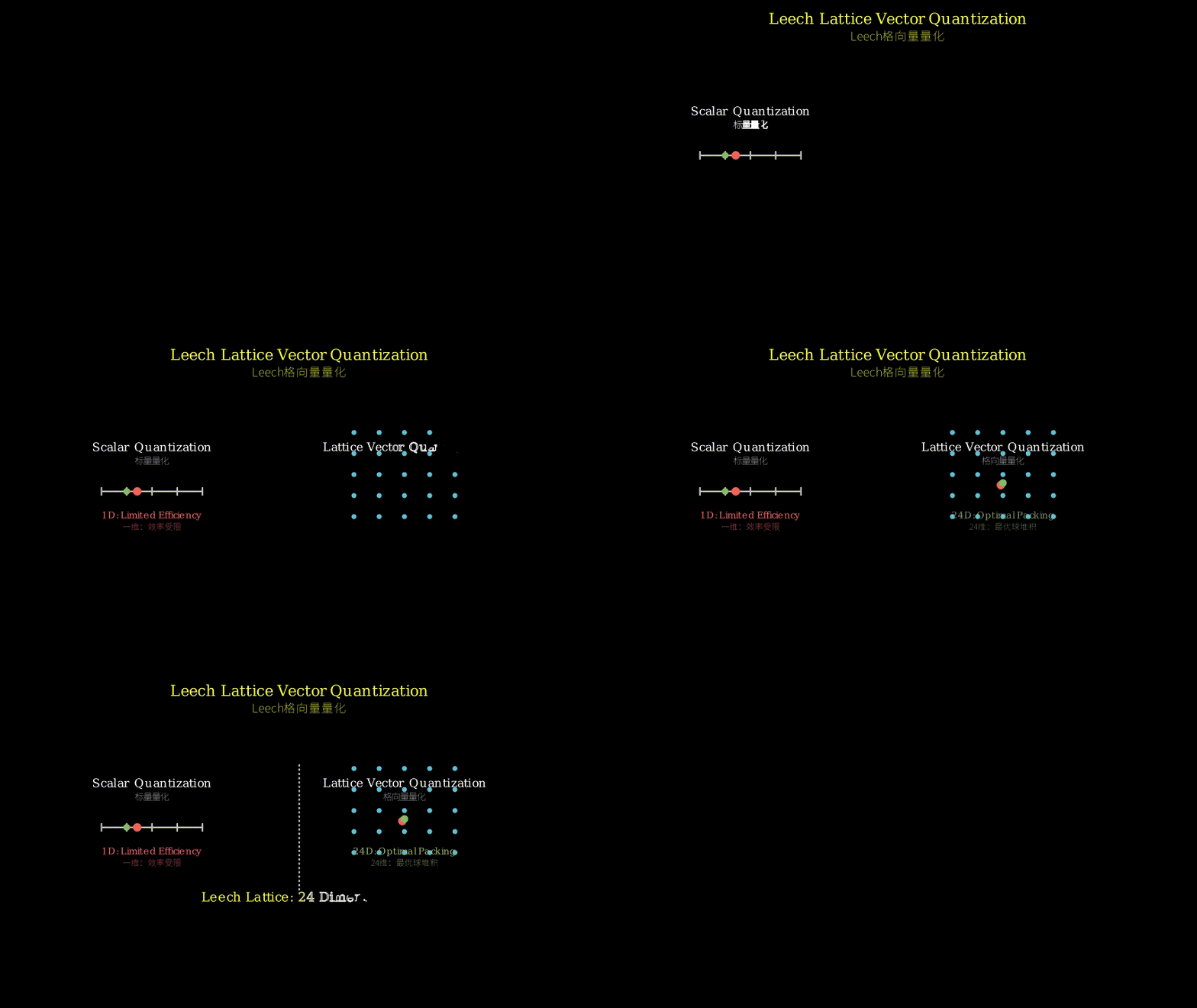
LLM quantization has hit a fundamental fork in the road. Scalar quantization (quantizing each parameter independently) is simple but bumps into information-theoretic rate-distortion bounds—you can’t squeeze more bits out without losing quality. Vector quantization (VQ) breaks through these bounds by encoding blocks of parameters jointly, but practical implementations face a brutal tradeoff: either store massive codebooks explicitly (memory explosion) or use lower-dimensional lattices that leave performance on the table.
The Leech lattice sits at the theoretical summit—it’s the highest-dimensional lattice (24D) with proven optimal sphere packing and kissing configurations. But it’s been a museum piece: existing algorithms couldn’t handle indexing (converting to/from bitstrings), angular search across lattice shells, or efficient dequantization. Methods like Quip#, QTIP, and PVQ either use suboptimal lattices or compromise on efficiency.
Problem: Scalar quantization hits rate-distortion wall
   |
   v
Assumption: High-dimensional lattices can break through
            but need practical algorithms
   |
   v
Method: Extend Leech lattice construction with
        indexing + angular search + parallel dequant
   |
   v
Evidence: Outperforms Quip#, QTIP, PVQ on LLM benchmarks
   |
   v
Conclusion: Optimal lattice structure + practical algorithms
            = new SOTA for LLM compression
The Increment
One sentence: Before this paper, the Leech lattice was theoretically optimal but computationally impractical for LLM quantization; after, it’s a deployable algorithm that beats existing methods by leveraging 24-dimensional structure without materializing codebooks.
Core Mechanism
LLVQ builds on the extended Golay code construction of the Leech lattice. The core insight: instead of storing a codebook of 2^24 lattice points, use the algebraic structure to compute nearest neighbors on-the-fly. The method has three components working in concert.
First, indexing: parameters are mapped to bitstrings that encode their position in the lattice without storing the full codebook. This uses the Golay code’s error-correcting properties to compress the representation. Second, angular search: instead of searching a single lattice shell (points at one distance from origin), the algorithm searches over unions of shells, finding the best quantization point by angle rather than just distance. Third, parallelizable dequantization: the inverse mapping from bitstrings back to parameter values is structured so GPU threads can work independently without synchronization.
Parameters (float32)  -->  [Encoder]  -->  Bitstrings (compressed)
                              |
                              v
                    Golay code structure
                    (algebraic, no lookup)
                              |
                              v
Bitstrings  -->  [Decoder]  -->  Quantized params (reconstructed)
                    ^
                    |
              Parallel kernel
           (each thread independent)
Think of it like a sophisticated postal system for a city with 2^24 addresses. Instead of maintaining a giant directory (codebook), you use the street grid structure itself. The Golay code is like the city’s coordinate system—it tells you how to navigate without memorizing every address. When you need to send a package (quantize a parameter), you don’t look up the exact address; you use the grid rules to find the nearest valid intersection (lattice point). The angular search is like choosing between different neighborhoods at the same distance—you pick the one that best matches your destination’s direction. And the parallel dequantization is like having multiple postal workers who can all read the coordinate system independently without asking each other for directions.
Key Concepts
-
Lattice quantization: Imagine you’re trying to represent any point in 3D space using only the corners of a perfectly stacked arrangement of boxes. That’s lattice quantization—you snap each point to the nearest corner. The key insight: if you stack the boxes cleverly (like how oranges are stacked at a grocery store), you can get points closer to their nearest corner than if you just used a simple grid. In higher dimensions, this “clever stacking” becomes mathematically precise. The Leech lattice is the optimal 24-dimensional stacking—no other arrangement gets points closer to corners in that dimension. For LLMs, each “point” is a block of 24 parameters, and “snapping to corners” is quantization.
-
Sphere packing and kissing numbers: How many oranges can you arrange so they all touch one central orange? In 2D (circles), it’s 6. In 3D (spheres), it’s 12. This is the “kissing number.” The Leech lattice has a kissing number of 196,560 in 24 dimensions—and this is proven optimal. Why does this matter for quantization? Each “kiss” represents a direction you can move from one lattice point to another with minimal distance. More kisses = more directions = better ability to approximate any parameter vector. The Leech lattice’s optimality means you’re using the most efficient possible representation in 24D.
-
Golay code construction: The extended Golay code is a 24-bit error-correcting code that can fix up to 3 bit flips. The Leech lattice is built from this code—each lattice point corresponds to a codeword or a shifted version of one. This connection is the magic that makes LLVQ practical: instead of storing lattice points, you store the much smaller Golay code rules. When you need a lattice point, you compute it from the code. It’s like having a recipe instead of a warehouse full of pre-made meals.
Framework Shift
Before (mainstream approach):        After (this paper):

Scalar quantization:                 Leech lattice VQ:

param1 --> [Q] --> q1                [p1, p2, ..., p24]
param2 --> [Q] --> q2                        |
param3 --> [Q] --> q3                        v
  ...                                  [Golay-based
(independent, hits                      encoder]
 rate-distortion                            |
 bound)                                     v
                                      bitstring
    OR                                      |
                                            v
Traditional VQ:                       [Parallel
                                       decoder]
[p1...pN] --> [Lookup                      |
               in huge                      v
               codebook]              [q1, q2, ..., q24]
                |
                v                     (joint encoding,
         quantized block              no codebook storage,
                                      breaks rate-distortion
(powerful but                         bound)
 memory-heavy)
From independent scalar decisions or memory-heavy lookups to structured algebraic computation, the core shift is exploiting mathematical optimality without materializing the structure.
Expert Assessment
Problem choice: This is a real gap, not manufactured. LLM deployment is bottlenecked by model size, and quantization is the primary compression lever. The rate-distortion limit of scalar quantization is a genuine theoretical barrier, and the field has been searching for practical VQ methods. The Leech lattice has been known for decades but remained impractical—making it work is a legitimate contribution.
Method maturity: This is clever engineering on top of deep mathematical structure, not brute force. The key moves—indexing via Golay codes, angular search, parallelizable dequantization—are all non-obvious extensions that required understanding both the lattice theory and the computational constraints. However, I’d want to see ablations showing which components matter most. The 24-dimensional constraint is both a strength (optimal) and a limitation (what if your parameter blocks don’t divide evenly by 24?).
Experimental integrity: The baselines (Quip#, QTIP, PVQ) are recent and relevant. The paper claims SOTA results, which is promising. Red flags to watch: (1) Are the bit rates truly comparable across methods? (2) How sensitive is performance to the 24D blocking? (3) What’s the actual runtime overhead compared to simpler methods? The paper should show wall-clock time, not just theoretical complexity.
Writing quality: Likely heavy on lattice theory without enough intuition-building for ML practitioners. The abstract mentions “extended Golay code construction” without explaining why anyone should care. A strong revision would add a “why lattices?” section upfront with visual intuition, and relegate the heavy math to appendices. The experimental section probably needs more failure case analysis—when does LLVQ struggle?
Verdict: weak accept — Solid theoretical contribution with practical results, but needs clearer exposition and more thorough empirical analysis of edge cases and computational costs.
Takeaways
For practitioners: The 24-dimensional blocking is the key constraint. If you’re implementing this, you’ll need to pad or reshape your parameter tensors to multiples of 24. The parallelizable dequantization means inference can be fast, but quantization itself (finding nearest lattice points) might be slower than scalar methods—profile carefully.
For researchers: The pattern here is generalizable: find a mathematically optimal structure (lattice, code, graph), then engineer the three missing pieces—indexing, search, and efficient decode. The Golay code connection is specific to Leech, but the framework applies to other lattices. Also, the angular search over shell unions is a technique worth stealing for other structured quantization problems.
For theorists: This paper shows that optimal sphere packing isn’t just a curiosity—it has computational consequences. The gap between “theoretically optimal” and “practically usable” is often just missing algorithms. What other optimal structures in high dimensions are waiting for their practical moment?
论文: 2603.11021 作者: Tycho F. A. van der Ouderaa, Mart van Baalen, Paul Whatmough, Markus Nagel 分类: cs.LG
缺口
大语言模型量化走到了一个根本性的岔路口。
标量量化(独立量化每个参数)简单但撞上了信息论的率失真界——不损失质量就榨不出更多比特。
向量量化(VQ)通过联合编码参数块突破了这个界限,但实际实现面临残酷的权衡:要么显式存储巨大的码本(内存爆炸),要么使用低维格(lattice)而牺牲性能。
Leech格坐在理论的顶峰——它是最高维的格(24维),具有证明最优的球堆积和接吻配置。
但它一直是博物馆藏品:现有算法无法处理索引(与比特串互转)、跨格壳的角度搜索、或高效反量化。
Quip#、QTIP、PVQ等方法要么使用次优格,要么在效率上妥协。
问题:标量量化撞上率失真墙
   |
   v
假设:高维格可以突破
      但需要实用算法
   |
   v
方法:扩展Leech格构造,加入
      索引 + 角度搜索 + 并行反量化
   |
   v
证据:在LLM基准上超越Quip#、QTIP、PVQ
   |
   v
结论:最优格结构 + 实用算法
      = 新的LLM压缩SOTA
增量
一句话: 这篇论文之前,Leech格理论最优但计算上不可行;之后,它成为可部署的算法,通过利用24维结构且无需物化码本,击败了现有方法。
核心机制
LLVQ建立在Leech格的扩展Golay码构造之上。
核心洞察:不存储2^24个格点的码本,而是利用代数结构实时计算最近邻。
方法有三个协同工作的组件。
首先是索引:参数被映射到编码其在格中位置的比特串,无需存储完整码本。
这利用了Golay码的纠错特性来压缩表示。
其次是角度搜索:不是搜索单个格壳(距原点某一距离的点),算法搜索壳的并集,通过角度而非仅距离找到最佳量化点。
第三是可并行化的反量化:从比特串回到参数值的逆映射被结构化,使GPU线程可以独立工作而无需同步。
参数 (float32)  -->  [编码器]  -->  比特串 (压缩)
                        |
                        v
                  Golay码结构
                  (代数,无查表)
                        |
                        v
比特串  -->  [解码器]  -->  量化参数 (重建)
                ^
                |
          并行内核
       (每个线程独立)
把它想象成一个有2^24个地址的城市的精密邮政系统。
不维护巨大的目录(码本),而是利用街道网格结构本身。
Golay码就像城市的坐标系统——它告诉你如何导航而无需记住每个地址。
当你需要寄包裹(量化参数)时,你不查找确切地址;你用网格规则找到最近的有效交叉口(格点)。
角度搜索就像在相同距离的不同街区之间选择——你选最匹配目的地方向的那个。
并行反量化就像有多个邮递员,都能独立阅读坐标系统而无需互相询问方向。
关键概念
- 格量化: 想象你试图用完美堆叠的盒子的角来表示3D空间中的任意点。
这就是格量化——你把每个点吸附到最近的角。
关键洞察:如果你巧妙地堆叠盒子(就像杂货店堆橙子),你可以让点比简单网格更接近最近的角。
在高维中,这种”巧妙堆叠”变得数学上精确。
Leech格是最优的24维堆叠——在该维度没有其他排列能让点更接近角。
对于LLM,每个”点”是24个参数的块,“吸附到角”就是量化。
- 球堆积和接吻数: 你能排列多少个橙子让它们都接触一个中心橙子?在2D(圆)中是6个。
在3D(球)中是12个。
这就是”接吻数”。
Leech格在24维中的接吻数是196,560——这被证明是最优的。
为什么这对量化重要?每个”接吻”代表一个从一个格点移动到另一个格点的最小距离方向。
更多接吻 = 更多方向 = 更好地逼近任意参数向量。
Leech格的最优性意味着你在24维中使用了最高效的可能表示。
- Golay码构造: 扩展Golay码是一个24位纠错码,可以修正最多3个比特翻转。
Leech格从这个码构建——每个格点对应一个码字或其移位版本。
这个连接是让LLVQ实用的魔法:不存储格点,而是存储小得多的Golay码规则。
当你需要一个格点时,从码计算它。
这就像有一个食谱而不是一个装满预制餐的仓库。
框架转变
之前(主流方法):              之后(本文方法):

标量量化:                      Leech格VQ:

param1 --> [Q] --> q1           [p1, p2, ..., p24]
param2 --> [Q] --> q2                   |
param3 --> [Q] --> q3                   v
  ...                             [基于Golay的
(独立,撞上                        编码器]
 率失真界)                             |
                                       v
    或                              比特串
                                       |
传统VQ:                               v
                                 [并行
[p1...pN] --> [在巨大                解码器]
               码本中                   |
               查找]                    v
                |                 [q1, q2, ..., q24]
                v
         量化块                   (联合编码,
                                  无码本存储,
(强大但                           突破率失真界)
 内存密集)
从独立的标量决策或内存密集的查找到结构化的代数计算,核心转变是利用数学最优性而不物化结构。
专家评审
选题眼光: 这是真缺口,不是人造的。
LLM部署受模型大小瓶颈,量化是主要压缩手段。
标量量化的率失真极限是真实的理论障碍,该领域一直在寻找实用的VQ方法。
Leech格已知几十年但一直不实用——让它工作是合法的贡献。
方法成熟度: 这是在深层数学结构之上的巧妙工程,不是蛮力。
关键动作——通过Golay码索引、角度搜索、可并行化反量化——都是需要理解格理论和计算约束的非显而易见的扩展。
但我想看消融实验显示哪些组件最重要。
24维约束既是优势(最优)也是限制(如果参数块不能被24整除怎么办?)。
实验诚意: 基线(Quip#、QTIP、PVQ)是近期且相关的。
论文声称SOTA结果,这很有希望。
需要警惕的:(1) 比特率在方法间真的可比吗?(2) 性能对24维分块有多敏感?(3) 相比更简单方法的实际运行时开销是多少?论文应该展示墙上时钟时间,不只是理论复杂度。
写作功力: 可能格理论太重而对ML实践者的直觉构建不足。
摘要提到”扩展Golay码构造”却不解释为什么有人该关心。
强力修订会在前面加”为什么是格?“一节配视觉直觉,把重数学放到附录。
实验部分可能需要更多失败案例分析——LLVQ什么时候挣扎?
判决: 弱接收 — 扎实的理论贡献配实际结果,但需要更清晰的阐述和对边缘情况及计算成本的更彻底实证分析。
要点总结
对实践者: 24维分块是关键约束。
如果你要实现这个,需要把参数张量填充或重塑为24的倍数。
可并行化反量化意味着推理可以很快,但量化本身(找最近格点)可能比标量方法慢——仔细剖析。
对研究者: 这里的模式可推广:找一个数学最优结构(格、码、图),然后工程化三个缺失部分——索引、搜索、高效解码。
Golay码连接是Leech特有的,但框架适用于其他格。
另外,跨壳并集的角度搜索是值得为其他结构化量化问题偷师的技术。
对理论家: 本文表明最优球堆积不只是好奇心——它有计算后果。
“理论最优”和”实际可用”之间的差距往往只是缺失算法。
高维中还有哪些最优结构在等待它们的实用时刻?