Paper: 2602.16682 Authors: Chuhan Li, Ruilin Han, Joy Hsu, Yongyuan Liang, Rajiv Dhawan Categories: cs.CV
The Gap
Current benchmarks for multimodal foundation models focus heavily on environment-centric spatial relations—understanding how objects relate to each other in a scene. A model can tell you “the cup is on the table” or “the car is behind the building.” But there’s a critical missing piece: observer-centric reasoning.
Humans don’t just understand scenes as abstract spatial arrangements. We constantly reason about our relationship to the environment: “Can I reach that shelf?” “If I turn left, will I see the door?” “How far am I from that obstacle?” This is situated awareness—understanding the world relative to your viewpoint, pose, and motion.
Existing benchmarks largely ignore this. They test whether models can identify spatial relationships between objects, but not whether models can reason about the observer’s position and capabilities within that space. This gap matters because embodied AI systems—robots, AR assistants, autonomous vehicles—need observer-centric reasoning to function in the real world.
Current Benchmarks:
  Environment-centric: "Where is object A relative to object B?"
                       [Third-person, god's-eye view]

Missing Capability:
  Observer-centric: "Where am I relative to object A?"
                    "Can I reach that from here?"
                    "What will I see if I move forward?"
                    [First-person, embodied perspective]

Gap: Models trained on environment-centric tasks
     fail at observer-centric reasoning
The Increment
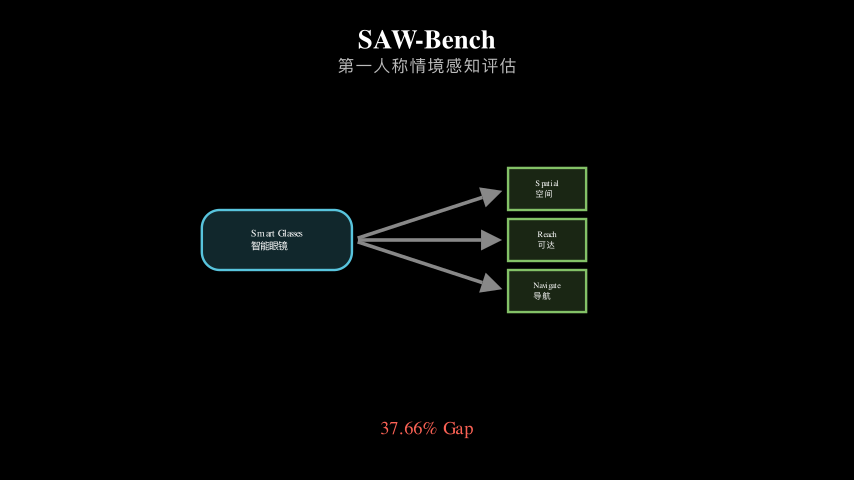
One sentence: Before SAW-Bench, we had no systematic way to evaluate observer-centric spatial reasoning in real-world egocentric videos; after SAW-Bench, we have 786 real-world videos with 2,071 questions probing six types of situated awareness, revealing a 37.66% human-model gap.
Core Mechanism
SAW-Bench uses real-world egocentric videos captured with Ray-Ban Meta smart glasses across diverse indoor and outdoor environments. The benchmark tests six awareness tasks:
- Spatial localization: Where is the observer relative to objects?
- Reachability: Can the observer reach or interact with objects?
- Navigability: Can the observer move through spaces?
- View prediction: What will the observer see from different positions?
- Motion understanding: How is the observer moving through space?
- Geometric reasoning: What is the camera’s pose and orientation?
Each video is paired with human-annotated question-answer pairs that require reasoning about the observer’s viewpoint, not just object relationships. The questions are designed to be unanswerable without understanding the observer’s position and capabilities.
Traditional Benchmark:
  Video → "What objects are in the scene?"
          "Where is the cup relative to the table?"
          [Environment-centric questions]

SAW-Bench:
  Egocentric Video → "Can I reach the top shelf from here?"
                     "If I turn 90° left, what will I see?"
                     "How far am I from the door?"
                     [Observer-centric questions]

  Requires: Understanding camera pose, observer height,
            reachability constraints, spatial geometry
Think of it like the difference between reading a map (environment-centric) and navigating with that map (observer-centric). The map shows all the streets and buildings, but navigation requires knowing “I am here” and “I need to go there” and “I can walk this fast.”
Key Concepts
-
Egocentric vs. allocentric: Egocentric (first-person) perspective means understanding the world from the observer’s viewpoint. Allocentric (third-person) perspective means understanding the world from an external viewpoint. Most vision benchmarks are allocentric—they show scenes from arbitrary camera angles. SAW-Bench is purely egocentric, using head-mounted camera footage.
-
Situated awareness: The ability to understand your relationship to the physical environment and reason about possible actions. This includes knowing where you are, what you can reach, where you can go, and what you’ll see if you move. It’s the foundation for embodied intelligence.
-
Observer-centric geometry: Unlike environment-centric geometry (object A is 2 meters from object B), observer-centric geometry is relative to the agent (object A is 1 meter in front of me, at eye level). This requires inferring the camera’s pose, the observer’s height, and the observer’s capabilities.
Framework Shift
Before (environment-centric):       After (SAW-Bench observer-centric):

Input: Scene image/video            Input: Egocentric video
       [Any viewpoint]                     [First-person viewpoint]

Task: "Where is A relative to B?"   Task: "Where am I relative to A?"
      "What objects are present?"         "Can I reach A from here?"
      [Object relationships]              [Observer-action relationships]

Reasoning: Spatial relations        Reasoning: Camera pose inference
           Object detection                   Reachability constraints
           Scene understanding                Motion prediction
           [Passive observation]              [Active embodiment]
One sentence: From passive third-person scene understanding to active first-person embodied reasoning, requiring models to infer their own position and capabilities.
Expert Assessment
Problem choice: This is a genuine gap. The field has been so focused on object recognition and scene understanding that we’ve neglected the observer’s perspective. For embodied AI, this is critical—a robot that can identify all objects but doesn’t know where it is relative to them is useless. The problem is well-motivated and timely.
Method maturity: The benchmark design is solid. Using real-world egocentric videos from smart glasses ensures ecological validity. The six task categories cover the key aspects of situated awareness. The human annotation process appears rigorous with 2,071 QA pairs across 786 videos.
Experimental integrity: The 37.66% human-model gap is striking and credible. The evaluation includes multiple state-of-the-art models (Gemini, GPT-4V, etc.), and the analysis goes beyond aggregate scores to identify specific failure modes. The finding that models can exploit partial geometric cues but fail to infer coherent camera geometry is particularly insightful.
Writing quality: The paper clearly articulates the distinction between environment-centric and observer-centric reasoning. The task definitions are precise. The analysis of failure modes adds depth beyond just reporting numbers. Could benefit from more discussion of how to close the gap.
Verdict: strong accept — Identifies and addresses a critical gap in multimodal evaluation, with a well-designed benchmark using real-world data and thorough analysis of model failures.
Takeaways
-
Embodied AI needs observer-centric reasoning: If you’re building robots, AR systems, or any embodied agent, test on observer-centric tasks, not just object recognition. SAW-Bench shows current models are weak at this.
-
Egocentric video is different: Models trained on third-person videos don’t automatically transfer to first-person perspectives. The geometric reasoning required is fundamentally different. If your application uses egocentric cameras, you need egocentric training data.
-
Partial cues aren’t enough: The finding that models can exploit some geometric cues but fail to infer coherent camera geometry suggests they’re pattern-matching rather than truly understanding 3D space. This has implications for reliability—models might work in familiar scenarios but fail unpredictably in novel ones.
-
Benchmark design matters: The six-task structure (localization, reachability, navigability, view prediction, motion, geometry) provides a template for evaluating embodied reasoning. These categories are transferable to other domains beyond vision.
论文: 2602.16682 作者: Chuhan Li, Ruilin Han, Joy Hsu, Yongyuan Liang, Rajiv Dhawan 分类: cs.CV
缺口
当前多模态基础模型的基准测试主要关注环境中心的空间关系——理解场景中物体之间的关系。模型可以告诉你”杯子在桌子上”或”汽车在建筑物后面”。但有一个关键的缺失部分:观察者中心推理。
人类不仅仅将场景理解为抽象的空间排列。我们不断推理自己与环境的关系:“我能够到那个架子吗?""如果我向左转,我会看到门吗?""我离那个障碍物有多远?“这就是情境感知——相对于你的视角、姿态和运动理解世界。
现有基准测试在很大程度上忽略了这一点。它们测试模型是否能识别物体之间的空间关系,但不测试模型是否能推理观察者在该空间中的位置和能力。这个差距很重要,因为具身AI系统——机器人、AR助手、自动驾驶汽车——需要观察者中心推理才能在现实世界中运作。
当前基准测试:
  环境中心:"物体A相对于物体B在哪里?"
            [第三人称,上帝视角]

缺失能力:
  观察者中心:"我相对于物体A在哪里?"
              "我能从这里够到那个吗?"
              "如果我向前移动会看到什么?"
              [第一人称,具身视角]

差距:在环境中心任务上训练的模型
      在观察者中心推理上失败
增量
一句话:SAW-Bench之前,我们没有系统的方法来评估真实世界第一人称视频中的观察者中心空间推理;SAW-Bench之后,我们有了786个真实世界视频和2,071个问题,探测六种类型的情境感知,揭示了37.66%的人机差距。
核心机制
SAW-Bench使用Ray-Ban Meta智能眼镜在不同室内外环境中捕获的真实世界第一人称视频。基准测试测试六个感知任务:
- 空间定位:观察者相对于物体在哪里?
- 可达性:观察者能够到或与物体交互吗?
- 可导航性:观察者能通过空间移动吗?
- 视图预测:观察者从不同位置会看到什么?
- 运动理解:观察者如何在空间中移动?
- 几何推理:相机的姿态和方向是什么?
每个视频都配有人工标注的问答对,需要推理观察者的视角,而不仅仅是物体关系。这些问题被设计为在不理解观察者位置和能力的情况下无法回答。
传统基准测试:
  视频 → "场景中有什么物体?"
         "杯子相对于桌子在哪里?"
         [环境中心问题]

SAW-Bench:
  第一人称视频 → "我能从这里够到顶层架子吗?"
                 "如果我向左转90°,我会看到什么?"
                 "我离门有多远?"
                 [观察者中心问题]

  需要:理解相机姿态、观察者高度、
        可达性约束、空间几何
可以把它想象成阅读地图(环境中心)和使用地图导航(观察者中心)之间的区别。地图显示所有街道和建筑物,但导航需要知道”我在这里”和”我需要去那里”以及”我能走多快”。
关键概念
-
自我中心vs.异我中心:自我中心(第一人称)视角意味着从观察者的视角理解世界。异我中心(第三人称)视角意味着从外部视角理解世界。大多数视觉基准测试是异我中心的——它们从任意相机角度显示场景。SAW-Bench纯粹是自我中心的,使用头戴式相机镜头。
-
情境感知:理解你与物理环境的关系并推理可能的行动的能力。这包括知道你在哪里、你能够到什么、你能去哪里以及如果你移动会看到什么。这是具身智能的基础。
-
观察者中心几何:与环境中心几何(物体A距离物体B 2米)不同,观察者中心几何是相对于智能体的(物体A在我前面1米,与眼睛齐平)。这需要推断相机的姿态、观察者的高度和观察者的能力。
框架转变
之前(环境中心):                之后(SAW-Bench观察者中心):

输入:场景图像/视频                输入:第一人称视频
      [任意视角]                        [第一人称视角]

任务:"A相对于B在哪里?"          任务:"我相对于A在哪里?"
      "有什么物体?"                    "我能从这里够到A吗?"
      [物体关系]                        [观察者-行动关系]

推理:空间关系                      推理:相机姿态推断
      物体检测                            可达性约束
      场景理解                            运动预测
      [被动观察]                        [主动具身]
一句话:从被动的第三人称场景理解到主动的第一人称具身推理,要求模型推断自己的位置和能力。
专家评审
选题眼光:这是一个真正的缺口。该领域一直专注于物体识别和场景理解,以至于忽略了观察者的视角。对于具身AI来说,这至关重要——一个能识别所有物体但不知道自己相对于它们在哪里的机器人是无用的。问题动机充分且及时。
方法成熟度:基准设计扎实。使用智能眼镜的真实世界第一人称视频确保了生态有效性。六个任务类别涵盖了情境感知的关键方面。人工标注过程看起来严格,786个视频有2,071个问答对。
实验诚意:37.66%的人机差距令人震惊且可信。评估包括多个最先进的模型(Gemini、GPT-4V等),分析超越了总体分数,识别了特定的失败模式。模型可以利用部分几何线索但无法推断连贯的相机几何这一发现特别有洞察力。
写作功力:论文清楚地阐述了环境中心和观察者中心推理之间的区别。任务定义精确。失败模式分析增加了深度,超越了仅仅报告数字。可以从更多关于如何缩小差距的讨论中受益。
判决:强接收 — 识别并解决了多模态评估中的关键缺口,使用真实世界数据设计了良好的基准测试,并对模型失败进行了彻底分析。
要点总结
-
具身AI需要观察者中心推理:如果你在构建机器人、AR系统或任何具身智能体,在观察者中心任务上测试,而不仅仅是物体识别。SAW-Bench表明当前模型在这方面很弱。
-
第一人称视频不同:在第三人称视频上训练的模型不会自动迁移到第一人称视角。所需的几何推理根本不同。如果你的应用使用第一人称相机,你需要第一人称训练数据。
-
部分线索不够:模型可以利用一些几何线索但无法推断连贯的相机几何这一发现表明它们在模式匹配而不是真正理解3D空间。这对可靠性有影响——模型可能在熟悉的场景中工作,但在新场景中不可预测地失败。
-
基准设计很重要:六任务结构(定位、可达性、可导航性、视图预测、运动、几何)为评估具身推理提供了模板。这些类别可迁移到视觉之外的其他领域。