Paper: 2603.13186 Authors: Xingli Fang, Jung-Eun Kim Categories: cs.LG, cs.AI, cs.CR
The Gap
Existing privacy-preserving methods treat neural networks like monolithic blocks — they either retrain everything or apply uniform noise across all parameters. Differential privacy adds noise everywhere. Unlearning retrains the whole model. These approaches are expensive and cause unnecessary utility loss because they assume privacy vulnerability is uniformly distributed.
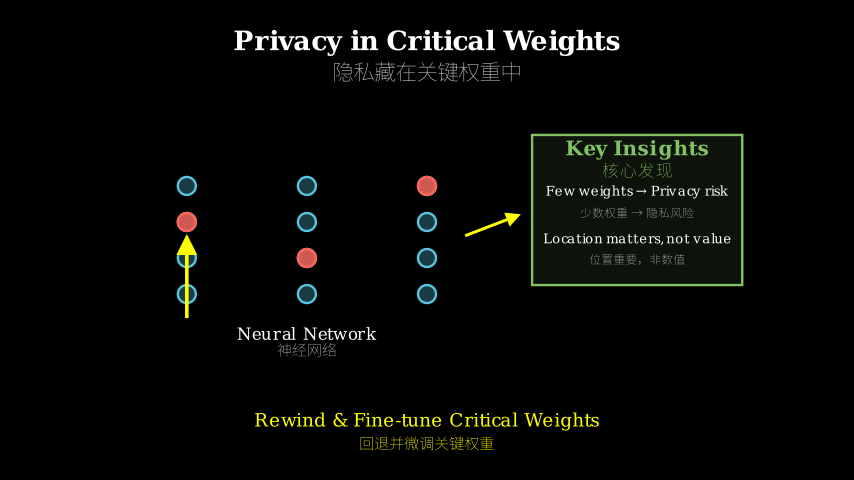
The gap: nobody asked where in the network the privacy leaks actually concentrate. If only a few weights leak membership information, why touch the rest?
Problem: Privacy leaks in trained models
   |
   v
Prior assumption: Vulnerability distributed across all weights
   |
   +---> Method: Retrain/noise entire network
   |
   v
Consequence: High cost + utility loss
   |
   v
This paper's insight: Vulnerability concentrated in <1% of weights
   |
   +---> Method: Score + rewind only critical weights
   |
   v
Evidence: Better privacy/utility tradeoff on CIFAR/Purchase datasets
   |
   v
Conclusion: Location matters more than values
The Increment
One sentence: Before — protect privacy by modifying all weights; after — identify the <1% of weights that leak information and surgically rewind only those.
Core Mechanism
The method has three stages. First, score every weight by how much it contributes to both privacy vulnerability (measured by membership inference attack success) and utility (measured by validation accuracy). This creates a 2D landscape where each weight gets coordinates: (privacy_risk, utility_importance).
Second, identify the critical zone — weights that are high on both axes. These are the troublemakers: they leak membership information but also matter for performance. The paper’s key observation: most privacy-leaking weights fall into this critical zone, not scattered randomly.
Third, instead of deleting or randomizing these weights, rewind them to their values from an earlier training checkpoint, then fine-tune only those weights while freezing everything else. This preserves the network’s overall structure while giving the critical weights a chance to “forget” the specific training examples they memorized.
Training trajectory:

Checkpoint 1 -----> Checkpoint 2 -----> Final model
(early)             (mid)               (memorized)
                                            |
                                            v
                                    Score all weights
                                            |
                    +-----------------------+
                    |
                    v
            Critical weights identified (<1%)
                    |
                    v
            Rewind to Checkpoint 2 values
                    |
                    v
            Fine-tune ONLY those weights
                    |
                    v
            Privacy-preserved model
Think of it like a security audit of a building. Instead of replacing all locks (expensive, disruptive), you identify which doors actually had break-ins. But here’s the twist: those same doors are also the main entrances everyone uses. You can’t just seal them. So you rewind the lock mechanisms to an earlier configuration before the vulnerability was learned, then carefully re-tune just those locks. The rest of the building stays untouched.
The structural mapping: doors = weights, break-ins = privacy leaks, main entrances = utility-critical paths, lock mechanism = weight values, earlier configuration = checkpoint values, re-tuning = fine-tuning. The metaphor carries the core insight: location (which doors) matters more than the specific lock design (weight values).
Key Concepts
-
Membership Inference Attack (MIA): Imagine you train a model on patient records. An attacker queries your model with a specific patient’s data and tries to guess: was this person in the training set? If the model is overconfident on training data (high confidence) but uncertain on new data (low confidence), the attacker can distinguish members from non-members. It’s like a teacher who only remembers students from their own class — if you ask about a student and they respond with detailed memories, you know that student was in their class. The attack succeeds when models memorize training examples instead of learning general patterns.
-
Weight Rewinding: During training, models go through phases. Early on, they learn general features (edges, textures). Later, they start memorizing specific training examples to minimize loss. Rewinding means taking a weight’s current value and replacing it with its value from an earlier checkpoint, then continuing training from there. It’s like hitting “undo” on specific neurons while keeping the rest of the network’s progress. The hypothesis: early checkpoints captured useful patterns without the memorization that causes privacy leaks.
-
Location vs Value Hypothesis: The paper claims a weight’s importance comes from *where it sits in the network architecture, not its