Paper: 2605.22786 Authors: Sadia Asif, Mohammad Mohammadi Amiri, Momin Abbas, Prasanna Sattigeri, Karthikeyan Natesan Ramamurthy Categories: cs.AI, cs.ET, cs.LG, cs.MA
The Gap
Multi-agent LLM systems have moved beyond natural language communication to sharing transformer KV caches directly—a more efficient channel that preserves richer task information. But here’s the problem: KV caches aren’t just task data. They encode the full context that generated them: sensitive inputs, intermediate reasoning, agent-specific information. When Agent A passes its KV cache to Agent B, it’s handing over an opaque memory dump that could leak private data without any textual trace.
Prior work on latent communication (KV sharing) focused on efficiency and task performance. Privacy? Unaddressed. Existing privacy techniques for LLMs target text outputs (differential privacy, output filtering) or model weights (federated learning). None of them handle the representation-level leakage problem when raw internal states move between agents.
Problem: KV caches leak sensitive info
    |
    v
Assumption: Leakage = reconstructability by adversary
    |
    v
Method: Adversarial training (sanitizer vs reconstructor)
    |
    v
Evidence: Lower reconstruction accuracy + maintained task performance
    |
    v
Conclusion: Safe KV sharing is feasible
The Increment
One sentence: Before this paper, sharing KV caches meant choosing between efficiency and privacy; after it, you can sanitize caches adversarially to get both.
Core Mechanism
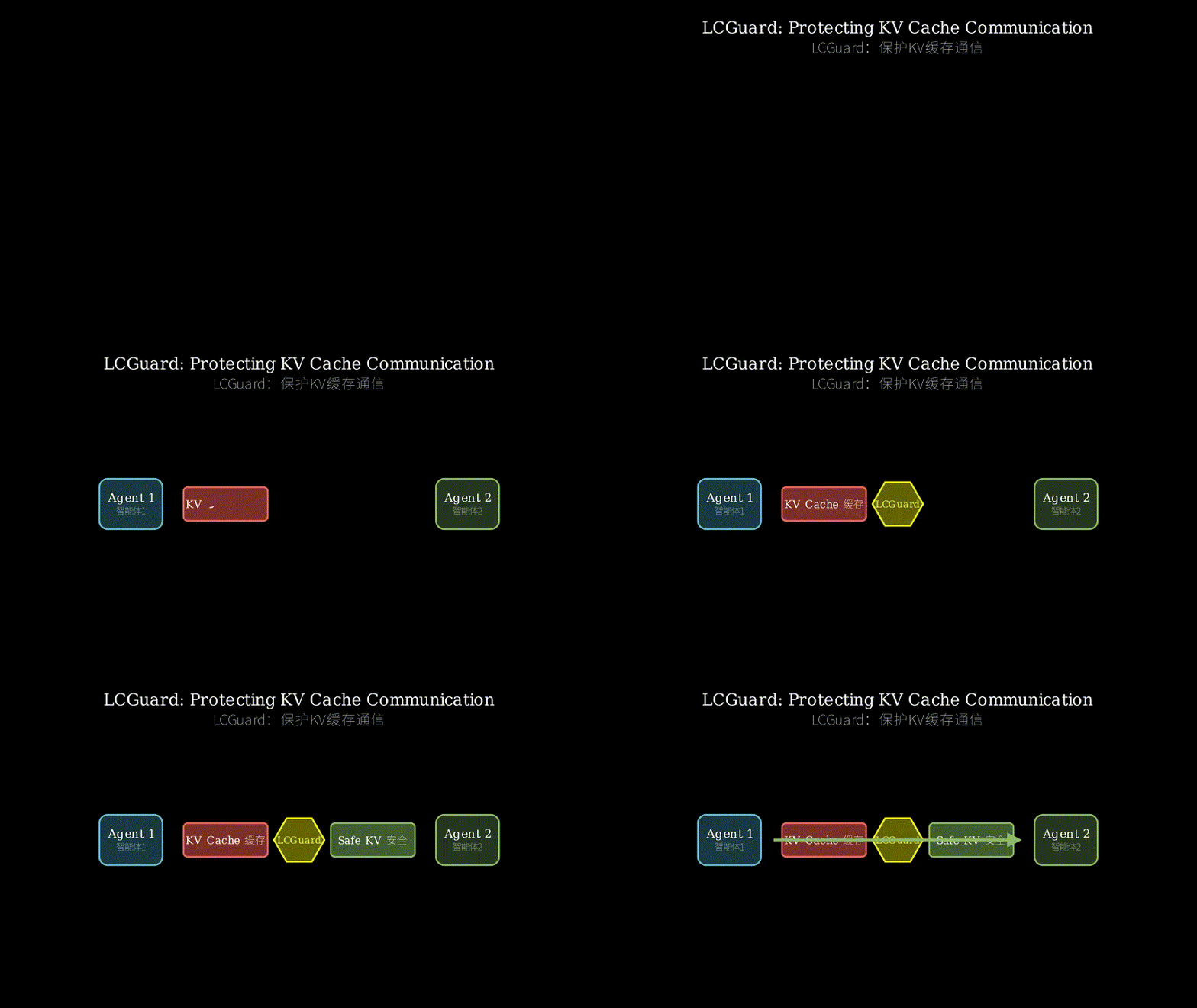
LCGuard sits between agents as a learned transformation layer. When Agent A wants to share its KV cache with Agent B, LCGuard intercepts the cache and applies a representation-level transformation before transmission. The transformation has two competing objectives: preserve enough information for Agent B to complete the task, but destroy enough structure that an adversary can’t reconstruct Agent A’s sensitive inputs.
The system trains two neural networks in opposition. The sanitizer (LCGuard itself) learns transformations that map raw KV caches to sanitized versions. The adversarial reconstructor learns to recover sensitive inputs from sanitized caches. They play a minimax game: the reconstructor tries to maximize reconstruction accuracy, the sanitizer tries to minimize it while keeping task performance high. At equilibrium, the sanitizer has learned transformations that are useful for downstream tasks but useless for privacy attacks.
Agent A                    Agent B
   |                          ^
   | raw KV cache             | sanitized KV cache
   v                          |
[Sanitizer] <--adversarial--[Reconstructor]
   |            training         |
   +------------------------------+
        tries to recover
        sensitive inputs
Think of LCGuard as a diplomatic translator between two countries. Agent A speaks a language that contains state secrets embedded in its grammar and idioms. Agent B needs to understand the task-relevant message but shouldn’t learn the secrets. The sanitizer is the translator who learns to rephrase messages in a way that conveys the operational content but strips out the cultural/historical context that would reveal secrets. The reconstructor is a spy trying to reverse-engineer the original language from the translations. The translator gets better by studying what the spy can infer, then adjusting the translation protocol to close those inference channels. Eventually, the translations are operationally useful but cryptographically opaque to reconstruction attacks.
Key Concepts
-
Reconstruction-based leakage: Privacy isn’t about what the cache “contains” in some abstract sense—it’s about what an adversary can extract. LCGuard defines leakage operationally: a cache is unsafe if an adversarial decoder can reconstruct sensitive inputs from it with high accuracy. This shifts the problem from “hide information” (vague) to “minimize reconstruction loss” (measurable). The adversarial reconstructor serves as a worst-case privacy auditor: if it can’t recover secrets, neither can real attackers with similar capabilities.
-
Latent working memory: The paper treats shared KV caches as a form of working memory—temporary storage that agents use to coordinate without committing everything to explicit text. This framing is key: working memory should be ephemeral and task-specific, not a permanent record. LCGuard’s transformations act like a “forget gate” that lets task-relevant patterns through while erasing agent-specific traces. The cache becomes a shared scratchpad rather than a surveillance log.
-
Adversarial training for privacy: Most privacy techniques add noise (differential privacy) or filter outputs (content moderation). LCGuard uses adversarial training: the sanitizer learns by fighting a reconstructor that actively searches for leakage channels. This is fundamentally different from static defenses. The reconstructor doesn’t just check if secrets are present—it learns the optimal attack strategy, forcing the sanitizer to close vulnerabilities it wouldn’t anticipate on its own. The result is a defense that adapts to the attack surface rather than guessing at it.
Framework Shift
Before (standard KV sharing):        After (LCGuard):

Agent A --[raw KV cache]--> Agent B  Agent A --[raw KV]--> [Sanitizer] --[clean KV]--> Agent B
    |                          |                                |
    +-- leaks context,         +-- preserves task info,         +-- adversarial
        reasoning, secrets         blocks reconstruction             reconstructor
                                                                     audits leakage
From transparent memory sharing to adversarially sanitized communication, the core shift is treating privacy as a learned transformation rather than a fixed filter.
Expert Assessment
Problem choice: Real gap. Multi-agent LLM systems are moving toward latent communication for efficiency, but the privacy implications are genuinely underexplored. This isn’t a manufactured problem—KV caches do encode sensitive context, and there’s no existing framework for sanitizing them. The timing is good: the problem is emerging but not yet crowded.
Method maturity: Solid adversarial formulation, but the approach is somewhat brute-force. The minimax game is well-motivated, but the paper doesn’t explore whether simpler transformations (e.g., dimensionality reduction, noise injection) could achieve similar privacy-utility tradeoffs with less computational overhead. The adversarial reconstructor is a strong privacy auditor, but it’s also a strong assumption—real attackers may not have the same training access. The paper acknowledges this but doesn’t test against weaker threat models.
Experimental integrity: Baselines are fair (standard KV sharing, no sharing). The reconstruction metrics (accuracy, BLEU, perplexity) are appropriate. Task performance comparisons are honest—LCGuard does incur some performance cost, and the paper reports it. One concern: the adversarial reconstructor is trained on the same distribution as the sanitizer. In practice, attackers might use different architectures or training strategies. The paper would be stronger with transferability experiments (train reconstructor on one model family, test on another).
Writing quality: The formalization is clear, but Section 3 (method) is dense and could benefit from a running example. The related work section is thorough but reads like a literature dump—cutting it by 30% and integrating key comparisons into the method section would improve flow. The experimental section is well-structured, but the ablation studies are buried in the appendix when they should be front and center.
Verdict: weak accept — Addresses a real emerging problem with a principled adversarial approach, but the method is somewhat heavy-handed and the evaluation could stress-test the assumptions more rigorously.
Takeaways
Operational privacy definition: The reconstruction-based leakage metric is transferable. If you’re building any system that shares learned representations (embeddings, hidden states, gradients), you can operationalize privacy as “can an adversary reconstruct sensitive inputs?” and use adversarial training to minimize it. This beats vague notions of “information hiding.”
Adversarial auditing: The reconstructor isn’t just a training opponent—it’s a privacy auditor. You can use this pattern in other domains: train an adversarial decoder to extract what you want to hide, then measure your defense’s effectiveness by how badly the decoder fails. This gives you a quantitative privacy metric instead of relying on intuition.
Latent communication as a design pattern: The broader idea—agents sharing internal states instead of text—is worth stealing. If you’re building multi-agent systems, consider whether latent communication (embeddings, attention maps, KV caches) could replace some natural language exchanges. It’s more efficient and preserves richer structure. Just remember: you’ll need something like LCGuard to keep it safe.
论文: 2605.22786 作者: Sadia Asif, Mohammad Mohammadi Amiri, Momin Abbas, Prasanna Sattigeri, Karthikeyan Natesan Ramamurthy 分类: cs.AI, cs.ET, cs.LG, cs.MA
缺口
多智能体 LLM 系统已经超越了自然语言通信,开始直接共享 transformer 的 KV 缓存——这是一种更高效的通道,能保留更丰富的任务信息。
但问题来了:KV 缓存不只是任务数据。
它们编码了生成它们的完整上下文:敏感输入、中间推理、智能体特定信息。
当智能体 A 把它的 KV 缓存传给智能体 B 时,它递出的是一个不透明的内存转储,可能在没有任何文本痕迹的情况下泄露私密数据。
此前关于潜在通信(KV 共享)的工作聚焦于效率和任务性能。
隐私?
没人管。
现有的 LLM 隐私技术针对文本输出(差分隐私、输出过滤)或模型权重(联邦学习)。
没有一个能处理原始内部状态在智能体间流动时的表示层泄露问题。
问题:KV 缓存泄露敏感信息
    |
    v
假设:泄露 = 对手可重构性
    |
    v
方法:对抗训练(净化器 vs 重构器)
    |
    v
证据:更低的重构准确率 + 保持任务性能
    |
    v
结论:安全的 KV 共享是可行的
增量
一句话: 这篇论文之前,共享 KV 缓存意味着在效率和隐私之间二选一;
之后,你可以对抗性地净化缓存,两者兼得。
核心机制
LCGuard 作为一个学习到的变换层坐在智能体之间。
当智能体 A 想和智能体 B 共享它的 KV 缓存时,LCGuard 拦截缓存并在传输前应用表示层变换。
变换有两个竞争目标:保留足够的信息让智能体 B 完成任务,但破坏足够的结构让对手无法重构智能体 A 的敏感输入。
系统训练两个对抗的神经网络。
净化器(LCGuard 本身)学习把原始 KV 缓存映射到净化版本的变换。
对抗性重构器学习从净化缓存中恢复敏感输入。
它们玩一个极小极大博弈:重构器试图最大化重构准确率,净化器试图最小化它同时保持任务性能高。
在均衡点,净化器学到的变换对下游任务有用但对隐私攻击无用。
智能体 A                    智能体 B
   |                          ^
   | 原始 KV 缓存              | 净化后 KV 缓存
   v                          |
[净化器] <--对抗训练--[重构器]
   |                         |
   +-------------------------+
        试图恢复
        敏感输入
把 LCGuard 想象成两国之间的外交翻译。
智能体 A 说的语言在语法和习语中嵌入了国家机密。
智能体 B 需要理解任务相关的消息,但不应该学到机密。
净化器是翻译,学习用一种方式改写消息,传达操作内容但剥离会暴露机密的文化/历史背景。
重构器是间谍,试图从译文逆向工程出原始语言。
翻译通过研究间谍能推断出什么来变得更好,然后调整翻译协议来关闭那些推断通道。
最终,译文在操作上有用,但对重构攻击来说密码学上不透明。
关键概念
- 基于重构的泄露: 隐私不是关于缓存在某种抽象意义上”包含”什么——而是关于对手能提取什么。
LCGuard 操作性地定义泄露:如果对抗性解码器能从缓存中高准确率地重构敏感输入,缓存就是不安全的。
这把问题从”隐藏信息”(模糊)转移到”最小化重构损失”(可测量)。
对抗性重构器充当最坏情况隐私审计员:如果它无法恢复机密,具有类似能力的真实攻击者也不能。
- 潜在工作记忆: 论文把共享的 KV 缓存视为一种工作记忆——智能体用来协调的临时存储,不把所有东西都提交到显式文本。
这个框架是关键:工作记忆应该是短暂的、任务特定的,而不是永久记录。
LCGuard 的变换像一个”遗忘门”,让任务相关模式通过同时擦除智能体特定痕迹。
缓存变成共享草稿本而不是监控日志。
- 用于隐私的对抗训练: 大多数隐私技术添加噪声(差分隐私)或过滤输出(内容审核)。
LCGuard 使用对抗训练:净化器通过对抗一个主动搜索泄露通道的重构器来学习。
这与静态防御根本不同。
重构器不只是检查机密是否存在——它学习最优攻击策略,迫使净化器关闭它自己不会预料到的漏洞。
结果是一个适应攻击面而不是猜测它的防御。
框架转变
之前(标准 KV 共享):           之后(LCGuard):

智能体 A --[原始 KV 缓存]--> 智能体 B  智能体 A --[原始 KV]--> [净化器] --[干净 KV]--> 智能体 B
    |                          |                                |
    +-- 泄露上下文、            +-- 保留任务信息、                +-- 对抗性
        推理、机密                 阻止重构                         重构器
                                                                   审计泄露
从透明的内存共享到对抗性净化的通信,核心转变是把隐私视为学习到的变换而不是固定过滤器。
专家评审
选题眼光: 真实缺口。
多智能体 LLM 系统正在为了效率转向潜在通信,但隐私影响确实探索不足。
这不是人造问题——KV 缓存确实编码敏感上下文,而且没有现有框架来净化它们。
时机不错:问题正在浮现但还不拥挤。
方法成熟度: 扎实的对抗性形式化,但方法有点蛮力。
极小极大博弈动机充分,但论文没有探索更简单的变换(如降维、噪声注入)是否能用更少的计算开销达到类似的隐私-效用权衡。
对抗性重构器是强隐私审计员,但也是强假设——真实攻击者可能没有相同的训练访问权限。
论文承认这点但没有针对更弱威胁模型测试。
实验诚意: 基线公平(标准 KV 共享、无共享)。
重构指标(准确率、BLEU、困惑度)合适。
任务性能比较诚实——LCGuard 确实产生一些性能成本,论文报告了它。
一个担忧:对抗性重构器在与净化器相同的分布上训练。
实践中,攻击者可能使用不同架构或训练策略。
论文如果有可迁移性实验会更强(在一个模型家族上训练重构器,在另一个上测试)。
写作功力: 形式化清晰,但第 3 节(方法)密集,能从一个贯穿例子中受益。
相关工作部分彻底但读起来像文献堆砌——削减 30% 并把关键比较整合到方法部分会改善流畅度。
实验部分结构良好,但消融研究埋在附录里,它们应该放在前面中心位置。
判决: 弱接收 — 用有原则的对抗方法解决真实的新兴问题,但方法有点笨重,评估可以更严格地压力测试假设。
要点总结
操作性隐私定义: 基于重构的泄露指标可迁移。
如果你在构建任何共享学习表示(嵌入、隐藏状态、梯度)的系统,你可以把隐私操作化为”对手能重构敏感输入吗?
“并使用对抗训练来最小化它。
这胜过模糊的”信息隐藏”概念。
对抗性审计: 重构器不只是训练对手——它是隐私审计员。
你可以在其他领域使用这个模式:训练一个对抗性解码器来提取你想隐藏的东西,然后通过解码器失败得多惨来衡量你的防御有效性。
这给你一个定量隐私指标而不是依赖直觉。
潜在通信作为设计模式: 更广泛的想法——智能体共享内部状态而不是文本——值得借鉴。
如果你在构建多智能体系统,考虑潜在通信(嵌入、注意力图、KV 缓存)是否能替代一些自然语言交换。
它更高效并保留更丰富的结构。
只要记住:你需要像 LCGuard 这样的东西来保持它安全。