
Paper: 2603.24581 Authors: Linbo Wang, Yupeng Zheng, Qiang Chen, Shiwei Li, Yichen Zhang, Zebin Xing, Qichao Zhang, Xiang Li, Deheng Qian, Pengxuan Yang Categories: cs.CV, cs.RO
The Gap
World-model-based autonomous driving planners have hit a compression wall. Methods like GAIA-1, MILE, and UniAD either keep raw pixel representations (computationally expensive), use naive compression (losing spatial structure), or ignore temporal dynamics (poor future prediction). The result: you need massive datasets and compute to get decent planning, and even then performance plateaus.
The specific bottleneck: existing approaches treat compression, spatial understanding, and temporal modeling as separate problems. They compress first (losing geometry), then try to recover spatial reasoning later. Or they model dynamics in pixel space (wasteful). No one’s asking: what if we compress with spatial awareness baked in, then model dynamics in that compressed space?
Problem: World models waste compute on redundant representations
   |
   v
Assumption: Compression + spatial reasoning + dynamics can be unified
   |
   v
Method: SCWE (compress with geometry) + DLWM (dynamics in latent space)
   |
   v
Evidence: 89.3 EPDMS on NAVSIM v2 with 104M params, 10x less data
   |
   v
Conclusion: Spatially-aware latent compression enables efficient planning
The Increment
One sentence: Before, you needed billions of parameters and massive datasets to get world models working for driving; now you can match or beat that performance with 104M parameters and a fraction of the data by doing compression and dynamics modeling in a spatially-aware latent space.
Core Mechanism
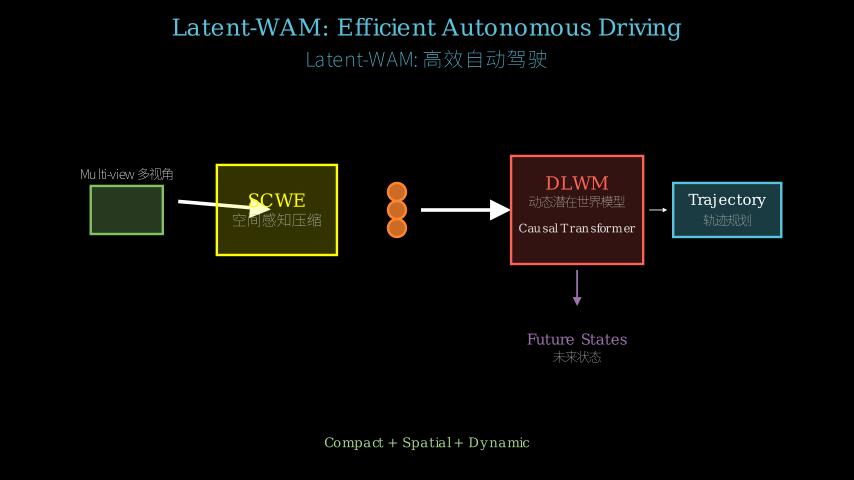
Latent-WAM has two modules working in sequence. First, the Spatial-Aware Compressive World Encoder (SCWE) takes multi-view camera images and squashes them into a small set of “scene tokens” — think of it as distilling six camera views into 64 compact descriptors. It does this using learnable queries (like DETR) but crucially distills geometric knowledge from a frozen foundation model (DINOv2) so the tokens retain spatial structure even after aggressive compression.
Second, the Dynamic Latent World Model (DLWM) takes these scene tokens plus the vehicle’s motion history and predicts future scene tokens autoregressively. It’s a causal Transformer that rolls forward in time, generating what the world will look like at future timesteps. Finally, a lightweight planner head reads these predicted future tokens and outputs a trajectory.
Multi-view images (6 cameras)
   |
   v
[SCWE: Compress with geometry]
   |
   +---> Learnable queries (64 tokens)
   |
   +---> Distill from DINOv2 (spatial structure)
   |
   v
Scene tokens (compact, spatially-aware)
   |
   v
[DLWM: Predict future in latent space]
   |
   +---> Causal Transformer
   |
   +---> Autoregressive rollout (t+1, t+2, ...)
   |
   v
Future scene tokens
   |
   v
[Planner head]
   |
   v
Trajectory waypoints
Think of SCWE as a skilled sketch artist at a crime scene. Instead of photographing every detail (raw pixels), the artist draws a compact schematic that captures the essential geometry — where the cars are, road boundaries, spatial relationships. The sketch is tiny compared to photos but preserves what matters for reasoning. Then DLWM is like an animator who takes that sketch and draws the next frames, showing how the scene evolves. The animator works entirely in “sketch space” (latent tokens), never going back to full photos. Finally, the planner is a director who looks at the animated sketches and decides where the car should go. The magic: by working in sketch space throughout, you avoid the computational cost of manipulating full images while keeping the spatial intelligence needed for planning.
Key Concepts
-
Learnable Queries for Compression: Instead of encoding every pixel, you start with a fixed set of learnable vectors (queries) that act like questions: “Where are the vehicles?” “What’s the road geometry?” These queries attend to the image features and pull out only the information needed to answer those questions, compressing the scene into a small set of tokens. It’s like having a checklist of important things to notice rather than memorizing everything you see. The queries are learned during training to extract exactly what’s useful for driving decisions.
-
Distillation from Foundation Models: DINOv2 is a vision model pre-trained on millions of images to understand general visual concepts and geometry. Latent-WAM “distills” this knowledge by training SCWE to match DINOv2’s feature representations. Concretely, they add a loss term that penalizes differences between SCWE’s internal features and DINOv2’s features for the same image. This forces SCWE to inherit DINOv2’s spatial understanding even though SCWE is compressing aggressively. It’s like learning to paint by copying a master — you absorb their understanding of perspective and composition.
-
Autoregressive Latent Dynamics: The DLWM predicts future scene tokens one timestep at a time, where each prediction depends on all previous tokens (causal). At time t, it sees tokens from t-2, t-1, t and predicts t+1. Then it uses that predicted t+1 to predict t+2, and so on. This is “autoregressive” — each step feeds into the next. Crucially, this happens entirely in token space (64 tokens per timestep), not pixel space (millions of values). It’s like predicting tomorrow’s weather by looking at today’s summary statistics rather than re-simulating every air molecule.
Framework Shift
Before (mainstream approach):        After (this paper):

Raw pixels (H x W x C x T)           Raw pixels
    |                                    |
    v                                    v
Encode each frame                    SCWE (geometry-aware)
    |                                    |
    v                                    v
Pixel/feature sequences              Scene tokens (64 x D)
    |                                    |
    v                                    v
Model dynamics in                    DLWM (latent dynamics)
high-dim space                           |
    |                                    v
    v                                Future tokens (64 x D)
Decode to actions                        |
                                         v
(Expensive, needs                    Plan from tokens
 massive data)
                                     (Efficient, less data)
From modeling the world in observation space to modeling it in a compressed, spatially-aware latent space, the core shift is moving the dynamics prediction bottleneck from high-dimensional representations to compact tokens that retain geometric structure.
Expert Assessment
Problem choice: Real gap. World models for driving have been stuck in a compute-data trap — you need both to scale, but most teams have neither. Attacking the representation efficiency is the right lever. This sits at the intersection of two trends: foundation model distillation and latent world models, both hot but not yet combined effectively for driving.
Method maturity: Mostly clever composition of existing ideas (learnable queries from DETR, distillation from DINOv2, causal Transformers). The novelty is in the integration and the specific design choices (what to distill, where to compress). Not groundbreaking conceptually, but solid engineering. One concern: the reliance on DINOv2 means you’re inheriting its biases and limitations — if DINOv2 fails on certain geometric patterns, so will this.
Experimental integrity: Strong results on two benchmarks (NAVSIM v2, HUGSIM) with fair baselines. The 10x data efficiency claim is compelling but needs scrutiny — they compare against methods trained on different data distributions, so it’s not apples-to-apples. The ablations are thorough (Table 2 shows each component’s contribution). One red flag: no failure case analysis. What scenarios does this fail on? When does latent compression lose critical information?
Writing quality: Section 3.2 (SCWE) is dense and could use a diagram showing the distillation process explicitly. The related work section name-drops too many methods without clearly positioning this work’s unique angle until the method section. The results section is solid but buries the data efficiency story — that should be front and center since it’s the main practical win.
Verdict: weak accept — Solid execution on an important problem with strong empirical results, but limited conceptual novelty and missing critical failure analysis. The data efficiency gains are valuable for practitioners even if the method is incremental.
Takeaways
Steal the distillation strategy: if you’re building a task-specific model and have access to a strong foundation model, add a distillation loss to inherit its representations while compressing. This is cheaper than fine-tuning the foundation model directly and lets you control the bottleneck size.
The learnable query pattern for compression is underused outside object detection. If you’re dealing with high-dimensional inputs (images, point clouds, sensor arrays) and need compact representations, learnable queries let you compress with task-awareness baked in from the start.
For temporal modeling, consider whether you really need to work in observation space. If your task has a natural bottleneck (like scene understanding for driving), push the dynamics modeling to happen after that bottleneck in a lower-dimensional space. The compute savings compound over time.
论文: 2603.24581 作者: Linbo Wang, Yupeng Zheng, Qiang Chen, Shiwei Li, Yichen Zhang, Zebin Xing, Qichao Zhang, Xiang Li, Deheng Qian, Pengxuan Yang 分类: cs.CV, cs.RO
缺口
基于世界模型的自动驾驶规划器撞上了压缩瓶颈。
GAIA-1、MILE、UniAD这些方法要么保留原始像素表示(计算昂贵),要么用朴素压缩(丢失空间结构),要么忽略时间动态(未来预测差)。
结果就是:你需要海量数据集和算力才能得到像样的规划,即便如此性能也会见顶。
具体卡点在哪?
现有方法把压缩、空间理解、时间建模当成三个独立问题。
先压缩(丢几何信息),再试图恢复空间推理。
或者在像素空间建模动态(浪费算力)。
没人问:如果我们在压缩时就烘焙进空间感知,然后在压缩空间里建模动态,会怎样?
问题:世界模型在冗余表示上浪费算力
   |
   v
假设:压缩+空间推理+动态建模可以统一
   |
   v
方法:SCWE(带几何的压缩)+ DLWM(潜空间动态)
   |
   v
证据:NAVSIM v2上89.3 EPDMS,1.04亿参数,数据量1/10
   |
   v
结论:空间感知的潜压缩能实现高效规划
增量
一句话: 以前你需要数十亿参数和海量数据才能让世界模型在驾驶任务上工作;
现在你用1.04亿参数和一小部分数据就能达到或超越那个性能,靠的是在空间感知的潜空间里做压缩和动态建模。
核心机制
Latent-WAM有两个串联模块。
第一个是空间感知压缩世界编码器(SCWE),它接收多视角相机图像,把它们压成一小组”场景token”——可以理解为把六个相机视角蒸馏成64个紧凑描述符。
它用可学习查询(类似DETR)来做这件事,但关键是从冻结的基础模型(DINOv2)蒸馏几何知识,所以即使激进压缩后,token仍保留空间结构。
第二个是动态潜世界模型(DLWM),它接收这些场景token加上车辆的运动历史,自回归地预测未来场景token。
这是个因果Transformer,在时间上向前滚动,生成未来时刻世界的样子。
最后,一个轻量规划头读取这些预测的未来token,输出轨迹。
多视角图像(6个相机)
   |
   v
[SCWE:带几何的压缩]
   |
   +---> 可学习查询(64个token)
   |
   +---> 从DINOv2蒸馏(空间结构)
   |
   v
场景token(紧凑、空间感知)
   |
   v
[DLWM:在潜空间预测未来]
   |
   +---> 因果Transformer
   |
   +---> 自回归展开(t+1, t+2, ...)
   |
   v
未来场景token
   |
   v
[规划头]
   |
   v
轨迹路点
把SCWE想象成犯罪现场的速写画家。
画家不拍摄每个细节(原始像素),而是画一张紧凑示意图,捕捉关键几何——车在哪、道路边界、空间关系。
速写比照片小得多,但保留了推理所需的要素。
然后DLWM像个动画师,拿着速写画下一帧,展示场景如何演变。
动画师完全在”速写空间”(潜token)工作,从不回到完整照片。
最后规划器是个导演,看着动画速写决定车该往哪开。
魔法在于:全程在速写空间工作,你避免了操作完整图像的计算成本,同时保留了规划所需的空间智能。
关键概念
- 用于压缩的可学习查询: 不编码每个像素,而是从一组固定的可学习向量(查询)开始,它们像问题:“车辆在哪?""道路几何是什么?“这些查询关注图像特征,只提取回答这些问题所需的信息,把场景压缩成一小组token。
就像有个重要事项清单,而不是记住你看到的一切。
查询在训练中学习提取对驾驶决策有用的东西。
- 从基础模型蒸馏: DINOv2是在数百万图像上预训练的视觉模型,理解通用视觉概念和几何。
Latent-WAM通过训练SCWE匹配DINOv2的特征表示来”蒸馏”这些知识。
具体来说,他们加了个损失项,惩罚SCWE内部特征与DINOv2对同一图像的特征之间的差异。
这迫使SCWE继承DINOv2的空间理解,即使SCWE在激进压缩。
就像临摹大师画作学画——你吸收他们对透视和构图的理解。
- 自回归潜动态: DLWM一次预测一个时间步的未来场景token,每个预测依赖所有先前token(因果)。
在时刻t,它看到t-2、t-1、t的token,预测t+1。
然后用预测的t+1预测t+2,以此类推。
这是”自回归”——每步输入下一步。
关键是这完全发生在token空间(每时间步64个token),而非像素空间(数百万值)。
就像通过看今天的摘要统计预测明天天气,而不是重新模拟每个空气分子。
框架转变
之前(主流方法):                之后(本文方法):

原始像素(H x W x C x T)         原始像素
    |                                |
    v                                v
编码每帧                          SCWE(几何感知)
    |                                |
    v                                v
像素/特征序列                     场景token(64 x D)
    |                                |
    v                                v
在高维空间                        DLWM(潜动态)
建模动态                             |
    |                                v
    v                             未来token(64 x D)
解码到动作                           |
                                     v
(昂贵,需要                      从token规划
 海量数据)
                                 (高效,少数据)
从在观测空间建模世界到在压缩的、空间感知的潜空间建模,核心转变是把动态预测瓶颈从高维表示移到保留几何结构的紧凑token。
专家评审
选题眼光: 真缺口。
驾驶世界模型陷入算力-数据陷阱——两者都要扩展,但多数团队两者都缺。
攻击表示效率是对的杠杆。
这处于两个趋势交叉点:基础模型蒸馏和潜世界模型,都很热但还没在驾驶上有效结合。
方法成熟度: 主要是现有想法的巧妙组合(DETR的可学习查询、DINOv2蒸馏、因果Transformer)。
新颖性在整合和具体设计选择(蒸馏什么、在哪压缩)。
概念上不算突破,但工程扎实。
一个担忧:依赖DINOv2意味着继承它的偏见和局限——如果DINOv2在某些几何模式上失败,这个也会。
实验诚意: 两个基准(NAVSIM v2、HUGSIM)上结果强劲,基线公平。
10倍数据效率的说法有说服力,但需要审视——他们对比的方法在不同数据分布上训练,所以不是完全对等比较。
消融实验彻底(表2展示每个组件贡献)。
一个红旗:没有失败案例分析。
什么场景下失败?
潜压缩何时丢失关键信息?
写作功力: 3.2节(SCWE)密集,需要图表明确展示蒸馏过程。
相关工作部分罗列太多方法,直到方法部分才清晰定位本文独特角度。
结果部分扎实但埋没了数据效率故事——那应该放前面,因为是主要实用价值。
判决: 弱接收——在重要问题上执行扎实,实证结果强劲,但概念新颖性有限且缺失关键失败分析。
数据效率提升对实践者有价值,即使方法是渐进的。
要点总结
偷蒸馏策略:如果你在构建任务特定模型且能访问强基础模型,加个蒸馏损失来继承它的表示同时压缩。
这比直接微调基础模型便宜,还能控制瓶颈大小。
可学习查询的压缩模式在目标检测外用得太少。
如果你处理高维输入(图像、点云、传感器阵列)且需要紧凑表示,可学习查询让你从一开始就用任务感知来压缩。
对于时间建模,考虑是否真需要在观测空间工作。
如果你的任务有自然瓶颈(如驾驶的场景理解),把动态建模推到瓶颈后的低维空间。
算力节省随时间复合增长。