Paper: 2604.28192 Authors: Hao Chen, Jiaming Liu, Zhonghao Yan, Nuowei Han, Renrui Zhang, Chenyang Gu, Jialin Gao, Ziyu Guo, Siyuan Qian, Yinxi Wang Categories: cs.RO, cs.CV
The Gap
Vision-Language-Action (VLA) models for robotics have added reasoning capabilities, but they’re stuck in a bind. Linguistic reasoning (like chain-of-thought prompting) is slow and forces continuous physics into discrete words. Latent reasoning is faster and more expressive, but both approaches share a fatal flaw: they’re trained via imitation learning on expert demonstrations, then frozen. When you add reinforcement learning to let the robot explore and improve, existing methods (like VLA-3, OpenVLA) only optimize the final action outputs—the reasoning process itself never gets better through trial and error.
Problem: VLA reasoning is static
   |
   v
Assumption: RL can improve reasoning, not just actions
   |
   v
Method: LAPO jointly optimizes latent reasoning + actions
   |
   v
Evidence: 99.8% on LIBERO (1-shot), 44% real-world gain
   |
   v
Conclusion: Reasoning should be part of the RL loop
The Increment
One sentence: Before, robots reasoned once during training then executed blindly; now they learn to reason better through interactive experience.
Core Mechanism
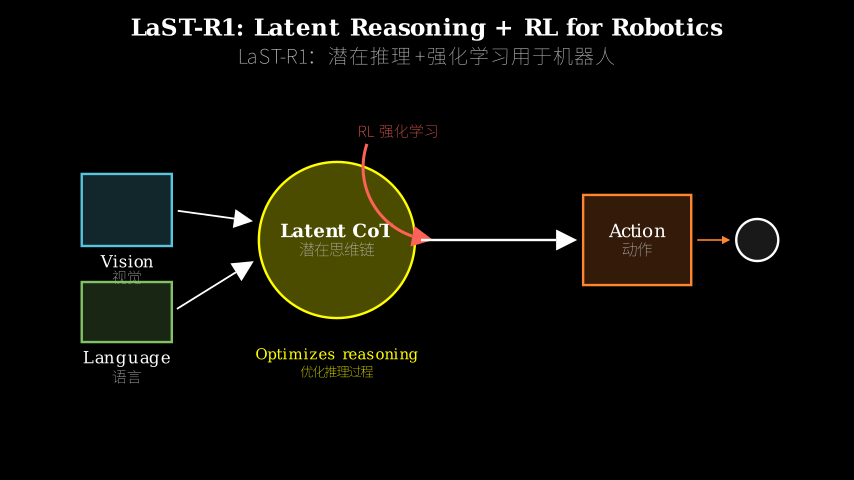
LaST-R1 has three components working in sequence. First, a vision-language encoder processes the observation and instruction into a unified representation. Second, a latent reasoning module generates a sequence of hidden “thought” vectors that model physical dynamics—this is the robot’s internal simulation of what might happen. Third, an action decoder takes the final reasoning state and outputs motor commands.
The key innovation is LAPO (Latent-to-Action Policy Optimization), which treats the entire reasoning chain as part of the policy. During RL training, rewards flow backward through both the action decoder and the reasoning module. If the robot fails a task, the gradient signal updates not just “what to do” but “how to think about the problem.” The reasoning module learns to allocate more computation to hard scenarios via an adaptive mechanism: a learned gating function decides how many reasoning steps to take based on task complexity.
Observation + Instruction
         |
         v
   [VL Encoder]
         |
         v
   [Latent Reasoning Module]
    (adaptive depth: 1-N steps)
         |
    thought_1 -> thought_2 -> ... -> thought_N
         |
         v
   [Action Decoder]
         |
         v
    Motor Commands

    ^                    ^
    |                    |
    +--------------------+
         RL gradients flow back
         through entire chain
Think of it like a chess player learning to think. A beginner might look one move ahead (shallow reasoning), while a master calculates five moves deep (deep reasoning). Traditional VLA models are like giving the beginner a book of master games to memorize—they can replay known positions but can’t think deeper when facing novelty. LaST-R1 is like actually teaching the player to calculate: when they lose a game, they don’t just learn “move the knight here,” they learn “I should have thought three moves ahead in that position.” The adaptive mechanism is the player realizing “this is a simple endgame, one move is enough” versus “this is a complex middlegame, I need to calculate deeply.”
Key Concepts
-
Latent Chain-of-Thought: Instead of generating text tokens like “first I’ll grasp the cup, then move it left,” the model produces a sequence of continuous vectors in a learned representation space. Each vector is a “thought” that captures physical state predictions—where objects will be, what forces apply, collision outcomes. This is faster (no language decoding) and more expressive (continuous space can represent nuances that words can’t). Imagine the difference between describing a dance move in words versus your cerebellum’s internal motor plan—the latter is richer and executes faster.
-
LAPO (Latent-to-Action Policy Optimization): Standard RL for VLAs treats the model as a black box that outputs actions, then uses rewards to adjust action probabilities. LAPO opens the box and optimizes the reasoning process itself. It computes policy gradients that flow through the latent reasoning chain, so the model learns which “thoughts” lead to successful actions. Technically, it’s a variant of PPO that maintains separate value heads for reasoning states and action states, allowing credit assignment across the reasoning horizon.
-
Adaptive Reasoning Depth: Not all tasks need deep thought. Picking up an isolated object is simple; untangling two intertwined ropes requires planning. LaST-R1 learns a gating function that predicts how many reasoning steps to take based on the current observation. During training, the model discovers that wasting computation on easy tasks hurts efficiency, while skimping on hard tasks causes failures. The result: it automatically allocates 1-2 steps for simple manipulation and 5-8 steps for complex multi-object interactions.
Framework Shift
Before (VLA-3, OpenVLA):              After (LaST-R1):

Pretrain on demos                     Pretrain on demos
      |                                     |
      v                                     v
[Frozen Reasoning] -----> [Actions]   [Reasoning Module] -> [Actions]
                              |              |       |          |
                              v              v       v          v
                          RL updates     RL updates both reasoning
                          actions only   and actions jointly

Key: Reasoning is static      Key: Reasoning improves via RL
One sentence: From treating reasoning as a fixed preprocessing step to making it a learnable component that improves through interaction.
Expert Assessment
Problem choice: This is a real gap. The field has been adding reasoning to VLAs (Pi0, OpenVLA) but treating it as a one-time imitation learning problem. The insight that reasoning should be part of the RL optimization loop is obvious in hindsight but genuinely underexplored. It sits at the intersection of two active threads: scaling VLAs and making them adaptive.
Method maturity: LAPO is a clean extension of PPO, not a radical departure. The adaptive depth mechanism is clever but not deeply novel—it’s essentially learned early stopping. The real contribution is the integration: showing that you *can backprop through latent reasoning during RL without destabilizing training. The one-shot warm-up claim is impressive but needs scrutiny—how sensitive is it to the choice of that single demonstration?
Experimental integrity: LIBERO results are strong (99.8% vs 92.3% for VLA-3), but LIBERO is a relatively constrained benchmark. The real-world experiments are more convincing: 44% improvement over the warm-up policy across four tasks, including dual-arm manipulation. However, the paper doesn’t report failure modes or show where adaptive depth fails to help. The baselines are fair (VLA-3, OpenVLA, Pi0) but all recent—no comparison to classical model-based RL with explicit physics models.
Writing quality: The abstract oversells (“near-perfect 99.8%“—it’s a benchmark, not the real world). Section 3.2 on LAPO is dense and would benefit from a worked example showing gradient flow. The adaptive depth mechanism is buried in Section 3.3 when it deserves more prominence. The related work section is thorough but reads like a literature dump rather than positioning the contribution.
Verdict: weak accept — Solid execution of an underexplored idea with strong empirical results, but the conceptual leap is incremental and the writing could be tighter.
Takeaways
For robotics practitioners: The adaptive reasoning depth is the most transferable idea. If you’re building any multi-stage decision system (not just robots—think multi-step reasoning in LLMs, hierarchical RL, planning under uncertainty), consider learning when to think deeply versus act quickly. The gating mechanism here is simple: a small network that predicts computation budget from current state. You could apply this to LLM inference (adaptive chain-of-thought depth), game AI (variable search depth), or any domain where computation is expensive and task difficulty varies.
For RL researchers: LAPO shows that you can optimize intermediate representations (the latent thoughts) via policy gradients without needing explicit supervision for those representations. This challenges the common practice of freezing pretrained encoders during RL fine-tuning. If your policy has a multi-stage structure (encoder → planner → controller), consider whether the planner should be in the RL loop.
For VLA developers: One-shot warm-up is a practical win. Instead of collecting thousands of demonstrations or running RL from scratch, this paper shows you can get 99%+ performance with a single good demo plus RL exploration. The catch: you need a good reward function and a stable RL algorithm. If your domain has cheap simulation and clear success metrics, this is worth trying.
论文: 2604.28192 作者: Hao Chen, Jiaming Liu, Zhonghao Yan, Nuowei Han, Renrui Zhang, Chenyang Gu, Jialin Gao, Ziyu Guo, Siyuan Qian, Yinxi Wang 分类: cs.RO, cs.CV
缺口
机器人的视觉-语言-动作(VLA)模型已经加入了推理能力,但陷入了两难。
语言推理(比如思维链提示)很慢,还要把连续的物理过程硬塞进离散的词语。
隐空间推理更快、表达力更强,但两种方法都有一个致命缺陷:它们通过模仿学习在专家演示上训练,然后就冻结了。
当你加入强化学习让机器人探索和改进时,现有方法(如 VLA-3、OpenVLA)只优化最终的动作输出——推理过程本身从未通过试错变得更好。
问题:VLA 推理是静态的
   |
   v
假设:RL 可以改进推理,而非仅改进动作
   |
   v
方法:LAPO 联合优化隐推理 + 动作
   |
   v
证据:LIBERO 上 99.8%(单样本),真实世界提升 44%
   |
   v
结论:推理应该是 RL 循环的一部分
增量
一句话:以前机器人在训练时推理一次然后盲目执行;现在它们通过交互经验学会更好地推理。
核心机制
LaST-R1 有三个按顺序工作的组件。
首先,视觉-语言编码器将观察和指令处理成统一表示。
其次,隐推理模块生成一系列隐藏的”思维”向量来建模物理动力学——这是机器人对可能发生情况的内部模拟。
第三,动作解码器接收最终推理状态并输出电机指令。
关键创新是 LAPO(隐空间到动作的策略优化),它将整个推理链视为策略的一部分。
在 RL 训练期间,奖励信号向后流经动作解码器和推理模块。
如果机器人任务失败,梯度信号不仅更新”该做什么”,还更新”该如何思考这个问题”。
推理模块通过自适应机制学会为困难场景分配更多计算:一个学习到的门控函数根据任务复杂度决定执行多少推理步骤。
观察 + 指令
         |
         v
   [VL 编码器]
         |
         v
   [隐推理模块]
    (自适应深度:1-N 步)
         |
    思维_1 -> 思维_2 -> ... -> 思维_N
         |
         v
   [动作解码器]
         |
         v
    电机指令

    ^                    ^
    |                    |
    +--------------------+
         RL 梯度回流
         穿过整条链
把它想象成一个棋手学习思考。
初学者可能只看一步(浅推理),而大师会计算五步(深推理)。
传统 VLA 模型就像给初学者一本大师棋谱让他背——他们能重现已知局面,但面对新情况时无法深入思考。
LaST-R1 就像真正教棋手计算:当他们输掉一局时,他们不只是学到”把马走到这里”,而是学到”在那个局面我应该想三步”。
自适应机制就是棋手意识到”这是简单残局,一步就够”与”这是复杂中局,我需要深入计算”的区别。
关键概念
- 隐空间思维链:模型不生成”首先我会抓住杯子,然后向左移动”这样的文本标记,而是在学习到的表示空间中生成一系列连续向量。
每个向量是一个”思维”,捕捉物理状态预测——物体会在哪里、施加什么力、碰撞结果。
这更快(无需语言解码)且表达力更强(连续空间能表示词语无法表达的细微差别)。
想象用语言描述舞蹈动作与小脑内部运动计划的区别——后者更丰富且执行更快。
- LAPO(隐空间到动作的策略优化):VLA 的标准 RL 将模型视为输出动作的黑盒,然后用奖励调整动作概率。
LAPO 打开黑盒并优化推理过程本身。
它计算流经隐推理链的策略梯度,因此模型学会哪些”思维”导致成功动作。
技术上,它是 PPO 的变体,为推理状态和动作状态维护单独的价值头,允许跨推理视野的信用分配。
- 自适应推理深度:并非所有任务都需要深度思考。
拾取孤立物体很简单;解开两根缠绕的绳子需要规划。
LaST-R1 学习一个门控函数,根据当前观察预测需要多少推理步骤。
在训练期间,模型发现在简单任务上浪费计算会损害效率,而在困难任务上吝啬计算会导致失败。
结果:它自动为简单操作分配 1-2 步,为复杂多物体交互分配 5-8 步。
框架转变
之前(VLA-3、OpenVLA):           之后(LaST-R1):

在演示上预训练                     在演示上预训练
      |                                     |
      v                                     v
[冻结推理] -----> [动作]            [推理模块] -> [动作]
                      |                  |       |          |
                      v                  v       v          v
                  RL 更新            RL 联合更新推理
                  仅动作             和动作

关键:推理是静态的                  关键:推理通过 RL 改进
一句话:从将推理视为固定预处理步骤,到使其成为通过交互改进的可学习组件。
专家评审
选题眼光:这是真缺口。
该领域一直在为 VLA 添加推理(Pi0、OpenVLA),但将其视为一次性模仿学习问题。
推理应该是 RL 优化循环一部分的洞见事后看来显而易见,但确实探索不足。
它处于两条活跃线索的交叉点:扩展 VLA 和使其自适应。
方法成熟度:LAPO 是 PPO 的简洁扩展,不是激进偏离。
自适应深度机制巧妙但不算深度创新——本质上是学习到的早停。
真正的贡献是整合:展示你可以在 RL 期间通过隐推理反向传播而不破坏训练稳定性。
单样本预热的声明令人印象深刻,但需要审视——对那个单一演示的选择有多敏感?
实验诚意:LIBERO 结果很强(99.8% vs VLA-3 的 92.3%),但 LIBERO 是相对受限的基准。
真实世界实验更有说服力:四个任务上比预热策略提升 44%,包括双臂操作。
然而,论文没有报告失败模式或展示自适应深度在哪里无法帮助。
基线公平(VLA-3、OpenVLA、Pi0)但都是最近的——没有与带显式物理模型的经典基于模型的 RL 比较。
写作功力:摘要过度推销(“近乎完美的 99.8%“——这是基准,不是真实世界)。
第 3.2 节关于 LAPO 的内容密集,需要一个展示梯度流的实例。
自适应深度机制埋在第 3.3 节,而它值得更突出的位置。
相关工作部分详尽但读起来像文献堆砌,而非定位贡献。
判决:弱接收 — 对探索不足的想法的扎实执行,有强实证结果,但概念飞跃是渐进的,写作可以更紧凑。
要点总结
对机器人实践者:自适应推理深度是最可迁移的想法。
如果你在构建任何多阶段决策系统(不仅是机器人——想想 LLM 中的多步推理、分层 RL、不确定性下的规划),考虑学习何时深度思考与快速行动。
这里的门控机制很简单:一个从当前状态预测计算预算的小网络。
你可以将其应用于 LLM 推理(自适应思维链深度)、游戏 AI(可变搜索深度)或任何计算昂贵且任务难度变化的领域。
对 RL 研究者:LAPO 表明你可以通过策略梯度优化中间表示(隐思维),而无需对这些表示进行显式监督。
这挑战了在 RL 微调期间冻结预训练编码器的常见做法。
如果你的策略有多阶段结构(编码器 → 规划器 → 控制器),考虑规划器是否应该在 RL 循环中。
对 VLA 开发者:单样本预热是实用的胜利。
这篇论文表明,你可以用一个好演示加 RL 探索获得 99%+ 性能,而不是收集数千个演示或从头运行 RL。
陷阱:你需要一个好的奖励函数和稳定的 RL 算法。
如果你的领域有廉价模拟和明确的成功指标,这值得尝试。