Paper: 2605.04040 Authors: Sucheng Ren, Chen Chen, Zhenbang Wang, Liangchen Song, Xiangxin Zhu, Alan Yuille, Liang-Chieh Chen, Jiasen Lu Categories: cs.CV
The Gap
Modern text-to-image systems have unified around LLM backbones that handle both understanding and generation. These models excel at verification—given an image and a prompt, they accurately judge whether the image matches. But they struggle with generation—given the same prompt, they fail to produce images that satisfy it, especially for complex compositional requirements. The paradox: the same model that can tell you “this image is missing the red ball” cannot reliably generate an image with the red ball in the first place.
Prior approaches condition diffusion models directly on LLM embeddings or use LLMs purely as text encoders. The problem is that text alone under-specifies visual scenes, and LLMs’ verification strength never gets translated into actionable generation constraints.
Problem: LLMs verify well but generate poorly
    |
    v
Observation: Verification = understanding what's wrong
    |
    v
Hypothesis: Turn verification into corrective signals
    |
    v
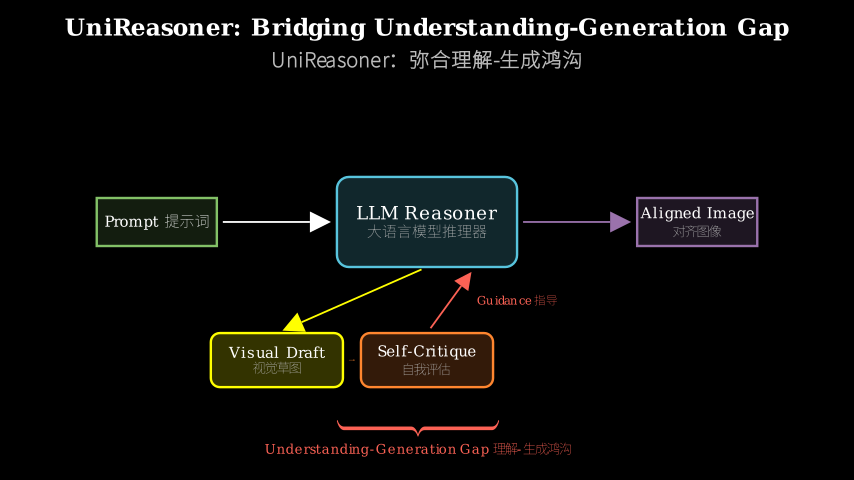
Method: LLM drafts → self-critiques → diffusion uses both
    |
    v
Evidence: Improved compositional alignment, same image quality
    |
    v
Conclusion: Reasoning bridges understanding-generation gap
The Increment
One sentence: Before, LLMs were passive text encoders for diffusion models; now they actively reason about what’s missing and guide generation with explicit corrections.
Core Mechanism
UniReasoner operates in three stages. First, the LLM generates a coarse visual draft using discrete vision tokens—think of it as a rough sketch of the scene. Second, the LLM evaluates this draft against the original prompt, producing grounded textual feedback that identifies specific failures: missing objects, wrong relationships, hallucinated elements. Third, a diffusion model receives three inputs simultaneously: the original prompt, the visual draft, and the evaluation text. The draft anchors the scene structure, the prompt provides the target, and the evaluation supplies corrective constraints.
The key insight is complementarity. Text prompts are ambiguous—“a red ball next to a blue cube” doesn’t specify positions, sizes, or backgrounds. The visual draft resolves this ambiguity by committing to a concrete layout. But drafts make mistakes. The evaluation catches these mistakes and converts them into explicit instructions: “add the red ball on the left,” “remove the extra chair,” “make the cat larger than the dog.”
Input Prompt
    |
    v
+-------------------+
| LLM: Draft Stage  |  --> Discrete vision tokens
+-------------------+      (coarse visual layout)
    |
    v
+-------------------+
| LLM: Critique     |  --> Grounded evaluation text
+-------------------+      ("missing X", "wrong Y")
    |
    v
+-------------------+
| Diffusion Model   | <-- Prompt + Draft + Evaluation
+-------------------+
    |
    v
Final Image
Think of it like a film production. The director (LLM) first storyboards the scene (visual draft)—rough sketches showing where actors stand, camera angles, lighting. Then the director reviews the storyboard against the script (self-critique), noting “the protagonist is too far back” or “we’re missing the MacGuffin on the table.” Finally, the cinematographer (diffusion model) shoots the scene using the script, the storyboard, and the director’s notes. The storyboard prevents the cinematographer from inventing a completely different scene. The notes prevent the cinematographer from faithfully reproducing the storyboard’s mistakes. The script keeps everyone aligned on the narrative goal.
Key Concepts
-
Understanding-Generation Gap: LLMs can judge whether an image matches a prompt (verification) with high accuracy, but struggle to generate images that match that same prompt (synthesis). This isn’t a capability gap—it’s an architectural one. Verification is a discriminative task: given two inputs, output a binary judgment. Generation is open-ended: given one input, produce a high-dimensional output. The same model can be excellent at the former and mediocre at the latter because the tasks have different information structures. UniReasoner’s bet is that verification ability can be converted into generation guidance if you make the LLM’s reasoning explicit and actionable.
-
Grounded Evaluation: Not just “this image is wrong,” but “the red ball is missing from the left side” or “there are two cats instead of one.” Grounding means tying abstract judgments to concrete visual elements. This matters because diffusion models need spatial and semantic specificity to correct errors. Generic feedback like “improve composition” is useless. Grounded feedback like “move the vase closer to the window” directly constrains the generation process. The LLM produces this by comparing its draft against the prompt and articulating discrepancies in natural language that the diffusion model’s text encoder can parse.
-
Visual Draft as Anchor: Discrete vision tokens form a low-resolution, tokenized representation of the scene—similar to VQ-VAE or VQGAN outputs. This draft is intentionally coarse because it’s meant to specify layout and object presence, not fine details. The draft solves the under-specification problem: text alone doesn’t tell you where objects go or how large they should be. By committing to a concrete spatial arrangement, the draft gives the diffusion model a structural scaffold. It’s not the final image—it’s a constraint that narrows the solution space from “infinite possible scenes” to “variations on this layout.”
Framework Shift
Before (mainstream approach):        After (this paper):

Text Prompt                          Text Prompt
    |                                    |
    v                                    v
+----------+                         +----------+
| LLM      |                         | LLM      |
| Encoder  |                         | Reasoner |
+----------+                         +----------+
    |                                 /    |    \
    | (embeddings)                   /     |     \
    v                            Draft  Critique  Embeddings
+----------+                         \     |     /
| Diffusion|                          \    |    /
| Model    |                           v   v   v
+----------+                         +----------+
    |                                | Diffusion|
    v                                | Model    |
  Image                              +----------+
                                         |
                                         v
                                       Image
From passive encoding to active reasoning, the core shift is making the LLM’s understanding explicit and multi-modal.
Expert Assessment
Problem choice: Real gap, not manufactured. The understanding-generation asymmetry is well-documented in multimodal LLMs and has practical consequences—users constantly complain about compositional failures in DALL-E, Stable Diffusion, etc. The problem sits at the intersection of two mature areas (LLMs and diffusion models), which makes it timely.
Method maturity: Clever insight with reasonable execution. The three-stage pipeline is conceptually clean, though the reliance on discrete vision tokens adds complexity. A simpler approach might use attention maps or bounding boxes instead of full visual drafts, but the authors’ choice enables richer spatial reasoning. The self-critique mechanism is the real contribution—it’s a practical way to externalize LLM reasoning without requiring architectural changes to the diffusion model.
Experimental integrity: Baselines are fair (DALL-E 3, Stable Diffusion 3, Emu3). The compositional benchmarks (T2I-CompBench, DVMP) are appropriate. Numbers show consistent improvements in attribute binding and spatial relationships without sacrificing FID or CLIP scores. One concern: the paper doesn’t deeply analyze failure modes or show where the method breaks down. The evaluation text quality likely varies—what happens when the LLM’s critique is wrong or vague?
Writing quality: Abstract and introduction are strong. Method section is dense but clear. The experiments section could use more ablation studies—what if you remove the draft but keep the critique? What if you use a weaker LLM for reasoning? The related work section name-drops many papers without clearly positioning the contribution. Rewriting the ablation section to systematically isolate each component’s contribution would elevate the paper significantly.
Verdict: Weak accept — solid idea with convincing results, but lacks depth in analysis and ablation.
Takeaways
The core transferable idea: when a model is better at verification than generation, make it verify its own drafts and use the critique as guidance. This pattern applies beyond vision—code generation (LLM writes code, critiques it, passes critique to a refinement model), music generation (draft melody, critique harmony, refine), even writing (outline, self-edit, rewrite with edits as constraints). The key is making the critique grounded and actionable, not generic.
Technically, the discrete vision token draft is a form of intermediate representation that bridges modalities. If you’re building multimodal systems, consider whether your pipeline would benefit from explicit intermediate outputs that can be reasoned about, rather than end-to-end black boxes.
The three-input conditioning (prompt + draft + critique) is a practical pattern for combining complementary signals in diffusion models. You can adapt this to other domains where you have multiple sources of guidance with different strengths—e.g., style transfer with content image + style image + textual style description.
论文: 2605.04040 作者: Sucheng Ren, Chen Chen, Zhenbang Wang, Liangchen Song, Xiangxin Zhu, Alan Yuille, Liang-Chieh Chen, Jiasen Lu 分类: cs.CV
缺口
现代文生图系统已经统一到以大语言模型为骨干,同时处理理解和生成任务。
这些模型在验证任务上表现出色——给定一张图像和一段提示词,它们能准确判断图像是否匹配。
但在生成任务上却力不从心——给定同样的提示词,它们难以生成满足要求的图像,尤其是复杂的组合性需求。
悖论在于:同一个模型能告诉你”这张图缺少红色的球”,却无法可靠地生成一张带红球的图。
此前的方法要么直接用大语言模型的嵌入向量作为扩散模型的条件,要么把大语言模型纯粹当作文本编码器。
问题在于,纯文本对视觉场景的描述不够充分,而大语言模型的验证能力从未被转化为可操作的生成约束。
问题:大语言模型验证强但生成弱
    |
    v
观察:验证 = 理解哪里出错了
    |
    v
假设:把验证转化为纠正信号
    |
    v
方法:大语言模型起草 → 自我批判 → 扩散模型同时使用两者
    |
    v
证据:组合对齐改善,图像质量不变
    |
    v
结论:推理能力弥合理解-生成鸿沟
增量
一句话: 之前大语言模型是扩散模型的被动文本编码器;现在它们主动推理缺失内容,用明确的纠正信号指导生成。
核心机制
UniReasoner 分三个阶段运作。
第一阶段,大语言模型用离散视觉token生成粗糙的视觉草图——可以理解为场景的粗略速写。
第二阶段,大语言模型对照原始提示词评估这份草图,产生有根据的文本反馈,指出具体的失败点:缺失的物体、错误的关系、幻觉出的元素。
第三阶段,扩散模型同时接收三个输入:原始提示词、视觉草图、评估文本。
草图锚定场景结构,提示词提供目标,评估文本提供纠正约束。
关键洞察在于互补性。
文本提示词是模糊的——“一个红球挨着一个蓝立方体”没有指定位置、大小或背景。
视觉草图通过承诺一个具体的布局来消解这种模糊性。
但草图会犯错。
评估文本捕捉这些错误并将其转化为明确的指令:“在左边加上红球”、“移除多余的椅子”、“让猫比狗大”。
输入提示词
    |
    v
+-------------------+
| 大语言模型:起草  |  --> 离散视觉token
+-------------------+      (粗糙视觉布局)
    |
    v
+-------------------+
| 大语言模型:批判  |  --> 有根据的评估文本
+-------------------+      ("缺少X"、"Y错了")
    |
    v
+-------------------+
| 扩散模型          | <-- 提示词 + 草图 + 评估
+-------------------+
    |
    v
最终图像
可以把它想象成电影制作。
导演(大语言模型)先画分镜头脚本(视觉草图)——粗略的草图显示演员站位、机位、光线。
然后导演对照剧本审查分镜(自我批判),标注”主角站得太靠后”或”桌上少了关键道具”。
最后摄影师(扩散模型)根据剧本、分镜和导演的批注拍摄场景。
分镜防止摄影师发明一个完全不同的场景。
批注防止摄影师忠实地复制分镜的错误。
剧本让所有人对叙事目标保持一致。
关键概念
- 理解-生成鸿沟: 大语言模型能高精度地判断图像是否匹配提示词(验证),但难以生成匹配该提示词的图像(合成)。
这不是能力差距——是架构差距。
验证是判别任务:给定两个输入,输出二元判断。
生成是开放任务:给定一个输入,产生高维输出。
同一个模型可以在前者上表现优异,在后者上表现平庸,因为任务的信息结构不同。
UniReasoner 的赌注是,如果让大语言模型的推理过程显式化且可操作,验证能力就能转化为生成指导。
- 有根据的评估: 不是泛泛地说”这张图不对”,而是”左侧缺少红球”或”有两只猫而不是一只”。
有根据意味着把抽象判断绑定到具体的视觉元素上。
这很重要,因为扩散模型需要空间和语义的具体性才能纠正错误。
泛泛的反馈如”改善构图”毫无用处。
有根据的反馈如”把花瓶移近窗户”直接约束生成过程。
大语言模型通过对比草图和提示词,用自然语言阐述差异,而扩散模型的文本编码器能解析这些差异。
- 视觉草图作为锚点: 离散视觉token形成场景的低分辨率、token化表示——类似VQ-VAE或VQGAN的输出。
这份草图故意保持粗糙,因为它的目的是指定布局和物体存在性,而非精细细节。
草图解决了描述不足的问题:纯文本不会告诉你物体放在哪里或应该多大。
通过承诺一个具体的空间排列,草图给扩散模型提供了结构支架。
它不是最终图像——它是一个约束,把解空间从”无限可能的场景”缩小到”这个布局的变体”。
框架转变
之前(主流方法):                之后(本文方法):

文本提示词                        文本提示词
    |                                |
    v                                v
+----------+                     +----------+
| 大语言   |                     | 大语言   |
| 模型编码 |                     | 模型推理 |
+----------+                     +----------+
    |                             /    |    \
    | (嵌入向量)                 /     |     \
    v                        草图   批判   嵌入
+----------+                     \     |     /
| 扩散模型 |                      \    |    /
+----------+                       v   v   v
    |                            +----------+
    v                            | 扩散模型 |
  图像                           +----------+
                                     |
                                     v
                                   图像
从被动编码到主动推理,核心转变是让大语言模型的理解显式化且多模态化。
专家评审
选题眼光: 真实缺口,非人造问题。
理解-生成不对称在多模态大语言模型中有充分记录,且有实际后果——用户不断抱怨DALL-E、Stable Diffusion等的组合性失败。
问题位于两个成熟领域(大语言模型和扩散模型)的交叉点,时机恰当。
方法成熟度: 巧妙洞察配合合理执行。
三阶段流水线概念清晰,尽管对离散视觉token的依赖增加了复杂度。
更简单的方法可能使用注意力图或边界框而非完整视觉草图,但作者的选择支持更丰富的空间推理。
自我批判机制是真正的贡献——它是一种实用方法,能外化大语言模型推理而无需改变扩散模型架构。
实验诚意: 基线公平(DALL-E 3、Stable Diffusion 3、Emu3)。
组合性基准(T2I-CompBench、DVMP)合适。
数字显示属性绑定和空间关系的一致改善,且不牺牲FID或CLIP分数。
一个担忧:论文没有深入分析失败模式或展示方法在哪里失效。
评估文本质量可能参差不齐——当大语言模型的批判错误或模糊时会发生什么?
写作功力: 摘要和引言扎实。
方法部分密集但清晰。
实验部分需要更多消融研究——如果移除草图但保留批判会怎样?如果用更弱的大语言模型推理会怎样?相关工作部分罗列了很多论文但没有清晰定位贡献。
重写消融部分以系统地隔离每个组件的贡献,能显著提升论文档次。
判决: 弱接收 — 扎实的想法配合令人信服的结果,但缺乏分析和消融的深度。
要点总结
核心可迁移思想:当模型在验证上强于生成时,让它验证自己的草稿,把批判作为指导。
这个模式适用于视觉之外——代码生成(大语言模型写代码、批判代码、把批判传给精炼模型)、音乐生成(起草旋律、批判和声、带约束精炼)、甚至写作(列提纲、自我编辑、带编辑意见重写)。
关键是让批判有根据且可操作,而非泛泛而谈。
技术上,离散视觉token草图是一种桥接模态的中间表示形式。
如果你在构建多模态系统,考虑你的流水线是否会受益于可推理的显式中间输出,而非端到端黑盒。
三输入条件(提示词 + 草图 + 批判)是在扩散模型中组合互补信号的实用模式。
你可以把它适配到其他有多个不同强度指导源的领域——例如风格迁移用内容图 + 风格图 + 文本风格描述。