Paper: 2606.03979 Authors: Ali Behrouz, Farnoosh Hashemi, Vahab Mirrokni Categories: cs.LG, cs.AI
The Gap
Current LLMs excel at instant prediction and in-context learning but hit a wall: they cannot transfer temporary knowledge from their context window into permanent parameters. When you feed an LLM new information during a conversation, it “remembers” only until the context resets. The model’s weights remain frozen. Prior continual learning approaches either catastrophically forget old knowledge when learning new tasks, or require careful rehearsal buffers and regularization tricks that don’t scale.
The core limitation: existing models learn in one direction — parameters guide inference. There’s no reverse channel for runtime experiences to update those parameters systematically. Fine-tuning is expensive, prone to forgetting, and disconnected from the model’s actual usage patterns.
Problem: LLMs stuck in static mode
         |
         v
Gap: No pathway from context → parameters
         |
         v
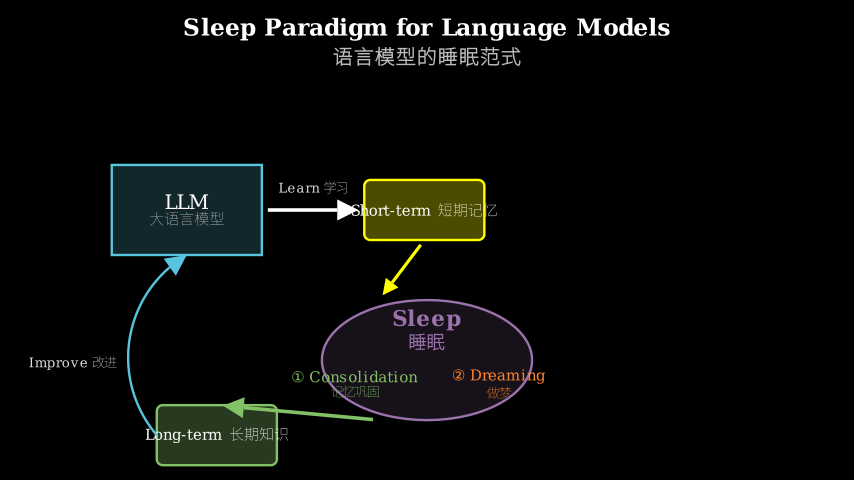
Assumption: Human sleep does this (consolidate + improve)
         |
         v
Method: Two-stage sleep cycle
        (1) Memory Consolidation: distill small→large
        (2) Dreaming: RL-driven synthetic curriculum
         |
         v
Evidence: Improved continual learning, long-horizon tasks
         |
         v
Conclusion: Sleep enables parameter updates from experience
The Increment
One sentence: Before, LLMs were static agents using in-context learning as a workaround for non-updateable parameters; after, they can sleep to consolidate context into weights and dream to self-improve.
Core Mechanism
The method has two stages mimicking human sleep. First, Memory Consolidation takes the model’s recent context — think of it as short-term memories from recent tasks — and distills them into a larger version of itself. This isn’t standard distillation (large teacher → small student). It’s reversed: a smaller model that has been working and accumulating experience teaches a larger model. The larger model has more capacity, so it can absorb the small model’s knowledge without overwriting existing skills. The distillation uses a combination of behavioral cloning (on-policy distillation) and reinforcement learning to ensure the larger model imitates the smaller one’s successful behaviors.
Second, Dreaming uses reinforcement learning to generate synthetic training data. The model essentially quizzes itself, creates new problems based on what it’s learned, and practices solving them. This phase doesn’t require human labels. The model uses RL rewards to identify which synthetic examples improve performance and incorporates them into its curriculum. It’s a self-play loop: generate data, evaluate, keep what works, repeat.
Sleep Cycle Architecture:

Context/Experience → [Small Model] → Task Performance
                          |
                          | (Memory Consolidation)
                          v
                    [Large Model] ← Knowledge Seeding
                          |        (Distillation + RL)
                          |
                          | (Dreaming Phase)
                          v
                    Generate Synthetic Data
                          |
                          v
                    RL Evaluation → Curriculum
                          |
                          v
                    Updated [Large Model]
Think of this as a company with junior and senior employees. The junior employee (small model) works on tasks all day, gaining hands-on experience. At night, they debrief the senior employee (large model), who has more capacity but less recent field experience. The senior absorbs the junior’s insights without forgetting their own expertise — that’s Memory Consolidation. Then the senior employee runs mental simulations (Dreaming), imagining new scenarios and practicing responses to build skills without waiting for real-world examples. The junior-to-senior flow solves the capacity bottleneck: you can’t just keep stuffing knowledge into a fixed-size model. The dreaming phase solves the data bottleneck: you don’t need endless human annotations to keep learning.
Key Concepts
-
Knowledge Seeding (Upward Distillation): Traditional distillation compresses a large teacher into a small student to save compute. Knowledge Seeding flips this: a small model that has been actively learning transfers its knowledge to a larger model with more parameter capacity. Why? The small model has fresh, task-specific experience but limited room to store it. The large model has room but is stale. By distilling upward, you get the best of both: recent experience + capacity to hold more knowledge without overwriting. Imagine a field researcher (small model) returning from months of data collection and uploading findings into a central database (large model) that archives everything without losing historical records.
-
Generalized Distillation with RL: Standard distillation matches output distributions between teacher and student. This paper combines that with reinforcement learning: the large model learns not just to mimic the small model’s outputs, but to imitate behaviors that led to high rewards. It’s behavioral cloning informed by RL signals. If the small model solved a task successfully, the large model learns the policy (action sequence) that led to that success, not just the final answer. This makes the transfer more robust because it captures strategies, not just solutions.
-
Dreaming as Synthetic Curriculum: Most continual learning needs human-labeled data for each new task. Dreaming bypasses this by having the model generate its own training examples. The model uses RL to evaluate which synthetic problems are useful (they improve performance on held-out validation). It’s a feedback loop: generate candidates, test them, keep the good ones, repeat. The curriculum evolves based on what the model needs to practice, not what humans decided to annotate. Think of it as an athlete visualizing different game scenarios and practicing responses mentally — no coach required.
Framework Shift
Before (mainstream approach):        After (this paper):

[Fixed LLM]                          [Small Model] (active learning)
     |                                      |
     v                                      v
In-Context Learning                   Memory Consolidation
(ephemeral, no weight update)               |
     |                                      v
     v                                [Large Model] (updated weights)
Task → Context → Prediction                 |
                                            v
                                     Dreaming (synthetic curriculum)
                                            |
                                            v
                                     Improved [Large Model]

One-way: parameters → inference      Two-way: experience ⇄ parameters
One sentence: From static parameter sets with disposable context to a sleep cycle where experience consolidates into parameters and synthetic rehearsal refines capabilities.
Expert Assessment
Problem choice: Real gap. Continual learning in LLMs is genuinely unsolved — fine-tuning causes forgetting, in-context learning is ephemeral, and most continual learning research focuses on smaller models or contrived task sequences. The biological sleep metaphor is more than decoration here; it maps directly to consolidation and rehearsal mechanisms studied in neuroscience. The timing is right: as LLMs are deployed long-term, the inability to update from interaction is a bottleneck.
Method maturity: Conceptually solid but implementation details are sparse. The upward distillation idea is clever — it sidesteps catastrophic forgetting by giving the model more capacity rather than overwriting existing parameters. However, the paper waves its hands at “generalized distillation” combining on-policy distillation with RL-based imitation, without specifying how the RL reward is structured or how to balance the distillation loss with the RL objective. The dreaming phase is essentially quality-diverse search over synthetic data, which is known to work but not groundbreaking. The novelty is in the framing (sleep) and the combination of upward distillation + synthetic curriculum, not in the underlying techniques.
Experimental integrity: The abstract promises experiments on “long-horizon, continual learning, knowledge incorporation, and few-shot generalization tasks” but provides no numbers, baselines, or datasets in the abstract itself. Without seeing the full paper, it’s impossible to assess whether baselines are fair (do they compare against rehearsal methods like Experience Replay or elastic weight consolidation?) or whether the improvements are marginal or substantial. The phrase “support the importance of the sleep stage” is vague — does sleep add 2% or 20% performance? Red flag: no mention of computational cost. Upward distillation and RL-based dreaming are expensive; if sleep costs more compute than it saves, the practical value diminishes.
Writing quality: The abstract is clear but oversells the biological inspiration. “Inspired by human learning process” sounds grand, but the connection is surface-level — humans sleep, so we call our two-stage process sleep. The analogy helps with intuition but doesn’t constrain the design. The abstract would be stronger if it led with the technical contribution (upward distillation for continual learning) and kept the sleep metaphor as framing. The phrase “recursively improve themselves” is buzzwordy; it just means iterative self-training.
Verdict: weak accept — The upward distillation concept is a genuine contribution to continual learning for LLMs, and the combination with synthetic curriculum generation is well-motivated. However, the method’s novelty is in framing and integration, not in new algorithmic primitives. The experimental section needs to demonstrate clear wins over strong baselines and account for computational overhead. If the numbers are weak or the baselines are strawmen, this drops to borderline.
Takeaways
Upward distillation as a continual learning primitive: If you’re building systems that need to learn from interaction without forgetting, consider distilling a small, actively learning model into a larger, stable one instead of directly fine-tuning the large model. This decouples capacity (how much you can learn) from catastrophic forgetting (overwriting what you know). The small model can be retrained frequently and cheaply; the large model updates only during consolidation.
Synthetic curriculum generation works when you have a good evaluation signal: If you can generate candidate training examples cheaply and have a reliable way to score them (RL reward, validation loss, etc.), you can bootstrap a curriculum without human labels. This is especially useful in domains where labeling is expensive but simulation or generation is cheap (code, math, strategic games).
The sleep metaphor is a forcing function: By structuring the system as “wake” (active learning) and “sleep” (consolidation + rehearsal), you separate concerns: the wake phase optimizes for immediate task performance, the sleep phase optimizes for long-term retention and transfer. This separation can simplify system design even if you’re not literally implementing sleep.
论文: 2606.03979 作者: Ali Behrouz, Farnoosh Hashemi, Vahab Mirrokni 分类: cs.LG, cs.AI
缺口
当前的大语言模型擅长即时预测和上下文学习,但遇到了一堵墙:它们无法将上下文窗口中的临时知识转移到永久参数中。
当你在对话中向LLM提供新信息时,它只”记住”到上下文重置为止。
模型的权重保持冻结。
现有的持续学习方法要么在学习新任务时灾难性地遗忘旧知识,要么需要精心设计的重放缓冲区和正则化技巧,这些方法无法扩展。
核心局限:现有模型单向学习——参数指导推理。
运行时经验没有反向通道来系统性地更新这些参数。
微调成本高昂,容易遗忘,且与模型的实际使用模式脱节。
问题:LLM困在静态模式
         |
         v
缺口:没有从上下文→参数的路径
         |
         v
假设:人类睡眠做这件事(巩固+改进)
         |
         v
方法:两阶段睡眠周期
      (1) 记忆巩固:蒸馏小→大
      (2) 做梦:RL驱动的合成课程
         |
         v
证据:持续学习、长期任务改进
         |
         v
结论:睡眠使参数从经验中更新
增量
一句话:之前,LLM是静态代理,用上下文学习作为不可更新参数的变通方法;之后,它们可以通过睡眠将上下文巩固到权重中,并通过做梦实现自我改进。
核心机制
该方法有两个模拟人类睡眠的阶段。
首先,记忆巩固阶段获取模型的近期上下文——可以把它想象成最近任务的短期记忆——并将它们蒸馏到自己的更大版本中。
这不是标准蒸馏(大教师→小学生)。
它是反向的:一个一直在工作并积累经验的小模型教一个大模型。
大模型有更多容量,所以它可以吸收小模型的知识而不覆盖现有技能。
蒸馏结合了行为克隆(在策略蒸馏)和强化学习,以确保大模型模仿小模型的成功行为。
其次,做梦阶段使用强化学习生成合成训练数据。
模型本质上是在自我测验,根据所学内容创建新问题并练习解决它们。
这个阶段不需要人工标注。
模型使用RL奖励来识别哪些合成示例能提高性能,并将它们纳入课程。
这是一个自我对弈循环:生成数据、评估、保留有效的、重复。
睡眠周期架构:

上下文/经验 → [小模型] → 任务表现
                  |
                  | (记忆巩固)
                  v
            [大模型] ← 知识播种
                  |    (蒸馏 + RL)
                  |
                  | (做梦阶段)
                  v
            生成合成数据
                  |
                  v
            RL评估 → 课程
                  |
                  v
            更新的[大模型]
把这想象成一家有初级和高级员工的公司。
初级员工(小模型)整天处理任务,获得实践经验。
晚上,他们向高级员工(大模型)汇报,后者容量更大但最近的现场经验较少。
高级员工吸收初级员工的见解而不忘记自己的专业知识——这就是记忆巩固。
然后高级员工进行心理模拟(做梦),想象新场景并练习应对措施,在不等待真实世界示例的情况下构建技能。
初级到高级的流程解决了容量瓶颈:你不能一直往固定大小的模型里塞知识。
做梦阶段解决了数据瓶颈:你不需要无尽的人工标注来持续学习。
关键概念
- 知识播种(向上蒸馏):传统蒸馏将大教师压缩成小学生以节省计算。
知识播种反转了这一点:一个一直在主动学习的小模型将其知识转移到一个具有更多参数容量的大模型中。
为什么?小模型有新鲜的、特定任务的经验,但存储空间有限。
大模型有空间但陈旧。
通过向上蒸馏,你得到两全其美:最近的经验+容纳更多知识而不覆盖的能力。
想象一个田野研究员(小模型)在数月的数据收集后返回,将发现上传到一个中央数据库(大模型),该数据库存档所有内容而不丢失历史记录。
- 带RL的广义蒸馏:标准蒸馏匹配教师和学生之间的输出分布。
本文将其与强化学习结合:大模型不仅学习模仿小模型的输出,还学习模仿导致高奖励的行为。
这是由RL信号指导的行为克隆。
如果小模型成功解决了一个任务,大模型会学习导致该成功的策略(行动序列),而不仅仅是最终答案。
这使得转移更加稳健,因为它捕获了策略,而不仅仅是解决方案。
- 做梦作为合成课程:大多数持续学习需要人工标注的数据用于每个新任务。
做梦通过让模型生成自己的训练示例来绕过这一点。
模型使用RL来评估哪些合成问题有用(它们在保留验证集上提高了性能)。
这是一个反馈循环:生成候选、测试它们、保留好的、重复。
课程根据模型需要练习的内容演变,而不是人类决定标注的内容。
把它想象成运动员想象不同的比赛场景并在心理上练习应对——不需要教练。
框架转变
之前(主流方法):              之后(本文方法):

[固定LLM]                      [小模型](主动学习)
     |                              |
     v                              v
上下文学习                      记忆巩固
(短暂的,无权重更新)                |
     |                              v
     v                        [大模型](更新权重)
任务 → 上下文 → 预测                  |
                                    v
                              做梦(合成课程)
                                    |
                                    v
                              改进的[大模型]

单向:参数 → 推理              双向:经验 ⇄ 参数
一句话:从具有一次性上下文的静态参数集到睡眠周期,其中经验巩固到参数中,合成排练完善能力。
专家评审
选题眼光:真实缺口。
LLM中的持续学习确实未解决——微调导致遗忘,上下文学习是短暂的,大多数持续学习研究集中在较小的模型或人为的任务序列上。
生物睡眠隐喻在这里不仅仅是装饰;它直接映射到神经科学研究的巩固和排练机制。
时机恰当:随着LLM长期部署,无法从交互中更新的能力是一个瓶颈。
方法成熟度:概念上稳固,但实现细节稀疏。
向上蒸馏的想法很巧妙——它通过给模型更多容量而不是覆盖现有参数来规避灾难性遗忘。
然而,论文对”广义蒸馏”结合在策略蒸馏和基于RL的模仿含糊其辞,没有具体说明RL奖励如何结构化或如何平衡蒸馏损失与RL目标。
做梦阶段本质上是对合成数据的质量多样性搜索,这已知有效但不具开创性。
新颖性在于框架(睡眠)和向上蒸馏+合成课程的组合,而不在于底层技术。
实验诚意:摘要承诺在”长期、持续学习、知识整合和少样本泛化任务”上进行实验,但摘要本身没有提供数字、基线或数据集。
在没有看到完整论文的情况下,无法评估基线是否公平(它们是否与经验重放或弹性权重巩固等排练方法进行比较?)或改进是边际的还是实质性的。
“支持睡眠阶段的重要性”这个短语很模糊——睡眠增加了2%还是20%的性能?警示:没有提及计算成本。
向上蒸馏和基于RL的做梦成本高昂;如果睡眠的计算成本超过它节省的成本,实用价值就会降低。
写作功力:摘要清晰但过度宣传了生物学灵感。
“受人类学习过程启发”听起来很宏大,但联系是表面的——人类睡觉,所以我们称我们的两阶段过程为睡眠。
类比有助于直觉,但不约束设计。
如果摘要以技术贡献(用于持续学习的向上蒸馏)开头,并将睡眠隐喻作为框架,会更有力。
“递归改进自己”这个短语是流行语;它只是意味着迭代自我训练。
判决:弱接收 — 向上蒸馏概念是对LLM持续学习的真正贡献,与合成课程生成的组合动机充分。
然而,该方法的新颖性在于框架和整合,而不在于新的算法原语。
实验部分需要证明相对于强基线的明确胜利,并考虑计算开销。
如果数字疲软或基线是稻草人,这会降到临界。
要点总结
向上蒸馏作为持续学习原语:如果你正在构建需要从交互中学习而不遗忘的系统,考虑将一个小的、主动学习的模型蒸馏到一个更大的、稳定的模型中,而不是直接微调大模型。
这将容量(你能学多少)与灾难性遗忘(覆盖你知道的)解耦。
小模型可以频繁且廉价地重新训练;大模型仅在巩固期间更新。
当你有良好的评估信号时,合成课程生成有效:如果你可以廉价地生成候选训练示例,并有可靠的方法对它们评分(RL奖励、验证损失等),你可以在没有人工标签的情况下引导课程。
这在标注昂贵但模拟或生成廉价的领域特别有用(代码、数学、策略游戏)。
睡眠隐喻是一个强制功能:通过将系统结构化为”清醒”(主动学习)和”睡眠”(巩固+排练),你分离了关注点:清醒阶段优化即时任务表现,睡眠阶段优化长期保留和迁移。
即使你没有真正实现睡眠,这种分离也可以简化系统设计。