Paper: 2605.23878 Authors: Bo Jiang, Depu Meng, Yihan Hu, Yichen Xie, Tianshuo Xu, Wei Zhan Categories: cs.CV
The Gap
Video diffusion models generate visually impressive clips but fail at physical plausibility—objects float, momentum vanishes, collisions look wrong. Prior fixes bolt on external physics engines (PhysDreamer), distill from teacher models (VideoPoet), or curate physics-specific datasets (Physion). These approaches work but require heavy external machinery. The gap: can we extract motion supervision from the same unlabeled videos already used for training, without adding new data sources or simulators?
Problem: Video generators lack physical consistency
         |
         v
Observation: Training videos contain implicit motion patterns
         |
         v
Assumption: Frame-to-frame latent changes encode motion priors
         |
         v
Method: Model P(latent_change | current_latent, prompt)
        + Use as training loss (macro drift)
        + Use as sampling guidance (micro field)
         |
         v
Evidence: Improves physics benchmarks (VideoPhy/VideoPhy2)
          Preserves general quality (VBench)
         |
         v
Conclusion: Unlabeled video contains usable motion supervision
The Increment
One sentence: Before LaMo, improving video physics meant adding external supervision; after LaMo, you can extract motion priors from the training data itself.
Core Mechanism
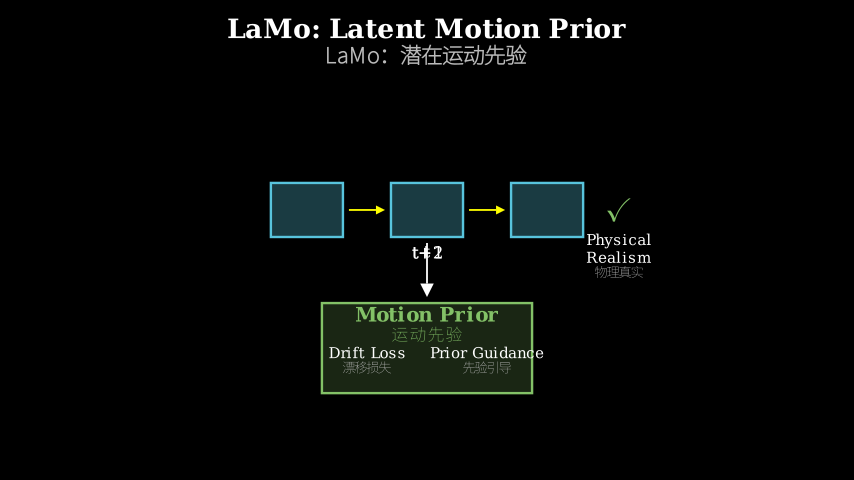
LaMo models the distribution of frame-to-frame changes in latent space, conditioned on the current latent and text prompt. This “latent motion prior” has two readouts. First, a macro motion drift predictor outputs a single vector representing expected overall motion direction. During training, this drift vector acts as a regularization target—the model’s actual latent change should align with the predicted drift. Second, a micro motion field predictor outputs a dense spatial field of motion vectors. During sampling, this field guides the denoising process toward physically plausible trajectories.
Both components are lightweight networks trained on the same video data used for the base diffusion model. The drift predictor sees consecutive latent frames and learns to predict their difference. The field predictor learns a spatially-resolved version of the same task. Crucially, neither requires physics labels—they learn purely from observing how real video latents evolve over time.
Training:
  Video frames --> Encoder --> Latent sequence
                                    |
                    +---------------+---------------+
                    |                               |
                    v                               v
            Drift Predictor                 Diffusion Model
            (macro motion)                  (generates video)
                    |                               |
                    v                               v
            Expected drift <---compare---> Actual latent change
                                |
                                v
                        Motion Drift Loss
                        (regularization)

Sampling:
  Noisy latent + prompt --> Diffusion Model --> Predicted noise
                                    ^
                                    |
                            Motion Prior Guidance
                                    |
                                    v
                            Field Predictor
                            (micro motion field)
                            nudges toward physical trajectories
Think of LaMo as a driving instructor sitting beside a student driver (the diffusion model). The instructor doesn’t control the wheel but has two ways to help. First, before each trip (training), they point out the general direction traffic should flow—“cars on this road usually move northeast.” This is the macro drift, a compass heading. Second, during the drive (sampling), they tap the dashboard when the student drifts into the wrong lane—“that truck ahead is moving left, you should account for it.” This is the micro field, a real-time correction based on local motion patterns. The instructor learned both skills not from a driving manual (external physics) but from years of watching traffic (unlabeled video). The student driver improves because the instructor’s corrections are grounded in how real traffic behaves, not abstract rules.
Key Concepts
-
Latent Motion Prior: In diffusion models, videos are compressed into latent space before generation. A motion prior is a learned distribution over how these latents should change from frame to frame. Instead of modeling raw pixel motion (expensive, noisy), LaMo models latent-space motion—the compressed representation of motion. This is like learning how chess positions evolve rather than tracking individual piece pixels. The prior is “self-supervised” because it’s trained on frame pairs from real videos without needing labels like “this is a falling object” or “this obeys Newton’s laws.” The model simply learns: given latent A and prompt P, latent B tends to follow in direction D with spatial variations F.
-
Macro vs Micro Motion: Macro motion is a single vector summarizing the overall direction of change—think “camera pans right” or “object moves down.” Micro motion is a dense field where each spatial location has its own motion vector—think “top-left corner moves up, bottom-right moves down, center stays still.” LaMo uses macro drift during training as a soft constraint (the model’s generated motion should roughly align with typical motion patterns) and micro field during sampling as guidance (steer the denoising process toward locally consistent motion). The split lets LaMo operate at two scales: coarse regularization during learning, fine-grained correction during generation.
Framework Shift
Before (mainstream approach):        After (LaMo):

External Physics Engine              Training Video Corpus
        |                                    |
        v                                    v
  Simulate dynamics              Extract latent motion patterns
        |                                    |
        v                                    v
  Supervise video model            Self-supervise motion prior
        |                                    |
        +-----> Video Generator              +-----> Video Generator
                                                     (with motion guidance)

Key difference:                      Key difference:
- Requires physics simulator        - Uses existing training data
- Explicit physical rules            - Implicit motion statistics
- External dependency                - Self-contained
One sentence: From explicit physics simulation to implicit motion statistics learned from the training corpus itself.
Expert Assessment
Problem choice: Real gap. Video generators genuinely struggle with physics, and existing fixes are heavyweight. The self-supervised angle is underexplored and practically valuable—if you’re already training on millions of videos, why not extract motion cues from them? Sits at the intersection of video generation and self-supervised learning, both hot areas.
Method maturity: Clever but not revolutionary. The core idea—model latent changes as a prior—is straightforward. The dual readout (drift + field) is sensible engineering. However, the paper doesn’t deeply explore why this works or when it fails. Are certain motion types (rotation, deformation) harder to capture? Does the prior collapse to dataset biases (e.g., most videos have static cameras)? The method feels like a solid first step, not a final answer.
Experimental integrity: Baselines are fair (CogVideoX, recent physics-aware methods). VideoPhy and VideoPhy2 are appropriate benchmarks. VBench results show LaMo doesn’t hurt general quality, which is important. However, the paper lacks failure case analysis. What happens on out-of-distribution physics (e.g., zero gravity, underwater)? Ablations are present but shallow—would be stronger with analysis of when drift vs field matters most.
Writing quality: Clear structure, good motivation. The related work section is thorough. However, the method section is dense—Figure 2 does heavy lifting but isn’t self-explanatory. The paper would benefit from a “LaMo in 3 sentences” box upfront and more intuitive explanation of why latent-space motion is the right level of abstraction. The results section lists numbers but doesn’t tell a story—why does LaMo win on some metrics but not others?
Verdict: weak accept — Solid contribution with practical value, but lacks depth in understanding when and why the method works. Good engineering, needs more science.
Takeaways
Steal the two-scale supervision pattern: Training with coarse-grained regularization (drift loss) and sampling with fine-grained guidance (motion field) is a transferable idea. If you’re building any generative model where output should follow implicit patterns (e.g., code generation following API usage patterns, molecule generation following chemical stability), consider learning a prior over transitions and using it at both training and inference time.
Latent-space priors are underutilized: Most work on improving generation quality focuses on architecture or data. LaMo shows you can extract useful supervision from the latent dynamics of your training data. If your model compresses inputs into latents, ask: what structure exists in how those latents evolve? Can you model and exploit it?
Self-supervision from temporal structure: Video has natural supervision in its temporal axis—frame N+1 follows frame N. LaMo exploits this without labels. The same principle applies to any sequential data: audio (waveform evolution), time-series (sensor dynamics), even text (token transition patterns). If your data has a time dimension, you have free supervision.
论文: 2605.23878 作者: Bo Jiang, Depu Meng, Yihan Hu, Yichen Xie, Tianshuo Xu, Wei Zhan 分类: cs.CV
缺口
视频扩散模型生成的画面视觉效果惊艳,但物理真实性堪忧——物体悬浮、动量凭空消失、碰撞看起来不对劲。
此前的解决方案要么外挂物理引擎(PhysDreamer),要么从教师模型蒸馏(VideoPoet),要么精心策划物理数据集(Physion)。
这些方法有效但依赖重型外部机制。
缺口在于:能否从训练视频扩散模型时已经使用的无标注视频中提取运动监督,而不引入新数据源或模拟器?
问题:视频生成器缺乏物理一致性
         |
         v
观察:训练视频包含隐式运动模式
         |
         v
假设:帧间潜变量变化编码了运动先验
         |
         v
方法:建模 P(潜变量变化 | 当前潜变量, 提示词)
      + 用作训练损失(宏观漂移)
      + 用作采样引导(微观场)
         |
         v
证据:改善物理基准(VideoPhy/VideoPhy2)
      保持通用质量(VBench)
         |
         v
结论:无标注视频包含可用的运动监督
增量
一句话: LaMo之前,改善视频物理性需要添加外部监督;
LaMo之后,可以从训练数据本身提取运动先验。
核心机制
LaMo对潜空间中的帧间变化分布建模,条件是当前潜变量和文本提示。
这个”潜运动先验”有两个输出端。
第一,宏观运动漂移预测器输出单个向量,表示预期的整体运动方向。
训练时,这个漂移向量充当正则化目标——模型的实际潜变量变化应与预测漂移对齐。
第二,微观运动场预测器输出密集的空间运动向量场。
采样时,这个场引导去噪过程朝向物理上合理的轨迹。
两个组件都是轻量级网络,在用于基础扩散模型的相同视频数据上训练。
漂移预测器观察连续的潜帧并学习预测它们的差异。
场预测器学习同一任务的空间分辨版本。
关键是,两者都不需要物理标签——它们纯粹通过观察真实视频潜变量如何随时间演化来学习。
训练阶段:
  视频帧 --> 编码器 --> 潜序列
                          |
          +---------------+---------------+
          |                               |
          v                               v
  漂移预测器                        扩散模型
  (宏观运动)                      (生成视频)
          |                               |
          v                               v
  期望漂移 <---比较---> 实际潜变量变化
                          |
                          v
                  运动漂移损失
                  (正则化)

采样阶段:
  噪声潜变量 + 提示词 --> 扩散模型 --> 预测噪声
                              ^
                              |
                      运动先验引导
                              |
                              v
                      场预测器
                      (微观运动场)
                      推向物理轨迹
把LaMo想象成坐在学员司机(扩散模型)旁边的驾驶教练。
教练不控制方向盘,但有两种帮助方式。
第一,每次出发前(训练),他们指出交通流的大致方向——“这条路上的车通常往东北方向走”。
这是宏观漂移,一个罗盘方位。
第二,驾驶过程中(采样),当学员偏离车道时他们敲仪表盘——“前面那辆卡车在往左移,你应该考虑到它”。
这是微观场,基于局部运动模式的实时修正。
教练学会这两项技能不是从驾驶手册(外部物理)而是从多年观察交通(无标注视频)。
学员司机进步了,因为教练的修正基于真实交通的行为方式,而非抽象规则。
关键概念
- 潜运动先验: 在扩散模型中,视频在生成前被压缩到潜空间。
运动先验是关于这些潜变量应如何逐帧变化的学习分布。
LaMo不建模原始像素运动(昂贵、有噪声),而是建模潜空间运动——运动的压缩表示。
这就像学习国际象棋局面如何演化,而非追踪单个棋子的像素。
先验是”自监督”的,因为它在真实视频的帧对上训练,无需”这是下落物体”或”这遵守牛顿定律”之类的标签。
模型只是学习:给定潜变量A和提示词P,潜变量B倾向于沿方向D变化,带有空间变化F。
- 宏观与微观运动: 宏观运动是总结整体变化方向的单个向量——想象”相机向右平移”或”物体向下移动”。
微观运动是密集场,每个空间位置都有自己的运动向量——想象”左上角向上移,右下角向下移,中心静止”。
LaMo在训练时使用宏观漂移作为软约束(模型生成的运动应大致与典型运动模式对齐),在采样时使用微观场作为引导(引导去噪过程朝向局部一致的运动)。
这种分离让LaMo在两个尺度上操作:学习时粗粒度正则化,生成时细粒度修正。
框架转变
之前(主流方法):                之后(LaMo):

外部物理引擎                      训练视频语料库
      |                                  |
      v                                  v
模拟动力学                        提取潜运动模式
      |                                  |
      v                                  v
监督视频模型                      自监督运动先验
      |                                  |
      +-----> 视频生成器                 +-----> 视频生成器
                                               (带运动引导)

关键差异:                        关键差异:
- 需要物理模拟器                  - 使用现有训练数据
- 显式物理规则                    - 隐式运动统计
- 外部依赖                        - 自包含
一句话: 从显式物理模拟到从训练语料库本身学习的隐式运动统计。
专家评审
选题眼光: 真实缺口。
视频生成器确实在物理性上挣扎,现有修复方案都很重。
自监督角度探索不足且实用价值高——如果你已经在数百万视频上训练,为什么不从中提取运动线索?
处于视频生成和自监督学习的交叉点,两者都是热门领域。
方法成熟度: 巧妙但非革命性。
核心思想——将潜变量变化建模为先验——很直接。
双输出端(漂移+场)是合理的工程设计。
然而,论文没有深入探讨为什么有效或何时失效。
某些运动类型(旋转、形变)是否更难捕捉?
先验是否会坍缩到数据集偏差(例如大多数视频相机静止)?
方法感觉像扎实的第一步,而非最终答案。
实验诚意: 基线公平(CogVideoX、近期物理感知方法)。
VideoPhy和VideoPhy2是合适的基准。
VBench结果显示LaMo不损害通用质量,这很重要。
然而,论文缺乏失败案例分析。
在分布外物理(例如零重力、水下)上会发生什么?
消融实验存在但浅显——如果分析漂移与场何时最重要会更强。
写作功力: 结构清晰,动机充分。
相关工作部分详尽。
然而,方法部分密集——图2承担重任但不够自解释。
论文会受益于开头的”三句话讲清LaMo”框和更直观地解释为什么潜空间运动是正确的抽象层次。
结果部分列举数字但不讲故事——为什么LaMo在某些指标上赢但在其他指标上没赢?
判决: 弱接收 — 扎实的贡献,有实用价值,但缺乏对方法何时及为何有效的深度理解。
工程不错,需要更多科学。
要点总结
偷走双尺度监督模式: 用粗粒度正则化(漂移损失)训练,用细粒度引导(运动场)采样,是可迁移的思想。
如果你在构建任何输出应遵循隐式模式的生成模型(例如代码生成遵循API使用模式,分子生成遵循化学稳定性),考虑学习转换先验并在训练和推理时都使用它。
潜空间先验未被充分利用: 大多数改善生成质量的工作聚焦于架构或数据。
LaMo表明你可以从训练数据的潜动力学中提取有用的监督。
如果你的模型将输入压缩到潜变量,问问:这些潜变量如何演化中存在什么结构?
能否建模并利用它?
从时间结构中自监督: 视频在其时间轴上有天然监督——第N+1帧跟随第N帧。
LaMo利用这一点而无需标签。
同样原理适用于任何序列数据:音频(波形演化)、时间序列(传感器动力学)、甚至文本(词元转换模式)。
如果你的数据有时间维度,你就有免费的监督。