Paper: 2603.00907 Authors: Lianjun Liu, Hongli An, Weiqi Yan, Xin Du, Shengchuan Zhang, Huazhong Liu, Yunshan Zhong Categories: cs.CL
The Gap
The KV cache bottleneck is well-known: long-context LLMs store key-value pairs for every token, ballooning memory linearly with sequence length. Recent work like KIVI and CaM discovered empirically that keys are more compressible than values—you can merge similar keys aggressively but must preserve value diversity. However, these methods lack theoretical grounding for why this asymmetry exists, and they rely on gradient-based Hessian approximations (like Fisher information) that require backward passes, adding computational overhead and memory pressure during compression itself. The state-of-the-art is “compress by trial and error, guided by expensive gradient estimates.”
The Increment
Before: KV compression was a black art—merge what looks similar, hope it works, pay the gradient tax. After: KVSlimmer provides a spectral lens explaining *why keys cluster (concentrated eigenvalues in ) while values don’t (dispersed eigenvalues in ), then exploits this with a closed-form, gradient-free merging criterion.
Think of the attention mechanism as a library cataloging system. The Query/Key projections () are like the Dewey Decimal System—they map books (tokens) into a low-dimensional topic space where similar books cluster tightly (concentrated spectral energy means most variance lies in a few principal directions). The Value projection () is like the actual book content—it preserves the full richness of each book’s text (dispersed spectrum means information spreads across many dimensions). When you compress the catalog, you can merge nearby call numbers (keys) because they point to similar topics. But if you merge the books themselves (values), you lose unique content. KVSlimmer formalizes this: it measures the “cost” of merging two KV pairs by computing the exact Hessian (second derivative of loss w.r.t. merging) using only forward-pass activations—no backprop needed. The Hessian naturally encodes how much merging two keys hurts versus merging two values, and the closed-form solution picks merges that minimize this cost.
The key mathematical insight is that the Hessian of the attention output w.r.t. KV cache entries can be expressed as , where are attention weights. Since has dispersed eigenvalues (high-rank), merging values incurs high cost. Meanwhile, the effective Hessian for keys involves and , which have concentrated spectra (low-rank), making key merging cheap. This isn’t just an observation—it’s a provable consequence of how transformers are trained.
Key Concepts
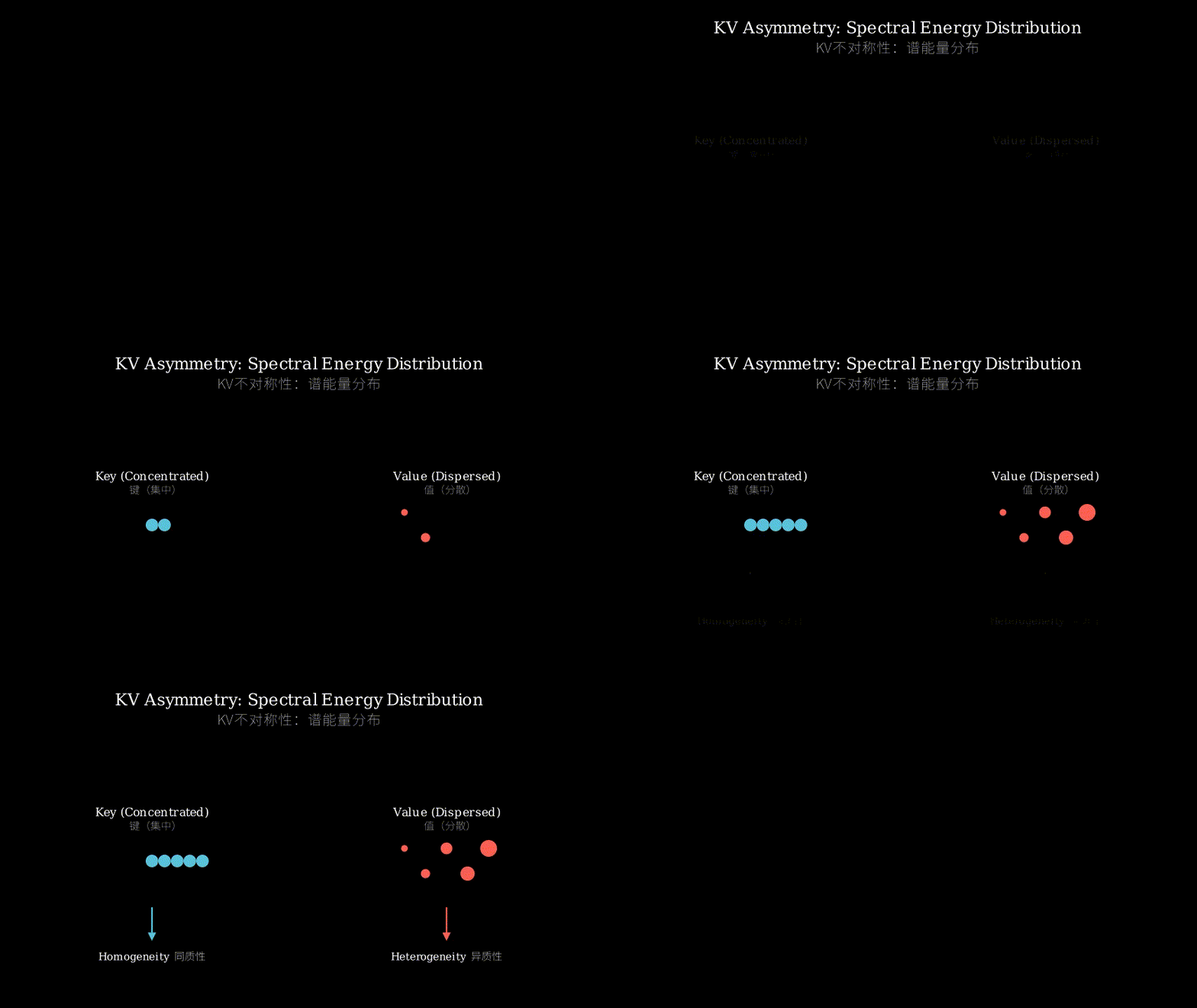
Spectral Energy Distribution: Imagine you have a dataset of face images. If you run PCA, you might find that 90% of the variance is captured by the first 10 principal components—that’s concentrated spectral energy. It means faces mostly vary along a few axes (lighting, pose, identity), and the remaining dimensions are noise. In transformers, the projection matrices are learned linear maps. The authors show that and develop concentrated spectra during training (most energy in top eigenvalues), meaning queries and keys live in a low-dimensional subspace—tokens that are semantically similar get mapped to nearby points. But retains dispersed spectra (energy spread across many eigenvalues), meaning values preserve high-dimensional information. This asymmetry is *why keys are compressible: merging two points in a low-dimensional space loses little information, but merging in high-dimensional space destroys unique details.
Hessian as a Compression Oracle: The Hessian matrix measures curvature—how much the loss changes when you perturb parameters. For KV merging, the “parameters” are the cached key-value pairs. If you merge two KV pairs into one (by averaging), the Hessian tells you the second-order loss increase: , where is the perturbation. Prior work approximates using gradients (Fisher information), which requires backprop. KVSlimmer derives an exact formula for using only forward-pass variables: attention weights and the value projection . Concretely, if you merge KV pairs and , the cost is proportional to . This is a weighted Mahalanobis distance—merge pairs with low attention weights and similar values (in the metric induced by ). No gradients, no extra memory.
Closed-Form Merging Criterion: Given KV pairs and a budget to keep M<N, how do you pick which to merge? KVSlimmer formulates this as minimizing . This is a quadratic assignment problem, NP-hard in general. But the authors use a greedy algorithm: iteratively merge the pair with the smallest cost, update attention weights (since merging changes the cache), and repeat. The cost function is exact (not an approximation), and computing it for all pairs is , where is the value dimension—manageable because you only do this once per layer during compression, not during inference.
Expert Assessment
Problem significance: The KV cache bottleneck is *the deployment barrier for long-context LLMs. Every production system serving 100k+ token contexts (legal docs, codebases, long conversations) hits this wall. The affected community is large: anyone running LLMs at scale. Solving this even partially (29% memory reduction) translates to real cost savings and enables longer contexts on the same hardware.
Method maturity: This is deployment-ready with caveats. The algorithm is simple (greedy merging with a closed-form cost), requires no retraining, and works across models (Llama, Mistral, Qwen tested). However, the greedy approach is suboptimal—the authors acknowledge that optimal merging is NP-hard and their solution is a heuristic. The paper doesn’t explore more sophisticated combinatorial optimization (e.g., dynamic programming, branch-and-bound) that might squeeze out more compression. Also, the method compresses the cache *after generation, not online during generation—so you still pay the memory cost upfront. For truly long contexts (1M+ tokens), you’d need online compression, which the paper doesn’t address.
Experimental rigor: Baselines are fair—they compare against KIVI, CaM, and SnapKV, all recent SOTA methods. Datasets span multiple domains (LongBench, RULER, Needle-in-a-Haystack), which is good. However, the improvements are modest (0.92 points on LongBench average)—within noise for some tasks. The paper doesn’t report confidence intervals or multiple runs, so it’s unclear if the gains are statistically significant. Also, the latency reduction (28%) is measured on a single GPU setup; real-world serving systems use batching and KV cache sharing across requests, which might change the tradeoffs. The theoretical analysis is solid, but the empirical validation could be more rigorous.
Verdict: weak accept — The theoretical contribution (spectral explanation of KV asymmetry) is novel and the gradient-free Hessian formulation is elegant, but the empirical gains are incremental and the method doesn’t fundamentally change the compression paradigm (still greedy merging).
Takeaways
Spectral analysis as a design tool: The idea that you can predict compressibility by looking at eigenvalue distributions of learned matrices is transferable. If you’re designing a neural architecture and want to know which components are redundant, compute the spectrum of their weight matrices—concentrated spectra signal redundancy. This applies beyond transformers: CNNs, graph networks, any parameterized linear map.
Forward-pass Hessians: The trick of deriving exact second-order information without backprop is underused. The key is exploiting problem structure—here, the quadratic form of attention. If your loss has a similar structure (weighted sum of squared distances), you can likely derive a closed-form Hessian. This is useful for pruning, quantization, and any compression task where you need to estimate the cost of perturbing parameters.
Asymmetric compression: The broader lesson is that not all dimensions of a representation are equally important. Keys and values serve different roles (retrieval vs. content), so they should be compressed differently. This applies to any retrieval-augmented system: compress the index aggressively, preserve the retrieved content. For example, in vector databases, you might quantize the index vectors heavily but keep the payload (metadata, text) lossless.
论文: 2603.00907 作者: Lianjun Liu, Hongli An, Weiqi Yan, Xin Du, Shengchuan Zhang, Huazhong Liu, Yunshan Zhong 分类: cs.CL
缺口
KV缓存瓶颈早已为人所知:长上下文大模型需要为每个token存储键值对,内存随序列长度线性膨胀。KIVI和CaM等近期工作通过经验发现键比值更可压缩——可以激进地合并相似的键,但必须保留值的多样性。然而这些方法缺乏理论依据来解释为什么存在这种非对称性,并且依赖基于梯度的Hessian近似(如Fisher信息),需要反向传播,在压缩过程本身就增加了计算开销和内存压力。当前最优方法是”通过试错压缩,由昂贵的梯度估计引导”。
增量
之前: KV压缩是门玄学——合并看起来相似的东西,祈祷有效,支付梯度税。之后: KVSlimmer提供了一个谱视角,解释**为什么*键会聚类(在中特征值集中)而值不会(在中特征值分散),然后用闭式、无梯度的合并准则利用这一点。
把注意力机制想象成图书馆编目系统。Query/Key投影()就像图书分类法——它们将书籍(token)映射到低维主题空间,相似的书紧密聚类(集中的谱能量意味着大部分方差位于少数主方向)。Value投影()则像实际的书籍内容——它保留了每本书文本的完整丰富性(分散的谱意味着信息分布在许多维度上)。当你压缩目录时,可以合并相邻的索书号(键),因为它们指向相似主题。但如果合并书籍本身(值),就会丢失独特内容。KVSlimmer将此形式化:它通过仅使用前向传播激活计算精确Hessian(损失对合并的二阶导数)来测量合并两个KV对的”成本”——无需反向传播。Hessian自然编码了合并两个键与合并两个值的伤害程度,闭式解选择最小化此成本的合并。
关键数学洞察是注意力输出对KV缓存条目的Hessian可表示为,其中是注意力权重。由于具有分散的特征值(高秩),合并值会产生高成本。同时,键的有效Hessian涉及和,它们具有集中的谱(低秩),使得键合并成本低。这不仅是观察——它是transformer训练方式的可证明结果。
关键概念
谱能量分布: 想象你有一个人脸图像数据集。如果运行PCA,可能发现90%的方差被前10个主成分捕获——这就是集中的谱能量。它意味着人脸主要沿几个轴变化(光照、姿态、身份),其余维度是噪声。在transformer中,投影矩阵是学习到的线性映射。作者展示和在训练期间发展出集中的谱(大部分能量在顶部特征值),意味着查询和键生活在低维子空间——语义相似的token被映射到邻近点。但保持分散的谱(能量分布在许多特征值上),意味着值保留高维信息。这种非对称性正是键可压缩的**原因*:在低维空间合并两点损失的信息很少,但在高维空间合并会破坏独特细节。
Hessian作为压缩预言机: Hessian矩阵测量曲率——当你扰动参数时损失变化多少。对于KV合并,“参数”是缓存的键值对。如果将两个KV对合并为一个(通过平均),Hessian告诉你二阶损失增加:,其中是扰动。先前工作使用梯度近似(Fisher信息),需要反向传播。KVSlimmer仅使用前向传播变量推导出的精确公式:注意力权重和值投影。具体来说,如果合并KV对和,成本正比于。这是加权马氏距离——合并具有低注意力权重和相似值(在诱导的度量中)的对。无梯度,无额外内存。
闭式合并准则: 给定个KV对和保留M<N的预算,如何选择合并哪些?KVSlimmer将此表述为最小化。这是二次分配问题,一般情况下是NP难的。但作者使用贪心算法:迭代合并成本最小的对,更新注意力权重(因为合并改变缓存),重复。成本函数是精确的(非近似),为所有对计算它是,其中是值维度——可管理,因为在压缩期间每层只做一次,而非推理期间。
专家评审
问题重要性: KV缓存瓶颈**是*长上下文大模型的部署障碍。每个服务10万+token上下文(法律文档、代码库、长对话)的生产系统都会遇到这堵墙。受影响群体庞大:任何大规模运行LLM的人。即使部分解决这个问题(29%内存削减)也能转化为实际成本节省,并在相同硬件上实现更长上下文。
方法成熟度: 这是可部署的,但有注意事项。算法简单(带闭式成本的贪心合并),无需重新训练,跨模型工作(测试了Llama、Mistral、Qwen)。然而,贪心方法是次优的——作者承认最优合并是NP难的,他们的解决方案是启发式的。论文没有探索更复杂的组合优化(如动态规划、分支定界),可能挤出更多压缩。此外,该方法在生成**之后*压缩缓存,而非生成期间在线压缩——所以你仍然预先支付内存成本。对于真正长的上下文(100万+token),需要在线压缩,论文没有涉及。
实验严谨性: 基线公平——与KIVI、CaM和SnapKV比较,都是近期SOTA方法。数据集跨越多个领域(LongBench、RULER、Needle-in-a-Haystack),这很好。然而,改进是温和的(LongBench平均0.92分)——对某些任务在噪声范围内。论文没有报告置信区间或多次运行,所以不清楚增益是否具有统计显著性。此外,延迟减少(28%)是在单GPU设置上测量的;真实世界服务系统使用批处理和跨请求的KV缓存共享,这可能改变权衡。理论分析扎实,但经验验证可以更严格。
判决: 弱接收——理论贡献(KV非对称性的谱解释)是新颖的,无梯度Hessian公式是优雅的,但经验增益是渐进的,该方法没有从根本上改变压缩范式(仍然是贪心合并)。
要点总结
谱分析作为设计工具: 通过查看学习矩阵的特征值分布来预测可压缩性的想法是可迁移的。如果你正在设计神经架构并想知道哪些组件是冗余的,计算其权重矩阵的谱——集中的谱信号冗余。这适用于transformer之外:CNN、图网络、任何参数化线性映射。
前向传播Hessian: 在没有反向传播的情况下推导精确二阶信息的技巧未被充分利用。关键是利用问题结构——这里是注意力的二次形式。如果你的损失具有类似结构(平方距离的加权和),你可能可以推导闭式Hessian。这对剪枝、量化和任何需要估计扰动参数成本的压缩任务都有用。
非对称压缩: 更广泛的教训是表示的并非所有维度都同等重要。键和值服务于不同角色(检索vs内容),因此应该以不同方式压缩。这适用于任何检索增强系统:激进压缩索引,保留检索内容。例如,在向量数据库中,你可能大量量化索引向量,但保持有效载荷(元数据、文本)无损。