Paper: 2605.20170 Authors: Davide Cavicchini, Fausto Giunchiglia, Jacopo Staiano Categories: cs.CL
The Gap
LLMs encode knowledge in their parameters — opaque, hard to update, prone to hallucinations. Knowledge Graphs (KGs) offer structured, editable knowledge but current integration methods (RAG, fine-tuning) either flood the context window with verbose triples or require expensive retraining. The field has two incompatible paradigms: parametric (LLMs) vs symbolic (KGs), with no efficient bridge that preserves both interpretability and computational economy.
Problem: LLM knowledge is opaque + KG integration is expensive
   |
   v
Assumption: KG structure can be compressed without losing semantics
   |
   v
Method: Encode 1-hop subgraphs -> discrete tokens -> inject into LLM
   |
   v
Evidence: 10x token reduction + competitive accuracy on 3 benchmarks
   |
   v
Conclusion: Compact KG representations ground LLMs efficiently
The Increment
One sentence: Before — choose between parametric opacity or context-window bloat; after — inject structured knowledge as compact discrete tokens without retraining.
Core Mechanism
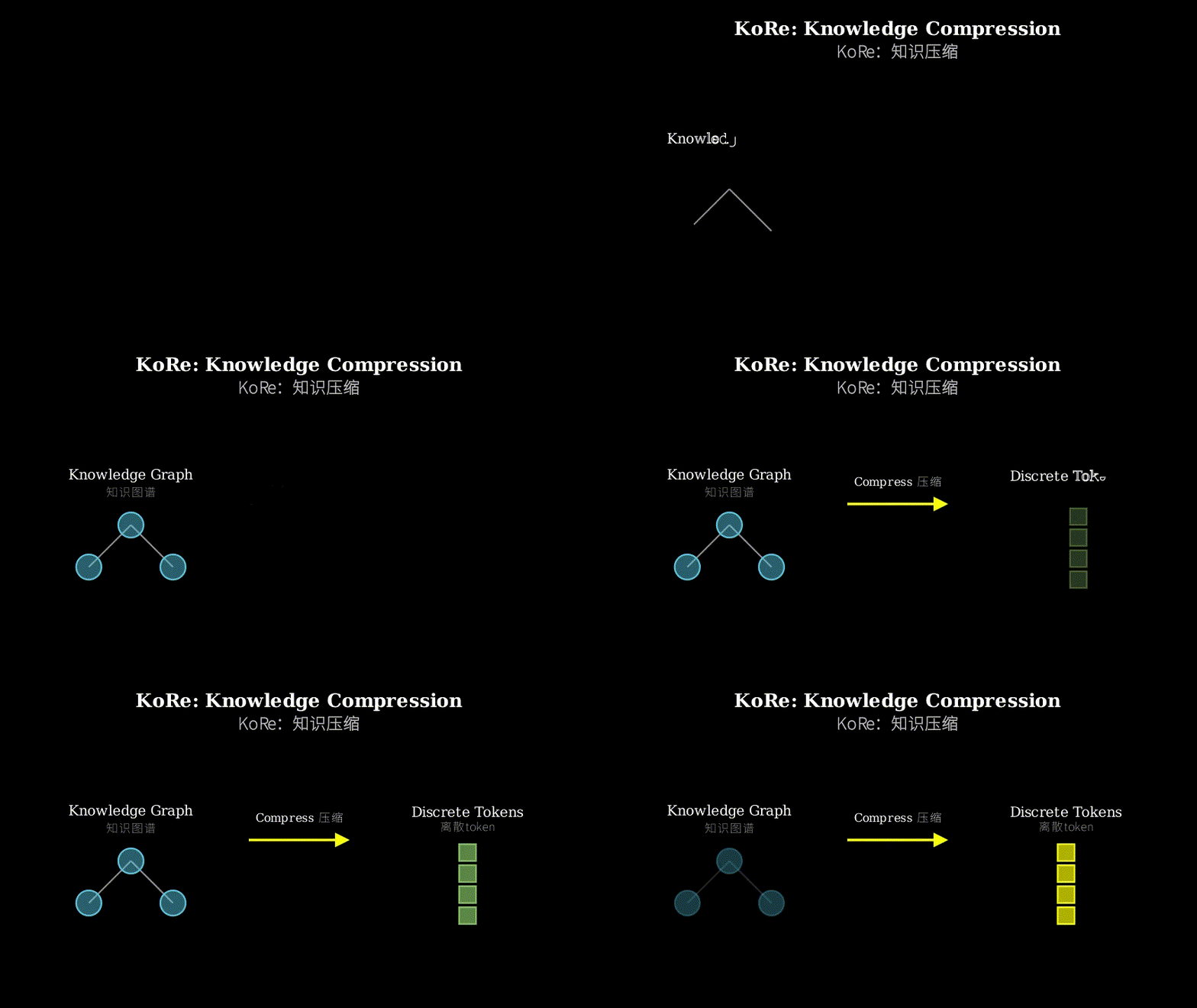
KoRe operates in three stages. First, given an entity mention in text, it extracts the relevant 1-hop subgraph from a KG (the entity plus all directly connected neighbors and relations). Second, it encodes this subgraph into a fixed-length discrete representation using a learned encoder that maps graph structure to a sequence of token IDs from a learned codebook. Third, these “knowledge tokens” are prepended to the input text and fed into a frozen LLM backbone.
The encoder is trained separately on a KG corpus to learn compact representations that preserve relational structure. During inference, the LLM sees both the original text and the compressed KG context, but the KG arrives as a handful of discrete tokens rather than hundreds of verbose triples. The LLM’s parameters remain frozen — no fine-tuning required.
Input text: "Einstein won the Nobel Prize"
     |
     v
Extract 1-hop subgraph from KG:
  Einstein --won--> Nobel Prize
  Einstein --born--> 1879
  Einstein --field--> Physics
     |
     v
Encode subgraph -> [K1, K2, K3] (3 discrete tokens)
     |
     v
Prepend to text: [K1, K2, K3] + "Einstein won the Nobel Prize"
     |
     v
Feed to frozen LLM -> prediction
Think of KoRe as a compression algorithm for knowledge. Imagine you’re packing for a trip: instead of bringing entire books (verbose KG triples), you bring index cards with key facts (discrete tokens). The encoder is your packing strategy — it learns which facts to keep and how to arrange them compactly. The LLM is your brain at the destination — it reads the index cards alongside the main text and makes decisions. The codebook is your set of standardized card templates, learned from many packing sessions. You never repack your brain (no LLM retraining), just hand it better-organized cards.
Key Concepts
-
1-hop subgraph: For a given entity, this is the immediate neighborhood in the knowledge graph — the entity itself, all entities directly connected to it, and the relations between them. If “Einstein” is the entity, a 1-hop subgraph includes “Nobel Prize” (connected by “won”), “Physics” (connected by “field”), “1879” (connected by “born”), but not “Relativity” if it’s two hops away through “Physics”. This local slice captures the most relevant context without exponential explosion.
-
Discrete token encoding: Instead of feeding raw graph triples as text (“Einstein won Nobel Prize. Einstein born 1879…”), the method learns a vocabulary of abstract tokens (like K1, K2, K3) where each token represents a compressed pattern in the graph structure. A learned encoder maps subgraphs to sequences of these tokens. The LLM treats them like any other token in its vocabulary, but they carry dense relational information. It’s like replacing “the quick brown fox” with a single symbol that the model has learned means exactly that phrase.
-
Frozen backbone: The LLM’s weights are never updated during KoRe integration. This is crucial — it means you can plug KoRe into any existing LLM without retraining costs. The knowledge tokens are simply prepended to the input, and the LLM processes them through its existing attention mechanisms. The model learns to “read” these tokens during its original pretraining (or through the encoder’s training), but the LLM itself remains unchanged.
Framework Shift
Before (RAG / Fine-tuning):          After (KoRe):

Text input                           Text input
    |                                    |
    v                                    v
Retrieve KG triples                  Extract 1-hop subgraph
    |                                    |
    v                                    v
"Einstein won Nobel Prize.           Encode -> [K1, K2, K3]
 Einstein born 1879.                     |
 Einstein field Physics..."              v
 (100+ tokens)                       Prepend (3 tokens)
    |                                    |
    v                                    v
Stuff into context window            Feed to frozen LLM
    |                                    |
    v                                    v
LLM (maybe fine-tuned)               LLM (frozen)
From verbose symbolic injection to compact learned compression, the core shift is trading interpretability for efficiency while preserving grounding.
Expert Assessment
Problem choice: Real gap. The parametric vs symbolic divide has plagued the field since BERT met Freebase. RAG is clunky, fine-tuning is expensive, and hallucinations remain unsolved. This sits squarely in the “grounding LLMs” trajectory, which is hot but crowded.
Method maturity: Clever compression idea, but the execution feels undercooked. Why 1-hop only? The paper doesn’t justify this hard boundary — it’s likely a computational convenience dressed as a design choice. The encoder architecture (details sparse in the abstract) probably matters more than admitted. Also, “learned codebook” raises questions: how big? how trained? what if the KG schema changes?
Experimental integrity: Three benchmarks is decent but not exhaustive. The 10x token reduction is impressive, but “competitive performance” is weasel-wording — does it match RAG or fall short? Baselines matter: if they’re comparing against naive triple concatenation, that’s a strawman. Need to see ablations (what if you use 2-hops? what if you don’t compress?) and failure cases (when does compression lose critical info?).
Writing quality: The abstract oversells. “Consistently proven beneficial” (about KGs) is vague. “Compact discrete knowledge tokens” sounds like jargon invented to sound novel. The methodology section (not in abstract) likely buries key details. If I were reviewing, I’d ask: show me the encoder architecture, show me failure modes, show me what happens when the KG is incomplete.
Verdict: weak accept — Solid incremental contribution with practical value, but needs deeper analysis of when and why compression works.
Takeaways
Steal the compression framing: If you’re integrating any structured data (databases, ontologies, schemas) into LLMs, ask: can I learn a compact encoding instead of dumping raw records? The 1-hop subgraph idea generalizes — local context often suffices, and you can train a small encoder to compress it.
Discrete tokens as interface: This paper shows you can inject non-textual information into LLMs without fine-tuning by treating it as a learned vocabulary. Applicable beyond KGs: imagine discrete tokens for code ASTs, protein structures, or UI state.
Watch the tradeoff: Compression always loses information. The paper doesn’t deeply explore what gets lost (nuanced relations? rare entities?). Before adopting this approach, profile your task: if you need exhaustive reasoning over multi-hop paths, compression might hurt. If you need quick grounding on common entities, it’s a win.
论文: 2605.20170 作者: Davide Cavicchini, Fausto Giunchiglia, Jacopo Staiano 分类: cs.CL
缺口
大语言模型将知识编码在参数中——不透明、难更新、易幻觉。
知识图谱提供结构化、可编辑的知识,但现有集成方法(RAG、微调)要么用冗长三元组淹没上下文窗口,要么需要昂贵的重训练。
领域存在两种不兼容范式:参数化(LLM)与符号化(KG),缺乏既保留可解释性又节省计算的高效桥梁。
问题:LLM知识不透明 + KG集成成本高
   |
   v
假设:KG结构可压缩而不丢失语义
   |
   v
方法:编码1跳子图 -> 离散token -> 注入LLM
   |
   v
证据:10倍token压缩 + 3个基准上竞争力性能
   |
   v
结论:紧凑KG表示高效地为LLM提供基础
增量
一句话:之前——在参数不透明和上下文膨胀之间二选一;
之后——将结构化知识作为紧凑离散token注入,无需重训练。
核心机制
KoRe分三个阶段运作。
首先,给定文本中的实体提及,从知识图谱中提取相关的1跳子图(该实体加上所有直接连接的邻居和关系)。
其次,使用学习到的编码器将此子图编码为固定长度的离散表示,编码器将图结构映射为来自学习码本的token ID序列。
第三,这些”知识token”被前置到输入文本并送入冻结的LLM主干。
编码器在KG语料上单独训练,学习保留关系结构的紧凑表示。
推理时,LLM同时看到原始文本和压缩的KG上下文,但KG以少量离散token而非数百个冗长三元组的形式到达。
LLM参数保持冻结——无需微调。
输入文本:"爱因斯坦获得诺贝尔奖"
     |
     v
从KG提取1跳子图:
  爱因斯坦 --获得--> 诺贝尔奖
  爱因斯坦 --出生--> 1879
  爱因斯坦 --领域--> 物理学
     |
     v
编码子图 -> [K1, K2, K3](3个离散token)
     |
     v
前置到文本:[K1, K2, K3] + "爱因斯坦获得诺贝尔奖"
     |
     v
送入冻结LLM -> 预测
把KoRe想象成知识的压缩算法。
想象你在打包旅行:不是带整本书(冗长的KG三元组),而是带索引卡片记录关键事实(离散token)。
编码器是你的打包策略——它学习保留哪些事实以及如何紧凑排列。
LLM是你到达目的地的大脑——它读取索引卡片和正文并做决策。
码本是你的标准化卡片模板集,从多次打包会话中学习。
你从不重新打包大脑(无LLM重训练),只是递给它组织更好的卡片。
关键概念
- 1跳子图:对于给定实体,这是知识图谱中的直接邻域——实体本身、所有直接连接到它的实体,以及它们之间的关系。
如果”爱因斯坦”是实体,1跳子图包括”诺贝尔奖”(通过”获得”连接)、“物理学”(通过”领域”连接)、“1879”(通过”出生”连接),但不包括”相对论”如果它通过”物理学”相隔两跳。
这个局部切片捕获最相关的上下文而不会指数爆炸。
- 离散token编码:不是将原始图三元组作为文本输入(“爱因斯坦获得诺贝尔奖。
爱因斯坦出生1879…”),该方法学习抽象token词汇表(如K1、K2、K3),每个token代表图结构中的压缩模式。
学习到的编码器将子图映射为这些token的序列。
LLM像处理词汇表中的任何其他token一样处理它们,但它们携带密集的关系信息。
这就像用单个符号替换”the quick brown fox”,模型已学会该符号恰好表示那个短语。
- 冻结主干:KoRe集成期间LLM的权重从不更新。
这很关键——意味着你可以将KoRe插入任何现有LLM而无需重训练成本。
知识token只是前置到输入,LLM通过其现有注意力机制处理它们。
模型在原始预训练期间(或通过编码器训练)学会”阅读”这些token,但LLM本身保持不变。
框架转变
之前(RAG / 微调):                之后(KoRe):

文本输入                            文本输入
    |                                   |
    v                                   v
检索KG三元组                         提取1跳子图
    |                                   |
    v                                   v
"爱因斯坦获得诺贝尔奖。                编码 -> [K1, K2, K3]
 爱因斯坦出生1879。                      |
 爱因斯坦领域物理学..."                  v
 (100+个token)                      前置(3个token)
    |                                   |
    v                                   v
塞入上下文窗口                        送入冻结LLM
    |                                   |
    v                                   v
LLM(可能微调过)                     LLM(冻结)
从冗长符号注入到紧凑学习压缩,核心转变是用效率换可解释性同时保留基础性。
专家评审
选题眼光:真实缺口。
参数化与符号化的分裂自BERT遇见Freebase以来一直困扰该领域。
RAG笨拙,微调昂贵,幻觉仍未解决。
这正处于”为LLM提供基础”的轨迹上,该方向很热但拥挤。
方法成熟度:巧妙的压缩想法,但执行感觉不够成熟。
为什么只用1跳?
论文没有证明这个硬边界——很可能是计算便利性伪装成设计选择。
编码器架构(摘要中细节稀疏)可能比承认的更重要。
此外,“学习码本”引发问题:多大?
如何训练?
如果KG模式改变怎么办?
实验诚意:三个基准还算不错但不够详尽。
10倍token压缩令人印象深刻,但”竞争力性能”是含糊措辞——是匹配RAG还是不及?
基线很重要:如果他们与朴素三元组拼接比较,那是稻草人。
需要看到消融实验(如果用2跳会怎样?
如果不压缩会怎样?
)和失败案例(压缩何时丢失关键信息?
)。
写作功力:摘要过度推销。
“一致证明有益”(关于KG)很模糊。
“紧凑离散知识token”听起来像为显得新颖而发明的术语。
方法论部分(不在摘要中)可能埋藏关键细节。
如果我在评审,我会问:给我看编码器架构,给我看失败模式,给我看KG不完整时会发生什么。
判决:弱接收 — 具有实用价值的扎实增量贡献,但需要更深入分析压缩何时以及为何有效。
要点总结
偷走压缩框架:如果你在将任何结构化数据(数据库、本体、模式)集成到LLM中,问:我能否学习紧凑编码而不是倾倒原始记录?
1跳子图想法可推广——局部上下文通常足够,你可以训练小型编码器来压缩它。
离散token作为接口:本文展示你可以通过将非文本信息视为学习词汇表来注入LLM而无需微调。
适用于KG之外:想象代码AST、蛋白质结构或UI状态的离散token。
注意权衡:压缩总是丢失信息。
论文没有深入探讨丢失了什么(细微关系?
罕见实体?
)。
采用此方法前,分析你的任务:如果需要对多跳路径进行详尽推理,压缩可能有害。
如果需要对常见实体快速提供基础,这是胜利。