Paper: 2606.11156 Authors: Zhengkai Pan, Peter Potaptchik, Wenxi Yao, Michael S. Albergo, Jakiw Pidstrigach Categories: stat.ML, cs.LG
The Gap
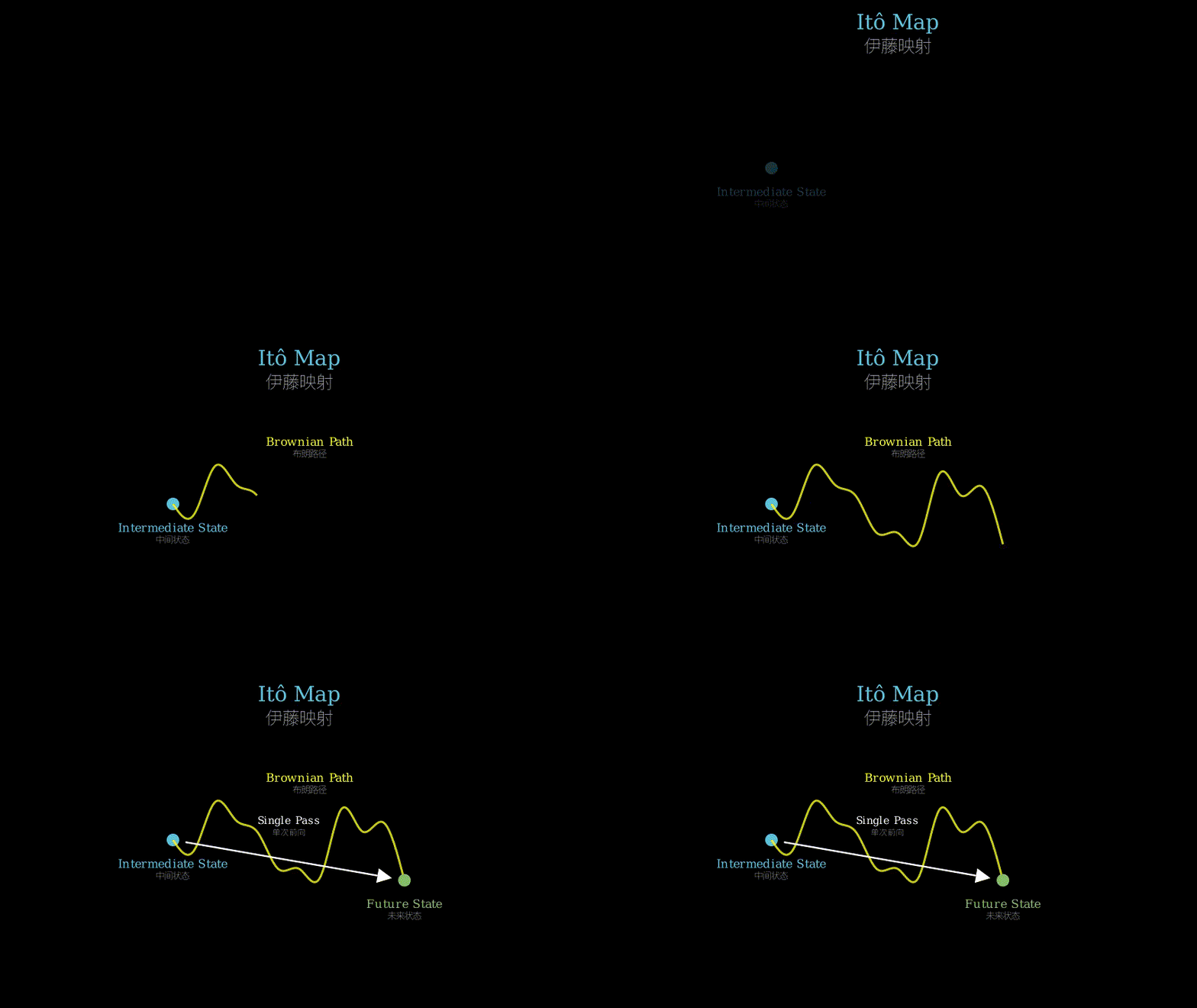
Recent one-step generative models (Rectified Flow, Flow Matching, Consistency Models) learn deterministic flow maps from ODEs. They accelerate sampling but ignore the stochasticity inherent in score-based diffusion or Langevin dynamics. Prior work cannot exactly distill a multi-step SDE into a single deterministic or stochastic map — they either approximate or keep multiple steps. This paper bridges that gap by defining the Itô map: a stochastic flow that ingests a Brownian path segment and outputs the SDE endpoint in one pass.
+---
-------------------------------+ +-------------------------------------+
| Problem: Existing one-step | | Assumption: A single stochastic |
| flow maps are deterministic | ---> | map can exactly integrate |
| (ODE only) | | any-step SDE dynamics |
+----------------------------------+ +-------------------------------------+
|
v
+----------------------------------+ +-------------------------------------+
| Method: Itô map f(x_t, B) -> x_T | | Evidence: Conditional validity |
| trained via conditional flow | <--- | (marginal/conditional tests) |
| matching | | + steering experiments on images |
+----------------------------------+ +-------------------------------------+
|
v
+-----------------------------------------------------------------+
| Conclusion: Any-step SDE integration is a useful primitive |
| for posterior sampling and stochastic control |
+-----------------------------------------------------------------+
The Increment
One sentence: Before this paper, SDEs required iterative simulation or approximation for generative sampling; after this paper, any-step SDE integration is possible in a single forward pass via the Itô map.
Core Mechanism
The Itô map is a function , where is an intermediate state and is the full Brownian path from time to . The key insight: by conditioning on the entire Brownian path, the SDE trajectory becomes deterministic, so learning the endpoint mapping reduces to a conditional regression problem.
Training proceeds via conditional flow matching: sample a random intermediate time , an initial state , and a Brownian path . Generate the SDE solution by numerically simulating the SDE with that specific path (or use a known closed form). Then train a neural network to predict , using a simple MSE loss. At inference, given any and a newly sampled Brownian path, outputs the corresponding endpoint in one shot.
The neural network architecture typically consists of two encoders: one for the state (e.g., a U-Net backbone) and one for the Brownian path (e.g., a transformer that processes discretized path values). Their outputs are fused, then passed to a prediction head that outputs .
Input: (x_t, B sampled path)
        |                |
        v                v
   [State Encoder]  [Path Encoder]
        |                |
        +-----[Fusion]----+
                |
          [Prediction Head]
                |
                v
         Output: x_T (predicted endpoint)
Structural metaphor: Think of the Itô map as a recipe transformer. You have a partially cooked dish (state ) and a detailed step-by-step recipe (Brownian path ). The original recipe requires you to follow each step sequentially (iterative SDE solve). The Itô map is a master chef who, given the current state and the full recipe, can directly plate the final dish in one go. The recipe encodes all randomness (e.g., “add a pinch of salt at step 3” is fixed), so the chef only needs to learn the mapping from (current dish, recipe) → final dish. Different chefs (network weights) can be trained on many (dish, recipe, final) triplets.
Key Concepts
-
Stochastic Flow Map: A function that maps an initial or intermediate state (and possibly external randomness) to a final state, preserving the distribution of the underlying SDE. Unlike deterministic flow maps (which collapse noise), stochastic flow maps retain the randomness from the Brownian path, allowing them to generate diverse but conditionally valid samples.
-
Path Conditioning: The method conditions on the *entire Brownian path, not just the initial noise. This transforms the SDE into a deterministic mapping from path to endpoint. In practice, paths are discretized into a sequence of Brownian increments; a transformer or RNN encodes this sequence into a fixed-size embedding that is injected into the network.
-
Conditional Validity: For a given intermediate state , the Itô map’s outputs, when marginalized over the Brownian path, should match the true conditional distribution . The paper verifies this by comparing histograms or using statistical tests (e.g., energy distance) between generated and ground-truth conditional samples.
Framework Shift
The core shift is from iterative local simulation to global single-pass prediction conditioned on path randomness.
Before (mainstream approach):         After (this paper):
  x_0                                    x_0 + sampled path B
   |                                        |
   v                                        v
  [SDE Step 1]                          [Itô map network]
   |                                        |
   v                                        v
  x_1                                      x_T (predicted endpoint)
   |
   v
  [SDE Step 2]
   |
   v
  ... (many steps)
   |
   v
  x_T (sampled after N steps)
One sentence: From multi-step iterative SDE simulation to single-pass conditional prediction, the core shift is replacing temporal iteration with function approximation of the entire flow.
Expert Assessment
Problem choice: Real gap. ODE-based one-step models are popular but ignore stochasticity; this paper directly addresses the missing piece for SDEs. However, the question “do we need exact SDE integration?” is open — many applications use deterministic flows and get away with it.
Method maturity: A clever combination of conditional flow matching and path conditioning, but the idea of conditioning on the Brownian path is not entirely new (used in diffusion bridge literature). The main novelty is framing it as a general-purpose “any-step” primitive. The training requires generating full Brownian paths, which could be costly in high dimensions.
Experimental integrity: The paper provides conditional validity tests (histograms, energy distance) and steering results on synthetic data and CIFAR-10. Baselines are reasonable (multi-step SDE, one-step ODE). Minor red flag: the steering experiments only show qualitative outputs; quantitative comparisons to other stochastic control methods are missing.
Writing quality: The abstract and introduction are sharp. However, section 3 (training details) feels rushed — the network architecture for path encoding is described only vaguely. A more detailed ablation (e.g., transformer vs RNN for path embedding) would strengthen the paper.
Verdict: weak accept — The idea of an any-step SDE map is useful and the method is sound, but the paper lacks thorough comparison to simpler alternatives (e.g., just adding noise to ODE flows) and needs clearer architectural guidance.
Takeaways
-
Conditional flow matching on noise paths: This technique can be pulled out and applied to any stochastic dynamical system where you want to jump from an intermediate state to the endpoint. For example, in reinforcement learning with stochastic environments, you could learn an Itô-like map to predict terminal rewards given partial trajectories.
-
Path encoding as a first-class input: Treating the noise trajectory as a learnable embedding (instead of using a fixed noise seed) unlocks the ability to do posterior inference and control. Practitioners in diffusion models can borrow this idea to better handle stochasticity in their pipelines.
-
Single-pass posterior sampling: If you need to sample from for many different or many different observed states, the Itô map amortizes the computation. This is immediately useful for inverse problems (e.g., image restoration) where you condition on partial observations.
论文: 2606.11156 作者: Zhengkai Pan, Peter Potaptchik, Wenxi Yao, Michael S. Albergo, Jakiw Pidstrigach 分类: stat.ML, cs.LG
缺口
现有的单步生成模型(整流流、流匹配、一致性模型)基于ODE学习确定性流映射。 它们加速了采样,但忽略了基于分数的扩散或Langevin动力学中固有的随机性。 先前的工作无法将多步SDE精确蒸馏为一个单一的确定性或随机映射——要么近似,要么保持多步。 这篇论文通过定义伊藤映射填补了这一空白:一种随机流映射,接收布朗路径片段并一步输出SDE终点。
+----------------------------------+      +-------------------------------------+
| 问题:现有单步流映射是确定性的    |      | 假设:存在一个单一随机映射          |
| (仅ODE)                        | ---> | 可以精确整合任意步SDE动力学          |
+----------------------------------+      +-------------------------------------+
                                                          |
                                                          v
+----------------------------------+      +-------------------------------------+
| 方法:伊藤映射 f(x_t, B) -> x_T  |      | 证据:条件有效性                     |
| 通过条件流匹配训练                | <--- | (边缘/条件测试)                    |
|                                   |      | + 图像上的引导实验                  |
+----------------------------------+      +-------------------------------------+
                                                          |
                                                          v
+-----------------------------------------------------------------+
| 结论:任意步SDE整合成为用于后验采样和随机控制的有用原语          |
+-----------------------------------------------------------------+
增量
一句话:在这篇论文之前,SDE生成采样需要迭代模拟或近似; 在这篇论文之后,可以通过伊藤映射在单次前向中完成任意步SDE整合。
核心机制
伊藤映射是一个函数 , 其中 是中间状态, 是从时间 到 的完整布朗路径。 关键洞察:通过以完整布朗路径为条件,SDE轨迹变为确定性的, 因此学习终点映射简化为一个条件回归问题。
训练通过条件流匹配进行: 采样一个随机的中间时间 、初始状态 和一条布朗路径 。 用该特定路径数值模拟SDE获得终点 (或使用已知闭式解)。 然后训练神经网络 预测 ,使用简单的MSE损失。 推理时,给定任意 和新采样的布朗路径, 一步输出对应的终点。
网络架构通常包含两个编码器:一个用于状态 (如U-Net骨架), 一个用于布朗路径(如对离散化路径值进行处理的Transformer)。 它们的输出融合后传递给预测头,输出 。
输入: (x_t, 采样的路径B)
        |                |
        v                v
   [状态编码器]      [路径编码器]
        |                |
        +-----[融合]------+
                |
          [预测头]
                |
                v
         输出: x_T (预测终点)
结构比喻:把伊藤映射想象成一个食谱转换器。 你有一个半成品菜肴(状态 )和一份详细的步骤式食谱(布朗路径 )。 原始食谱要求你逐步遵循每个步骤(迭代SDE求解)。 伊藤映射是一位主厨,给定当前状态和完整食谱后,可以一步直接端出成品。 食谱编码了所有随机性(例如“第3步加一撮盐”是固定的), 所以主厨只需学习从(当前菜肴,食谱)到最终菜肴的映射。 不同的主厨(网络权重)可以在大量(菜肴、食谱、成品)三元组上训练。
关键概念
-
随机流映射:一个将初始或中间状态(可能外加外部随机性)映射到最终状态的函数, 同时保持底层SDE的分布。 与确定性流映射(坍缩噪声)不同,随机流映射保留了来自布朗路径的随机性, 从而生成多样但条件有效的样本。
-
路径条件化:该方法以**完整*布朗路径为条件,而不仅仅是初始噪声。 这使SDE变为从路径到终点的确定性映射。 实践中,路径被离散化为一系列布朗增量; Transformer或RNN将这些增量序列编码为固定大小的嵌入,注入到网络中。
-
条件有效性:对于给定的中间状态 , 伊藤映射的输出(在布朗路径上边缘化后)应与真实条件分布 匹配。 论文通过比较直方图或使用统计检验(如能量距离)来验证生成的和真实的条件样本。
框架转变
核心转变是从迭代局部模拟到全局单次预测(以路径随机性为条件)。
之前(主流方法):                 之后(本文方法):
  x_0                                 x_0 + 采样路径 B
   |                                    |
   v                                    v
  [SDE第一步]                        [伊藤映射网络]
   |                                    |
   v                                    v
  x_1                                  x_T (预测终点)
   |
   v
  [SDE第二步]
   |
   v
  ... (多步)
   |
   v
  x_T (N步后采样)
一句话:从多步迭代SDE模拟到单次条件预测,核心转变是用函数近似取代时间迭代。
专家评审
选题眼光:真实缺口。基于ODE的单步模型流行但忽略随机性;这篇论文直接解决了SDE的缺失部分。但”是否真的需要精确SDE整合”这个问题仍开放——许多应用使用确定性流也能工作。
方法成熟度:条件流匹配和路径条件化的巧妙结合,但以布朗路径为条件的思想并非全新(扩散桥文献中已有)。主要新颖之处是将其框架化为通用的”任意步”原语。训练需要生成完整布朗路径,在高维时可能代价高昂。
实验诚意:论文提供了条件有效性测试(直方图、能量距离)以及在合成数据和CIFAR-10上的引导结果。基线合理(多步SDE、单步ODE)。小警示:引导实验只展示了定性输出,缺少与其它随机控制方法的定量比较。
写作功力:摘要和引言很清晰。但第3节(训练细节)显得仓促——路径编码的网络架构描述模糊。对路径嵌入(Transformer vs RNN)的更详细消融会提升论文。
判决:弱接收——任意步SDE映射的想法有用且方法合理,但论文缺少与更简单替代方案(如给ODE流加噪声)的充分比较,且架构指导不够清晰。
要点总结
-
噪声路径上的条件流匹配:这项技术可以提取出来应用于任何随机动力系统,其中你想从中间状态跳转到终点。例如,在强化学习中,给定部分轨迹,你可以学习类似伊藤映射来预测最终奖励。
-
将路径编码作为第一类输入:将噪声轨迹作为可学习嵌入(而非固定种子)处理,解锁了后验推理和控制。扩散模型的实践者可以借用这个想法更好地处理流水线中的随机性。
-
单次后验采样:如果你需要为很多不同的 或不同观测状态采样 ,伊藤映射摊销了计算。这对逆问题(如图像恢复)直接有用,因为你可以以部分观测为条件。