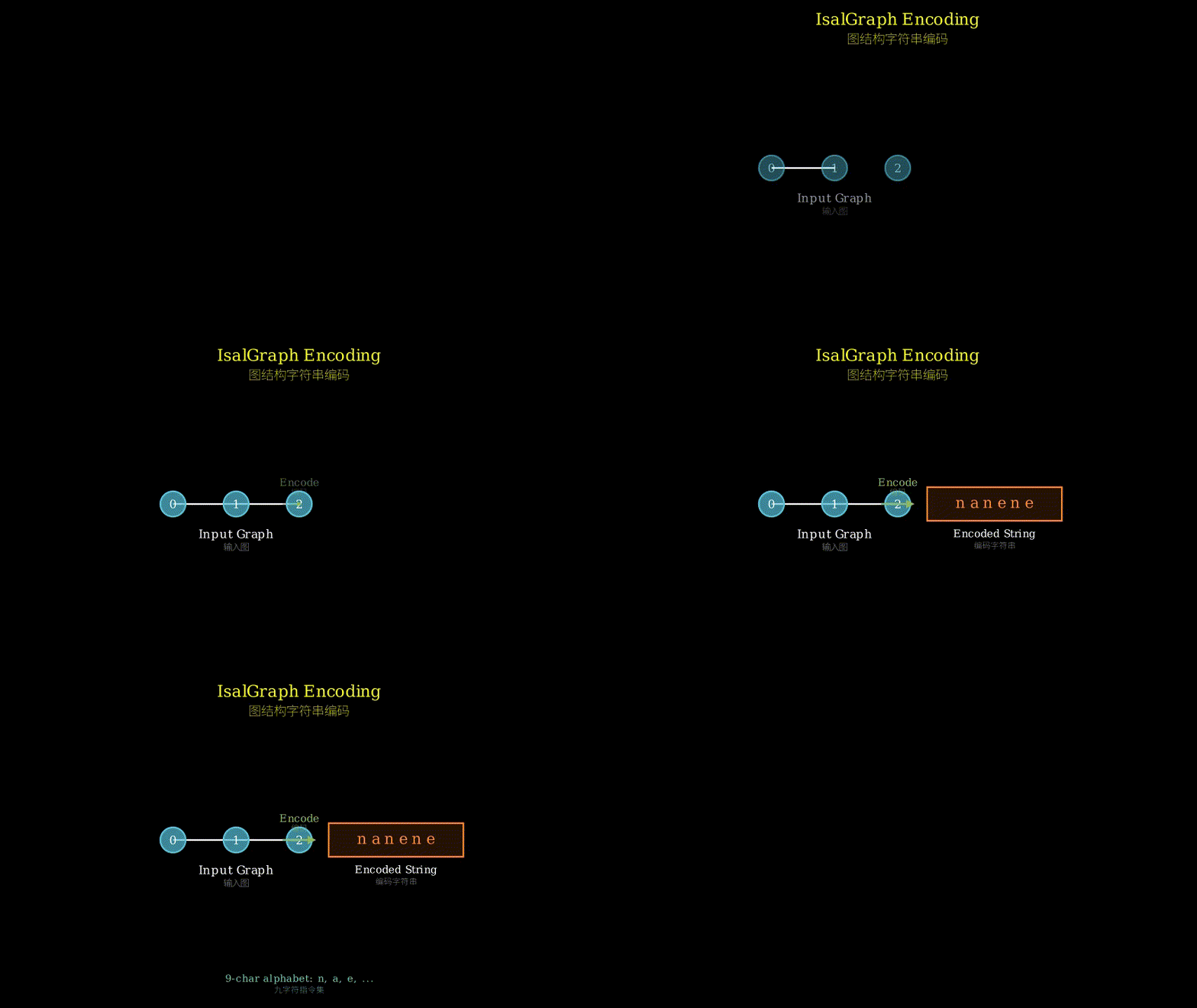
Paper: 2603.11039 Authors: Ezequiel Lopez-Rubio, Mario Pascual-Gonzalez Categories: cs.CL, cs.AI, cs.DS
The Gap
Graphs are everywhere in ML — molecules, social networks, program ASTs, knowledge graphs. But the dominant tools for working with them (GNNs, graph kernels, GED solvers) all share a structural problem: they don’t produce a flat string. That matters because the most powerful sequence models (transformers, LLMs) eat strings for breakfast. If you want to use a language model to generate or compare graphs, you need a serialization.
Prior serializations exist but each has a catch. Adjacency matrices are quadratic in size and not canonical. SMILES (for molecules) is domain-specific and breaks on non-molecular graphs. Graph6 and Sparse6 are compact but not designed for edit-distance alignment — Levenshtein distance on them doesn’t correlate with graph edit distance. And most serializations have invalid states: a random string doesn’t decode to a valid graph, which makes generative modeling painful (you need constrained decoding or heavy post-processing).
The specific gap: no general-purpose, compact, always-valid, isomorphism-invariant graph serialization whose string edit distance tracks graph edit distance.
Problem: Graphs can't be fed to sequence models without serialization
    |
    v
Prior art: Adjacency matrix (too big), SMILES (domain-locked),
           Graph6 (no GED alignment), ad-hoc (invalid states)
    |
    v
Assumption: A small virtual machine with constrained ops
            can guarantee validity by construction
    |
    v
Method: IsalGraph -- 9-instruction VM over CDLL + sparse graph
        GraphToString (greedy) + canonical variant (backtracking)
    |
    v
Evidence: Levenshtein(IsalGraph strings) ~ GED on 5 benchmark datasets
    |
    v
Conclusion: Compact, valid, canonical, LM-compatible graph encoding
The Increment
One sentence: Before this paper, feeding a graph to a language model or using string edit distance as a graph similarity proxy required ugly hacks; after it, you have a clean, always-valid encoding where Levenshtein distance is a meaningful graph metric.
Core Mechanism
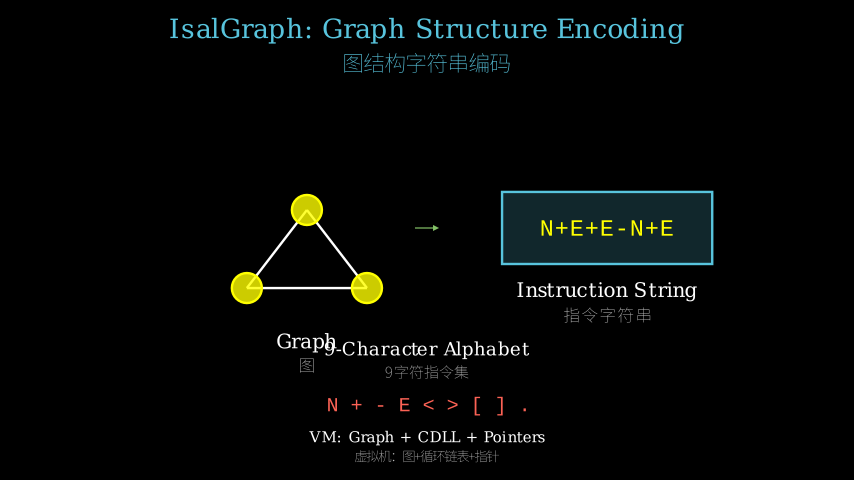
IsalGraph is a tiny virtual machine with three pieces of state: a sparse graph (nodes and edges accumulate here), a circular doubly-linked list (CDLL) of references to graph nodes, and two traversal pointers (call them P and Q) that walk around the CDLL. The nine instructions either move P or Q forward/backward around the ring, insert a new node into the graph (and add it to the CDLL), or insert an edge between the nodes currently pointed to by P and Q.
The key design insight is that every instruction is always applicable — there are no preconditions that can fail. Moving a pointer around a ring never fails. Inserting a node always succeeds (just add it). Inserting an edge between two valid pointer targets always succeeds (it’s a simple graph, so duplicates are silently ignored). This means any string over the nine-character alphabet decodes to some valid graph. No invalid states. No error handling. The VM is total.
Encoding goes the other direction. The greedy GraphToString picks a starting node, initializes the CDLL with it, then repeatedly finds the cheapest instruction sequence to bring the next unvisited node or edge into scope and emits those instructions. The canonical variant runs this over all possible starting nodes and all valid traversal orders, keeping the lexicographically smallest shortest string — giving you an isomorphism-invariant fingerprint.
  Input graph G
       |
       v
  Pick start node  <----+
       |                |
       v                | (backtracking variant:
  Init CDLL + ptrs      |  try all start nodes,
       |                |  keep lex-min result)
       v                |
  Greedy emit loop -----+
  [move P? move Q? insert node? insert edge?]
       |
       v
  String s over {a,b,c,d,e,f,g,h,i}
       |
       v
  Decode: VM replays s -> reconstructs G
Think of it like giving someone directions to draw a graph on a whiteboard using only nine spoken commands. The listener holds a marker (two markers, actually — P and Q), a whiteboard (the graph), and a lazy-susan of node labels (the CDLL). You can say “spin your left marker one step clockwise,” “spin your right marker one step back,” “add a new node to the lazy-susan,” or “draw a line between whatever your two markers are pointing at right now.” Because every command is always physically doable, your listener can never get confused or stuck — any sequence of commands produces some drawing. The encoding problem is just: what’s the shortest sequence of commands that produces this specific drawing?
Key Concepts
-
Circular Doubly-Linked List (CDLL) as traversal context: The CDLL isn’t storing the graph — it’s storing a *cursor context for traversal. Think of it as a ring of bookmarks. As you encode a graph, you add new nodes to this ring and move your two pointers around it to “aim” at the nodes you want to connect next. The ring structure means pointer movement wraps around naturally, which is why it’s always valid. Without the CDLL, you’d need explicit node-addressing instructions, which would either blow up the alphabet size or introduce invalid states (what if you address a node that doesn’t exist yet?).
-
Isomorphism invariance via canonical form: Two graphs are isomorphic if one is just a relabeling of the other — same structure, different node names. A canonical encoding assigns the same string to all isomorphic graphs. IsalGraph achieves this by exhaustive search: try every starting node and every valid traversal order, take the lexicographically smallest shortest string. It’s brute-force canonicalization, not a clever polynomial-time algorithm, which is fine for small graphs but worth noting for scale.
-
Levenshtein distance as a GED proxy: Graph Edit Distance (GED) counts the minimum node/edge insertions and deletions to transform one graph into another. Computing it exactly is NP-hard. The paper’s bet is that if two graphs have similar structure, their IsalGraph strings will also be similar, so Levenshtein distance (cheap to compute) approximates GED (expensive). This is an empirical claim, not a theoretical guarantee — and the paper validates it on five datasets.
Framework Shift
Before (mainstream approach):        After (this paper):

  Graph G                              Graph G
     |                                    |
     v                                    v
  GNN / kernel / GED solver           IsalGraph VM encoder
     |                                    |
     v                                    v
  Embedding vector                     String "aabcdiefg..."
  or distance matrix                      |
     |                              +-----+-----+
     v                              v           v
  Downstream task               LM directly  Levenshtein
  (needs special arch)          ingests it   ~ GED
From task-specific graph architectures to a universal string serialization, the core shift is: treat graph structure as a language, not a topology.
Expert Assessment
Problem choice: This is a real gap, not a manufactured one. The friction between graph-structured data and sequence models is genuinely felt by anyone who’s tried to do graph generation with LLMs. The paper sits at a productive intersection of graph theory and NLP infrastructure. It’s not a flashy problem, but it’s a useful one.
Method maturity: The VM design is clever — the “always-valid by construction” property is the paper’s best idea, and it’s clean. The canonical encoding via exhaustive backtracking is less impressive; it’s exponential in the worst case and the paper doesn’t deeply analyze when it’s tractable. The greedy encoder is polynomial but not canonical, so you’re choosing between speed and uniqueness. A smarter canonicalization algorithm (e.g., based on graph automorphism groups) would strengthen the contribution significantly.
Experimental integrity: The correlation between Levenshtein distance and GED is the central empirical claim, and the five datasets (IAM Letter LOW/MED/HIGH, LINUX, AIDS) are standard benchmarks — that’s good. But the paper doesn’t compare against other serializations (Graph6, SMILES where applicable, adjacency list) on the same correlation metric. Without that baseline, you can’t tell if IsalGraph is *better or just also works. That’s a meaningful gap in the evaluation.
Writing quality: The VM specification section is precise and well-done. The weakest part is the discussion of computational complexity for the canonical encoder — it’s hand-wavy where it should be rigorous. Tightening that section (with a proper complexity analysis and a discussion of graph classes where backtracking is tractable) would elevate the paper from “interesting system paper” to “solid theoretical contribution.”
Verdict: weak accept — the core idea is sound and practically useful, but the evaluation doesn’t fully justify the claims and the canonical encoder’s complexity is underanalyzed.
Takeaways
-
The “always-valid by construction” VM design is directly stealable for any domain where you want to do generative modeling over structured objects. If you can define a small instruction set where every instruction is always applicable, you get free validity guarantees for any sequence model you train on it. This pattern applies to trees, DAGs, chemical reactions, even simple programs.
-
Using a CDLL as a traversal cursor (rather than explicit addressing) is a nice trick for keeping the instruction alphabet small while maintaining enough expressiveness to reach any node. Worth thinking about in other serialization contexts.
-
The Levenshtein-as-GED-proxy idea is practically useful even if theoretically loose. If you’re doing graph similarity search and GED is too slow, this gives you a cheap approximate metric that’s easy to implement and doesn’t require a GNN.
论文: 2603.11039 作者: Ezequiel Lopez-Rubio, Mario Pascual-Gonzalez 分类: cs.CL, cs.AI, cs.DS
缺口
图结构数据在机器学习中无处不在——分子、社交网络、程序语法树、知识图谱。 但处理它们的主流工具(图神经网络、图核方法、GED求解器)都有一个共同的结构性问题:它们不产生平坦的字符串。 这很要命,因为当今最强大的序列模型(Transformer、大语言模型)吃的就是字符串。 如果你想用语言模型来生成或比较图,你必须先把图序列化。
现有的序列化方案各有硬伤。 邻接矩阵的大小是节点数的平方,也不是规范形式。 SMILES专为分子设计,对非分子图无能为力。 Graph6和Sparse6虽然紧凑,但不是为编辑距离对齐设计的——在它们上面算Levenshtein距离,和图编辑距离(GED)没什么相关性。 更麻烦的是,大多数序列化方案都有”非法状态”:一个随机字符串解码不出合法的图,这让生成式建模非常痛苦,你需要约束解码或繁重的后处理。
具体的缺口是:没有一种通用的、紧凑的、始终合法的、同构不变的图序列化方案,其字符串编辑距离能追踪图编辑距离。
问题:图结构无法直接喂给序列模型,必须先序列化
    |
    v
现有方案:邻接矩阵(太大)、SMILES(领域锁定)、
          Graph6(与GED不对齐)、临时方案(有非法状态)
    |
    v
假设:一个操作受限的小型虚拟机
      可以通过构造保证输出始终合法
    |
    v
方法:IsalGraph -- 基于CDLL和稀疏图的9指令虚拟机
      GraphToString(贪心)+ 规范变体(回溯穷举)
    |
    v
证据:在5个基准数据集上,Levenshtein(IsalGraph字符串) ~ GED
    |
    v
结论:紧凑、合法、规范、兼容语言模型的图编码方案
增量
一句话:这篇论文之前,把图喂给语言模型或用字符串编辑距离近似图相似度都需要丑陋的变通;之后,你有了一个干净的、始终合法的编码,其中Levenshtein距离是有意义的图度量。
核心机制
IsalGraph是一个只有三块状态的微型虚拟机:一个稀疏图(节点和边在这里累积)、一个存储图节点引用的循环双向链表(CDLL)、以及两个在CDLL上游走的遍历指针(称为P和Q)。 九条指令要么让P或Q在环上前进/后退,要么向图中插入新节点(同时加入CDLL),要么在P和Q当前指向的两个节点之间插入一条边。
核心设计洞察是:每条指令在任何时候都可以执行——没有任何前置条件会失败。 在环上移动指针永远不会失败。 插入节点总是成功(直接加进去)。 在两个有效指针目标之间插入边总是成功(简单图,重复边静默忽略)。 这意味着九字符字母表上的任意字符串都能解码为某个合法的图。 没有非法状态,不需要错误处理,虚拟机是全函数的。
编码走反方向。
贪心版GraphToString选一个起始节点,用它初始化CDLL,然后反复找到最便宜的指令序列把下一个未访问的节点或边纳入视野,并输出这些指令。
规范变体在所有可能的起始节点和所有合法遍历顺序上运行这个过程,保留字典序最小的最短字符串——得到一个同构不变的指纹。
  输入图 G
       |
       v
  选择起始节点  <----+
       |             |
       v             | (回溯变体:
  初始化CDLL+指针    |  尝试所有起始节点,
       |             |  保留字典序最小结果)
       v             |
  贪心输出循环 ------+
  [移动P?移动Q?插入节点?插入边?]
       |
       v
  字符串 s,字符来自 {a,b,c,d,e,f,g,h,i}
       |
       v
  解码:VM重放 s -> 重建图 G
想象一下,你在用九种口头指令指挥别人在白板上画图。 听者手持两支马克笔(P和Q),面前有一块白板(图)和一个懒人转盘(CDLL),转盘上放着节点标签。 你可以说”把左手笔顺时针转一格”、“把右手笔逆时针转一格”、“在转盘上加一个新节点”、或者”在你两支笔现在指着的节点之间画一条线”。 因为每条指令在物理上永远可以执行,听者永远不会卡住——任何指令序列都能产生某张图。 编码问题就是:产生这张特定图的最短指令序列是什么?
关键概念
-
CDLL作为遍历上下文:CDLL存储的不是图本身,而是遍历的**游标上下文*。 把它想成一圈书签。 编码图的过程中,你把新节点加入这个环,移动两个指针来”瞄准”下一个要连接的节点。 环形结构让指针移动自然地绕回,这就是为什么它永远合法。 没有CDLL,你就需要显式的节点寻址指令,要么让字母表爆炸,要么引入非法状态(如果你寻址一个还不存在的节点怎么办?)。
-
通过规范形式实现同构不变性:两个图同构,意味着一个只是另一个的节点重标签——结构相同,名字不同。 规范编码给所有同构图分配相同的字符串。 IsalGraph通过穷举搜索实现这一点:尝试每个起始节点和每种合法遍历顺序,取字典序最小的最短字符串。 这是暴力规范化,不是聪明的多项式时间算法,对小图没问题,但规模化时值得注意。
-
Levenshtein距离作为GED代理:图编辑距离(GED)计算将一个图变换为另一个图所需的最少节点/边插入和删除次数。 精确计算是NP难的。 本文的赌注是:如果两个图结构相似,它们的IsalGraph字符串也会相似,所以Levenshtein距离(计算廉价)可以近似GED(计算昂贵)。 这是一个经验性主张,不是理论保证——论文在五个数据集上验证了它。
框架转变
之前(主流方法):                    之后(本文方法):

  图 G                                  图 G
     |                                     |
     v                                     v
  GNN / 图核 / GED求解器             IsalGraph VM编码器
     |                                     |
     v                                     v
  嵌入向量                            字符串 "aabcdiefg..."
  或距离矩阵                               |
     |                               +-----+-----+
     v                               v           v
  下游任务                        LM直接        Levenshtein
  (需要专用架构)                 消费          ~ GED
从面向任务的图专用架构,到通用字符串序列化,核心转变是:把图结构当作一种语言来处理,而不是一种拓扑结构。
专家评审
选题眼光:这是真缺口,不是人造的。 图结构数据和序列模型之间的摩擦,是任何尝试用LLM做图生成的人都切实感受过的。 这篇论文站在图论和NLP基础设施的交叉点上,不是炫目的问题,但是有用的问题。
方法成熟度:VM设计是聪明的——“构造保证合法”这个性质是本文最好的想法,而且干净利落。 通过穷举回溯实现规范编码就没那么令人印象深刻了;最坏情况下是指数级的,论文对何时可行的分析也不够深入。 贪心编码器是多项式时间的但不规范,所以你在速度和唯一性之间二选一。 一个更聪明的规范化算法(比如基于图自同构群的方法)会显著加强这个贡献。
实验诚意:Levenshtein距离与GED的相关性是核心经验主张,五个数据集(IAM Letter LOW/MED/HIGH、LINUX、AIDS)是标准基准——这很好。 但论文没有在同一相关性指标上与其他序列化方案(Graph6、适用时的SMILES、邻接表)做比较。 没有这个基线,你无法判断IsalGraph是更好还是也能用。 这是评估中一个有意义的缺口。
写作功力:VM规范部分精确,写得好。 最弱的部分是规范编码器的计算复杂度讨论——在应该严谨的地方含糊其辞。 把那一节收紧(加上正式的复杂度分析,以及讨论回溯在哪些图类上可行)会让这篇论文从”有趣的系统论文”升级为”扎实的理论贡献”。
判决:弱接收——核心想法健全且有实用价值,但评估没有充分支撑主张,规范编码器的复杂度分析不足。
要点总结
“构造保证合法”的VM设计模式可以直接迁移到任何你想对结构化对象做生成式建模的领域。 只要你能定义一套每条指令永远可执行的小型指令集,你就能为任何在其上训练的序列模型免费获得合法性保证——这个模式适用于树、DAG、化学反应,甚至简单程序。
用CDLL作为遍历游标(而非显式寻址)是一个保持指令字母表小巧同时维持足够表达力的好技巧,在其他序列化场景中值得借鉴。
Levenshtein-作为-GED-代理的思路在实践中很有用,即便理论上不严格。 如果你在做图相似度搜索而GED太慢,这给了你一个廉价的近似度量,易于实现,不需要GNN。