Paper: 2606.03988 Authors: Mahtab Bigverdi, Lindsey Li, Weikai Huang, Yiming Liu, Jaemin Cho, Jieyu Zhang, Tuhin Kundu, Chris Dangjoo Kim, Zelun Luo, Linda Shapiro Categories: cs.AI
The Gap
Vision language models (VLMs) like GPT-4V and Gemini handle direct perception well—if you show them an image and ask what’s there, they answer correctly. But throw spatial reasoning at them where critical information is occluded or requires imagining alternative viewpoints, and they crumble. Prior work tried textual chain-of-thought (CoT) reasoning, essentially forcing the model to verbalize spatial computations through language. The problem: spatial structure doesn’t compress well into linear text. You’re asking a model to describe a 3D rotation or trace an occluded path using words, which is like trying to explain how to tie shoelaces over the phone.
The boundary this paper addresses: VLMs lack intermediate representations for spatial imagination. They jump directly from image tokens to text output, with no way to represent “what I would see if I moved here” or “the occluded region probably looks like this.”
Problem: VLMs fail on spatial tasks requiring imagination
                    |
                    v
Assumption: Language is wrong modality for spatial reasoning
                    |
                    v
Method: Introduce Imaginative Perception Tokens (IPT)
        - Intermediate perceptual representations
        - Supervised by ground truth imagined views
                    |
                    v
Evidence: 3.4% accuracy gain on multiview counting
          Competitive with closed-source models on path tracing
          Outperforms textual CoT on spatial tasks
                    |
                    v
Conclusion: Spatial reasoning needs perceptual intermediate steps
            Forcing computation through language degrades performance
The Increment
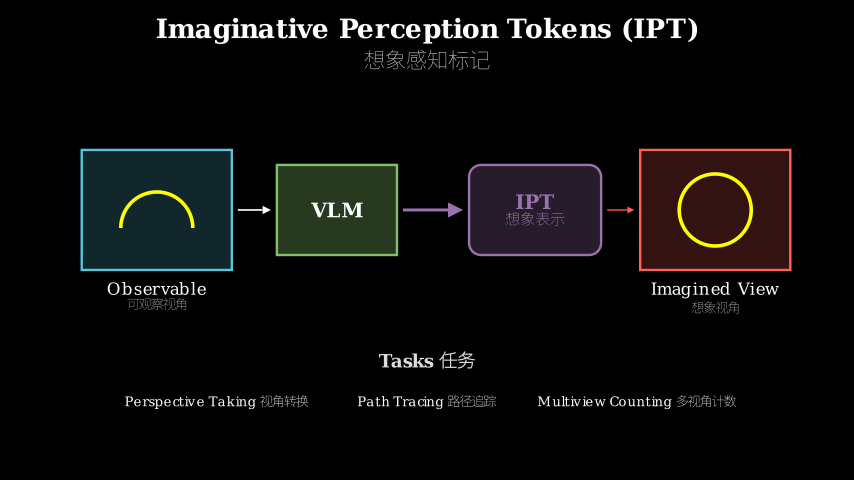
One sentence: Before this paper, VLMs reasoned about unobserved spatial structure by verbalizing it awkwardly in text; after, they generate intermediate perceptual tokens representing imagined views, keeping spatial computation in the visual modality.
Core Mechanism
IPT adds a bottleneck layer between the vision encoder and the final answer. When the model encounters a spatial reasoning task, it first generates IPT—tokens that represent what the model would perceive under alternative spatial configurations (different viewpoint, occluded region filled in, multiple partial views integrated). These tokens are supervised using ground truth “imagination” data: for perspective-taking tasks, the ground truth is the actual image from the target viewpoint; for path tracing, it’s a visualization of the occluded path; for multiview counting, it’s integrated representations of multiple views.
The architecture uses BAGEL (a unified VLM) as the backbone. During training, IPT are generated as intermediate outputs, then fed back into the model alongside the original image tokens to produce the final answer. At inference, you can either generate actual images from IPT (using a decoder) to visualize what the model imagined, or skip image generation entirely and just use the tokens internally—the paper shows both work, but skipping generation is faster.
Input Image --> Vision Encoder --> Image Tokens
                                        |
                                        v
                      [Generate Imaginative Perception Tokens]
                                        |
                                        v
                                      IPT
                                        |
                                        v
                Image Tokens + IPT --> LLM Decoder --> Answer
                                        ^
                                        |
                        (supervised by ground truth imagination)
Think of IPT like architectural blueprints. When an architect designs a building, they don’t describe every angle and sightline in text—they draw elevations, cross-sections, and perspective views. Each drawing is an “imagination” of what you’d see from a specific vantage point or if you sliced through the structure. IPT are those cross-sections for spatial reasoning: instead of verbalizing “if I stood here, I would see X, which means Y,” the model draws the intermediate perceptual state. The original image is the building’s exterior photo; IPT are the internal views you’d need to reason about the structure. The final answer is the architectural conclusion (e.g., “this hallway connects to that room”). By generating these intermediate drawings, the model keeps spatial computation in the visual domain where distances, angles, and occlusions have natural representations, rather than forcing it through the lossy codec of language.
Key Concepts
-
Imaginative Perception: VLMs typically reason over what’s directly observable in an image. Imaginative perception is the ability to infer what would be perceived under counterfactual spatial conditions—a different viewpoint, an occluded space made visible, or multiple fragmentary observations unified. It’s not hallucination (making things up ungrounded in input), but disciplined extrapolation: “Given what I see and the laws of 3D geometry, this is what I would see if X.” For example, if you show a model a photo of a street corner from the south, imaginative perception would generate what the same scene looks like from the north, constrained by the visible buildings, perspective geometry, and common-sense spatial layout. The key is that these imagined perceptions remain consistent with observed input—they’re hypotheses about unobserved structure, not random generation.
-
Modality Mismatch: Spatial reasoning involves operations like rotation, translation, occlusion reasoning, and integrating multiple viewpoints. These operations have compact representations in visual or geometric modalities (rotation matrices, 3D coordinates, depth maps), but decompress poorly into language. When you force a VLM to reason spatially through text (as in textual chain-of-thought), you’re asking it to serialize parallel spatial structure into linear tokens. It’s like describing a sculpture by listing the coordinates of every point versus just showing a 3D rendering—the latter preserves structure. This paper shows that textual CoT degrades performance on spatial tasks because the modality can’t efficiently carry the computation. IPT sidestep this by keeping intermediate reasoning in the perceptual modality.
Framework Shift
Before (textual CoT approach):        After (IPT approach):

Image --> Tokens --> LLM              Image --> Tokens --> IPT Generator
            |                                      |              |
            v                                      v              v
      "If I rotate..."                         [visual         IPT
      "Then I would see..."                  imagination]        |
      "Which means..."                                           v
            |                                             Tokens + IPT
            v                                                     |
         Answer                                                   v
                                                               Answer

(spatial computation                  (spatial computation stays
 forced through text)                  in visual modality)
One sentence: From serializing spatial structure into text descriptions, to generating intermediate perceptual representations that externalize imagined views, the core shift is keeping spatial reasoning in the modality where it’s naturally structured.
Expert Assessment
Problem choice: Real gap. Spatial reasoning is a known weak spot for VLMs, and the limitation of textual CoT for spatial tasks is under-explored. The problem sits at the intersection of embodied AI (where spatial reasoning matters for robotics) and multimodal reasoning (where vision-language integration struggles). Not a manufactured problem—it’s well-motivated by actual failure modes.
Method maturity: Clever insight, but execution is straightforward. The core idea—intermediate perceptual representations supervised by ground truth imaginations—is sound. The simplicity is a feature: you’re just adding a supervised intermediate step. However, the reliance on ground truth imagination data limits generalizability. The paper uses rendered or captured ground truth views for supervision, which works for their three tasks but doesn’t scale to arbitrary spatial reasoning. A future direction would be self-supervised IPT or learning to imagine without ground truth.
Experimental integrity: Baselines are fair. They compare against textual CoT, label-only supervision, and closed-source models (GPT-4V, Gemini). The numbers are modest (3.4% gain on multiview counting) but consistent. One concern: the tasks are somewhat narrow (perspective taking, path tracing, multiview counting). It’s unclear whether IPT generalize to broader spatial reasoning like 3D reconstruction or spatial question answering on real-world images. The fact that textual CoT degrades performance is compelling evidence of modality mismatch, but I’d want to see ablations on how much supervision is needed and whether IPT help on tasks where ground truth imagination isn’t available.
Writing quality: The paper is clear but front-loads motivation over mechanism. Section 3 (method) buries the architectural details—how IPT are generated, how they’re integrated into the backbone, and what the supervision signal looks like. Rewriting Section 3 to lead with a concrete example (input image → IPT generation → final answer) before diving into generalities would elevate clarity. The related work section is thorough but reads like a laundry list. Cutting it by half and focusing on the three closest lines of work (spatial reasoning in VLMs, intermediate representations, CoT vs. modality-specific reasoning) would sharpen the contribution.
Verdict: weak accept — The core insight (spatial reasoning needs perceptual intermediate steps, not textual ones) is valuable, and the evidence supports it, but the method’s generalizability is limited by reliance on ground truth imagination data, and the experimental scope is narrow.
Takeaways
Supervision signal for imagination: The idea of supervising intermediate representations with “what you would perceive under alternative conditions” transfers beyond spatial reasoning. For temporal reasoning (predicting future frames), causal reasoning (imagining counterfactual outcomes), or even code generation (imagining intermediate execution states), you can apply the same pattern: generate intermediate perceptual or symbolic states supervised by ground truth alternatives, then use those states to improve final predictions.
Modality-specific reasoning: The evidence that textual CoT degrades spatial reasoning performance is a wake-up call. If your task has natural structure in a non-linguistic modality (visual, geometric, temporal), forcing intermediate reasoning through text may hurt rather than help. Consider whether your CoT should be visual (like IPT), symbolic (like execution traces), or stay in the domain where the computation is naturally expressed.
Externalize imagination for interpretability: Generating IPT at inference time produces human-interpretable intermediate views. This is useful for debugging model failures—if the model gets the wrong answer, you can inspect the imagined view to see where spatial reasoning broke down. This pattern (externalize intermediate reasoning as inspectable artifacts) applies to any domain where interpretability matters.
论文: 2606.03988 作者: Mahtab Bigverdi, Lindsey Li, Weikai Huang, Yiming Liu, Jaemin Cho, Jieyu Zhang, Tuhin Kundu, Chris Dangjoo Kim, Zelun Luo, Linda Shapiro 分类: cs.AI
缺口
像 GPT-4V 和 Gemini 这样的视觉语言模型(VLM)处理直接感知没问题——给它们看一张图问里面有什么,它们答得对。
但扔给它们需要空间推理的任务,关键信息被遮挡或需要想象换个角度会看到什么时,它们就崩了。
之前的工作试过文本思维链(CoT)推理,本质上是强迫模型用语言把空间计算说出来。
问题在于:空间结构压缩不进线性文本。
你在要求模型用文字描述一个 3D 旋转或追踪一条被遮挡的路径,这就像试图在电话里教人系鞋带。
本文要解决的边界:VLM 缺乏空间想象的中间表征。
它们从图像标记直接跳到文本输出,没有办法表示”如果我走到这里会看到什么”或”被遮挡的区域可能长这样”。
问题:VLM 在需要想象的空间任务上失败
                    |
                    v
假设:语言是空间推理的错误模态
                    |
                    v
方法:引入想象感知标记(IPT)
      - 中间感知表征
      - 由真实想象视图监督
                    |
                    v
证据:多视角计数准确率提升 3.4%
      路径追踪上与闭源模型竞争
      空间任务上超越文本 CoT
                    |
                    v
结论:空间推理需要感知中间步骤
      强行通过语言计算会降低性能
增量
一句话:本文之前,VLM 通过在文本中笨拙地描述来推理未观察到的空间结构;本文之后,它们生成表示想象视图的中间感知标记,让空间计算留在视觉模态中。
核心机制
IPT 在视觉编码器和最终答案之间加了一个瓶颈层。
当模型遇到空间推理任务时,它首先生成 IPT——表示模型在替代空间配置下(不同视角、遮挡区域被填充、多个局部视图被整合)会感知到什么的标记。
这些标记由真实”想象”数据监督:对视角转换任务,真实值是目标视角的实际图像;对路径追踪,是被遮挡路径的可视化;对多视角计数,是多个视图的整合表征。
架构使用 BAGEL(一个统一的 VLM)作为骨干。
训练期间,IPT 作为中间输出生成,然后和原始图像标记一起反馈给模型以产生最终答案。
推理时,你可以从 IPT 生成实际图像(使用解码器)来可视化模型想象了什么,也可以完全跳过图像生成,只在内部使用标记——论文显示两种方式都有效,但跳过生成更快。
输入图像 --> 视觉编码器 --> 图像标记
                                |
                                v
                  [生成想象感知标记]
                                |
                                v
                              IPT
                                |
                                v
          图像标记 + IPT --> LLM 解码器 --> 答案
                                ^
                                |
                (由真实想象监督)
把 IPT 想象成建筑图纸。
建筑师设计建筑时,不会用文字描述每个角度和视线——他们画立面图、剖面图和透视图。
每张图都是从特定视角或切开结构后”想象”你会看到什么。
IPT 就是空间推理的那些剖面图:模型不用说”如果我站在这里,我会看到 X,这意味着 Y”,而是画出中间感知状态。
原始图像是建筑的外观照片;IPT 是你推理结构需要的内部视图。
最终答案是建筑结论(比如”这条走廊连到那个房间”)。
通过生成这些中间图纸,模型让空间计算留在视觉域中,距离、角度和遮挡在那里有自然表示,而不是强行通过语言这个有损编解码器。
关键概念
- 想象感知:VLM 通常对图像中直接可观察的内容进行推理。
想象感知是推断在反事实空间条件下会感知到什么的能力——不同视角、遮挡空间变可见、或多个碎片观察被统一。
它不是幻觉(凭空编造与输入无关的东西),而是有纪律的外推:“鉴于我看到的和 3D 几何定律,如果 X 我会看到这个。
“比如,如果给模型看一张从南面拍的街角照片,想象感知会生成同一场景从北面看是什么样,受可见建筑、透视几何和常识空间布局约束。
关键在于这些想象的感知与观察到的输入保持一致——它们是关于未观察结构的假设,不是随机生成。
- 模态不匹配:空间推理涉及旋转、平移、遮挡推理和整合多视角等操作。
这些操作在视觉或几何模态中有紧凑表示(旋转矩阵、3D 坐标、深度图),但解压到语言中很糟糕。
当你强迫 VLM 通过文本进行空间推理(如文本思维链)时,你在要求它把并行的空间结构串行化为线性标记。
这就像通过列出每个点的坐标来描述雕塑,而不是直接展示 3D 渲染——后者保留了结构。
本文显示文本 CoT 在空间任务上降低性能,因为该模态无法高效承载计算。
IPT 通过让中间推理留在感知模态中绕过了这一点。
框架转变
之前(文本 CoT 方法):             之后(IPT 方法):

图像 --> 标记 --> LLM               图像 --> 标记 --> IPT 生成器
            |                                   |              |
            v                                   v              v
      "如果我旋转..."                        [视觉          IPT
      "那我会看到..."                        想象]            |
      "这意味着..."                                           v
            |                                          标记 + IPT
            v                                                  |
          答案                                                 v
                                                             答案

(空间计算被强行                    (空间计算留在
  通过文本进行)                      视觉模态中)
一句话:从把空间结构串行化为文本描述,到生成外化想象视图的中间感知表征,核心转变是让空间推理留在它自然结构化的模态中。
专家评审
选题眼光:真缺口。
空间推理是 VLM 的已知弱点,文本 CoT 在空间任务上的局限性探索不足。
问题位于具身 AI(空间推理对机器人很重要)和多模态推理(视觉-语言整合挣扎之处)的交叉点。
不是人造问题——由实际失效模式充分驱动。
方法成熟度:巧劲,但执行直接。
核心想法——由真实想象监督的中间感知表征——是合理的。
简单性是特点:你只是加了一个受监督的中间步骤。
然而,对真实想象数据的依赖限制了泛化能力。
论文对三个任务使用渲染或捕获的真实视图进行监督,这对它们的任务有效,但不能扩展到任意空间推理。
未来方向是自监督 IPT 或学习在没有真实值的情况下想象。
实验诚意:基线公平。
他们与文本 CoT、仅标签监督和闭源模型(GPT-4V、Gemini)比较。
数字适度(多视角计数提升 3.4%)但一致。
一个担忧:任务有些狭窄(视角转换、路径追踪、多视角计数)。
不清楚 IPT 是否泛化到更广泛的空间推理,如 3D 重建或真实世界图像上的空间问答。
文本 CoT 降低性能这一事实是模态不匹配的有力证据,但我想看消融研究需要多少监督,以及 IPT 在无真实想象可用时是否有帮助。
写作功力:论文清晰但前置动机多过机制。
第 3 节(方法)埋藏了架构细节——IPT 如何生成、如何整合到骨干中、监督信号是什么样。
重写第 3 节,在深入一般性之前先用具体例子(输入图像 → IPT 生成 → 最终答案)引导,会提升清晰度。
相关工作部分详尽但读起来像流水账。
砍掉一半,聚焦三条最接近的工作线(VLM 中的空间推理、中间表征、CoT vs 模态特定推理)会锐化贡献。
判决:弱接收 — 核心洞察(空间推理需要感知中间步骤,而非文本步骤)有价值,证据支持它,但方法的泛化能力受真实想象数据依赖限制,实验范围狭窄。
要点总结
想象的监督信号:“在替代条件下你会感知到什么”监督中间表征的想法,可迁移到空间推理之外。
对时间推理(预测未来帧)、因果推理(想象反事实结果)、甚至代码生成(想象中间执行状态),你可以应用同样的模式:生成由真实替代方案监督的中间感知或符号状态,然后用这些状态改进最终预测。
模态特定推理:文本 CoT 降低空间推理性能的证据是个警钟。
如果你的任务在非语言模态(视觉、几何、时间)中有自然结构,强行通过文本进行中间推理可能有害无益。
考虑你的 CoT 应该是视觉的(如 IPT)、符号的(如执行轨迹)、还是留在计算自然表达的域中。
外化想象以获得可解释性:推理时生成 IPT 产生人类可解释的中间视图。
这对调试模型失败有用——如果模型得到错误答案,你可以检查想象的视图,看空间推理在哪里崩溃。
这种模式(将中间推理外化为可检查的工件)适用于任何可解释性重要的领域。