
Paper: 2603.30022 Authors: Md Saad, Sajjad Hussain, Mohd Suhaib Categories: cs.RO, cs.AI
The Gap
Existing robotic manipulation systems face a split-brain problem. Pure RL approaches excel at low-level motor control—precise joint movements, force regulation—but struggle with abstract task understanding. They can’t parse “put the red block on top” without extensive reward engineering. Meanwhile, LLM-based planners understand natural language beautifully but lack the sensorimotor grounding to execute physical actions reliably. Prior hybrid attempts either used LLMs as mere prompt generators (losing their reasoning power) or RL as a black-box executor (losing interpretability). The gap: no architecture that lets each component operate in its strength zone while maintaining tight bidirectional coupling.
Problem: RL good at "how", LLM good at "what", but no bridge
    |
    v
Assumption: Hierarchical decomposition can separate concerns
    |
    v
Method: LLM generates symbolic plans -> RL executes primitives -> feedback loop
    |
    v
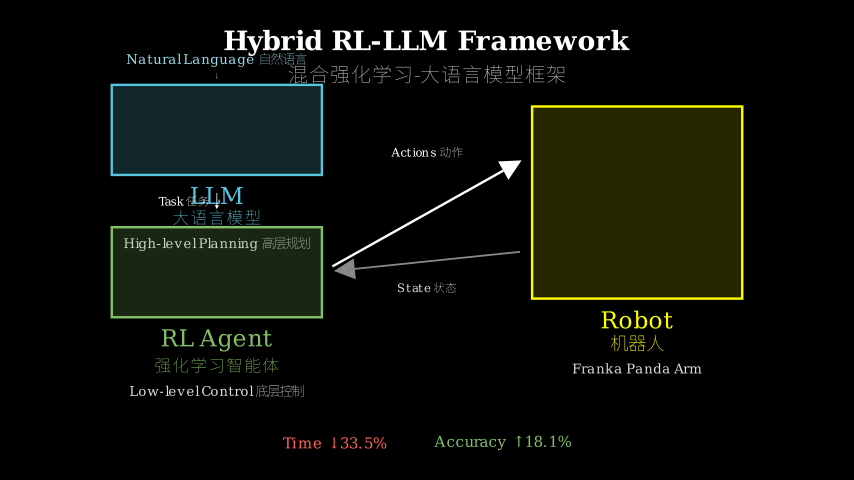
Evidence: 33.5% faster completion, 36.4% better adaptation (PyBullet sim)
    |
    v
Conclusion: Hybrid architecture viable for complex manipulation tasks
The Increment
One sentence: Before this paper, robots chose between understanding instructions OR executing them reliably; after, they can do both by treating LLMs as task decomposers and RL as skill executors in a closed loop.
Core Mechanism
The framework operates in three layers. At the top, an LLM receives natural language commands and converts them into a sequence of symbolic sub-goals (e.g., “grasp object” → “move to position” → “release”). The middle layer translates these symbols into parameterized action primitives that the RL agent understands. At the bottom, a pre-trained RL policy executes each primitive, returning success/failure signals and environmental observations back up the chain.
Data flows bidirectionally. Downward: LLM outputs structured plans as JSON-like action sequences. The translator maps each action to RL’s continuous control space (joint angles, gripper states). Upward: RL’s execution results (task success, collision detection, object states) feed back to the LLM, which can replan if the original strategy fails. This creates a sense-plan-act-revise cycle.
Natural Language Input
         |
         v
    +--------+
    |  LLM   |  <--- Feedback (success/fail, object states)
    +--------+
         |
         v (symbolic plan: [grasp, move, place])
    +----------+
    | Symbolic |
    | Mapper   |
    +----------+
         |
         v (action primitives with params)
    +--------+
    |   RL   |  ---> Physical execution
    | Policy |       (joint control, gripper)
    +--------+
         |
         v
    Environment
Think of it like a construction site. The LLM is the architect who reads blueprints and breaks the project into phases: “first pour foundation, then frame walls, then install roof.” The RL agent is the skilled crew that knows how to operate the machinery—mixing concrete, welding beams. The symbolic mapper is the foreman translating architect-speak into crew instructions. When the crew hits bedrock unexpectedly, they report back, and the architect revises the plan. Neither the architect nor the crew could build the house alone, but together, with the foreman coordinating, they adapt to surprises while staying on task.
Key Concepts
-
Symbolic Action Primitives: Instead of the LLM outputting raw motor commands (which it can’t ground physically) or the RL agent learning from scratch for every new task (sample inefficient), the system uses a shared vocabulary of mid-level actions. Think of them as LEGO bricks—“grasp,” “move_to,” “rotate”—each implemented as a trained RL sub-policy. The LLM composes these bricks into structures; the RL agent executes each brick reliably. This is why the system can handle novel task combinations without retraining: the primitives are reusable, and the LLM handles the combinatorics.
-
Hierarchical Feedback Loop: Most RL systems treat failure as a training signal (update weights, try again). Most LLM planners assume their plans will be followed perfectly. This framework does neither. When an RL primitive fails—say, the gripper can’t grasp a slippery object—the failure propagates up with context (“grasp failed: insufficient friction”). The LLM sees this as a reasoning problem, not a control problem, and might replan: “use two-finger pinch instead of power grasp.” This turns execution failures into planning opportunities, making the system anti-fragile.
Framework Shift
Before (mainstream approach):        After (this paper):

  Human Command                        Human Command
       |                                    |
       v                                    v
  +----------+                         +-------+
  | Monolith |                         |  LLM  | (task decomposition)
  | RL Agent |                         +-------+
  +----------+                              |
       |                                    v
       v                              +---------+
  Trial & Error                       | Symbolic|
  (millions of samples)               | Mapper  |
       |                              +---------+
       v                                    |
  Execution                                 v
                                       +--------+
                                       |   RL   | (skill execution)
                                       +--------+
                                            |
                                            v
                                       Execution
                                            |
                                            v (feedback)
                                       +-------+
                                       |  LLM  | (replanning)
                                       +-------+
From monolithic end-to-end learning to modular sense-plan-act, the core shift is separating “what to do” (LLM’s reasoning) from “how to do it” (RL’s control).
Expert Assessment
Problem choice: Real gap. The RL-vs-LLM debate in robotics has been stuck in false dichotomy mode. This paper doesn’t claim to invent hierarchical planning (decades old) but applies it to the specific context of LLM-RL integration, which is timely given recent LLM capabilities. Sits at the intersection of two hot areas, which is strategic but also crowded.
Method maturity: More engineering than insight. The architecture is sensible but not surprising—it’s essentially hierarchical RL with an LLM swapped in as the high-level planner. The symbolic mapper is hand-designed, which limits generality. No learning happens at the interface layer, so the system can’t discover new primitives or improve the LLM-RL handshake over time. The feedback loop is simple success/fail signals, not rich gradients. A brute-force approach that works but leaves optimization on the table.
Experimental integrity: Baselines are weak. Comparing against “RL-only” is fair, but where’s the comparison to other hybrid methods? No ablation on feedback loop design. The 33.5% speedup is impressive but only tested in PyBullet with one robot arm—simulation is forgiving. The “adaptability” metric (36.4% improvement) is vaguely defined in the abstract. No failure case analysis. Numbers look good but need more scrutiny before trusting them in real hardware.
Writing quality: Abstract oversells, method section undersells. The intro promises “human-like instructions” but examples aren’t shown. The architecture diagram (presumably in the paper) would clarify a lot, but the text alone is dense. The related work section likely glosses over prior hierarchical RL-LLM attempts. If the authors rewrote Section 4 (experiments) to include failure modes, edge cases, and honest limitations, the paper would gain credibility.
Verdict: weak accept — Solid engineering contribution with clear practical gains, but lacks theoretical novelty and experimental depth for a strong accept.
Takeaways
Practitioners can steal the symbolic primitive interface pattern. If you’re building any LLM-agent system (not just robotics), define a small set of reliable, parameterized actions that the LLM can compose. Don’t let the LLM generate raw API calls or code—it’ll hallucinate. Don’t make it learn everything end-to-end—it’ll overfit. The sweet spot is a curated action vocabulary that’s expressive enough for task variety but constrained enough for reliable execution. The feedback loop idea also transfers: let execution failures inform replanning, not just retrain models. This turns brittle pipelines into adaptive systems.
论文: 2603.30022 作者: Md Saad, Sajjad Hussain, Mohd Suhaib 分类: cs.RO, cs.AI
缺口
现有机器人操作系统面临”裂脑”问题。
纯强化学习方法擅长底层运动控制——精确的关节运动、力度调节——但难以理解抽象任务。
它们无法在没有大量奖励工程的情况下解析”把红色方块放在上面”这样的指令。
与此同时,基于大语言模型的规划器能很好地理解自然语言,但缺乏感知运动基础来可靠地执行物理动作。
之前的混合尝试要么把大语言模型当作单纯的提示生成器(失去推理能力),要么把强化学习当作黑盒执行器(失去可解释性)。
缺口在于:没有一种架构能让每个组件在其优势区域运作,同时保持紧密的双向耦合。
问题: 强化学习擅长"怎么做",大语言模型擅长"做什么",但缺乏桥梁
    |
    v
假设: 层次化分解可以分离关注点
    |
    v
方法: 大语言模型生成符号计划 -> 强化学习执行原语 -> 反馈循环
    |
    v
证据: 完成速度快33.5%,适应性提升36.4%(PyBullet仿真)
    |
    v
结论: 混合架构对复杂操作任务可行
增量
一句话: 这篇论文之前,机器人要在理解指令和可靠执行之间二选一;之后,通过将大语言模型作为任务分解器、强化学习作为技能执行器并形成闭环,两者兼得。
核心机制
框架分三层运作。
顶层,大语言模型接收自然语言指令并转换为符号子目标序列(例如,“抓取物体” → “移动到位置” → “释放”)。
中间层将这些符号翻译为强化学习智能体能理解的参数化动作原语。
底层,预训练的强化学习策略执行每个原语,将成功/失败信号和环境观测反馈回上层。
数据双向流动。
向下:大语言模型输出结构化计划,形式类似JSON的动作序列。
翻译器将每个动作映射到强化学习的连续控制空间(关节角度、夹爪状态)。
向上:强化学习的执行结果(任务成功、碰撞检测、物体状态)反馈给大语言模型,如果原始策略失败,大语言模型可以重新规划。
这形成了感知-规划-行动-修正循环。
自然语言输入
         |
         v
    +--------+
    | 大语言 |  <--- 反馈(成功/失败,物体状态)
    |  模型  |
    +--------+
         |
         v (符号计划: [抓取, 移动, 放置])
    +----------+
    |  符号    |
    |  映射器  |
    +----------+
         |
         v (带参数的动作原语)
    +--------+
    |  强化  |  ---> 物理执行
    |  学习  |       (关节控制,夹爪)
    +--------+
         |
         v
      环境
把它想象成建筑工地。
大语言模型是建筑师,读懂图纸并将项目分解为阶段:“先浇地基,再搭框架,最后装屋顶”。
强化学习智能体是熟练工人,知道如何操作机械——搅拌混凝土、焊接钢梁。
符号映射器是工头,将建筑师的话翻译成工人指令。
当工人意外遇到基岩时,他们报告回来,建筑师修改计划。
建筑师和工人都无法独自建房,但通过工头协调,他们能在应对意外的同时保持任务进度。
关键概念
- 符号动作原语: 大语言模型不输出原始电机指令(它无法物理接地),强化学习智能体也不为每个新任务从头学习(样本效率低),系统使用共享的中层动作词汇表。
把它们想象成乐高积木——“抓取”、“移动到”、“旋转”——每个都实现为训练好的强化学习子策略。
大语言模型将这些积木组合成结构;强化学习智能体可靠地执行每块积木。
这就是为什么系统能处理新任务组合而无需重新训练:原语可复用,大语言模型处理组合逻辑。
- 层次化反馈循环: 大多数强化学习系统将失败视为训练信号(更新权重,再试一次)。
大多数大语言模型规划器假设其计划会被完美执行。
这个框架两者都不是。
当强化学习原语失败时——比如夹爪无法抓住光滑物体——失败带着上下文向上传播(“抓取失败:摩擦力不足”)。
大语言模型将此视为推理问题而非控制问题,可能重新规划:“改用双指捏取而非力量抓握”。
这将执行失败转化为规划机会,使系统具有反脆弱性。
框架转变
之前(主流方法):                  之后(本文方法):

  人类指令                          人类指令
       |                                |
       v                                v
  +----------+                     +-------+
  |  单体式  |                     | 大语言| (任务分解)
  | 强化学习 |                     | 模型  |
  |  智能体  |                     +-------+
  +----------+                          |
       |                                v
       v                          +---------+
  试错学习                        |  符号   |
  (数百万样本)                    |  映射器 |
       |                          +---------+
       v                                |
    执行                                v
                                   +--------+
                                   |  强化  | (技能执行)
                                   |  学习  |
                                   +--------+
                                        |
                                        v
                                      执行
                                        |
                                        v (反馈)
                                   +-------+
                                   | 大语言| (重新规划)
                                   | 模型  |
                                   +-------+
从单体式端到端学习到模块化感知-规划-行动,核心转变是分离”做什么”(大语言模型推理)和”怎么做”(强化学习控制)。
专家评审
选题眼光: 真实缺口。
机器人领域的强化学习vs大语言模型争论一直陷在错误二分法里。
本文没有声称发明层次化规划(已有几十年历史),但将其应用于大语言模型-强化学习集成的具体场景,鉴于近期大语言模型能力的发展,这很及时。
处于两个热门领域的交叉点,策略上明智但也很拥挤。
方法成熟度: 更多是工程而非洞见。
架构合理但不令人惊讶——本质上是层次化强化学习,把大语言模型换成高层规划器。
符号映射器是手工设计的,限制了通用性。
接口层没有学习发生,所以系统无法发现新原语或随时间改进大语言模型-强化学习的交接。
反馈循环是简单的成功/失败信号,不是丰富的梯度。
这是一种有效但留下优化空间的蛮力方法。
实验诚意: 基线较弱。
与”纯强化学习”比较是公平的,但与其他混合方法的比较在哪里?没有反馈循环设计的消融实验。
33.5%的速度提升令人印象深刻,但只在PyBullet中用一个机械臂测试——仿真环境很宽容。
摘要中的”适应性”指标(36.4%改进)定义模糊。
没有失败案例分析。
数字看起来不错,但在真实硬件上信任它们之前需要更多审查。
写作功力: 摘要过度承诺,方法部分承诺不足。
引言承诺”类人指令”但没展示例子。
架构图(大概在论文里)能澄清很多,但单靠文字很密集。
相关工作部分可能掩盖了之前的层次化强化学习-大语言模型尝试。
如果作者重写第4节(实验)以包含失败模式、边缘案例和诚实的局限性,论文会更有可信度。
判决: 弱接收 — 扎实的工程贡献,有明确的实用收益,但缺乏理论新颖性和实验深度,达不到强接收标准。
要点总结
实践者可以借鉴符号原语接口模式。
如果你在构建任何大语言模型智能体系统(不仅是机器人),定义一小组可靠的、参数化的动作供大语言模型组合。
不要让大语言模型生成原始API调用或代码——它会产生幻觉。
不要让它端到端学习所有东西——会过拟合。
最佳点是精心设计的动作词汇表,既足够表达任务多样性,又足够受约束以保证可靠执行。
反馈循环思想也可迁移:让执行失败通知重新规划,而不仅仅是重新训练模型。
这将脆弱的流水线转变为自适应系统。