Paper: 2603.03280 Authors: Toru Lin, Shuying Deng, Zhao-Heng Yin, Pieter Abbeel, Jitendra Malik Categories: cs.RO, cs.AI, cs.CV, cs.LG, eess.SY
The Gap
Existing robot manipulation research has conquered tasks with clear success criteria—pick this, place that, insert peg A into hole B. But a vast class of real-world tasks resists this binary framing: food prep, surgery, craftsmanship. These tasks share two nasty properties: (1) they’re contact-rich and force-sensitive (press too hard, you bruise the apple; too soft, the peel stays on), and (2) success is continuous and subjective (what counts as “well peeled” varies by person and context). Prior work either avoids these tasks entirely, or tries to engineer quantitative reward functions—an approach that fails because you can’t capture “good peeling” in a formula without losing what makes it good.
The logical chain:
Problem: Contact-rich tasks with subjective quality
    |
    v
Assumption: Humans can judge quality even if they can't formalize it
    |
    v
Method: Learn robust base policy (imitation) + refine via preference feedback
    |
    v
Evidence: 90%+ success on varied produce, 40% improvement from refinement
    |
    v
Conclusion: Preference learning bridges the gap between objective dynamics
            and subjective task quality
The Increment
One sentence: Before this paper, robots couldn’t learn tasks where “done well” is subjective and contact-sensitive; after, they can bootstrap from demonstrations and align to human quality judgments using preference feedback.
Core Mechanism
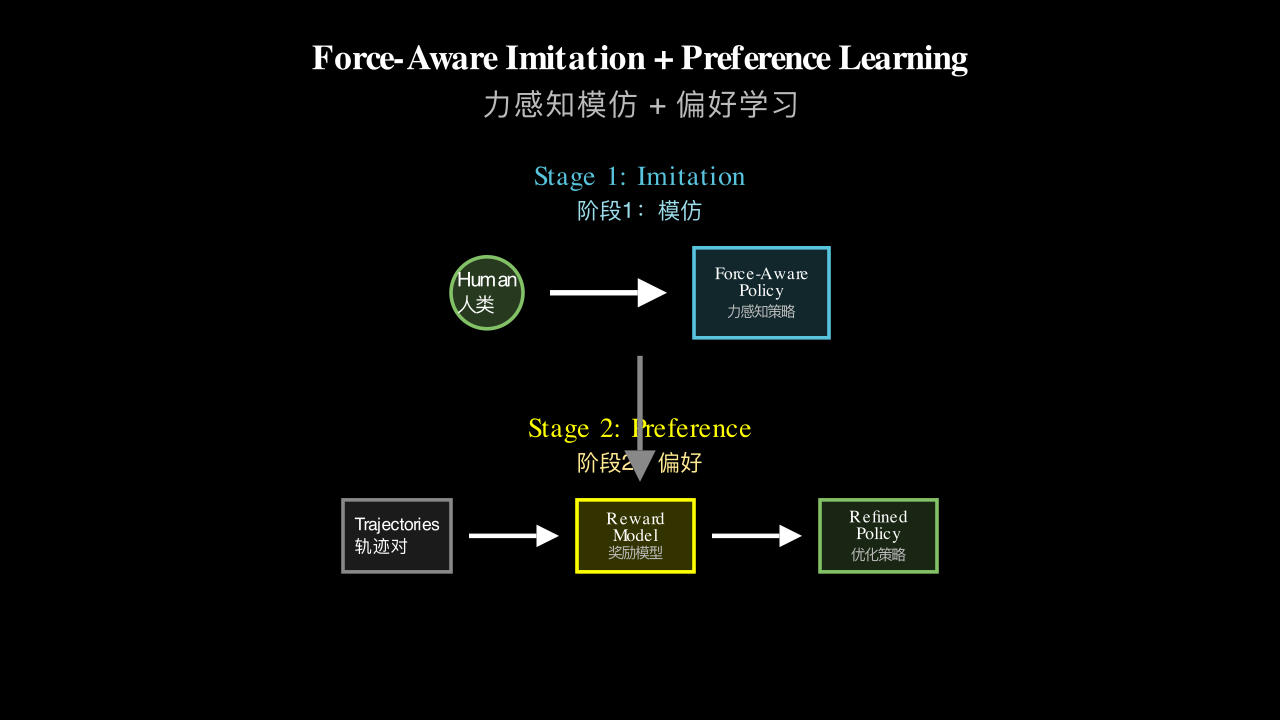
The method has two stages. Stage one builds a foundation: collect human demonstrations of peeling while recording force/torque data, then train a policy via behavioral cloning that conditions on both visual observations and haptic feedback. This gives you a policy that can generalize across object variations (different cucumber sizes, apple shapes) because it’s learned the force-sensitive dynamics—when to press, when to ease up.
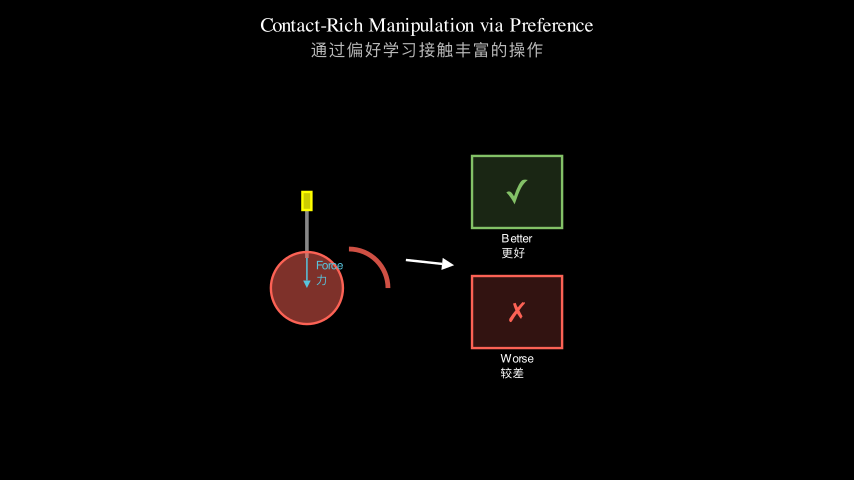
Stage two refines this foundation using human preferences. Generate trajectory pairs from the base policy, show them to humans who pick the better one (cleaner peel, less waste, smoother motion). Train a reward model on these preferences using Bradley-Terry modeling. Then finetune the policy against this learned reward using PPO, with the reward model providing dense feedback that captures subjective quality.
Stage 1: Imitation Learning
    Human demos --> [Force-aware policy] --> Base behavior
         |                                        |
    (visual + haptic)                    (generalizes to variations)

Stage 2: Preference Refinement
    Base policy --> Trajectory pairs --> Human picks better
                          |                      |
                          v                      v
                    [Reward model] <-- Bradley-Terry learning
                          |
                          v
                    PPO finetuning --> Refined policy
Think of it like learning to cook. Stage one is watching a chef and copying their knife technique—you learn the basic motions and when to apply pressure. But “good” cooking isn’t just correct motions; it’s about texture, presentation, taste. Stage two is like having the chef taste your dishes and tell you which attempts are better. You don’t get a recipe (explicit reward function), but through repeated comparisons, you internalize their standards. The reward model is your developing palate—it learns to predict what the chef will prefer. The policy refinement is you adjusting your technique based on that internalized sense of quality.
Key Concepts
-
Force-aware imitation learning: Standard imitation learning trains policies on visual observations—what the robot sees. But contact-rich tasks depend critically on what the robot feels. When you peel a potato, you’re constantly adjusting pressure based on resistance. Force-aware imitation means the policy conditions on force/torque sensor readings alongside vision. During data collection, humans demonstrate while the robot records both modalities. The trained policy then uses haptic feedback as a real-time signal: if resistance suddenly drops (knife broke through skin), ease up; if resistance is high (thick peel), maintain pressure. This is why the base policy generalizes—it’s learned the physics of peeling, not just the visual appearance of a specific cucumber.
-
Preference-based reward learning: You can’t write down what “well peeled” means mathematically, but you can look at two peeling attempts and say which is better. Preference learning exploits this asymmetry. Instead of asking humans to score trajectories (hard, inconsistent), you show pairs and collect binary preferences (easier, more reliable). The Bradley-Terry model assumes each trajectory has a latent quality score, and the probability of preferring trajectory A over B follows a logistic function of their score difference. Train a neural network to predict these scores from trajectory features (visual outcomes, force profiles, motion smoothness). Now you have a differentiable reward signal that captures human judgment, which you can optimize against using standard RL.
-
Generalization across object variations: The key challenge in manipulation is that every apple, cucumber, or potato is different—different sizes, shapes, skin thickness, firmness. The force-aware policy handles this by learning the relationship between sensed forces and appropriate actions, rather than memorizing specific trajectories. When encountering a new object, the policy uses real-time haptic feedback to adapt: if the peel is thicker than expected, it adjusts pressure accordingly. This is analogous to how humans peel—we don’t memorize exact motions, we feel our way through the task.
Why It Matters
This work opens the door to teaching robots subjective, quality-sensitive tasks that have been out of reach. The implications extend beyond peeling:
- Food preparation: Slicing, dicing, filleting—tasks where “done right” depends on texture, appearance, and human preference
- Medical procedures: Suturing, tissue manipulation—where force sensitivity and subjective quality are critical
- Craftsmanship: Sanding, polishing, assembly—tasks requiring feel and judgment
The two-stage approach is generalizable: use imitation to learn the physics and dynamics, then use preference feedback to align with human quality standards. This pattern could apply to any task where success is continuous and subjective rather than binary and objective.
The Results
The system achieves 90%+ success rates across cucumbers, apples, and potatoes with varying properties. The preference refinement stage improves performance by 40% over the base imitation policy. Crucially, the learned reward model transfers: a model trained on cucumber preferences generalizes to apples, suggesting it’s capturing general principles of “good peeling” rather than object-specific heuristics.
The force-aware policy is essential—ablations show that removing haptic feedback drops success rates dramatically. Vision alone isn’t enough for contact-rich tasks; you need to feel what’s happening.
Critical Analysis
Strengths: The combination of force-aware imitation and preference learning is elegant and practical. The results demonstrate real generalization across object variations. The approach sidesteps the impossible task of engineering reward functions for subjective quality.
Limitations: Preference collection is expensive—humans must watch and compare many trajectory pairs. The method assumes access to force/torque sensors, which not all robots have. The tasks studied (peeling) are relatively structured; it’s unclear how well this scales to more open-ended manipulation.
Open questions: Can we reduce the preference data requirements through better active learning? How does this approach handle tasks with multiple valid strategies (e.g., different peeling techniques)? Can we learn from implicit preferences (watching humans work) rather than explicit comparisons?
论文: 2603.03280 作者: Toru Lin, Shuying Deng, Zhao-Heng Yin, Pieter Abbeel, Jitendra Malik 类别: cs.RO, cs.AI, cs.CV, cs.LG, eess.SY
问题背景
现有的机器人操作研究已经攻克了具有明确成功标准的任务——拿起这个、放置那个、将销钉A插入孔B。但大量现实世界的任务抵制这种二元框架:食物准备、手术、工艺制作。这些任务有两个棘手的特性:(1) 它们接触丰富且对力敏感(压得太用力会压伤苹果;太轻则皮剥不下来),(2) 成功是连续且主观的(什么算”削得好”因人和情境而异)。先前的工作要么完全避开这些任务,要么试图设计定量奖励函数——这种方法会失败,因为你无法用公式捕捉”好的削皮”而不失去其本质。
逻辑链:
问题:接触丰富且质量主观的任务
    |
    v
假设:人类可以判断质量,即使无法形式化
    |
    v
方法:学习鲁棒基础策略(模仿)+ 通过偏好反馈优化
    |
    v
证据:在不同农产品上90%+成功率,优化带来40%改进
    |
    v
结论:偏好学习弥合了客观动力学与主观任务质量之间的差距
核心贡献
一句话总结:在本文之前,机器人无法学习”做得好”是主观且接触敏感的任务;之后,它们可以从演示中引导并使用偏好反馈对齐人类质量判断。
核心机制
该方法分两个阶段。第一阶段建立基础:收集人类削皮演示并记录力/扭矩数据,然后通过行为克隆训练一个同时依赖视觉观察和触觉反馈的策略。这给你一个可以跨对象变化泛化的策略(不同的黄瓜大小、苹果形状),因为它学习了力敏感的动力学——何时施压、何时放松。
第二阶段使用人类偏好优化这个基础。从基础策略生成轨迹对,展示给人类选择更好的一个(更干净的削皮、更少浪费、更平滑的动作)。使用Bradley-Terry建模在这些偏好上训练奖励模型。然后使用PPO针对这个学习到的奖励微调策略,奖励模型提供捕捉主观质量的密集反馈。
阶段1:模仿学习
    人类演示 --> [力感知策略] --> 基础行为
         |                          |
    (视觉+触觉)              (泛化到变化)

阶段2:偏好优化
    基础策略 --> 轨迹对 --> 人类选择更好的
                  |              |
                  v              v
            [奖励模型] <-- Bradley-Terry学习
                  |
                  v
            PPO微调 --> 优化后的策略
把它想象成学习烹饪。第一阶段是观看厨师并复制他们的刀法——你学习基本动作和何时施加压力。但”好”的烹饪不仅仅是正确的动作;它关乎质地、呈现、味道。第二阶段就像让厨师品尝你的菜肴并告诉你哪次尝试更好。你没有得到食谱(显式奖励函数),但通过反复比较,你内化了他们的标准。奖励模型是你发展中的味觉——它学习预测厨师会偏好什么。策略优化是你基于那种内化的质量感调整技术。
关键概念
-
力感知模仿学习:标准模仿学习在视觉观察上训练策略——机器人看到的东西。但接触丰富的任务关键依赖于机器人感受到的东西。当你削土豆时,你根据阻力不断调整压力。力感知模仿意味着策略在视觉之外还依赖力/扭矩传感器读数。在数据收集期间,人类演示时机器人记录两种模态。训练后的策略然后使用触觉反馈作为实时信号:如果阻力突然下降(刀突破了皮),放松;如果阻力高(厚皮),保持压力。这就是为什么基础策略能泛化——它学习了削皮的物理学,而不仅仅是特定黄瓜的视觉外观。
-
基于偏好的奖励学习:你无法用数学写下”削得好”意味着什么,但你可以看两次削皮尝试并说哪个更好。偏好学习利用了这种不对称性。不是要求人类给轨迹打分(困难、不一致),而是展示配对并收集二元偏好(更容易、更可靠)。Bradley-Terry模型假设每个轨迹有一个潜在质量分数,偏好轨迹A而非B的概率遵循其分数差的逻辑函数。训练神经网络从轨迹特征(视觉结果、力曲线、动作平滑度)预测这些分数。现在你有了一个捕捉人类判断的可微分奖励信号,可以使用标准RL进行优化。
-
跨对象变化的泛化:操作中的关键挑战是每个苹果、黄瓜或土豆都不同——不同的大小、形状、皮厚度、硬度。力感知策略通过学习感知力与适当动作之间的关系来处理这个问题,而不是记忆特定轨迹。遇到新对象时,策略使用实时触觉反馈进行适应:如果皮比预期厚,它会相应调整压力。这类似于人类削皮的方式——我们不记忆精确动作,我们通过感觉完成任务。
为什么重要
这项工作为教机器人主观的、质量敏感的任务打开了大门,这些任务以前是无法触及的。影响超越削皮:
- 食物准备:切片、切丁、去骨——成功取决于质地、外观和人类偏好的任务
- 医疗程序:缝合、组织操作——力敏感性和主观质量至关重要的地方
- 工艺制作:打磨、抛光、组装——需要感觉和判断的任务
两阶段方法是可泛化的:使用模仿学习物理和动力学,然后使用偏好反馈对齐人类质量标准。这种模式可以应用于任何成功是连续且主观而非二元且客观的任务。
实验结果
该系统在具有不同属性的黄瓜、苹果和土豆上实现了90%+的成功率。偏好优化阶段比基础模仿策略提高了40%的性能。关键的是,学习到的奖励模型可以迁移:在黄瓜偏好上训练的模型泛化到苹果,表明它捕捉的是”好削皮”的一般原则,而不是特定对象的启发式。
力感知策略是必不可少的——消融研究表明移除触觉反馈会大幅降低成功率。仅靠视觉不足以完成接触丰富的任务;你需要感受正在发生的事情。
批判性分析
优势:力感知模仿和偏好学习的结合既优雅又实用。结果展示了跨对象变化的真实泛化。该方法回避了为主观质量设计奖励函数这一不可能的任务。
局限性:偏好收集成本高昂——人类必须观看并比较许多轨迹对。该方法假设可以访问力/扭矩传感器,而并非所有机器人都有。研究的任务(削皮)相对结构化;不清楚这如何扩展到更开放式的操作。
开放问题:我们能否通过更好的主动学习减少偏好数据需求?这种方法如何处理具有多种有效策略的任务(例如,不同的削皮技术)?我们能否从隐式偏好(观看人类工作)而非显式比较中学习?