Paper: 2603.15617 Authors: Erik Y. Wang, Sumeet Motwani, James V. Roggeveen, Eliot Hodges, Dulhan Jayalath, Charles London, Kalyan Ramakrishnan, Flaviu Cipcigan, Philip Torr, Alessandro Abate Categories: cs.LG
The Gap
Existing AI math benchmarks test known problems with known solutions. MATH, GSM8K, and similar datasets measure reasoning ability, but they’re vulnerable to data contamination—models might have seen the answers during training. Formal proof benchmarks like Lean require expensive human verification or theorem provers that don’t scale. We can measure if AI can solve undergraduate calculus, but we can’t measure if AI can do actual mathematical research.
The boundary: we have no scalable way to test whether AI can make novel mathematical discoveries. Prior work either uses solved problems (contamination risk) or requires manual expert review (doesn’t scale).
Problem: Can AI discover new math?
    |
    v
Existing approaches fail:
    |
    +---> Known problems: Data contamination risk
    |
    +---> Formal proofs: Expensive verification
    |
    v
This paper's insight: Target problems where
    - Discovery is hard (requires insight)
    - Verification is easy (automatic)
    |
    v
Method: HorizonMath benchmark
    - 100+ unsolved problems
    - Automated verification
    - 8 computational math domains
    |
    v
Evidence: Models score ~0%, but GPT-4 found
          2 potential novel results
    |
    v
Conclusion: First scalable benchmark for
            mathematical discovery capability
The Increment
One sentence: Before this paper, we couldn’t systematically test AI’s ability to discover new mathematics at scale; after it, we have a benchmark of real unsolved problems with automatic verification where solutions could be publishable results.
Core Mechanism
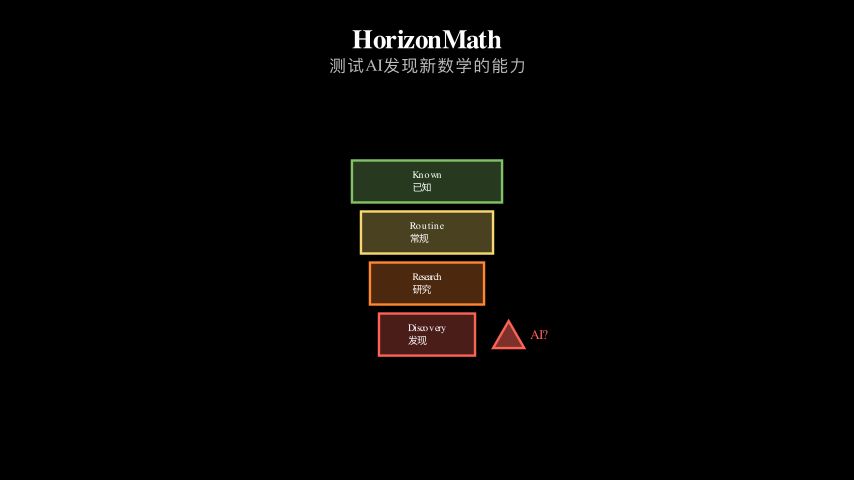
HorizonMath consists of three components working together. First, a curated problem set of 100+ unsolved problems across 8 domains (optimization, graph theory, combinatorics, number theory, etc.). These aren’t arbitrary puzzles—they’re problems where the mathematical community doesn’t know the answer, but where proposed solutions can be verified computationally.
Second, an automated verification framework. Each problem comes with a verification function that can check if a proposed solution is correct. For example, if the problem asks for the minimum value of some function, the verifier can evaluate the function at the proposed point and check constraints. This is the key innovation: the problems are chosen specifically because verification is cheap even though discovery is hard.
Third, a standardized evaluation protocol. Models are given problem statements and must output solutions in a structured format. The framework runs the verification automatically, tracks which problems are solved, and maintains a leaderboard. When a model proposes a solution that passes verification and improves on known bounds, it flags this as a potential novel contribution requiring expert review.
Problem Database                 AI Model
    |                               |
    v                               v
[Unsolved Problem] ---------> [Generate Solution]
    |                               |
    | (includes verification        |
    |  function)                    v
    |                          [Proposed Answer]
    |                               |
    v                               v
[Verification Function] <----- [Submit Solution]
    |
    v
Check: Is solution valid?
    |
    +---> Yes: Score point
    |     |
    |     v
    |     Better than known bound?
    |     |
    |     +---> Yes: Flag for expert review
    |     |          (potential novel result)
    |     |
    |     +---> No: Just a correct solution
    |
    +---> No: Score 0
Think of HorizonMath like a climbing gym for AI researchers. The gym has 100+ routes (problems) that no one has completed yet. Each route has a sensor at the top (verification function) that automatically detects if you reached the summit correctly—no human judge needed. The routes are designed so that getting to the top requires real climbing skill (mathematical insight), but once you’re there, the sensor can instantly verify you made it (computational check). Most climbers (current AI models) can’t complete any routes. But occasionally, someone finds a new path to the top that’s better than any known route—that’s a potential breakthrough worth having experts examine. The gym stays relevant because the routes are genuinely unsolved, and new routes can be added as the community discovers them.
Key Concepts
-
Discovery-hard, verification-easy problems: This is the sweet spot HorizonMath targets. Imagine you’re trying to pack circles into a square as tightly as possible. Finding the optimal packing requires deep geometric insight—you might need to try thousands of configurations, use symmetry arguments, or have a creative breakthrough. But once someone shows you a packing, verifying it’s valid is trivial: just check that no circles overlap and all fit inside the square. You can even compute the packing density automatically. This asymmetry—hard to find, easy to check—is what makes these problems perfect for automated benchmarking. It’s like Sudoku: solving is hard, but checking a solution takes seconds.
-
Data contamination immunity: Current benchmarks have a fatal flaw. If you train a language model on the entire internet, and the internet contains the answer to “What is 2+2?”, the model might just memorize “4” rather than learn addition. With HorizonMath, the answers literally don’t exist in any training data because they’re unsolved problems. It’s like testing a student’s creativity by asking them to write a story that’s never been written before—you know they can’t have memorized it. This makes the benchmark future-proof: even as models train on more data, they can’t cheat by memorization.
-
Computational mathematics domain: Not all math is created equal for this benchmark. HorizonMath focuses on computational and applied mathematics—areas where problems have numerical or algorithmic answers that can be verified by running code. This excludes pure mathematics where verification requires formal proofs (too expensive to automate) or subjective judgment (not scalable). Think of it as the difference between “find the shortest path through these 100 cities” (computational—you can verify by measuring the path length) versus “prove the Riemann hypothesis” (pure—requires human mathematicians to verify the logical argument). The benchmark lives in the computational zone where automation is possible.
Framework Shift
Before (mainstream approach):        After (this paper):

Known Problems                       Unsolved Problems
    |                                    |
    v                                    v
[Train on solutions] ------>        [No solutions exist]
    |                                    |
    v                                    v
Test on held-out                    Test on real open
known problems                      problems
    |                                    |
    v                                    v
Risk: Data contamination            Immune: Can't memorize
      Model may have seen                 what doesn't exist
      answers                             |
    |                                    v
    v                                Verification:
Verification:                       Automated (cheap)
Manual or formal proof
(expensive)                         Discovery:
                                    Requires insight
Measures: Reasoning
          on known math             Measures: Research
                                              capability
From testing if AI can solve textbook problems to testing if AI can discover new mathematics, the core shift is moving from evaluation on known answers to evaluation on unknown frontiers.
Expert Assessment
Problem choice: This is a real gap, not manufactured. The field has been stuck measuring AI on undergraduate-level math while claiming models can “reason.” The jump to research-level capability is the actual frontier, and this paper targets it directly. The timing is right—models are getting good enough that this question matters. The choice to focus on computational math is pragmatic and honest about what’s automatable.
Method maturity: This is more infrastructure than algorithmic innovation, and that’s fine—the field needs good benchmarks. The “discovery-hard, verification-easy” criterion is clever and well-executed. However, the paper doesn’t deeply explore why current models fail. Are they missing mathematical intuition, search strategies, or something else? The two potential novel results from GPT-4 are tantalizing but need expert confirmation—the paper is appropriately cautious here.
Experimental integrity: The baseline results are sobering—most models score near 0%, which validates that these are genuinely hard problems. The paper is transparent about the two potential discoveries being unverified. One concern: the problem selection process isn’t fully detailed. How were these 100+ problems chosen? Are they representative of mathematical research, or cherry-picked for verifiability? The paper would benefit from more discussion of problem curation methodology.
Writing quality: The paper is clear and well-structured, but the related work section undersells the novelty. The authors spend too much time comparing to formal proof benchmarks when the real contribution is the unsolved problem + automated verification combination. The experimental section could be tighter—some results feel like “we ran the models and they failed,” which is expected. More analysis of failure modes would add value.
Verdict: Strong accept — This is infrastructure the field needs, executed competently with appropriate caution about claims.
Takeaways
The “discovery-hard, verification-easy” framework transfers beyond mathematics. If you’re building benchmarks for any domain, look for problems where generating solutions requires creativity or insight, but checking solutions is mechanical. This asymmetry enables scalable evaluation without human judges. Examples: protein folding (hard to design, easy to simulate stability), algorithm optimization (hard to find, easy to benchmark performance), or even creative writing with constraint satisfaction (hard to write, easy to check constraints).
The data contamination immunity strategy is generalizable: use problems with unknown answers. For code generation, this means testing on newly released APIs or frameworks. For scientific reasoning, use recent preprints or ongoing research questions. The benchmark stays fresh because the frontier keeps moving.
The paper’s honesty about unverified discoveries is a model for AI research. When you find something that might be novel, flag it clearly and call for expert review rather than overclaiming. This builds trust and invites collaboration with domain experts.
论文: 2603.15617 作者: Erik Y. Wang, Sumeet Motwani, James V. Roggeveen, Eliot Hodges, Dulhan Jayalath, Charles London, Kalyan Ramakrishnan, Flaviu Cipcigan, Philip Torr, Alessandro Abate 分类: cs.LG
缺口
现有的AI数学基准测试的都是已知问题和已知答案。
MATH、GSM8K等数据集测量推理能力,但容易受数据污染影响——模型可能在训练时见过答案。
像Lean这样的形式化证明基准需要昂贵的人工验证或难以扩展的定理证明器。
我们能测量AI是否会解大学微积分,但测不了AI能否做真正的数学研究。
边界在于:我们没有可扩展的方法来测试AI能否做出新的数学发现。
此前的工作要么用已解决的问题(有污染风险),要么需要人工专家审查(无法扩展)。
问题:AI能发现新数学吗?
    |
    v
现有方法都失效:
    |
    +---> 已知问题:数据污染风险
    |
    +---> 形式化证明:验证成本高
    |
    v
本文洞察:瞄准这类问题
    - 发现很难(需要洞察力)
    - 验证很容易(可自动化)
    |
    v
方法:HorizonMath基准
    - 100多个未解决问题
    - 自动化验证
    - 8个计算数学领域
    |
    v
证据:模型得分约0%,但GPT-4
      找到2个潜在新结果
    |
    v
结论:首个可扩展的数学发现
      能力基准测试
增量
一句话:这篇论文之前,我们无法大规模系统地测试AI发现新数学的能力;
之后,我们有了一个真实未解决问题的基准,配备自动验证,其解答可能成为可发表的成果。
核心机制
HorizonMath由三个协同工作的组件构成。
首先是精选的问题集,包含100多个跨8个领域(优化、图论、组合学、数论等)的未解决问题。
这些不是随意的谜题——它们是数学界不知道答案的问题,但提出的解答可以通过计算验证。
第二是自动化验证框架。
每个问题都配有验证函数,可以检查提出的解答是否正确。
比如,如果问题要求某个函数的最小值,验证器可以在提出的点上计算函数值并检查约束条件。
这是关键创新:问题的选择标准就是验证成本低,即使发现很难。
第三是标准化评估协议。
模型接收问题陈述,必须以结构化格式输出解答。
框架自动运行验证,跟踪哪些问题被解决,维护排行榜。
当模型提出的解答通过验证且改进了已知界限时,系统会标记这是潜在的新贡献,需要专家审查。
问题数据库                    AI模型
    |                           |
    v                           v
[未解决问题] -----------> [生成解答]
    |                           |
    | (包含验证函数)              |
    |                           v
    |                      [提出的答案]
    |                           |
    v                           v
[验证函数] <------------- [提交解答]
    |
    v
检查:解答有效吗?
    |
    +---> 是:得分
    |     |
    |     v
    |     优于已知界限?
    |     |
    |     +---> 是:标记供专家审查
    |     |        (潜在新结果)
    |     |
    |     +---> 否:只是正确解答
    |
    +---> 否:得0分
把HorizonMath想象成AI研究者的攀岩馆。
馆里有100多条路线(问题),还没人完成过。
每条路线顶端有个传感器(验证函数),能自动检测你是否正确登顶——不需要人工裁判。
路线设计成登顶需要真正的攀岩技巧(数学洞察力),但一旦到顶,传感器能立即验证你成功了(计算检查)。
大多数攀岩者(当前AI模型)完成不了任何路线。
但偶尔有人找到登顶的新路径,比任何已知路线都好——这就是值得专家检验的潜在突破。
攀岩馆保持相关性,因为路线确实未被解决,而且随着社区发现新问题,可以添加新路线。
关键概念
- 发现难、验证易的问题:这是HorizonMath瞄准的甜蜜点。
想象你要把圆尽可能紧密地装进正方形。
找到最优装填需要深刻的几何洞察——你可能需要尝试数千种配置,使用对称性论证,或有创造性突破。
但一旦有人给你展示一种装填,验证它有效就很简单:只需检查圆不重叠且都在正方形内。
你甚至可以自动计算装填密度。
这种不对称性——难找到、易检查——正是这些问题完美适合自动化基准测试的原因。
就像数独:解题很难,但检查解答只需几秒钟。
- 数据污染免疫:当前基准有个致命缺陷。
如果你在整个互联网上训练语言模型,而互联网包含”2+2等于几?“的答案,模型可能只是记住”4”而不是学会加法。
对于HorizonMath,答案在任何训练数据中都不存在,因为它们是未解决的问题。
这就像通过要求学生写一个从未被写过的故事来测试创造力——你知道他们不可能记住它。
这使基准具有未来适应性:即使模型在更多数据上训练,它们也无法通过记忆作弊。
- 计算数学领域:不是所有数学都适合这个基准。
HorizonMath专注于计算和应用数学——问题有数值或算法答案,可以通过运行代码验证的领域。
这排除了需要形式化证明验证(自动化成本太高)或主观判断(不可扩展)的纯数学。
可以理解为”找出这100个城市的最短路径”(计算型——你可以通过测量路径长度验证)与”证明黎曼猜想”(纯数学——需要人类数学家验证逻辑论证)之间的区别。
基准存在于自动化可行的计算区域。
框架转变
之前(主流方法):              之后(本文方法):

已知问题                        未解决问题
    |                               |
    v                               v
[在解答上训练] -------->        [不存在解答]
    |                               |
    v                               v
在保留的已知                    在真实开放
问题上测试                      问题上测试
    |                               |
    v                               v
风险:数据污染                  免疫:无法记住
      模型可能见过                  不存在的东西
      答案                          |
    |                               v
    v                           验证:
验证:                          自动化(成本低)
人工或形式化证明
(成本高)                      发现:
                                需要洞察力
测量:对已知数学
      的推理能力                测量:研究能力
从测试AI能否解决教科书问题到测试AI能否发现新数学,核心转变是从对已知答案的评估转向对未知前沿的评估。
专家评审
选题眼光:这是真实的缺口,不是人造的。
该领域一直困在用本科水平数学测量AI,同时声称模型能”推理”。
跳到研究级能力才是真正的前沿,这篇论文直接瞄准了它。
时机恰当——模型已经足够好,这个问题变得重要。
选择专注于计算数学是务实的,对什么可以自动化很诚实。
方法成熟度:这更多是基础设施而非算法创新,这没问题——该领域需要好的基准。
“发现难、验证易”的标准很巧妙,执行得很好。
但论文没有深入探讨为什么当前模型会失败。
它们缺少数学直觉、搜索策略,还是别的什么?
GPT-4的两个潜在新结果很诱人,但需要专家确认——论文在这里适当谨慎。
实验诚意:基线结果令人清醒——大多数模型得分接近0%,这验证了这些确实是真正困难的问题。
论文对两个潜在发现未经验证很透明。
一个担忧:问题选择过程没有完全详述。
这100多个问题是如何选择的?
它们代表数学研究,还是为了可验证性而精心挑选的?
论文会受益于更多关于问题策展方法的讨论。
写作功力:论文清晰且结构良好,但相关工作部分低估了新颖性。
作者花太多时间与形式化证明基准比较,而真正的贡献是未解决问题+自动验证的组合。
实验部分可以更紧凑——一些结果感觉像”我们运行了模型,它们失败了”,这是预期的。
更多失败模式分析会增加价值。
判决:强接收——这是该领域需要的基础设施,执行得当,对声明适当谨慎。
要点总结
“发现难、验证易”框架可迁移到数学之外。
如果你在为任何领域构建基准,寻找生成解答需要创造力或洞察力、但检查解答是机械的问题。
这种不对称性使得无需人工裁判就能进行可扩展评估。
例子:蛋白质折叠(设计难、模拟稳定性易)、算法优化(找到难、基准性能易),甚至是带约束满足的创意写作(写作难、检查约束易)。
数据污染免疫策略可推广:使用答案未知的问题。
对于代码生成,这意味着在新发布的API或框架上测试。
对于科学推理,使用最近的预印本或正在进行的研究问题。
基准保持新鲜,因为前沿不断移动。
论文对未验证发现的诚实是AI研究的典范。
当你发现可能新颖的东西时,清楚地标记它并呼吁专家审查,而不是过度声称。
这建立信任并邀请与领域专家合作。